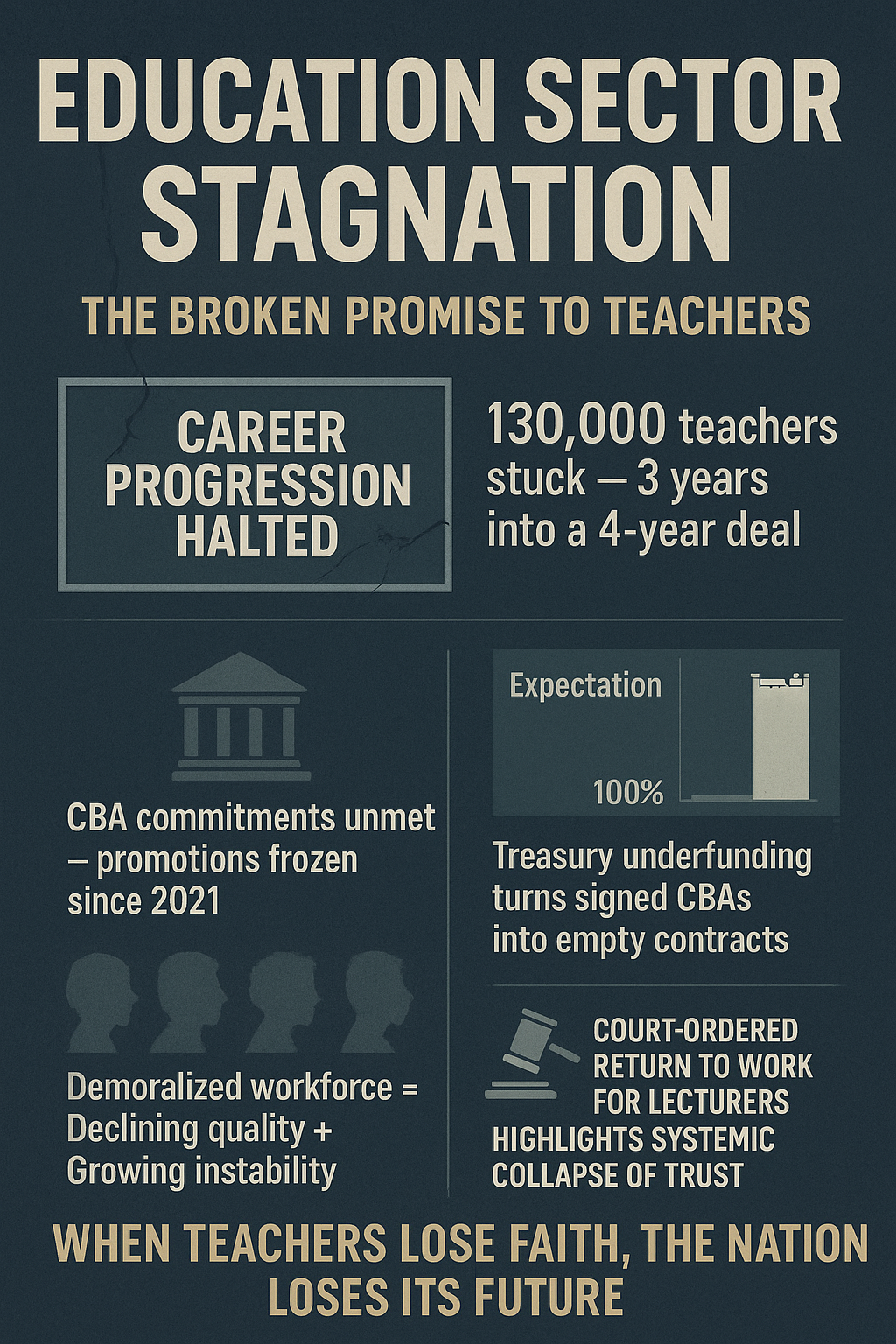
The crisis speaks to something more profound than missed promotions; it exposes a deliberate governance failure that prioritizes fiscal optics over human capital. The TSC’s inability to execute the agreed promotions has become emblematic of Kenya’s “paper promises” — deals inked and celebrated, then quietly buried when budgets tighten. Treasury allocations to the Commission repeatedly fall short of covering the wage and progression costs enshrined in signed CBAs. This chronic underfunding transforms legal agreements into empty gestures, leaving teachers to bear the brunt of political short-termism. The result is an education system running on disillusionment: educators forced to do more with less, students learning from underpaid, overworked instructors, and parents watching as quality erodes year after year.
Recent developments in higher education reveal that this dysfunction is not confined to basic learning. As of October 2025, the University of Nairobi (UoN) directed lecturers to resume work following a prolonged strike, acting on a court order that temporarily suspended the industrial action and mandated conciliation. The strike, spearheaded by academic unions including UASU, KUSU, and KUDHEIHA, centered on the government’s alleged failure to pay KSh 7.9 billion owed under the 2021–2025 Collective Bargaining Agreement — a claim contested by the Ministry of Education, which maintains that several payment tranches have already been released. The unions, however, insist that discrepancies persist and have demanded documentary proof such as payslips and audited records. This confrontation underscores a grim pattern: collective agreements, even when legally binding, are routinely undermined by bureaucratic opacity and political deflection. From teachers denied promotions to lecturers forced back to class under court order, the system thrives on compulsion rather than collaboration. When dialogue collapses into litigation and contractual rights depend on judicial enforcement rather than institutional integrity, it becomes clear that Kenya’s education crisis is no longer about money — it’s about the state’s eroding credibility. The country’s future is being taught by a workforce losing faith not just in their employer, but in the very promise of public service.
References:
Citizen Digital UoN directs lecturers to resume work on Monday amid ongoing strike
The Standard The Sh7.9 billion stalling university lecturers strike talks
Daily Nation Lecturers accuse SRC, universities of delay tactics over pay arrears
KTN News Kenya KUPPET demands promotion of over 130,000 teachers working under same job groups for many years.
The Court of Appeal’s recent intervention in the ongoing university funding dispute in Kenya has further complicated an already volatile situation. On March 26, 2025, the appellate court suspended the High Court’s ruling that had previously declared the Variable Scholarship Loan Funding (VSLF) model unconstitutional. This decision temporarily reinstated the controversial funding framework, allowing the government to resume its implementation while the appeal is heard. The suspension was granted based on arguments from the Higher Education Loans Board (HELB) and the Universities Fund (UF), both of which warned that halting the VSLF model would cripple their ability to allocate funds, potentially leading to financial instability and even the closure of multiple institutions. Former HELB Acting CEO Mary Muchoki emphasized in an affidavit that the High Court’s ruling could result in the indefinite closure of universities, underscoring the gravity of the situation. Similarly, former Universities Fund CEO Geoffrey Monari defended the VSLF model as a more equitable and cost-effective funding mechanism, cautioning that the previous decision could trigger a crisis in university financing. By suspending the High Court’s ruling, the Court of Appeal sought to balance the urgent need to sustain university funding with the concerns raised regarding the legality and fairness of the model. However, this move introduces another layer of uncertainty, as universities, students, and policymakers must now navigate an unpredictable legal landscape while awaiting a final resolution.
A Report by KTN News Kenya
To mitigate the immediate fallout and provide transparency, the Court of Appeal issued several directives aimed at ensuring that students, universities, and other stakeholders remain informed about the potential implications of the ongoing legal battle. The court instructed the Attorney General, HELB, and the Kenya Universities and Colleges Central Placement Service (KUCCPS) to disseminate detailed information about the VSLF model to all relevant parties within 14 days. This included clear communication to current beneficiaries and prospective applicants that the funding framework could still be subject to further changes. Additionally, the appellate court mandated the establishment of an appeals mechanism within the same timeframe, allowing students dissatisfied with their funding allocations or categorization to seek redress. These directives were an attempt to address the concerns raised by the High Court regarding the lack of transparency and due process in the implementation of the VSLF model. Nonetheless, the broader financial challenges facing Kenyan universities persist, as public institutions continue to struggle with substantial funding deficits while private universities remain burdened by unpaid government sponsorship funds. Although the temporary reinstatement of the VSLF model might alleviate some immediate financial pressures, the long-term sustainability of higher education funding in Kenya remains a pressing issue that requires a more comprehensive and permanent solution. The shift towards increased household contributions under the VSLF model raises additional concerns about affordability, particularly for students from low-income backgrounds, who now face the prospect of significant debt accumulation through student loans.
The current funding controversy is part of a broader historical shift in Kenya’s higher education financing strategy, transitioning from the Differentiated Unit Cost (DUC) model, which had been in place since 1995, to a more individualized, means-tested approach. Under the DUC model, public universities received block funding based on student enrollment and the costs associated with different academic programs, with the government initially expected to cover 80% of the unit cost. However, persistent underfunding led to financial distress for universities, necessitating alternative approaches. In May 2023, the government introduced the VSLF model, which sought to provide direct funding to students through a combination of scholarships, loans, and household contributions, assessed via a Means Testing Instrument (MTI). While this shift was designed to target financial aid to the most economically vulnerable students and encourage universities to diversify their revenue sources, it has sparked concerns about access and equity. The ongoing legal uncertainties surrounding the VSLF model have further exacerbated these concerns, as students remain unsure about their financial obligations, and universities continue to grapple with inconsistent funding. Moving forward, Kenya must establish a stable, transparent, and equitable university financing system that balances institutional sustainability with student accessibility. This requires strengthening legal frameworks, improving the MTI to ensure fairness, enhancing government investment, and exploring diversified funding sources such as public-private partnerships and alumni contributions. Without such reforms, the country risks entrenching financial instability in its higher education sector, limiting opportunities for students, and undermining national development objectives.
References:
Jijuze Impact of Kenya’s Court Decision on University Funding
The Standard Court of Appeal suspends ruling on university funding model
Kenya News Agency Govt reaffirms commitment to new varsity funding model
All Africa Kenya: COA Temporarily Allows Impementation of New University Funding Model
“Public Universities are part of the government and it was government’s wish that all its workers are well remunerated. As government, we want to see that the university staff is paid well. I appeal to unions, not to use the weapon of strike menacingly, but as a weapon of last resort,” said the Prime Minister, Raila Odinga, as he brokered negotiations to call off a similar strike by the University Academic Staff Union (UASU), last year.
The government’s failure to honor its pledges to civil servants, gives reason to the re-current strikes in public institutions. The University Academic Staff Union (UASU) cited stalled implementation of new salaries and allowances, as the reasons for the strike. Last year, Finance Permanent Secretary, Joseph Kinyua, “presented a signed letter to his Higher Education counterpart, Professor Crispus Kiamba, committing the government to pay the last installment of 2008/09 – 2009/10 financial years, collective bargaining agreements…” Capital FM website reported. Recently on October 19th varsity dons signalled a strike with the union chairman Samuel Kubasu, saying lecturers expected the new pay rise to be between 30-40 per cent. httpv://www.youtube.com/watch?v=ru9IicNR46Y&feature=fvsr The impasse at the universities arose after the authorities failed to respond to demands for a salary increase, whose negotiation started in 2009, but stalled mid-stream.” Meanwhile, Mr. Justice Paul Kosgei, of the Industrial Court ruled that, “pending the hearing and determination of an application filed by the Inter-University Council Consultative Forum, the lecturers should not engage in any activity likely to paralyze learning at higher institutions.” allAfrica.com reported. Despite the ruling, the strike continues. Egerton University becomes the latest institution to be closed, and students sent home as the lecturers strike proceeds into day 3. Going into the second week of the strike, the situation is expected to worsen following Thursday night’s unfruitful talks, involving the Prime Minister, Raila Odinga, seeking to arrive at a compromise.
With this new constitutional dispensation, and in this age and time, some things were bound to happen; on one hand, the citizenry would become more aware of their civil rights, thus demanding them, where they previously would not, and on the other, the government would fail to own up to its pledges, more so during this time, that you can only hide a little or none, from the public’s watchful eyes. What a risky area to begin a crisis? Education is the key. Whoever is concerned with its safe-keeping should be careful lest it breaks.
Since time immemorial, the youth have been excited about joining university, a phase in their lives where they are free from rules, parents and any other obstacles between them and freedom. Once in university, due to peer pressure, they get enthralled by clubbing, irresponsible drinking and other activities that may derail them from their goals. Following the death of three students this year, university scholars should critically analyze these happenings. They should ask themselves ‘is it worth the risk?’ therefore they are urged to be more responsible and be more careful when it comes to the choice of company. They should realize that at the end of the day it is their lives they are shaping. If it is a must to engage in these activities, then they should go with trustworthy individuals.
Ruth Wairimu Ng’anga lost her life after a night of drinking in the company of two male friends. She was found dead in a lodging in Ngara. The journalism student of Smart Media college had been warned against associating with strange people, as the director of the school stated. This was a few weeks after another journalism student of Nairobi university Mercy keino died after she had accompanied a cousin to a party in Westlands, Nairobi.she alledgedly stormed out of the apartments after an altercation with an MP at the party. Dennis Omondi Adari also lost his life in hospital after 6 days of treatment after he was battered by a the guard of ‘PSYS’ in westlands. He and his friends had been partying all around Nairobi when they decided to call it at the night at the club. They had been denied entry when he decided to go through the window. It is said that the boy was drunk.
They all did not have to die. Kenyan universities should offer guidance and counseling services to these youth. They should also be sensitized on the importance of maintaining morally upright peers. They should be taking charge of their lives because the ball is in their hands. Parents should also step up and advise their children on how to carry themselves while away from home. They should not leave this to teachers. The scholars should learn from those unfortunate happenings to be more responsible.
 Jijuze