Eldoret: The Reality of Kenya’s Newest City

Eldoret’s recent conferment to city status in August 2024 by President William Ruto brought high expectations for accelerated economic growth and modernized urban management. The Uasin Gishu County administration has been quick to inaugurate the first City Board and establish a service charter outlining explicit timelines for business licensing, urban planning, and municipal services like waste collection. The vision is to build a “Smart, Liveable, and Inclusive” city, with the administration eager to harness investment opportunities, particularly in the sports economy and light manufacturing. However, the transition from a municipality to a fully functioning city is already testing the local government’s capacity to balance administrative efficiency with the turbulent reality of local politics.

Eldoret was recently elevated to city status.
Eldoret was recently elevated to city status. Source: Kageni Joe / Getty Images

The most glaring manifestation of this friction is in the healthcare sector, which has been severely disrupted by persistent labor disputes. By mid-2026, the Kenya National Union of Nurses (KNUN) had paralyzed public health services across Uasin Gishu County, including within Eldoret city. The striking nurses and healthcare workers accuse Governor Jonathan Bii’s administration of failing to implement a Collective Bargaining Agreement (CBA) that dates back to 2017, delaying promotions, and failing to convert Universal Health Coverage (UHC) staff to permanent and pensionable terms. The situation has grown so severe that nurses have frequently marched through the streets of Eldoret and staged sit-ins at the county headquarters, demanding that the administration prioritize their welfare over political posturing.

The crisis in Eldoret perfectly illustrates the devolution dilemma: while the county leadership attempts to rebrand the city and attract investment, essential service delivery is held hostage by unresolved, highly politicized administrative failures. Residents and union officials have publicly accused some county executives of focusing more on their 2027 political ambitions than on resolving the crippling strikes. When a newly minted city cannot keep its hospital doors open because funds and attention are diverted by political wrangling, the promise of elevated urban status rings hollow. For Eldoret to truly thrive as a regional metropolis, the county administration must prove it can insulate its municipal and healthcare services from the constant disruptions of Kenya’s election cycle.

References:

The Standard Nurses strike paralyses healthcare services in Rift Valley counties

The Star Uasin Gishu nurses down tools over pay dispute
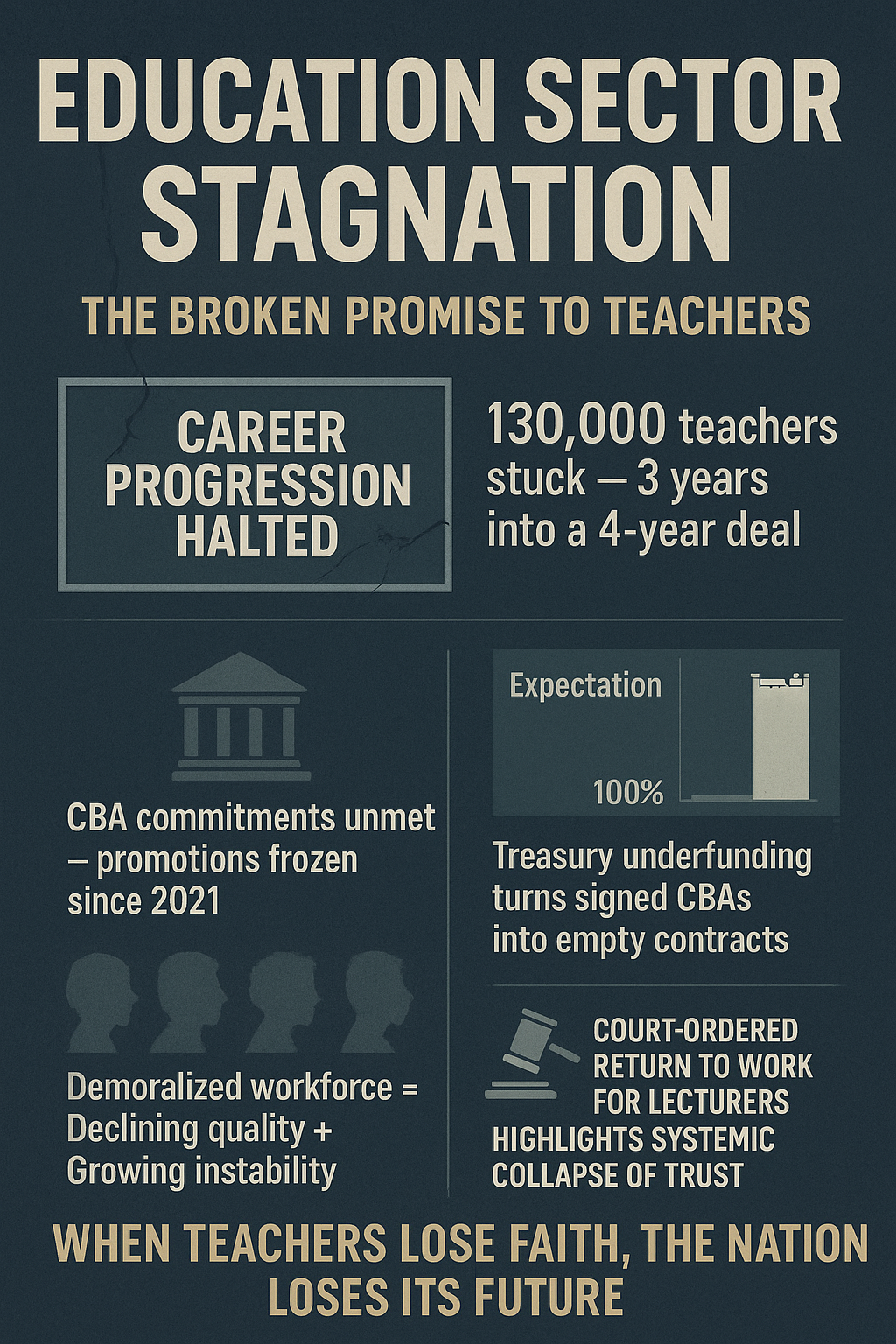
Education Sector Stagnation — The Crisis Behind Kenya’s Classrooms

The crisis speaks to something more profound than missed promotions; it exposes a deliberate governance failure that prioritizes fiscal optics over human capital. The TSC’s inability to execute the agreed promotions has become emblematic of Kenya’s “paper promises” — deals inked and celebrated, then quietly buried when budgets tighten. Treasury allocations to the Commission repeatedly fall short of covering the wage and progression costs enshrined in signed CBAs. This chronic underfunding transforms legal agreements into empty gestures, leaving teachers to bear the brunt of political short-termism. The result is an education system running on disillusionment: educators forced to do more with less, students learning from underpaid, overworked instructors, and parents watching as quality erodes year after year.

Recent developments in higher education reveal that this dysfunction is not confined to basic learning. As of October 2025, the University of Nairobi (UoN) directed lecturers to resume work following a prolonged strike, acting on a court order that temporarily suspended the industrial action and mandated conciliation. The strike, spearheaded by academic unions including UASU, KUSU, and KUDHEIHA, centered on the government’s alleged failure to pay KSh 7.9 billion owed under the 2021–2025 Collective Bargaining Agreement — a claim contested by the Ministry of Education, which maintains that several payment tranches have already been released. The unions, however, insist that discrepancies persist and have demanded documentary proof such as payslips and audited records. This confrontation underscores a grim pattern: collective agreements, even when legally binding, are routinely undermined by bureaucratic opacity and political deflection. From teachers denied promotions to lecturers forced back to class under court order, the system thrives on compulsion rather than collaboration. When dialogue collapses into litigation and contractual rights depend on judicial enforcement rather than institutional integrity, it becomes clear that Kenya’s education crisis is no longer about money — it’s about the state’s eroding credibility. The country’s future is being taught by a workforce losing faith not just in their employer, but in the very promise of public service.

References:

Citizen Digital UoN directs lecturers to resume work on Monday amid ongoing strike

The Standard The Sh7.9 billion stalling university lecturers strike talks

Daily Nation Lecturers accuse SRC, universities of delay tactics over pay arrears

KTN News Kenya KUPPET demands promotion of over 130,000 teachers working under same job groups for many years.

EDUCATION | Strike by Public University Dons Persists

“Public Universities are part of the government and it was government’s wish that all its workers are well remunerated. As government, we want to see that the university staff is paid well. I appeal to unions, not to use the weapon of strike menacingly, but as a weapon of last resort,” said the Prime Minister, Raila Odinga, as he brokered negotiations to call off a similar strike by the University Academic Staff Union (UASU), last year.

The government’s failure to honor its pledges to civil servants, gives reason to the re-current strikes in public institutions. The University Academic Staff Union (UASU) cited stalled implementation of new salaries and allowances, as the reasons for the strike. Last year, Finance Permanent Secretary, Joseph Kinyua, “presented a signed letter to his Higher Education counterpart, Professor Crispus Kiamba, committing the government to pay the last installment of 2008/09 – 2009/10 financial years, collective bargaining agreements…” Capital FM website reported.  Recently on October 19th varsity dons signalled a strike with the union chairman Samuel Kubasu, saying lecturers expected the new pay rise to be between 30-40 per cent. httpv://www.youtube.com/watch?v=ru9IicNR46Y&feature=fvsr            The impasse at the universities arose after the authorities failed to respond to demands for a salary increase, whose negotiation started in 2009, but stalled mid-stream.” Meanwhile, Mr. Justice Paul Kosgei, of the Industrial Court ruled that, “pending the hearing and determination of an application filed by the Inter-University Council Consultative Forum, the lecturers should not engage in any activity likely to paralyze learning at higher institutions.” allAfrica.com reported. Despite the ruling, the strike continues. Egerton University becomes the latest institution to be closed, and students sent home as the lecturers strike proceeds into day 3. Going into the second week of the strike, the situation is expected to worsen following Thursday night’s unfruitful talks, involving the Prime Minister, Raila Odinga, seeking to arrive at a compromise.

With this new constitutional dispensation, and in this age and time, some things were bound to happen; on one hand, the citizenry would become more aware of their civil rights, thus demanding them, where they previously would not, and on the other, the government would fail to own up to its pledges, more so during this time, that you can only hide a little or none, from the public’s watchful eyes. What a risky area to begin a crisis? Education is the key. Whoever is concerned with its safe-keeping should be careful lest it breaks.

References:

Court Halts Lecturers’ Strike allAfrica.com Novermber 9, 2011

Strike Cripples Varsity Exams and Graduation November 9, 2011

All the Sides to Blame for Unnecessary Strikes November 9, 2011

Judge Rules Varsity Dons Strike Illegal Novermber 10, 2011

Varsity lecturers’ signal strike October 19, 2011

Kenya university dons call off strike April 8, 2010