The Adult Filter Is Overrated: Reclaiming the Small Wonders of Life

What does it mean to be a kid at heart?


In the frantic, non-stop race of modern life, we often chase the “big things”—the promotion, the huge vacation, the major milestone. Yet, some of the wisest people I know aren’t those with the biggest bank accounts or titles; they’re the ones who’ve mastered the art of being a kid at heart.
This doesn’t mean avoiding responsibility or acting immature. It means possessing a superpower we tend to lose with age: the ability to find pure, uncomplicated joy in the smallest moments.
Think about a child. Hand them a piece of candy, or watch the sheer concentration and triumph on their face when they successfully blow a huge bubble. Their reaction isn’t measured or conditional; it’s a burst of unfiltered gratitude and delight. A simple act of kindness, a silly joke, or even just mastering a small skill is met with a sincere, radiant smile. They express the purest impression of thankfulness, even for the minutest act they can comprehend.
That is the essence of being a kid at heart: The capacity to appreciate the little things that warm the soul and make the world brighter.
It’s about ditching the adult filter of cynicism and comparison, and allowing yourself to be truly present for the moment. It’s about feeling the sunshine on your face, laughing until your stomach hurts over something ridiculous, or getting genuinely excited about your favorite snack.
It’s an open invitation to a happier life. So, today, let’s all try to be a little less “grown-up” and a lot more like the kids who know that the best things in life aren’t things at all—they are tiny moments of wonder, waiting to be appreciated.

Experience Ethical Travel: Watamu’s Blueprint for Climate-Smart Tourism

Watamu is no longer just a coastal getaway—it’s a case study in what community-powered, climate-smart tourism can look like for Africa. As Kenya’s tourism sector projects a historic KSh1.2 trillion contribution in 2025, Watamu stands out not only for its natural beauty, but for how it’s transforming development from the ground up. Local associations, women’s groups, and marine conservationists are leading the charge—turning beach cleanups, turtle protection, and plastic recycling into viable economic engines. This is not your typical resort town: here, environmental sustainability and economic inclusion go hand in hand. And for Kenyans living abroad, it offers a deeply meaningful opportunity to participate in rebuilding an economy that reflects both cultural pride and ecological urgency.

A Report by Taylor & Jordan Travel

Watamu is tapping into the global shift toward regenerative tourism—experiences that give back, not just take. Whether it’s community-run mangrove boardwalks, youth-led heritage tours, or conservation-linked seafood ventures, the town offers immersive, ethical travel that aligns with the values of many in the diaspora. Tourists are not just spectators here—they are contributors to a system that protects biodiversity and empowers local livelihoods. As the region attracts new interest for sustainable investments, Kenya’s diaspora is uniquely positioned to shape its trajectory: by supporting homegrown enterprises, backing eco-innovation, or simply choosing to travel with intention.

This is the moment for the diaspora to come home differently. Not just to visit—but to invest, collaborate, and amplify what Watamu is building. It’s a model that doesn’t just respond to climate change—it adapts and thrives through it. With marine spatial planning underway and local governance strengthening, the blueprint is clear: Kenya’s coastal future can be green, inclusive, and profitable. But it needs champions—especially those abroad who understand that tourism isn’t just about where you go, but what you leave behind. Watamu is not asking for charity—it’s offering a partnership in purpose.

References:

Hospitality Net Kenya’s Travel & Tourism Sector Set to Inject a Record KSh1.2TN in 2025

UNEP In beach town’s battle against plastic, echoes of a global crisis

KBC Tour Operators anticipate increased in arrivals

Oceanic Society How the Circular Economy Protects Nature and Tourism Business in Coastal Kenya

Conservation Challenges in Kenya’s Maasai Mara Region

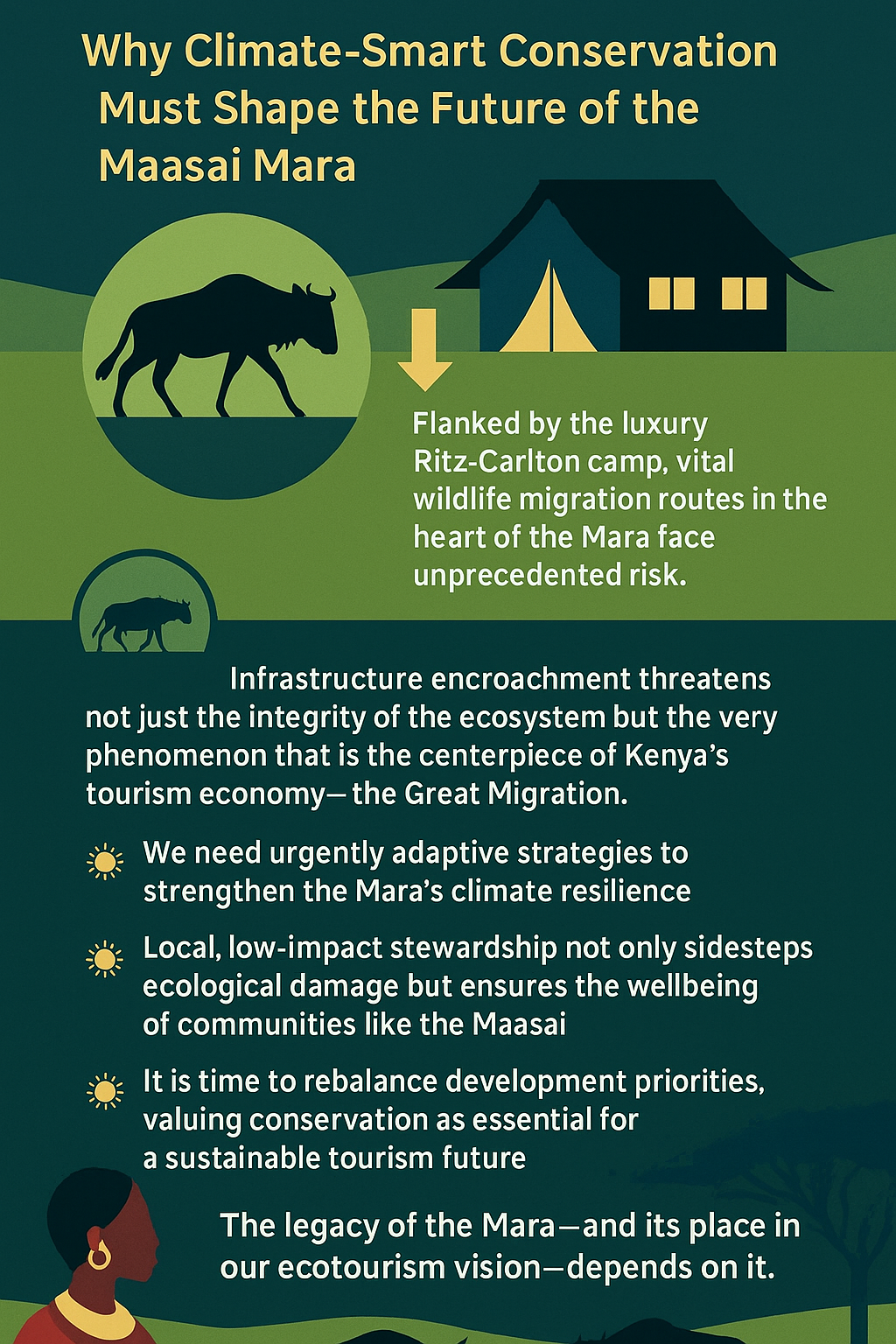
The Maasai Mara, one of the last remaining wild frontiers of Africa’s Great Migration and a cornerstone of Kenya’s ecotourism economy, now faces one of the gravest threats in its recent history—not from drought, poaching, or climate change alone, but from unchecked commercial expansion. A controversial plan to construct a high-end hotel complex and convention centre within the fragile Pardamat Conservation Area has triggered fierce opposition from environmental experts, conservancy leaders, tourism stakeholders, and sections of the local Maasai community. The development, backed by county government actors and private investors, was initially celebrated as a boost to job creation and conference tourism. But critics warn it could irreversibly damage the very ecosystem that draws visitors—and revenue—to the region.

At the heart of the concern is the ecological fragility of the Pardamat area, a critical corridor for wildebeest, elephants, and other migratory species. The proposed construction site borders sensitive wildlife routes and overlaps with communal land managed under an innovative conservation model that merges livestock grazing with wildlife protection. Experts argue that the scale and permanence of such infrastructure threaten to fragment habitat, displace species, and compromise the authenticity of the Mara’s wilderness appeal. Already, irregular land sales, fencing, and proliferation of unregulated camps have altered key migratory paths—choking the ecosystem and undermining decades of community-led conservation gains.

What the Mara needs is not another luxury venue, but a decisive pivot toward climate-smart, community-anchored ecotourism. This means planning developments in harmony with nature, prioritizing low-impact, mobile tourism models, and bolstering scientific land-use policies that preserve migratory corridors and biodiversity integrity. Kenya’s international tourism reputation—and its ability to withstand climate volatility—depends on how well we defend and innovate around natural heritage sites like the Mara. The future must be shaped not by profit margins alone, but by policies rooted in ecological wisdom, community ownership, and a long-term vision for a resilient, inclusive conservation economy.

References:

Spa Opportunities Marriott to open luxury safari camps in Kenya under JW Marriott and Ritz-Carlton brands, with architecture by LW Design

The Star Narok county defends Ritz-Carlton Safari Camp amid conservation criticism

The Standard County contests claims that new safari camp is obstructing wildlife

The Ritz Carlton The Ritz-Carlton, Masai Mara Safari Camp

Lake Nakuru’s New Waters: From Flamingo Spectacle to Tourism Uncertainty

Lake Nakuru, once Kenya’s unrivaled icon of flamingo tourism and a UNESCO World Heritage Site, is undergoing an environmental transformation that is quietly redefining its future. The dramatic shift from a shallow, alkaline soda lake to a swelling freshwater body—driven by climate change, deforestation, urban runoff, and persistent pollution—has reshaped not just the lake’s ecology, but also its economic and cultural purpose. Once celebrated as the “Lake of a Million Flamingos,” the site now faces a tourism identity crisis as its signature attraction—the vibrant flocks of Lesser Flamingos—has largely vanished due to the disappearance of Spirulina platensis, the algae they feed on. This ecological transition is not a fleeting anomaly; it signals a long-term reset, potentially stripping Kenya of one of its most iconic natural tourism assets.

The implications for Kenya’s tourism economy are profound. Flamingo migration has dealt a blow to the local hospitality industry, with ripple effects felt from Nakuru to Elementaita and Naivasha. The park’s submerged infrastructure—gates, roads, and buildings—has necessitated a KSh 38 million investment in repairs and relocation, eating into Kenya Wildlife Service’s already stretched budget. Yet amid this disruption, opportunity glimmers. Kenya has a chance to reframe Lake Nakuru not as a site of lost heritage, but as a blueprint for adaptive, resilient tourism in the age of climate change. KWS has already introduced new water-compatible experiences, including adjusted game-viewing routes and potential boating attractions. With careful investment, storytelling, and conservation marketing, this shift can usher in a new kind of eco-tourism centered on freshwater biodiversity, migratory birds, and climate adaptation success stories.

But realizing this vision demands urgency, strategy, and inclusivity. Conservation and tourism authorities must actively engage displaced communities, whose turn to illegal fishing underscores a deeper social fragility tied to the lake’s changes. Tourism policy must evolve to support heritage resilience—protecting UNESCO designation through scientific reinterpretation of the site’s ecological value, not just nostalgia for what it once was. Lake Nakuru stands at the frontline of global climate impact on natural heritage. If Kenya can lead the world in repurposing this park’s brand while safeguarding its ecosystems and communities, it won’t just save a destination—it will create a model for climate-smart tourism across Africa and beyond.

References:

Scientific Research Assessment of Spatial Expansion of Rift Valley Lakes Using Satellite Data

The Standard State of three Rift Valley Lakes worry experts

Talk Africa Lake Nakuru’s Water levels Expected to Cause More Havoc During The Rainy Season, Experts Say  

Jijuze Is Lake Nakuru’s Ecosystem at Risk Due to Pollution and Illegal Fishing?

2025 WRC Safari Rally: Kenya’s Grand Motorsport Celebration

Kenya is gearing up to welcome the world for the 2025 World Rally Championship (WRC) Safari Rally, taking place in Naivasha from 20th to 23rd of March 2025. This isn’t just another race; it’s a celebration of Kenya’s motorsport heritage, a testament to the country’s resilience, and a golden opportunity to showcase its stunning natural beauty to a global audience. Imagine the thrill of high-speed rally cars navigating the challenging terrain, the vibrant colors of Kenyan culture, and the warm hospitality of the people. As the engines roar and the dust settles, Kenya anticipates a significant economic boost, with the rally projected to inject a staggering Sh7 billion into the local economy. This influx of revenue will create jobs, support local businesses, and attract tourists from all corners of the world, further solidifying Kenya’s position as a premier tourist destination.

A review of the Best Action from the 2024 Edition WRC Safari Rally by DirtFish

The Safari Rally holds a special place in Kenya’s history, dating back to 1953 when it was first run as the East African Coronation Safari. This legendary rally, known for its demanding terrain and unpredictable weather, has tested the mettle of some of the greatest rally drivers in history, including the likes of Shekhar Mehta and Tommi Mäkinen. This year, organizers have introduced two new stages to the rally, a 5km shakedown at Camp Moran and an 8km race at Morendat Farm, promising an adrenaline-pumping spectacle for both seasoned rally enthusiasts and newcomers alike. President William Ruto will flag off the rally at City Hall Way in Nairobi, a change from the traditional flag-off location, bringing the excitement closer to the heart of the city and making it more accessible to fans.

But the 2025 WRC Safari Rally is more than just a thrilling race; it’s a testament to Kenya’s commitment to sustainable development and community engagement. Organizers are implementing measures to minimize the environmental impact of the rally, ensuring that the pristine landscapes that make Kenya so unique are protected for generations to come. Furthermore, the rally is creating numerous opportunities for local communities, with job creation in various sectors such as marshalling, hospitality, and logistics. Local businesses are also set to benefit from the influx of tourists and rally enthusiasts, contributing to the overall economic growth of the region. With its blend of high-octane action, rich history, and community involvement, the 2025 WRC Safari Rally is poised to be a resounding success, leaving a lasting legacy for Kenya and its people. As the Swahili saying goes, “Harakaharaka haina baraka,” meaning “Hurry hurry has no blessings.” This embodies the spirit of the rally, reminding us that true success comes with patience, perseverance, and a deep appreciation for the journey.

References:

RedBull This is the WRC calendar 2025

WRC Safari Rally Kenya: A WRC icon through the ages

Safari Rally Kenya KCB Commits KShs. 209 Million to 2025 Safari Rally

Is Lake Nakuru’s Ecosystem at Risk Due to Pollution and Illegal Fishing?

Lake Nakuru National Park, a renowned Kenyan wildlife sanctuary and UNESCO World Heritage Site, is facing a multifaceted crisis. While celebrated for its breathtaking scenery and diverse wildlife, the park is grappling with encroachment, illegal fishing, and escalating sociopolitical and moral conflicts. These issues are intertwined with the adverse effects of pollution, primarily from untreated sewage and industrial waste discharged into the lake from Nakuru town. This pollution not only contaminates the water and renders the fish unsafe for human consumption but also disrupts the delicate balance of the ecosystem, threatening the survival of various species and the livelihoods of surrounding communities.

A Report by Nakuru Today

The presence of fish in Lake Nakuru, once a predominantly saline lake, adds another layer of complexity to this crisis. The introduction of fish, primarily tilapia, can be traced back to an accidental spill from a fish farm uphill in the 1960s. This incident, coupled with the rising water levels that began in 2010, transformed the lake’s environment, making it more habitable for freshwater fish. The rising waters also submerged riparian land, displacing communities and intensifying human-wildlife conflicts. As a result, many residents turned to fishing as a source of livelihood, leading to a surge in illegal fishing activities despite the ban and health risks associated with consuming contaminated fish.

This situation has given rise to a clash between conservation efforts and the socioeconomic needs of local communities. While the Kenya Wildlife Service (KWS) enforces regulations against fishing and encroachment, impoverished communities view the lake as a vital resource for survival. This tension is further exacerbated by allegations of brutality and abuse of power by KWS officers against individuals caught fishing . Addressing this crisis requires a comprehensive approach that prioritizes pollution control as a means to restore the lake’s ecosystem and ensure the safety of the fish. This would pave the way for regulated fishing activities that benefit local communities while upholding conservation goals. Furthermore, fostering dialogue and collaboration between KWS and the community, ensuring ethical conduct within KWS, and promoting alternative livelihood opportunities are crucial steps towards achieving a sustainable and just solution.

References:

Nation The slow death of Lake Nakuru

Mtaa Wangu Nakuru X Space discussion reveals deeper issues in Lake Nakuru fishing menace

Kenya News Agency Uncertain future for wildlife and native plant species at Lake Nakuru National Park as invasive plant species wipe out grasslands and strangle natural fauna

Radio Baraza The Threat to Nakuru’s Green Belt: Human Encroachment Endangers a Vital Ecosystem