Climate Whiplash—When Infrastructure Meets Volatility

Nairobi has entered a perilous era of “climate whiplash,” where bone-dry droughts are abruptly terminated by high-intensity “long rains” that the city’s infrastructure is fundamentally unequipped to handle. Scientific assessments confirm that the climate crisis has increased the intensity of extreme rainfall in East Africa by approximately 40%. This volatility means that the “once-in-a-century” floods of the past are becoming our annual reality, yet our drainage networks remain trapped in the 20th century, designed for historical patterns that no longer exist.
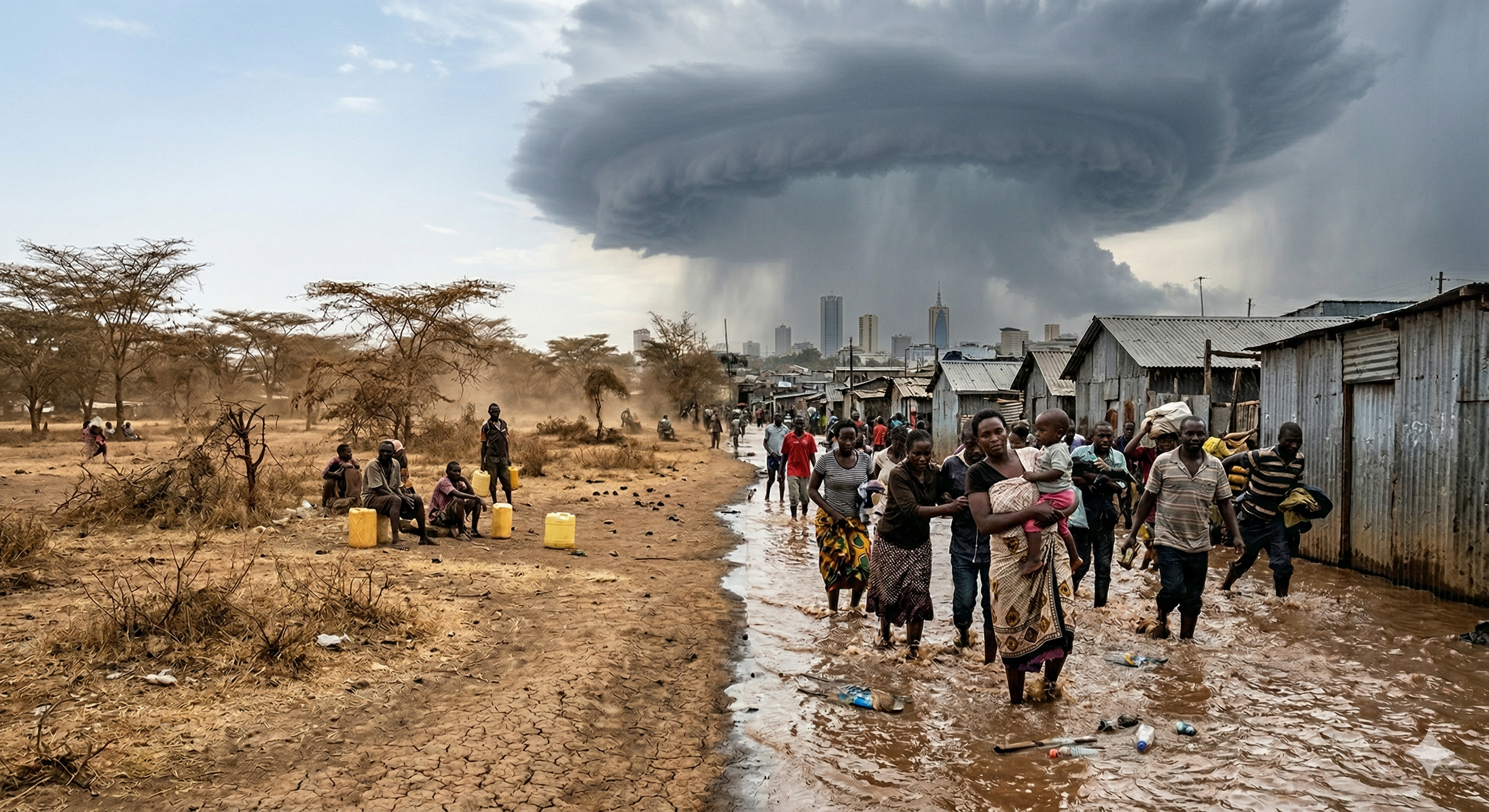
The MAM (March-April-May) rains of 2024 and the recent 2026 deluges have laid bare a systemic collapse. While upscale neighborhoods like Runda face property damage and traffic paralysis, the fallout in settlements like Mathare and Mukuru is existential, with over 200,000 people displaced nationally in 2024 alone. The tragedy is compounded by a failure to translate early warnings from the Meteorological Department into proactive evacuations, leaving residents to face rising waters with zero meaningful preparation.

This infrastructure deficit creates a “water paradox”: even as floods submerge the streets, taps in major estates run dry. The intense runoff carries such high levels of silt and organic debris that treatment plants at Ngethu and Sasumua are forced to shut down, unable to process the turbid water. This cycle of flood-induced scarcity underscores the urgent need for modernized filtration and massive retention reservoirs, as the city’s reliance on aging systems makes it a victim of its own climate-altered environment.

References:

Inside Climate News Following Months of Drought, Floods in Kenya Kill More Than 40 People

Greenpeace Deadly Kenyan floods show urgent need to build climate resilience

Streamline Nairobi’s Water Paradox: Infrastructure Failure Amidst Excessive Rainfall

The Cold Pulse of Kenyamware: Where River Gucha Meets Local Grit

In the quiet, fog-drenched highlands of Nyamira County lies Kenyamware, a place where the morning air is so sharp it feels like a physical presence. As the sun struggles to pierce through the thick white veil of the “Nyamira cold,” the day begins with the rhythmic sound of the Gucha River—the county’s longest waterway, stretching nearly 150km before eventually feeding the vast basin of Lake Victoria. Standing here, you realize that this river isn’t just a scenic backdrop; it is the primary lifeblood of the Gusii highlands, carving a path through the heart of a community that has mastered the art of survival along its winding banks.

A Jijuze Eco-Tour in Kenyamware, Nyamira County, Kenya.

Along these very banks, the Gucha’s water fuels a bustling corridor of small-scale, artisanal industries that represent the backbone of the region’s manual economy. Kenyamware serves as a micro-industrial hub where the scent of fresh sawdust from local lumbering sites mingles with the earthy aroma of wet clay from the nearby brick-making kilns. Rather than massive factories, this is an economy of the hands—a decentralized network of producers transforming the river’s silt and the highland timber into the literal building blocks for the ongoing construction boom in Nyamira and beyond.

As the fog finally retreats to reveal a landscape painted in hues of gold and amber, it becomes clear that Kenyamware holds a profound, untapped beauty. It is a moment of stillness that captures the essence of the Jijuze spirit: finding the extraordinary in the everyday. However, for these hidden gems to truly thrive, we must bridge the gap between this rural charm and the global traveler through a stronger uptake of local and international tourism on modern e-platforms. By putting places like Kenyamware on the digital map, we ensure that Nyamira’s quiet power isn’t just witnessed by the few, but celebrated by the many.