Kenya is entering a pivotal moment where its internal reforms — if executed with discipline — can position the country as the anchor of East Africa’s circular economy. The region is fractured by uneven policy implementation, weak cross-border standards, and inconsistent producer accountability. Uganda’s plastics bill remains contested; Tanzania’s sector is progressing but largely enforcement-light; Rwanda has strong bans but limited high-capacity recycling infrastructure. Amid this landscape, Kenya is uniquely placed: it has an active plastics pact, defined EPR regulations, a dense private sector ecosystem, and a maturing national conversation on circularity that is more advanced than its neighbours. But leadership is not declared — it is earned. For Kenya to be the region’s circular hub, it must create clear domestic order: stable EPR markets, reliable feedstock flows, predictable investment signals, and systems that can actually scale. Kenya will not lead East Africa by having the best policy documents; it will lead by having the most functional system.
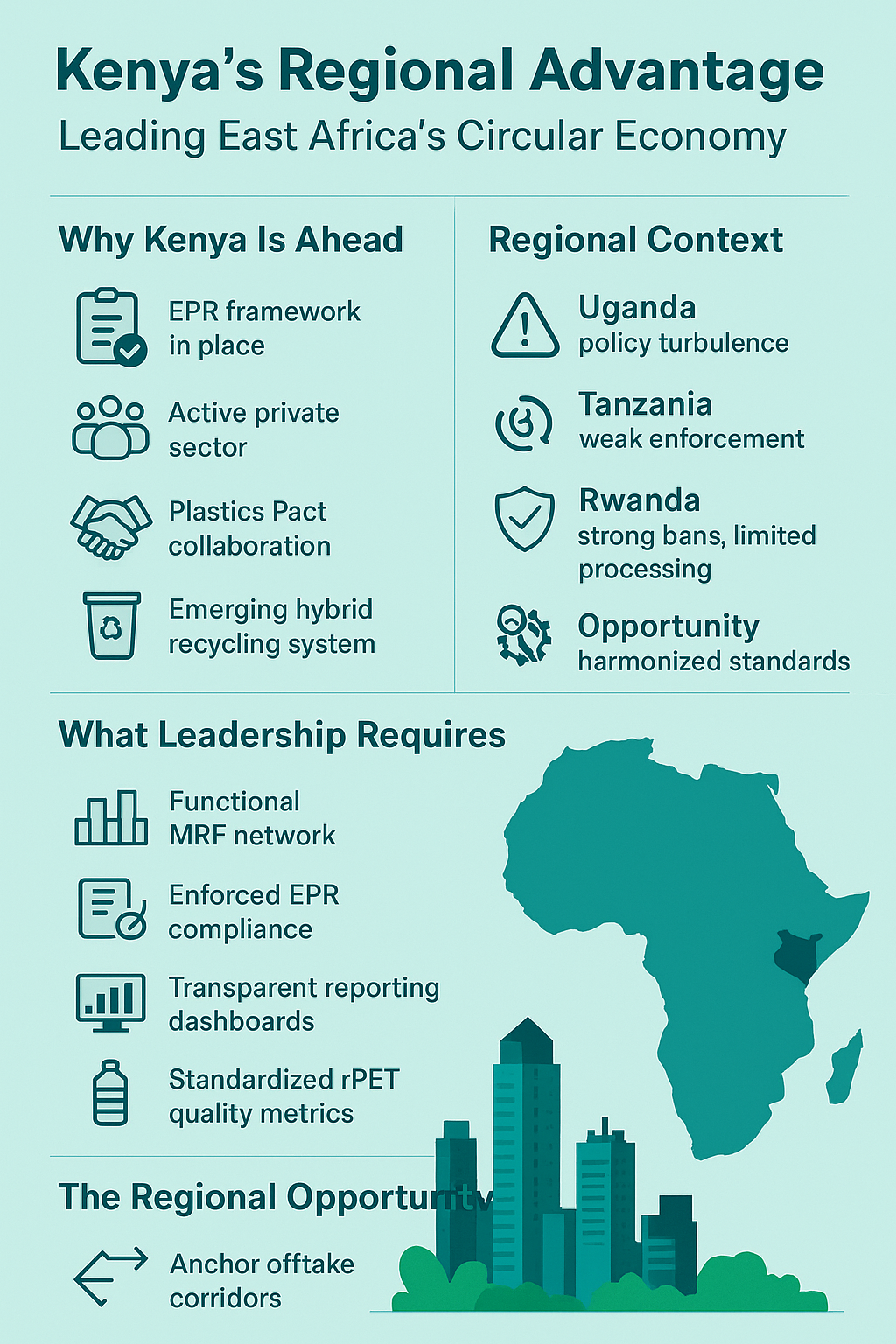
What makes this moment strategically significant is the shifting geopolitics of waste, recycling, and materials value chains. East Africa is rapidly becoming a new battleground in the global plastics transition. Europe is tightening export rules. Asia is closing loopholes. International brands are seeking compliant, reliable supply chains for recycled content, and multinationals are aggressively diversifying their sourcing away from over-saturated Asian markets. Kenya can seize this opportunity — but only if it builds regional interoperability. That means establishing cross-border quality standards for rPET and polyolefins, harmonizing EPR reporting templates within the EAC bloc, and negotiating regional offtake corridors that allow plastic waste and recycled outputs to move as legitimate industrial commodities rather than informal grey-market flows. If Kenya does not define the rules, someone else will — and the region will fall into predictable fragmentation, with each country setting incoherent standards that frustrate investors and undermine the economics of circularity.
Kenya’s next frontier is to turn its emerging domestic system into a regional value proposition. A country with functional MRFs, enforceable EPR, clear emissions oversight, and a formalized waste workforce can anchor regional offtakes, host cross-border recycling partnerships, and operate as the processing hub for high-quality recycled materials. This is not just about environmental leadership; it is about industrial strategy. Recycled PET, high-grade polyolefins, and monomers from enzymatic recycling are already becoming competitive export commodities. A well-structured Kenya can supply the region, attract capital, and negotiate stronger procurement terms with global brands seeking compliant supply chains. The opportunity is enormous — but it depends entirely on Kenya proving, through action rather than rhetoric, that it can run a transparent, disciplined, and investable circular system. If Kenya consolidates its internal framework now, it can shape East Africa’s circular economy for a generation. If it delays, the window closes — and leadership moves elsewhere.
References:
Kenya News Agency Kenya Plastics Pact Commits to Combat Plastic Pollution
Kenya News Agency Kenya launches roadmap for recyclable plastics by 2030
Sustainable Packaging Middle East & Africa Kenya’s Extended Producer Responsibility (EPR) regulations to take effect on May 5, 2025
Sustainable Packaging Middle East & Africa Kenya’s private sector rallies behind new plastics pact to drive circular economy shift
All Africa Kenya Launches Responsible Sourcing Drive to Protect Waste Pickers
The East African Plastic, plastic everywhere but not for African recyclers
 Jijuze