Kenya’s circular transition will ultimately depend on finance — not innovation alone, not legislation alone, and not public awareness alone. Finance is the absolute center of gravity. Every global circular success story has been capital-driven: France’s aggressive EPR enforcement, South Korea’s large-scale MRF modernization, South Africa’s PETCO producer-funded model. Kenya, by contrast, continues to rely on fragmented donor pilots, undercapitalized county systems, and private recyclers who operate without predictable feedstock, stable purchase agreements, or affordable credit. The informal workforce — waste pickers who recover the majority of recyclable material — remains excluded from formal banking, insurance, or guaranteed earnings. If Kenya is serious about a true circular transformation, it must design a capital architecture equal to the scale of its ambitions, and it must do so with urgency, discipline, and policy coherence.
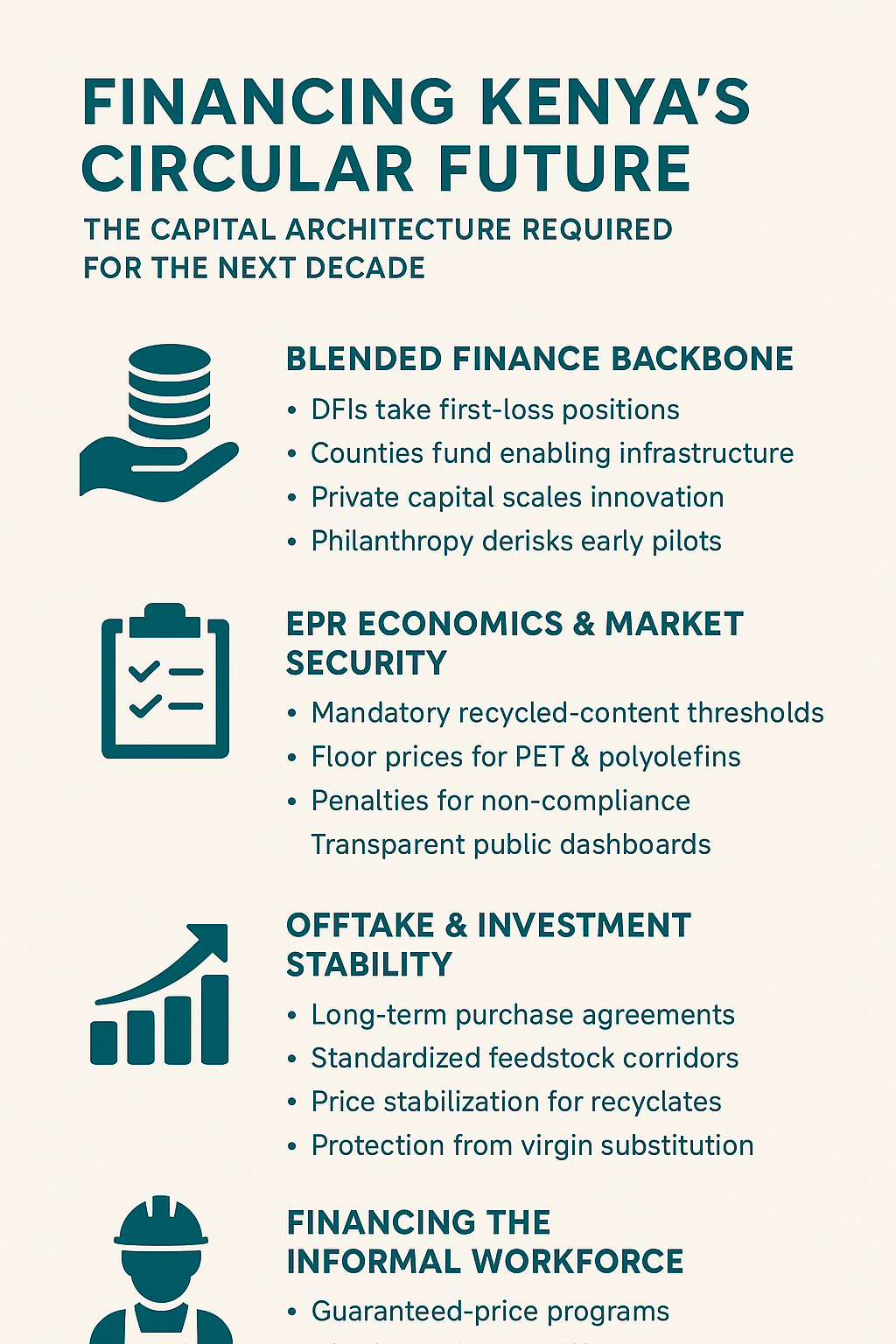
The backbone of this architecture must be blended finance: a structured layering of public, private, and philanthropic capital where DFIs absorb first-loss risk, counties provide enabling infrastructure, and private investors supply growth capital for recycling and waste-processing assets. Mechanical recycling plants, enzymatic modules, pyrolysis reactors, digital sorting systems, county-level MRFs — none of these scale through private capital alone because they depend heavily on long-term certainty of feedstock, energy prices, and off-take markets. That certainty can only come from enforceable EPR economics: mandatory recycled-content thresholds, minimum floor prices for PET and polyolefin feedstock, penalties for virgin substitution, and transparent national dashboards that expose producer compliance in real time. Without this market security, investors will hesitate, capital will stall, and Kenya will remain trapped in the expensive improvisation cycle that has defined the past decade.
But perhaps the most critical — and most overlooked — component of circular financing is the treatment of the informal waste workforce. They are the engine of Kenya’s recycling system, yet they absorb the greatest risks for the lowest rewards. Financing Kenya’s circular future means integrating waste pickers into the economic framework: stable purchase guarantees, micro-credit for equipment, digital wallets for secure payments, training stipends, and a national health and safety fund co-financed by government and producers. Social inclusion is not a humanitarian add-on — it is economic infrastructure. A circular economy that excludes the workforce that supplies its feedstock will remain permanently fragile. If Kenya builds a financing system that blends capital intelligently, enforces EPR without compromise, stabilizes feedstock markets, and dignifies the workers who keep the system alive, every innovation in this series becomes scalable. If not, even the most promising breakthroughs will collapse under the weight of familiar structural failure.
References:
Kenya News Agency Kenya launches roadmap for recyclable plastics by 2030
Kenya News Agency Kenya Plastics Pact Commits to Combat Plastic Pollution
Packaging Producer Responsibility Organization PAKPRO launches nationwide EPR awareness campaign in Mombasa, Kenya
Sustainable Packaging Middle East & Africa Kenya’s private sector rallies behind new plastics pact to drive circular economy shift
Sustainable Packaging Middle East & Africa Kenya’s Extended Producer Responsibility (EPR) regulations to take effect on May 5, 2025
All Africa Kenya Launches Responsible Sourcing Drive to Protect Waste Pickers
Climate Change.co.ke A Complete Guide to Kenya’s Green Bond Market for New Investors — Analysis of Kenya’s green bond issuances and investor appetite, relevant to discussions of blended and climate-aligned finance for circular infrastructure.

