Privacy vs. Security — Kenya’s New Surveillance Dilemma

Kenya’s abrupt pivot to algorithmic oversight has exposed a wrenching trade-off: the same machines that can trace illicit flows also watch citizens’ everyday lives. As Safaricom’s AI began mapping transaction behaviors and regulators demanded real-time feeds, private data that once moved only between users and platforms is now visible to a new ecosystem of state and corporate watchers. That visibility matters: behavioural scoring, timing analysis, and API logs can unmask syndicates — but they can also profile law-abiding users, freeze livelihoods, or expose sensitive patterns (medical payments, political donations, remittance partners). In practice, this tension has a name and a face: legitimate attempts to close laundering loopholes (especially in betting and mobile lending) have collided with privacy norms codified under Kenya’s Data Protection laws and enforced by the Data Protection Commissioner. The friction is no longer theoretical — it plays out in court rulings and public grievances, where an automated alert can instantly strand a small-business owner awaiting payroll, or a migrant worker trying to send school fees home.
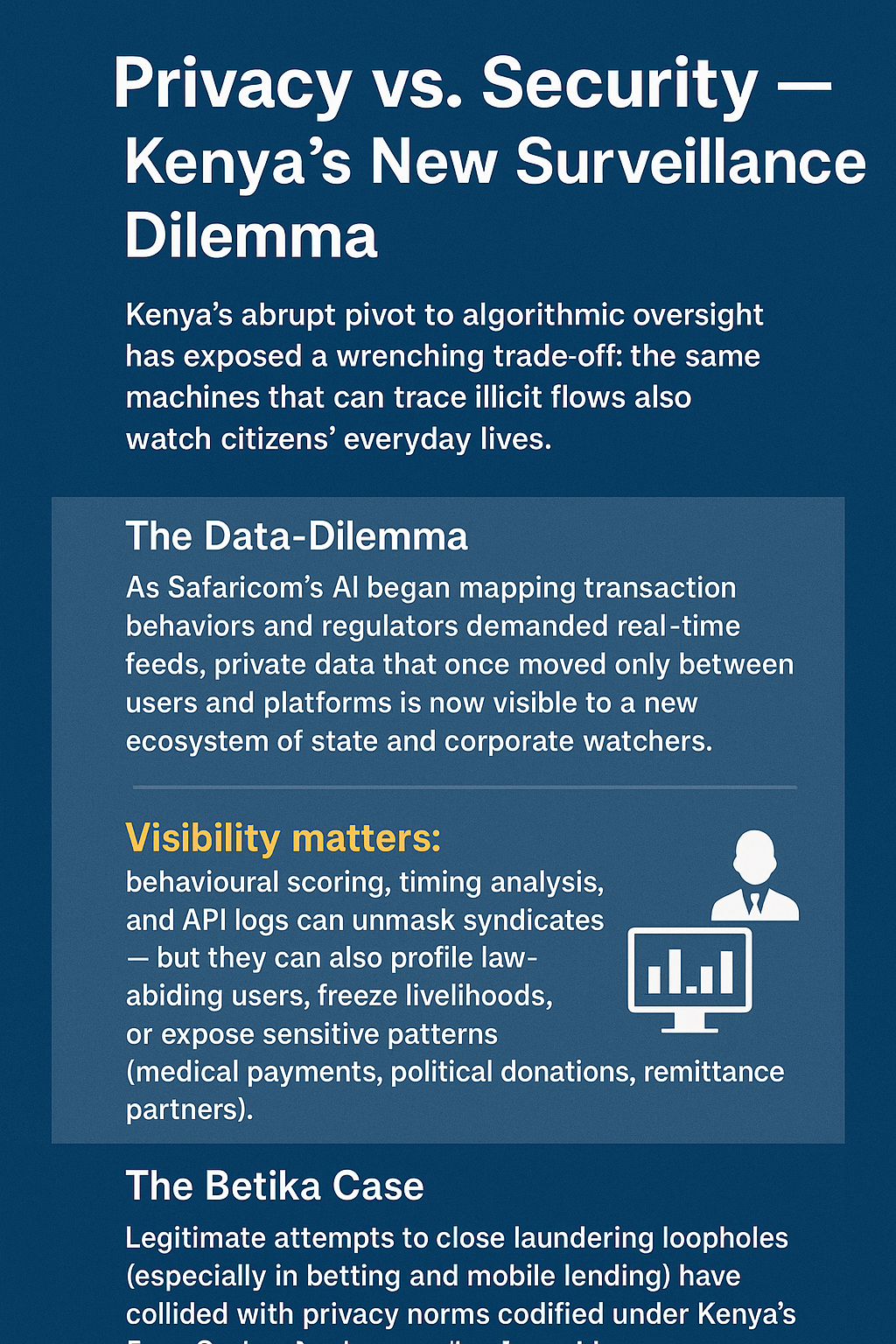
One high-profile example is the case involving Betika, which was ordered to pay KSh 250,000 for breaching data privacy rules. The ruling found that Betika had improperly processed users’ personal data without sufficient protections or lawful grounds. This case highlights a critical danger: when betting platforms (already under AML scrutiny) become nodes of state data demand, weak privacy compliance means corporate actors — not just regulators — can overreach data collection and usage, compounding surveillance risk. The Betika ruling proved that courts are willing to hold fintech operators accountable, but the scale of risk grows when those same APIs feed into AI-driven compliance systems without clear limits or safeguards.

The policy question is therefore blunt: how do you operationalize intrusive yet effective AML tools without creating a surveillance grid that punishes innocents? The answer requires more than slogans. It begins with strict, purpose-limited access: authorities and private partners should get only the minimal data needed to investigate a flagged flow — not full transaction histories. It requires explainable AI, where users receive understandable notices about why their wallet was flagged, and a clear appeals process exists. It demands robust oversight: the ODPC and FRC must enforce audit protocols, redress mechanisms, and limits on data retention and use. The Betika precedent is a warning: tightening oversight without privacy guardrails risks turning compliance into exclusion and exposing digital citizens to data abuse. Kenya now stands at a critical juncture: Will it build a system where enforcement respects rights — or drift into a regime where surveillance becomes default, and trust becomes collateral damage? In our next post, we’ll explore how to build explainable AI and regulatory harmony — practical steps to reconcile compliance, innovation, and rights.

References:

iGamingToday Betika ordered to pay KSh 250,000 for breaching data privacy rules

Subex How AI and Analytics Are Revolutionizing Fraud Detection in Mobile Money

Thomson Reuters AML challenges in evolving threat landscape, says ACAMS report

Techcabal How Safaricom’s AI exposed money laundering in Kenya’s betting boom
Fraud Syndicates and the Human Factor — The Dark Underside of M-Pesa

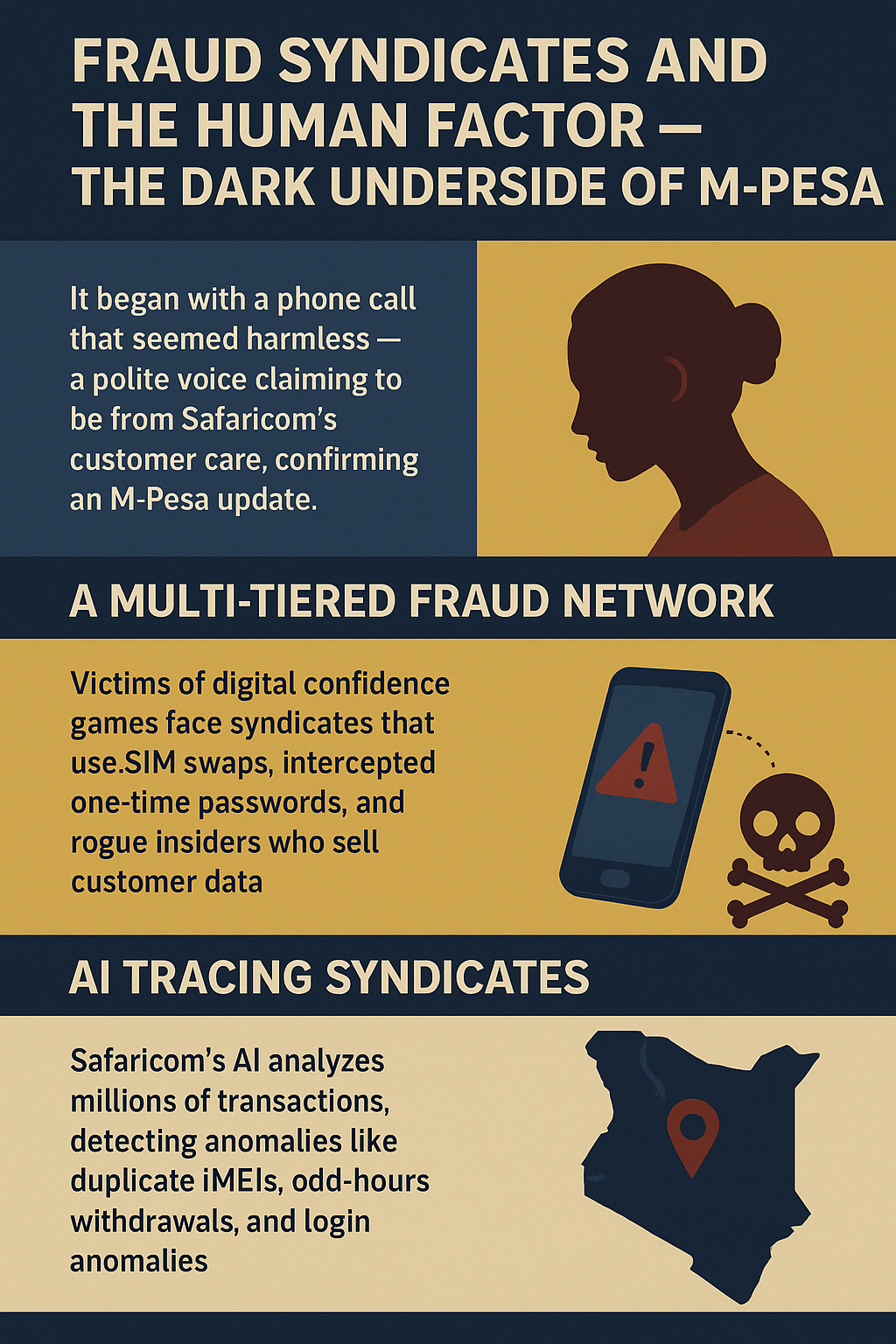
It began with a phone call that seemed harmless — a polite voice claiming to be from Safaricom’s customer care, confirming an M-Pesa update. Within minutes, Jane, a market trader from Nakuru, had lost everything in her wallet: her savings, her chama contributions, her business float. Hers wasn’t an isolated case. Across Kenya, from Kisumu to Kitengela, stories like Jane’s unfold daily — victims of digital confidence games that prey on trust and technological gaps. Beneath the convenience of Kenya’s mobile-money revolution lies a dark economy of cloned SIM cards, intercepted one-time passwords, and rogue insiders who sell customer data. What used to be petty phone scams has evolved into a multi-tiered fraud network, often coordinated through WhatsApp and Telegram groups, blending social engineering with technical precision. By the time victims realize their wallets have been emptied, the syndicates have already moved the money — split it, layered it, and cleaned it across dozens of M-Pesa accounts in seconds.

Behind the scenes, Safaricom’s AI compliance core is racing to keep up. Its models analyze millions of daily transactions, searching for irregular velocity, mirrored wallet behaviors, or login anomalies that betray coordinated fraud. The patterns are hauntingly human — the same phone IMEI used across unrelated accounts, repeated deposits at odd hours, or withdrawals made seconds after password resets. Investigators have identified rogue M-Pesa agents who act as the final cash-out nodes in this digital laundering chain, turning stolen virtual funds into physical currency. In one 2024 case in Eastlands, a syndicate of former call-centre employees was arrested after siphoning KSh 27 million from unsuspecting users — all through identity swaps and internal credential misuse. AI has since helped trace such insider leaks, tagging compromised agent IDs and disabling accounts that exhibit duplicate fingerprints. But even as the system grows smarter, so do the fraudsters, adapting to its logic, learning from its lags, and exploiting the tiniest cracks in Kenya’s fintech armor.

The war against M-Pesa fraud has thus become as much psychological as it is technological. For every line of defense built by machine learning, a counter-strategy emerges in the human domain — manipulation, deceit, and insider temptation. Regulators and investigators now warn that Kenya’s digital integrity hinges not only on code, but on culture — ethics, awareness, and enforcement. Safaricom has begun rolling out human-centered safeguards: community alerts, biometric verification pilots, and tighter collaboration with law enforcement. But the real test is whether ordinary Kenyans, from traders to teachers, can trust a system where the threat no longer comes from distant hackers but from within their own networks. The digital revolution gave Kenya financial freedom; now it must reckon with the predators it empowered. In our next post, we’ll explore the growing debate between privacy and security — and how Kenya’s AI revolution is forcing a reckoning over who really controls your data.

References:

Techcabal Safaricom fires 113 employees over fraud as internal cases rise

Techcabal How Safaricom’s AI exposed money laundering in Kenya’s betting boom
Rest of World M-Pesa has been huge for Kenya’s economy — and for scammers

Techpoint Africa Investigating M-PESA fraud cases in Kenya

The FATF Fallout — Kenya’s Grey Listing and the Regulatory Reckoning

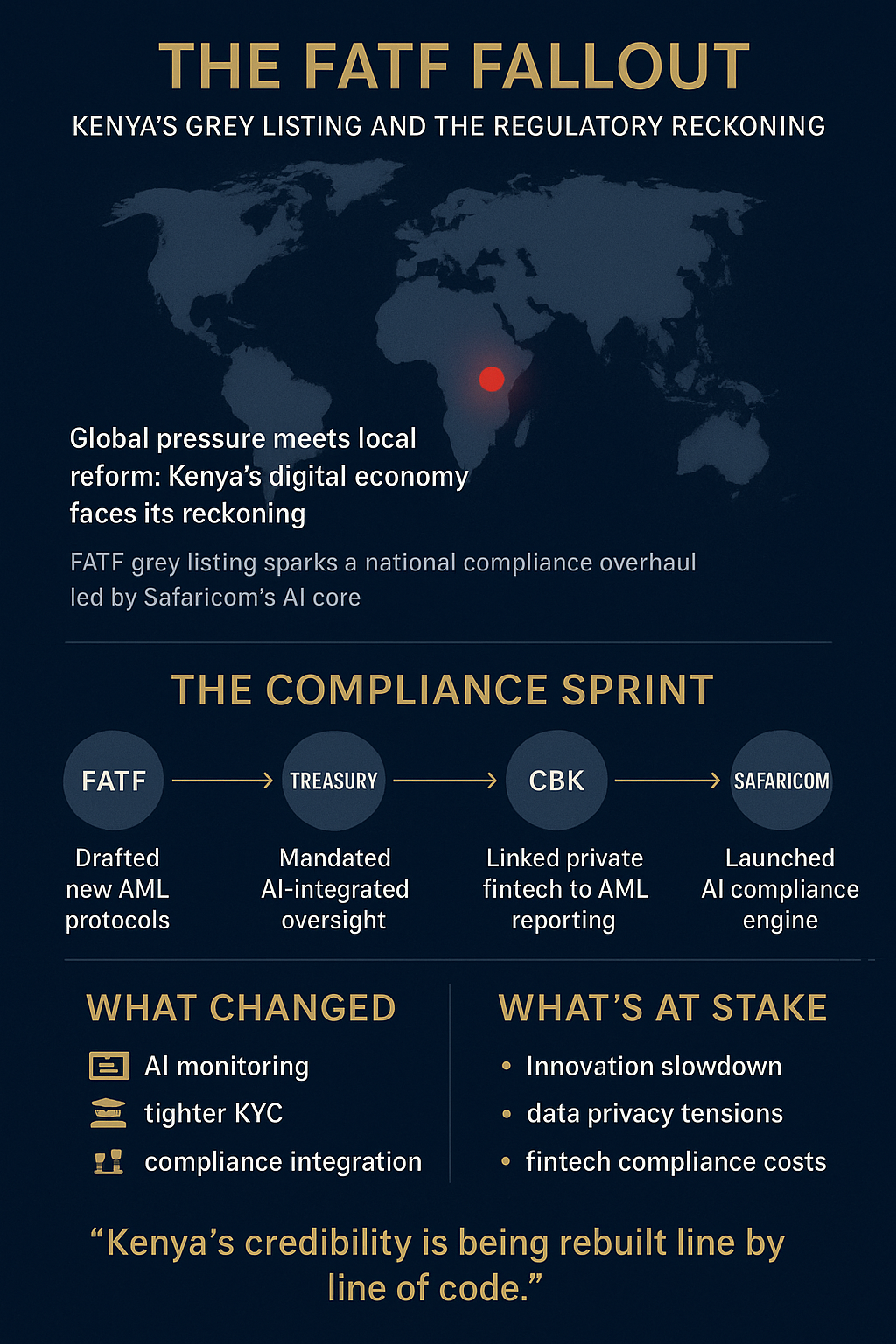
When Safaricom deployed its AI compliance engine, it wasn’t just about technological advancement — it was about survival. Behind the polished rollout was a growing alarm: Kenya had been placed on the Financial Action Task Force’s grey list in February 2024, forcing a reckoning over AML/CFT deficiencies exposed by international watchdogs. The grey listing exposed severe gaps: weak beneficial ownership disclosure, minimal prosecutions of money laundering, and under-regulation of sectors at high risk, including gambling, real estate, non-profit organisations, virtual assets, and law firms. Safaricom, already under pressure, recognized that its standing as the country’s digital financial backbone (through M-Pesa) meant that mere innovation would not suffice without credible compliance. The company’s AI overhaul was not a strategic choice — it was a compliance lifeline in a context where global trust, investor confidence, and even Kenya’s regional financial status were on the line.

The government’s response post-grey-listing was fast but fraught. On 17 June 2025, Kenya passed the new Anti-Money Laundering and Combating Terrorism Financing Act, strengthening the mandate of the Financial Reporting Centre (FRC) to oversee not just banks but non-financial businesses, regulated gambling operators, and high-risk non-profit entities. New requirements for beneficial ownership transparency, risk-based supervision, enhanced due diligence for high-risk customers, and stricter reporting of suspicious transactions were added. Yet, FATF’s June 2025 monitoring statement makes clear: Kenya is still under close watch. The list of obligations under “increased monitoring” remains long: non-financial entities must be better regulated; virtual asset service providers must be accounted for; suspicious transaction reports must rise; enforcement must reach even the high and powerful. The risk is no longer about drafting laws, but whether those laws bite.

But the FATF fallout isn’t only about compliance checkboxes—it’s rewriting Kenya’s fintech ecosystem. Startups, betting firms, M-Pesa agents, virtual asset operators are now navigating a regulatory terrain that demands transparency in ownership, speed in auditing, and an ever-watchful AI lens on behavior. The pushback has begun: fears of overreach, regulatory burden, and challenges for small operators. Still, for the first time in years, Kenya’s financial credibility is being rebuilt around enforceability—not just promise. As the Act takes effect and the global community watches, the real question is whether the government will apply these laws impartially — especially against the well-connected and politically exposed. Because grey-listing may be a stain, but it’s also the mirror revealing whether Kenya’s institutions have the courage and capacity to be truly accountable in a cashless, borderless world. Stay tuned for our next post as we continue to explore these developments and their implications!

References:

Institute for Security Studies Risk and reward of Kenya’s push to reverse FATF grey-listing

The FATF Jurisdictions under Increased Monitoring – 13 June 2025

Thomson Reuters AI, other technology the “only answer” to AML challenges in evolving threat landscape, says ACAMS report

ENACT IFFs and money laundering / Can anti-money laundering amendments get Kenya off FATF’s grey list?

Betting and Laundering — M-Pesa’s Hidden Battleground

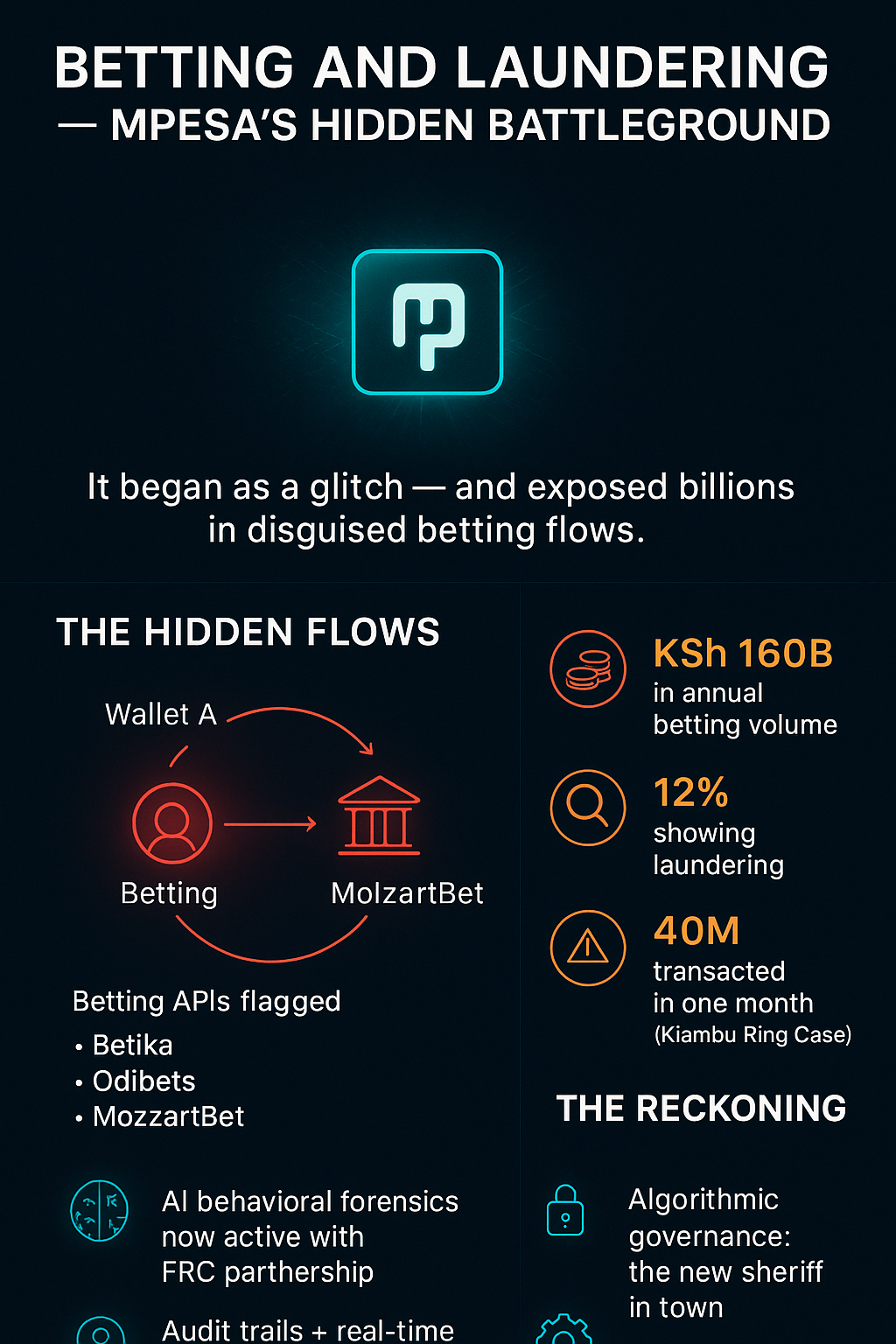
It began as a flicker of digital noise deep within Safaricom’s new artificial intelligence compliance system — a pattern so strange, even the engineers thought it was a software glitch. Betting wallets were trading in micro-loops, small deposits bouncing across networks at impossible speed, masquerading as gaming wins. But when the algorithm slowed the data stream, it exposed the truth: this wasn’t gambling; it was laundering. In days, Safaricom’s AI had flagged dozens of high-traffic betting APIs — among them Betika, Odibets, and MozzartBet — for suspicious activity, their systems pulsing with repeated micro-transactions that defied legitimate gaming behavior. What the model revealed was staggering. Ordinary player wallets had become conduits for billions of shillings, circulating under the guise of lucky streaks. Behind every spin, every small bet, was a meticulously choreographed web of digital cash-washing. The machine had finally confirmed what regulators long suspected but could not prove: Kenya’s fast-rising betting culture had evolved into the perfect laundromat — one hidden in plain sight inside the M-Pesa ecosystem.

The numbers told their own story. In the Kiambu Betting Ring case, investigators uncovered agents processing over KSh 40 million in just one month, using layered deposits and false payout slips to disguise dirty money as betting gains. Similar patterns appeared in the MozzartBet compliance freeze of mid-2024, where offshore cash-outs linked to unverified wallet owners triggered intervention by the Financial Reporting Centre (FRC) and Central Bank’s AML unit. By then, the data was irrefutable. AI modeling suggested that nearly 12 percent of Kenya’s annual betting volume — roughly KSh 160 billion — showed characteristics of laundering or structured fraud. The algorithms traced wallet behaviors that no manual audit could — bettors who “won” every day without ever placing bets, agents whose transaction volumes exceeded physical limits, and accounts that went dark after a single large payout. These were not random outliers; they were engineered identities, designed to game a system built for speed, not scrutiny. For years, M-Pesa’s success story — its promise of instant, borderless convenience — had inadvertently created the perfect storm: a seamless digital infrastructure exploited by syndicates more agile than the law itself.

Now, that same infrastructure is being weaponized against them. Safaricom’s AI partnership with the FRC has ushered in a new era of behavioral forensics — algorithms that don’t just track money but interpret motion, timing, and correlation. Yet this technological awakening has sparked backlash. Betting firms accuse Safaricom of overreach, freezing legitimate transactions and blurring the line between compliance and surveillance. Regulators, meanwhile, are tightening the screws: audit trails for all gaming wallets, mandatory KYC verification, and real-time data access for AML enforcement. The ripple effects extend far beyond gaming. Kenya’s digital economy now stands at an inflection point, where algorithmic oversight has become both protector and disruptor. In exposing how entertainment masked economic deceit, the AI has done more than flag fraudulent wallets — it has held up a mirror to the fragility of digital trust in a cashless nation. The house may always win, but in this new frontier, so does the machine — and its vision is only getting sharper.

References:

Techcabal Safaricom fires 113 employees over fraud as internal cases rise

KBC Channel 1 Kenya’s gambling industry set for shake-up after President Ruto signs into law Gambling Control Bill (Youtube)

The Kenyan Wall Street How Safaricom is Leveraging AI to Bolster M-Pesa Security and Efficiency

KBC M-pesa outage on Monday as Safaricom adopts AI to tame fraud

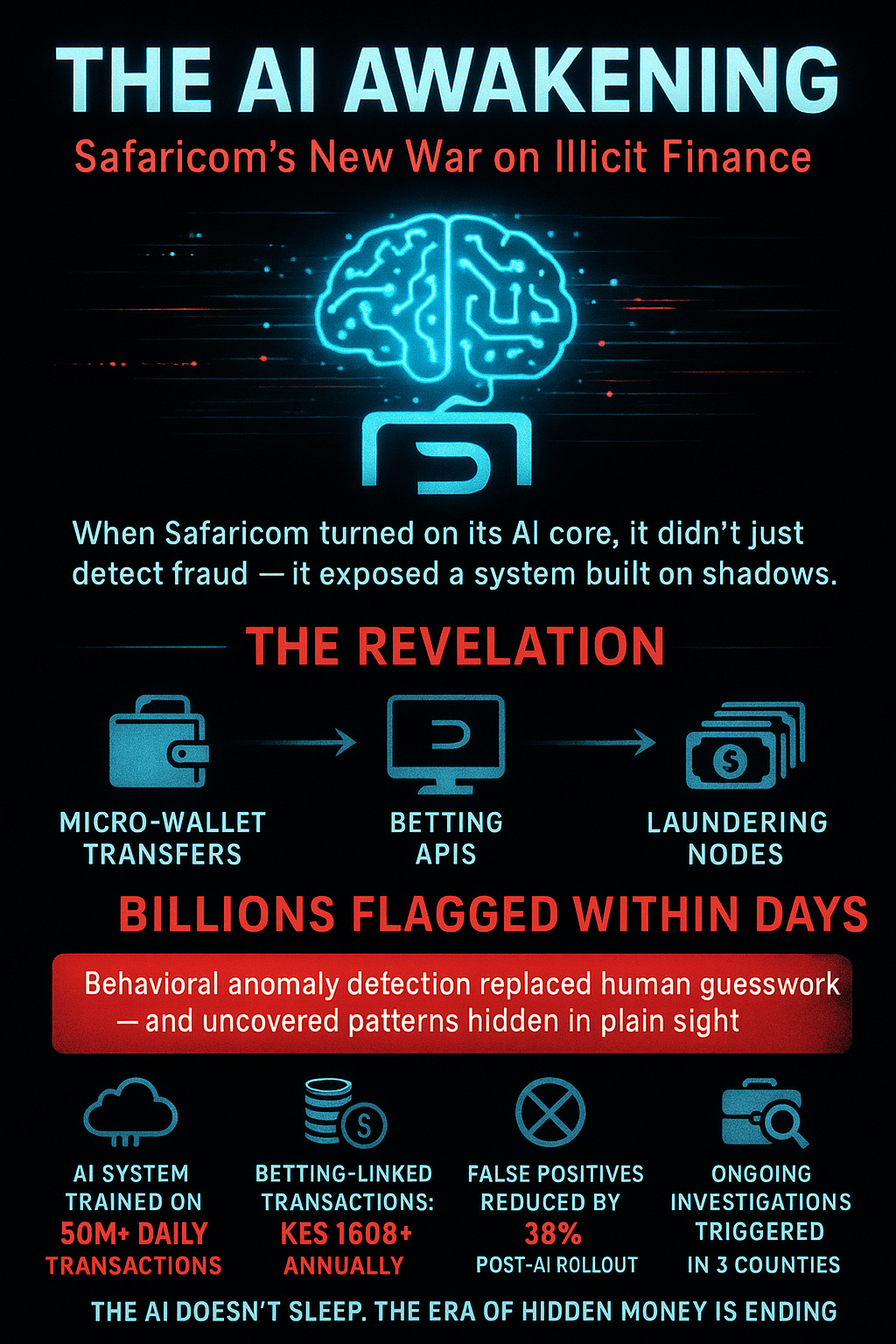
The AI Awakening — Safaricom’s New War on Illicit Finance

When Safaricom quietly switched on its new artificial intelligence engine earlier this year, no one expected it to rattle the country’s most powerful industry — or expose a side of M-Pesa no one was supposed to see. Within days, the system began lighting up with digital red flags: strange betting transactions looping through ordinary wallets, micro-deposits disguised as gaming payouts, and accounts moving small amounts in patterns too precise to be random. What the algorithms were seeing wasn’t play — it was laundering. Billions of shillings were silently being rinsed through Kenya’s favorite mobile platform, hidden beneath the guise of everyday betting. For weeks, engineers watched in disbelief as the AI’s alerts mapped a web of financial deception so intricate it blurred the line between entertainment and organized crime. The revelation shook Safaricom’s compliance teams — and soon after, the regulators who realized that Kenya’s most celebrated innovation had also become its most sophisticated laundering highway.

Inside Safaricom, a quiet revolution had begun. The company wasn’t just fighting fraud — it was reprogramming its financial DNA. The AI core, built in partnership with advanced compliance auditors and data scientists, doesn’t merely track transactions; it learns human behavior. It detects hesitation, timing anomalies, and wallet relationships that no manual audit could ever spot. What began as a compliance upgrade quickly turned into a forensic awakening — a self-learning system capable of catching what criminals believed was invisible. But the move also triggered backlash. Betting firms, some major ones, protested account freezes and accused Safaricom of overreach. Yet for Safaricom, this was no longer about risk — it was about survival. The same technology that made M-Pesa a lifeline for millions had made it a target for laundering syndicates. Turning AI loose on that frontier was less a choice than an inevitability.

Now, the discovery has thrown Kenya’s digital economy into uncharted territory. Regulators are scrambling to keep up, data privacy watchdogs are asking hard questions, and compliance officers are quietly celebrating the first real glimpse into the scale of illicit flows buried within mobile money. For the first time, artificial intelligence isn’t just assisting Kenya’s war on financial crime — it’s leading it. The system doesn’t sleep, doesn’t flinch, and doesn’t forget. And as it continues to learn, one thing is certain: the era of hidden money on M-Pesa is ending — but the reckoning it has triggered is only beginning. Stay tuned for the next post in this six-part series, where we will delve deeper into the implications of these changes.

References:

Techcabal How Safaricom’s AI exposed money laundering in Kenya’s betting boom
The Kenyan Wall Street How Safaricom is Leveraging AI to Bolster M-Pesa Security and Efficiency

Citizen Digital Father, son arrested for conning M-Pesa operators over Ksh.200K in Nairobi

KBC M-pesa outage on Monday as Safaricom adopts AI to tame fraud

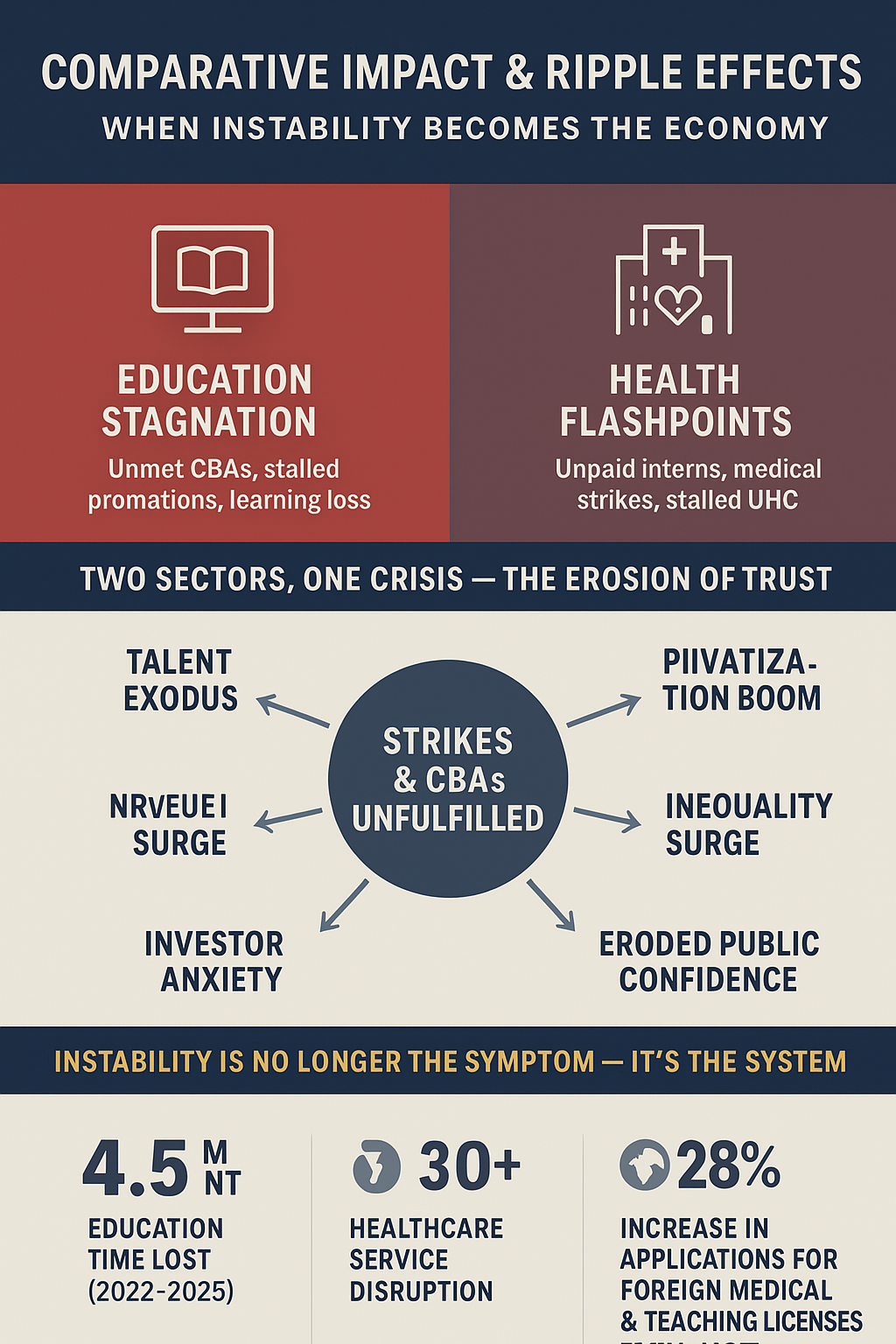
Comparative Impact & Ripple Effects — When Instability Becomes the Economy

Kenya’s twin crises in education and health now mirror each other so perfectly that they read like two halves of the same systemic failure. In both sectors, the story begins with noble ideals and ends in bureaucratic betrayal. Teachers denied promotions for years and doctors left unpaid for months are not victims of isolated lapses — they are casualties of a governance structure that treats agreements as aspirational and accountability as negotiable. What began as labor unrest has evolved into a chronic condition, one that corrodes morale, erodes professional standards, and undermines the country’s developmental spine. When classrooms and hospitals — the two pillars of human capital — falter simultaneously, the result is not just administrative paralysis; it is a national identity crisis. These strikes expose Kenya’s deepest institutional flaw: a state that signs social contracts it refuses to honor, and in doing so, normalizes dysfunction as policy.

The ripple effects stretch far beyond picket lines. Every unfulfilled CBA or stalled negotiation accelerates a quiet exodus — of talent, trust, and taxpayers — toward private alternatives. Parents turning to private schools and clinics are not exercising choice; they are fleeing collapse. What was once a temporary workaround has become a permanent migration, where education and healthcare are increasingly determined not by citizenship but by income. The rise of digital substitutes — telemedicine, e-learning platforms, private tutoring, and subscription-based health services — signals a privatized survival economy emerging in the vacuum of public failure. While the elite can insulate themselves, the poor are trapped in decaying facilities where teachers are demoralized, and doctors are on strike. Devolution, meant to democratize access, has inadvertently decentralized neglect. As the public system withers, inequality becomes Kenya’s most stable institution.

The economic and social toll of this instability is staggering yet deliberately undercounted. Prolonged strikes shave months off learning calendars, deepen skills gaps, and delay the entry of professionals into the workforce. Health disruptions spike morbidity, drain productivity, and inflate private health costs. Each wave of unrest injects uncertainty into the investment climate, with labor volatility now ranking among Kenya’s top deterrents for both local and foreign investors. The human cost is equally severe: young teachers and medics — once the backbone of Kenya’s social mobility — are migrating en masse to stable economies like Germany, Canada, and Australia, seeking the professional dignity their homeland denied them. What remains is a hollow state: one where service delivery depends on judicial orders, governance runs on press statements, and citizens learn to survive outside the system meant to protect them. Unless Kenya rebuilds credibility at the intersection of policy, trust, and labor justice, instability will cease to be a crisis — it will become the economy itself.

References:

NTV Kenya What factors drive Kenya’s brain drain, and how can it be reversed? | Unpacked

The Conversation Kenyan doctors’ strike: the government keeps failing to hold up its end of the bargain

The Standard Strikes make life expensive, scare investors, experts tell Kenyans

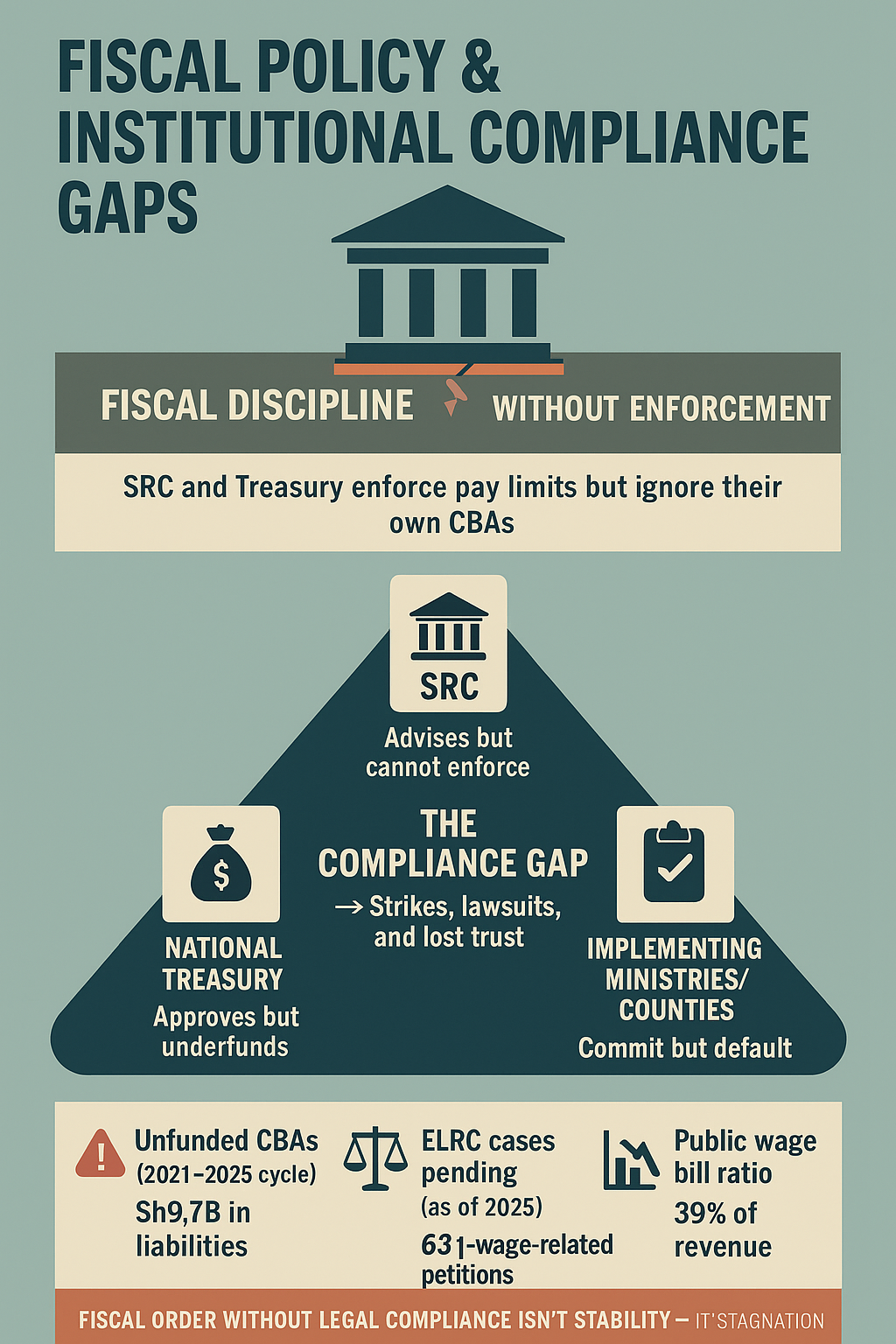
Kenya’s Labor Crisis: Governance Failure and Fiscal Discipline

At the heart of Kenya’s endless labor unrest lies a contradiction the state has refused to confront: it preaches fiscal discipline while institutionalizing non-compliance. The Salaries and Remuneration Commission (SRC) — the body constitutionally mandated to manage public wage policy — has become a paradox of design: all authority, no enforcement. It issues guidelines that ministries and counties cite when cornered but ignore when expedient. Its circulars on pay harmonization and job evaluation are routinely undermined by politically negotiated allowances, ad hoc promotions, and extra-legal CBAs signed under pressure. The result is a regulatory void where fiscal control is performative and accountability optional. SRC’s power is largely symbolic — a watchdog muzzled by law and outpaced by politics — while the wage bill continues to balloon, not because of policy ignorance, but because institutions have learned how to outmaneuver oversight.

The National Treasury sits at the center of this dysfunction, weaponizing scarcity while mismanaging prioritization. Its annual insistence on fiscal prudence rings hollow against a record of delayed disbursements, unpaid CBA arrears, and selective funding of politically strategic programs. Treasury’s budgeting cycle has effectively become a tool of containment — a means to manage unrest rather than reform systems. When doctors, teachers, or civil servants strike, it is rarely due to wage greed; it is because their legally negotiated agreements remain unfunded despite formal approval. The Treasury’s pattern of signing off on CBAs without allocating corresponding funds has turned the entire labor framework into a credibility trap. Each unhonored agreement erodes faith not just in the fiscal system, but in the idea that government commitments are binding at all. This chronic underfunding blurs the line between austerity and abdication — and in doing so, transforms fiscal caution into a breeding ground for revolt.

The compliance gap that emerges from this broken triangle — SRC, Treasury, and the implementing ministries or counties — is not administrative; it is existential. Each actor claims procedural innocence while collectively ensuring systemic failure. Ministries invoke budget ceilings; counties plead disbursement delays; SRC blames its limited mandate — and the Labor Ministry, the one body meant to arbitrate, has devolved into a crisis registrar. This institutional buck-passing is now a defining feature of Kenya’s governance culture. It explains why industrial action has become cyclical, why courts are perpetually mediating CBAs, and why public trust continues to collapse. Investors see it too: the volatility of Kenya’s labor market is not caused by worker militancy, but by the state’s refusal to honor its own laws. The strikes are symptoms — the disease is compliance failure dressed up as fiscal discipline. Until Kenya reforms the machinery of accountability between its fiscal and labor institutions, economic stability will remain an illusion built on broken promises.

References:

Daily Nation How bloated wage bills are choking counties and stalling development

Daily Nation A nation of protests and strikes

Business Daily Civil servants sue SRC over freezes on pay reviews

Health Sector Flashpoints — When Counties Betray Care

Kenya’s public health system is once again on the operating table — but this time, the diagnosis points beyond fiscal failure to institutional betrayal. The government’s May 2024 payout of KSh 3.5 billion in doctors’ arrears briefly restored faith in the state’s willingness to honor past commitments under the 2017–2024 CBA. Yet, beneath the celebration, cracks widened. Barely weeks later, the same administration plunged the sector into chaos over the medical interns’ stipend standoff, slashing agreed pay from KSh 206,400 to 70,000 under the guise of “limited fiscal space.” The ensuing paralysis—interns idled, courts flooded with petitions, hospitals short-staffed—signaled not financial constraint but a governance culture that governs by deferral, treating legality and professionalism as expendable luxuries. What should have been a steady reform agenda has degenerated into episodic crisis management, where every partial solution simply queues up the next emergency.

The deterioration has now metastasized to the counties, where devolved power has mutated into deflection and denial. In Kiambu County, doctors have been on strike for months, accusing the governor of presiding over a “battle of egos” instead of a rescue plan. (The Standard) The Kenya Medical Practitioners, Pharmacists and Dentists Union (KMPDU) has condemned county governments for “derailing progress” by ignoring CBAs, delaying salaries, and politicizing healthcare delivery. The union’s outrage spiked after reports that 131 newborns died amid the Kiambu crisis, a tragedy the Council of Governors publicly dismissed as “false publication.” (Citizen Digital) The KMPDU now demands accountability, an apology, and an independent investigation—warning of a nationwide strike on October 25 if county impunity persists. What began as a county dispute has evolved into a national indictment of how devolution, once hailed as reform, has devolved into an administrative minefield where human life becomes collateral to political vanity.

This crisis extends far beyond Kiambu — it is metastasizing across the entire devolved health network, revealing a structural rot that no press release can conceal. Health workers in Nairobi, Isiolo, Marsabit, and other counties are already on edge over delayed salaries, missing allowances, and ignored CBAs, while local leaders deflect responsibility with ritual blame games. Each county now operates like a fiefdom, where governors weaponize fiscal autonomy to evade national accountability. The result is a patchwork of suffering: hospitals running without drugs, maternity wards closing for lack of staff, and patients dying quietly as politicians trade televised barbs. In this grotesque inversion of priorities, doctors and nurses must fight court battles simply to be paid, while the state spends millions staging health summits and PR drives about universal care. The moral decay runs deeper than bureaucratic failure — it is ethical bankruptcy. Devolution was meant to bring services closer to the people; instead, it has brought corruption closer to the patient. The Council of Governors, once the face of localized empowerment, now functions as a shield for negligence, dismissing human tragedies as “falsehoods” even when families bury their dead. A government that forces doctors back to work through court orders, instead of dialogue, has abdicated the very essence of governance. Every delayed salary and every stillborn infant is a symptom of a political elite desensitized to suffering — one that governs not through service, but through spectacle. Unless the state reclaims discipline, compassion, and coherence in health governance, Kenya’s pursuit of universal healthcare will remain a hollow slogan floating over a silent emergency ward.

References:

The Standard Battle of egos: Counties accused of derailing progress in health sector

Citizen Digital KMPDU slams Governors over Kiambu health crisis, issues demands amid looming national strike

The Standard Doctors to join their striking Kiambu colleagues starting Wednesday

Finn Partners The Evolution of Healthcare in Kenya Amidst Doctor’s Strike and the Rise of Digital Health Innovations

TV47 Kenya Trust deficit is Kenya Kwanza’s greatest undoing” – MP Makali Mulu

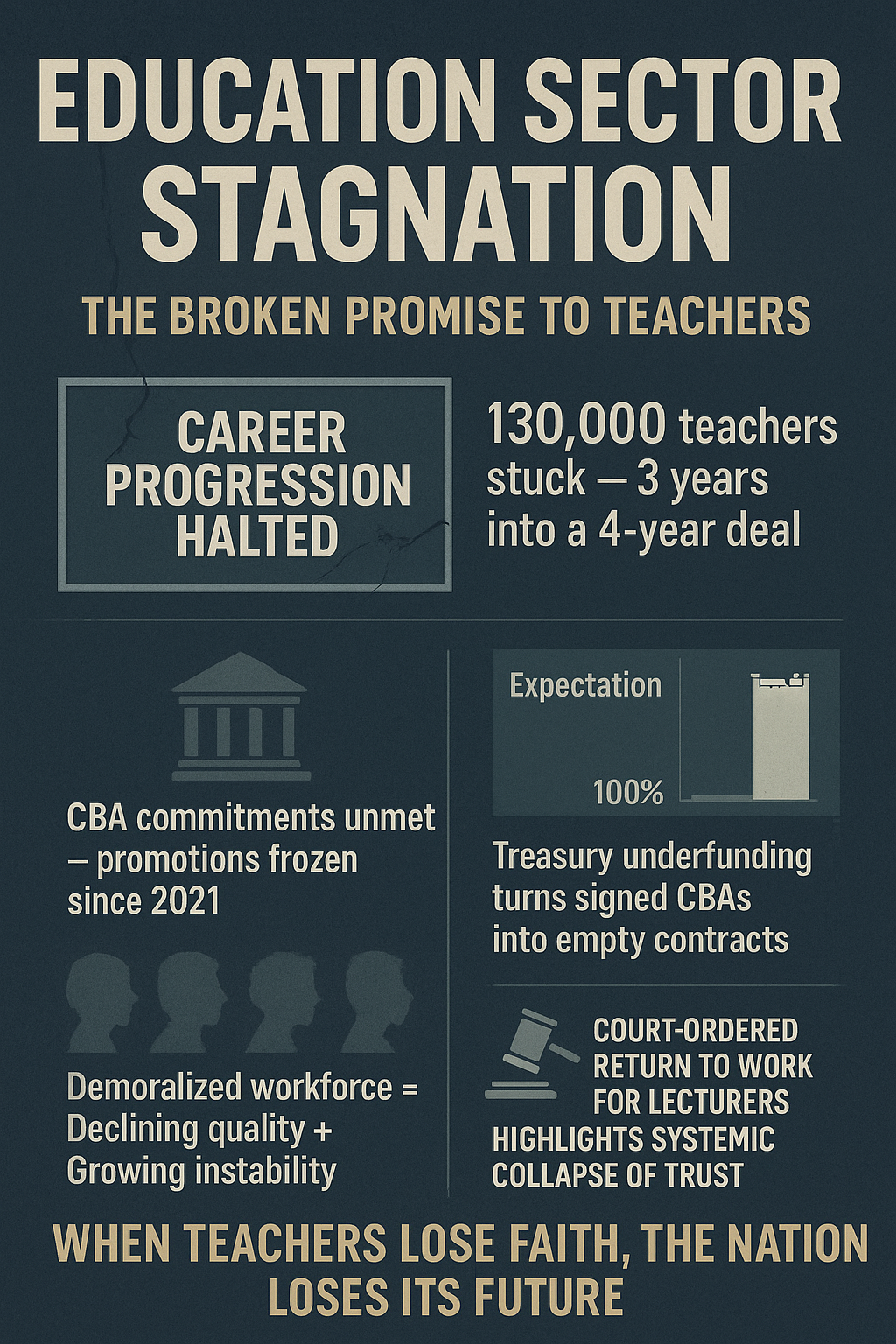
Education Sector Stagnation — The Crisis Behind Kenya’s Classrooms

The crisis speaks to something more profound than missed promotions; it exposes a deliberate governance failure that prioritizes fiscal optics over human capital. The TSC’s inability to execute the agreed promotions has become emblematic of Kenya’s “paper promises” — deals inked and celebrated, then quietly buried when budgets tighten. Treasury allocations to the Commission repeatedly fall short of covering the wage and progression costs enshrined in signed CBAs. This chronic underfunding transforms legal agreements into empty gestures, leaving teachers to bear the brunt of political short-termism. The result is an education system running on disillusionment: educators forced to do more with less, students learning from underpaid, overworked instructors, and parents watching as quality erodes year after year.

Recent developments in higher education reveal that this dysfunction is not confined to basic learning. As of October 2025, the University of Nairobi (UoN) directed lecturers to resume work following a prolonged strike, acting on a court order that temporarily suspended the industrial action and mandated conciliation. The strike, spearheaded by academic unions including UASU, KUSU, and KUDHEIHA, centered on the government’s alleged failure to pay KSh 7.9 billion owed under the 2021–2025 Collective Bargaining Agreement — a claim contested by the Ministry of Education, which maintains that several payment tranches have already been released. The unions, however, insist that discrepancies persist and have demanded documentary proof such as payslips and audited records. This confrontation underscores a grim pattern: collective agreements, even when legally binding, are routinely undermined by bureaucratic opacity and political deflection. From teachers denied promotions to lecturers forced back to class under court order, the system thrives on compulsion rather than collaboration. When dialogue collapses into litigation and contractual rights depend on judicial enforcement rather than institutional integrity, it becomes clear that Kenya’s education crisis is no longer about money — it’s about the state’s eroding credibility. The country’s future is being taught by a workforce losing faith not just in their employer, but in the very promise of public service.

References:

Citizen Digital UoN directs lecturers to resume work on Monday amid ongoing strike

The Standard The Sh7.9 billion stalling university lecturers strike talks

Daily Nation Lecturers accuse SRC, universities of delay tactics over pay arrears

KTN News Kenya KUPPET demands promotion of over 130,000 teachers working under same job groups for many years.

Understanding Kenya’s Labor Unrest: Beyond Government Missteps

Kenya’s labor unrest cannot be fully explained by the Kenya Kwanza administration’s missteps alone. The deeper roots of today’s incessant strikes lie in structural shifts unleashed by the 2010 Constitution. By embedding strong labor rights—including the freedom to unionize, collectively bargain, and strike—while simultaneously devolving key government functions, the Constitution created both an empowered workforce and a fragmented system of accountability. These changes reshaped labor relations across education and health, planting the seeds for recurrent clashes between workers, unions, and the state.

Nowhere is this clearer than in the health sector. When the 2010 Constitution devolved primary and secondary health services to 47 county governments, it fractured the once-unified employer-employee relationship between health unions and the state. Doctors, nurses, and other medical professionals suddenly faced a dual negotiation front: the national Ministry of Health and individual county governors. This decentralization introduced ambiguity about who should fund or enforce collective bargaining agreements (CBAs), fueling a wave of prolonged nationwide strikes. The infamous 2016–2017 standoff—where doctors and nurses collectively downed tools for nearly a year, resulting in 250 lost strike days—exemplified how devolution multiplied points of conflict rather than streamlining accountability.

By contrast, the education sector retained a centralized structure under the Teachers Service Commission (TSC). While this avoided the maze of devolved negotiations, it meant that disputes often escalated into high-stakes, nationwide confrontations. Teachers’ unions, dealing with a single employer, have consistently locked horns with the TSC over promotions, career progression, and salary schemes. Despite this centralization, the state has still failed to fund signed CBAs adequately, proving that the conflict is not just about institutional design but also about political will. Ultimately, the post-2010 constitutional settlement entrenched a dual dilemma: fragmentation in devolved sectors like health, and high-stakes concentration in centralized sectors like education—both of which ensure that labor unrest remains baked into Kenya’s governance model.

References:

KMPDU Promise Made, Promise Kept As Doctors Receive Full 2017–2024 CBA Arrears

BMJ Global Health Tackling health professionals’ strikes: an essential part of health system strengthening in Kenya

Health Business Ministry of Health signs agreement with KMPDU in new deal

Finn Partners The Evolution of Healthcare in Kenya Amidst Doctor’s Strike and the Rise of Digital Health Innovations