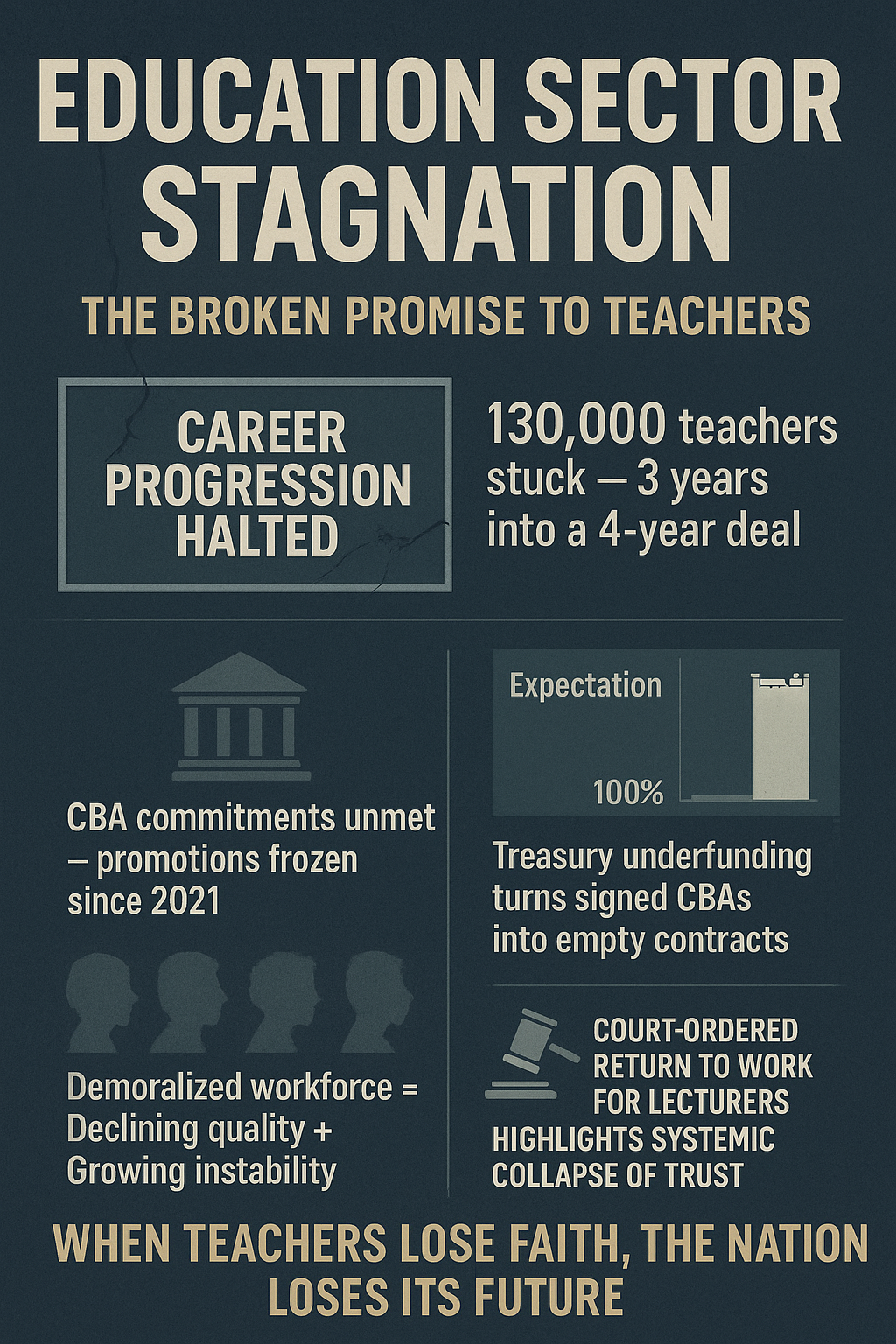
The crisis speaks to something more profound than missed promotions; it exposes a deliberate governance failure that prioritizes fiscal optics over human capital. The TSC’s inability to execute the agreed promotions has become emblematic of Kenya’s “paper promises” — deals inked and celebrated, then quietly buried when budgets tighten. Treasury allocations to the Commission repeatedly fall short of covering the wage and progression costs enshrined in signed CBAs. This chronic underfunding transforms legal agreements into empty gestures, leaving teachers to bear the brunt of political short-termism. The result is an education system running on disillusionment: educators forced to do more with less, students learning from underpaid, overworked instructors, and parents watching as quality erodes year after year.
Recent developments in higher education reveal that this dysfunction is not confined to basic learning. As of October 2025, the University of Nairobi (UoN) directed lecturers to resume work following a prolonged strike, acting on a court order that temporarily suspended the industrial action and mandated conciliation. The strike, spearheaded by academic unions including UASU, KUSU, and KUDHEIHA, centered on the government’s alleged failure to pay KSh 7.9 billion owed under the 2021–2025 Collective Bargaining Agreement — a claim contested by the Ministry of Education, which maintains that several payment tranches have already been released. The unions, however, insist that discrepancies persist and have demanded documentary proof such as payslips and audited records. This confrontation underscores a grim pattern: collective agreements, even when legally binding, are routinely undermined by bureaucratic opacity and political deflection. From teachers denied promotions to lecturers forced back to class under court order, the system thrives on compulsion rather than collaboration. When dialogue collapses into litigation and contractual rights depend on judicial enforcement rather than institutional integrity, it becomes clear that Kenya’s education crisis is no longer about money — it’s about the state’s eroding credibility. The country’s future is being taught by a workforce losing faith not just in their employer, but in the very promise of public service.
References:
Citizen Digital UoN directs lecturers to resume work on Monday amid ongoing strike
The Standard The Sh7.9 billion stalling university lecturers strike talks
Daily Nation Lecturers accuse SRC, universities of delay tactics over pay arrears
KTN News Kenya KUPPET demands promotion of over 130,000 teachers working under same job groups for many years.
 Jijuze