The Secret Deal: Why Transparency Matters

Despite the high stakes, the specific terms of the debt-for-food swap remain shrouded in secrecy, sparking legal battles and civil society alarm. A case filed at the East African Court of Justice, Wanjiru Gikonyo v The Attorney General, challenges the government’s refusal to disclose the full details of sovereign debt agreements. Litigants argue that committing future tax revenues and “savings” to long-term projects without public participation is unconstitutional. The lack of a public dashboard detailing exactly how the Sh129 billion will be spent creates a “transparency deficit” that invites mismanagement.
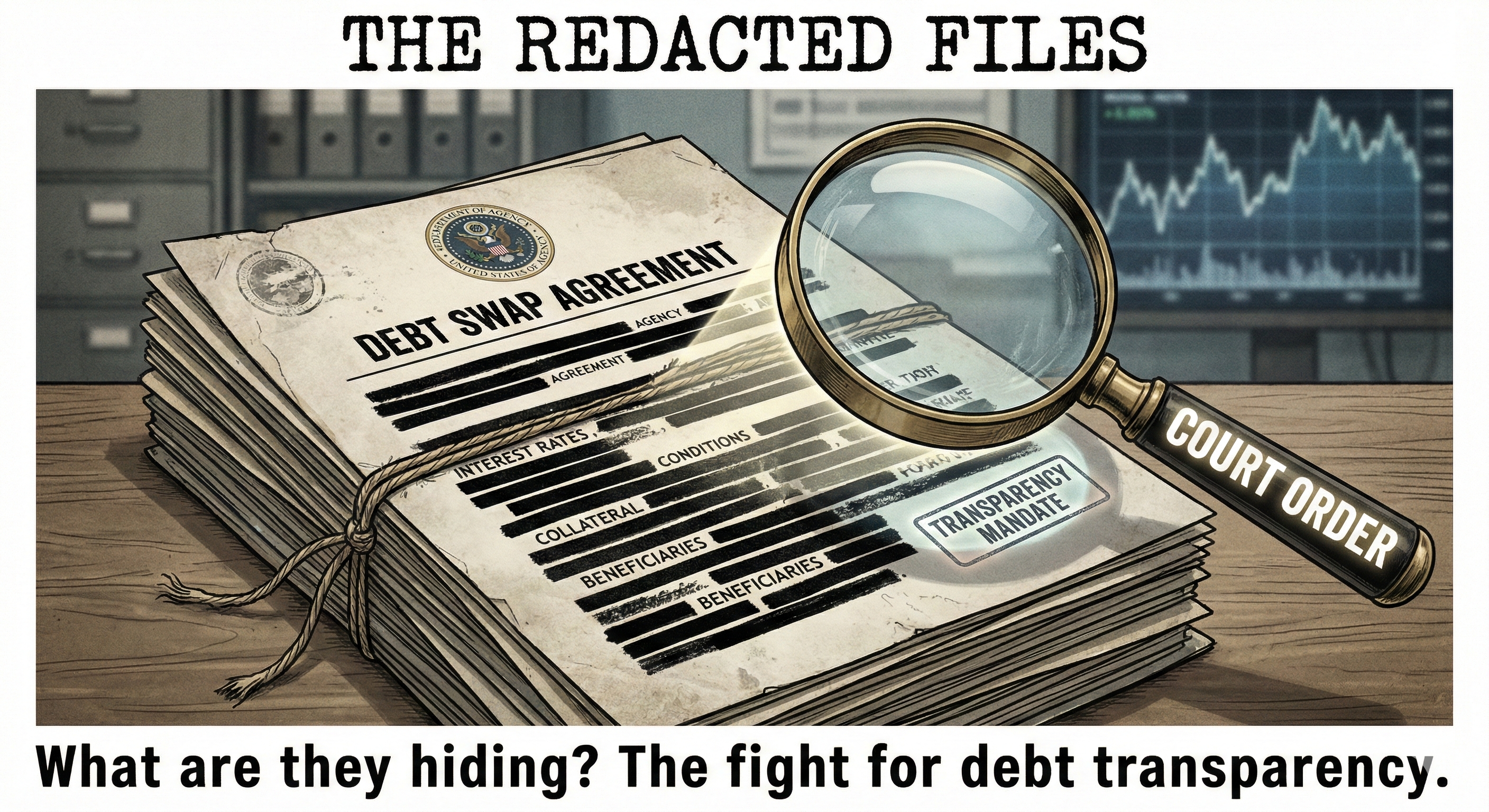
This opacity exacerbates the “sovereignty paradox.” By allowing the US-DFC and WFP to dictate the terms of expenditure, Kenya is effectively admitting that its own institutions cannot be trusted. While external conditionality acts as a safeguard against local corruption, the public remains in the dark about what exactly has been signed away. Are there hidden fees? What are the penalties for non-compliance? Without full disclosure, the Kenyan taxpayer is a passenger in a vehicle being driven by foreign creditors.

Transparency is not just a legal formality; it is the only disinfectant strong enough to prevent the “bureaucratic consignment” of funds. Civil society is demanding that the Treasury publish every shilling of the “savings” and every project beneficiary. Until then, the debt swap remains a “black box”—a deal negotiated in boardrooms in Washington and Nairobi, with the bill sent to the citizen who has no say in the menu.

References:

Afronomics Law Sovereign Debt News Update No. 147: The Promises and Transparency Pitfalls of Kenya’s $1 Billion Debt-for-Food Swap

The Institute for Social Accountability The High Court has ordered the National Treasury to disclose critical information on Kenya’s bilateral loans and sovereign bonds.
The Billion-Dollar Gamble: Inside Kenya’s “Food-for-Eurobond” Swap

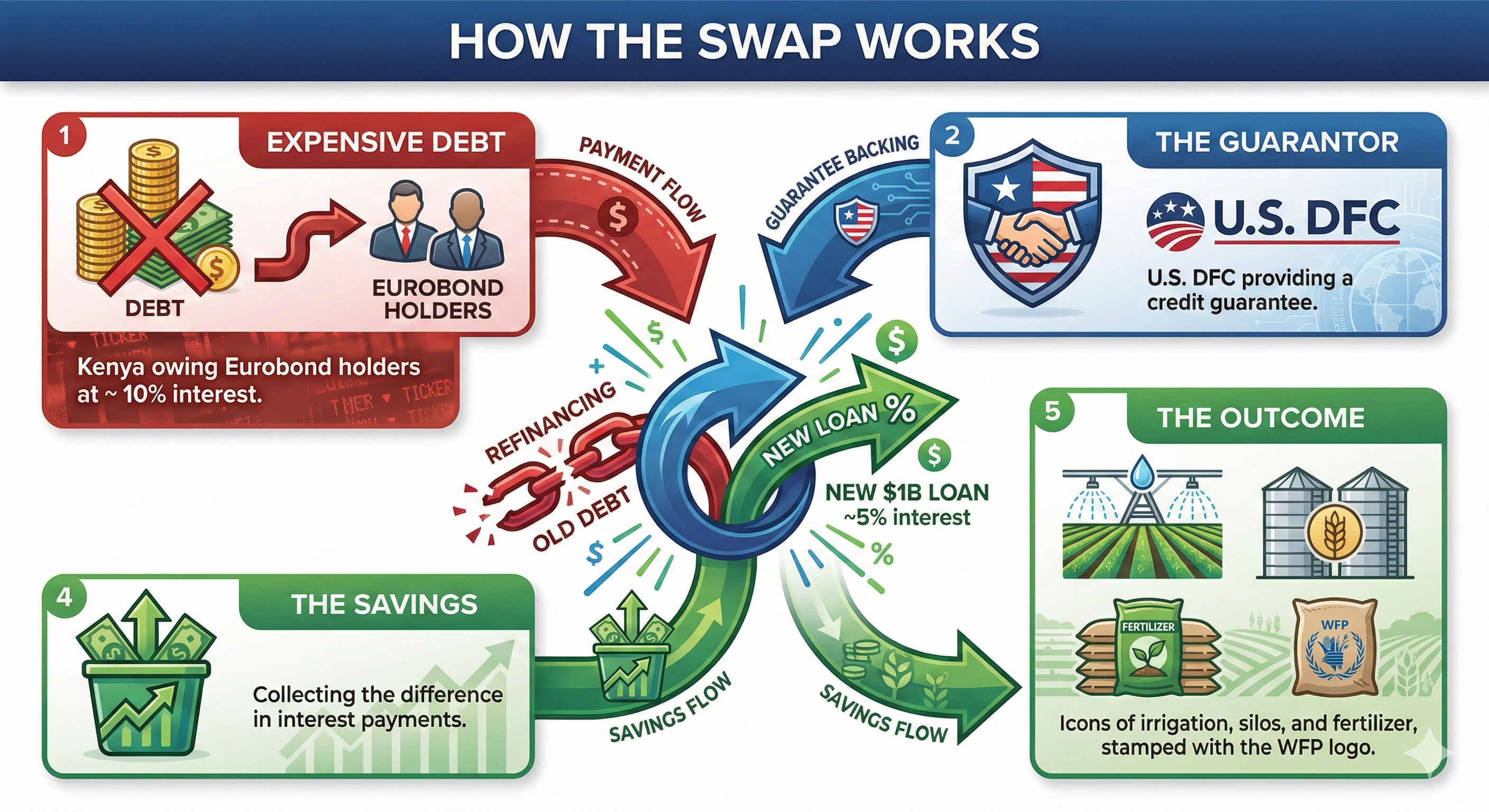
Kenya is on the verge of finalizing a landmark $1 billion (Sh129 billion) debt-for-food security swap, a sophisticated financial maneuver designed to rescue the country from a suffocating liquidity crunch. By leveraging a guarantee from the U.S. International Development Finance Corporation (DFC), the Treasury intends to refinance expensive Eurobond debt with cheaper, concessional loans. The plan is financially astute: it swaps high-interest commercial debt for lower-interest obligations, a move that prompted Moody’s to upgrade Kenya’s credit rating to B3 and stabilize the outlook on the nation’s sovereign debt.

However, the deal comes with a catch that transforms it from a simple refinancing operation into a complex development experiment. The interest “savings” generated from this swap must be ring-fenced and funneled directly into food security projects, managed in partnership with the World Food Programme (WFP). This arrangement effectively outsources a portion of national planning to an international body, admitting that the state needs external discipline to ensure funds aren’t diverted. While this stabilizes the shilling and pleases bondholders, it raises a fundamental question: is this a genuine strategy to feed the nation, or simply financial engineering to avoid default?

The stakes could not be higher. With 3.4 million Kenyans facing acute food insecurity and public debt service consuming over two-thirds of tax revenue, the government is betting that this “financial oil” can mix with the “water” of local agriculture without separating. If successful, it provides fiscal breathing room and lowers input costs for farmers; if it fails, Kenya will be left with the same debt burden and no improvement in the cost of living for the average wananchi.

References:

Business Insider Africa Kenya plans to borrow $1 billion using debt for food swap

CNBC Africa Kenya, US agency to proceed with $1 billion debt-for-food swap

Building Fiscal Buffers: Strategies for Economic Stability

The outcomes of economic reform efforts depend heavily on the ability to manage fiscal risks effectively. One potential path to success is the stabilization of national debt through renegotiation and prudent fiscal management. Drawing from global best practices, a key strategy is to build fiscal buffers—reserves that can cushion the economy against future shocks. By setting aside funds during periods of economic stability, nations can better manage external crises without resorting to unsustainable borrowing. Additionally, diversifying revenue streams and improving tax collection efficiency can reduce reliance on debt while boosting domestic resources.

2 Minute Economics Report

To mitigate risks from the financial sector, stronger regulatory oversight is essential. Insights from international fiscal strategies suggest that adopting a risk-based approach to financial supervision—focusing on systemically important institutions—can help manage vulnerabilities. Ensuring that banks and financial institutions maintain robust capital reserves can safeguard the economy from financial instability that might arise from exposure to public debt. This approach emphasizes prevention and resilience, reducing the likelihood of fiscal shocks originating from the financial sector.

In terms of international partnerships, promoting public-private partnerships (PPPs) offers a pathway to attracting foreign investment while maintaining control over national assets. Transparent PPP frameworks that involve local stakeholders can increase the legitimacy of large infrastructure projects and ensure that benefits are widely shared. Structured renegotiation clauses in international deals allow nations to retain strategic control over critical infrastructure, minimizing risks of foreign overreach. A clear communication strategy that explains the long-term benefits of such projects can also help manage public expectations and build political consensus. For emerging economies, these strategies provide a balanced approach to navigating fiscal and economic challenges in a globalized world.

References:

Nairobi Leo How Cancelling Adani Deal Unprocedurally Will Hurt Kenya – CS John Mbadi

The Star JKIA-Adani project is in negotiation phase, says CS Mbadi

The Kenyan Wall Street CS Mbadi Seeks Public Views on Kenya’s Economic Situation

Political Pressures and Fiscal Policies in Kenya

Despite Mbadi’s progressive ideas, the broader challenges he faces are immense, multi-layered and deeply rooted in fiscal imbalances. Kenya’s public debt has reached unsustainable levels, consuming a large percentage of national GDP. Debt restructuring efforts are often constrained by the need to continue funding development projects, putting nations like Kenya in a difficult position as they attempt to service debts while fostering growth. This creates a constrained fiscal space, limiting the capacity to implement reforms without triggering further economic downturns. Balancing debt management with development needs is a central issue for many emerging economies.

Citizen Digital Report

Political pressures also compound economic challenges. In countries where parliamentary or legislative scrutiny of fiscal policies is intense, any missteps or delays in implementing reforms can lead to significant political fallout. For example, debates over tax reforms and budgetary decisions often spark fierce opposition, with questions being raised about fairness, transparency, and long-term impact. This political friction is further complicated by the need to maintain public trust amid rising inflation and the high cost of living. Public sentiment around austerity measures or new tax regimes can easily turn negative, making it harder to implement necessary but unpopular policies.

International partnerships and foreign investments present additional complexities, especially when critical national assets are involved. Ongoing negotiations with foreign companies over infrastructure projects—like the management of airports or other strategic assets—can become flashpoints of political and public concern. Transparency and clear communication around such deals are essential to mitigate backlash. The challenge for governments lies in securing the economic benefits of foreign investment while protecting national interests and maintaining public support. Ensuring that these partnerships are structured in a way that benefits the domestic economy without compromising national control is key.

References:

The Standard Adani deal: Treasury CS Mbadi to appear before Senate

The Kenyan Wall Street CS Mbadi Seeks Public Views on Kenya’s Economic Situation

The Star I’m shocked! Sifuna censures CS Mbadi for failing to appear in Senate