Beyond the Guarded Gates: My Stealth Trek to the Edge of Menengai Crater
Standing at an altitude of 2,278 meters above sea level, the Menengai Crater remains one of Nakuru’s most formidable natural landmarks, but for this “Jijuze Eco-Tour,” the approach was anything but standard. Choosing a “guerrilla-style” entry to bypass the guarded main gates, I disembarked 2 kilometers early, navigating a bush-trek through the local scrubland. This off-road detour offered a raw, unshielded perspective of the terrain before merging back onto the main road, where the typical buzz of school buses and eco-tourists from across Kenya signaled our arrival at the primary viewpoint.
Menengai Crater – Jijuze Eco-Tour | Full video
The sheer scale of the caldera is a geographic marvel, boasting a staggering vertical drop of 485 meters into the floor below. It is a classroom without walls, where the silence of the heights is frequently punctuated by the excitement of visiting students witnessing the raw power of the Rift Valley. However, the beauty of the rim carries a physical warning: the ground is a treacherous mix of loose volcanic gravel and uneven soil. During the tour, a near-slip served as a visceral reminder that at these heights, the line between a breathtaking view and a dangerous situation is as thin as the mountain air.
As the tour concluded, the journey ended exactly as it began—retracing the “bypass” route through the bushes to return to the vehicle. This trek was less about the manicured tourism of the main entrance and more about the investigative spirit that defines the Jijuze platform. From the dizzying depths of the 485-meter abyss to the stealthy 2-kilometer bushwalk, this expedition highlighted that the Menengai Crater is not just a destination to be seen, but a landscape to be navigated with caution, curiosity, and a touch of defiance.
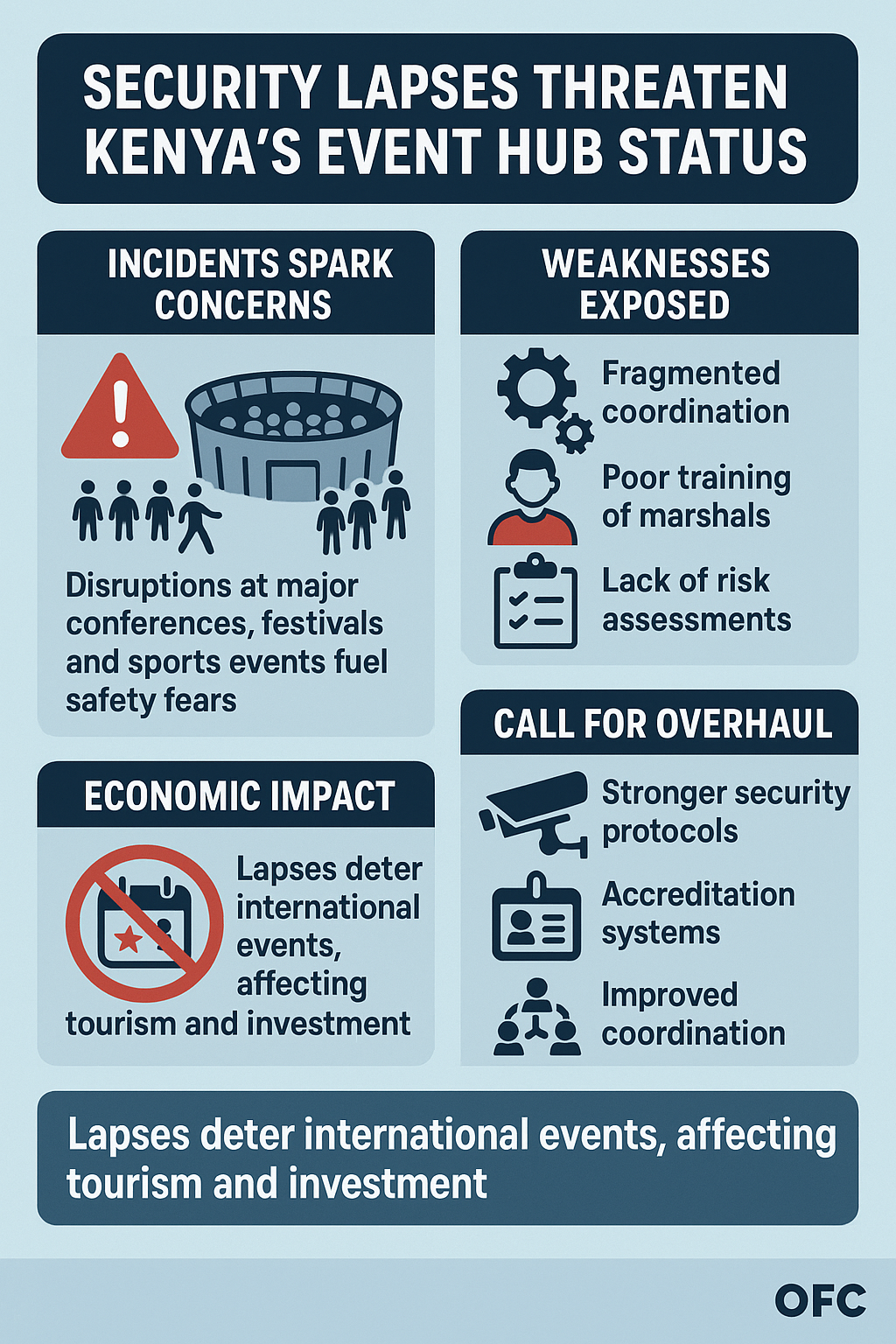
Kenya’s growing profile as a hub for international conferences, cultural festivals, and major sporting events hangs in the balance, threatened by a persistent and damaging weakness—event security lapses. The recent spate of high-profile disruptions, from chaotic crowd control failures to delayed emergency responses, has reignited fears that the country’s infrastructure and management systems are not keeping pace with its ambitions. While Kenya has successfully hosted large-scale gatherings in the past, these successes are increasingly overshadowed by incidents that put both safety and the nation’s reputation at risk. For a tourism and investment-driven economy, where marquee events serve as global shop windows, the stakes could not be higher. Any perception that Kenya cannot guarantee the safety of participants and spectators risks deterring international organizers, sponsors, and attendees, redirecting both revenue and influence to competing destinations.
At the core of the problem lies a combination of fragmented coordination among security agencies, inadequate training for event marshals, and a lack of robust, preemptive risk assessments. Large-scale events—from global athletics meets to high-profile music festivals—often depend on ad hoc arrangements, with security strategies being reactive rather than proactive. This has led to avoidable breaches, where unruly crowd surges, unauthorized access, and even petty crime have disrupted otherwise well-planned programs. For international guests, especially those attending for the first time, such lapses create a lasting negative impression, overshadowing the event’s core purpose and undermining Kenya’s pitch as a safe, reliable host. Stakeholders in the hospitality, transport, and retail sectors warn that the ripple effects of diminished confidence could translate into real economic losses, especially in cities like Nairobi and Mombasa where event-linked tourism forms a major income stream.
The solution requires more than isolated fixes—it demands a systemic overhaul anchored in professionalism, technology, and accountability. Kenya must invest in event-specific security protocols that integrate crowd science, digital surveillance, and emergency response drills into every planning phase. Clear chains of command, mandatory accreditation systems, and cross-agency coordination hubs should be standard practice, not aspirational goals. Without this, the “Africa’s Meeting Place” narrative risks collapsing under the weight of recurring security failures. The opportunity cost is immense: from losing bids to host continental championships, to deterring corporate conventions, to stalling the growth of cultural tourism. Kenya’s position as an event destination of choice is not guaranteed; it must be earned and safeguarded through consistent, visible competence. If the country cannot put its house in order, it may soon find the world taking its events—and its investment—elsewhere.
References:
Jijuze How CHAN 2024 is Boosting Tourism and Infrastructure in East Africa
The Kenyan Wall Street Legacy or Liability? Putting Kenya’s CHAN 2024 Moment Under the Lens
GhanaWeb Crowd disorder at CHAN raises concerns in Kenya
Pulse Sports Protect the Game: How CHAN 2024 Fans Can Keep Big Tournaments Coming to Kenya
FlashScore 2024 CHAN: Kenya fined by CAF again over multiple safety and security breaches
The Standard CHAN 2024: Why Kenya could lose quarterfinal hosting rights
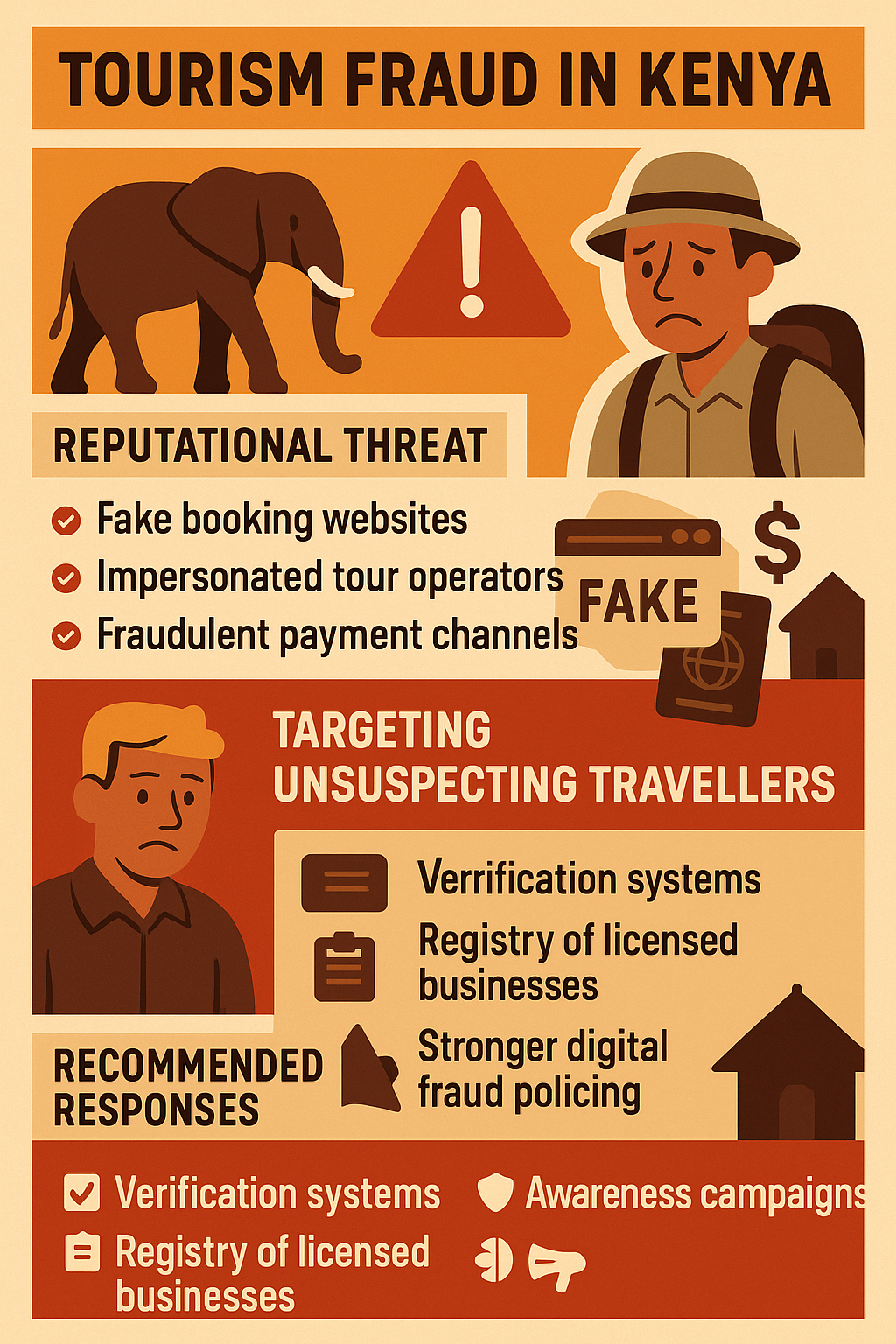
Kenya’s tourism industry, a vital pillar of the economy and a top foreign exchange earner, is now battling a growing reputational threat: sophisticated fraud targeting unsuspecting travelers. According to the latest sector review, a surge in fake booking websites, impersonated tour operators, and fraudulent payment channels is eroding visitor trust and undermining the gains made in post-pandemic recovery. Many of these scams operate with alarming polish—using stolen branding, cloned websites, and even counterfeit licenses to lure victims into paying for non-existent safaris, hotel stays, or cultural tours. Victims, often diaspora Kenyans and international tourists planning high-value itineraries, only discover the deceit upon arrival, when their bookings prove fake and their funds unrecoverable. The Kenya Tourism Board (KTB) and sector associations have flagged these schemes as a systemic risk that, if unchecked, could tarnish Kenya’s image as a safe, reliable destination.
Industry stakeholders stress that the challenge is compounded by gaps in regulatory oversight, slow cross-border law enforcement cooperation, and limited consumer awareness in key source markets. Fraudsters exploit these vulnerabilities, targeting peak travel seasons and leveraging digital marketing channels to reach large audiences with minimal traceability. Tour operators report that such scams not only cause financial loss but also drive potential travelers toward competing destinations perceived as safer or better regulated. Its important to note that while Kenya’s tourism marketing campaigns have successfully reignited global interest, this momentum risks being reversed if fraud-related horror stories dominate travel forums and social media. Experts recommend a multi-pronged response: real-time verification systems for operators, a central registry of licensed tourism businesses accessible to the public, stronger digital fraud policing, and targeted awareness campaigns in both domestic and foreign markets.
To its credit, the government has begun aligning with these recommendations, with the Ministry of Tourism working alongside the Communications Authority, cybercrime units, and private-sector stakeholders to roll out verification platforms and consumer education drives. Pilots for an online “Tourism Trust Mark” are already underway, enabling travelers to authenticate operators before making payments. Additionally, diplomatic missions are being engaged to circulate fraud alerts in high-risk markets, while tourism associations are exploring partnerships with payment processors to flag suspicious transactions. These initiatives, if scaled and sustained, could restore confidence and reinforce Kenya’s brand as a secure, trustworthy destination. In an increasingly competitive global tourism landscape, safeguarding the integrity of the travel experience is no longer optional—it’s a prerequisite for growth. Kenya’s long-term competitiveness will hinge not just on the beauty of its landscapes, but on the trustworthiness of the path visitors take to reach them.
References:
Kenyans.co.ke DCI Arrest Suspect After Greek Tourist Loses Ksh3.6 Million in Maasai Mara Scam
Kenya’s ambitious shift to a universal Electronic Travel Authorization (eTA) system on January 1, 2024, was meant to be a game-changer for tourism, projecting an image of digital efficiency and openness. The vision—replacing traditional visas with an online pre-authorization—was sold as “visa-free” travel for the world, echoing President William Ruto’s promise of easier entry and smoother travel. Yet, what travelers encountered was a reality at odds with the marketing: mandatory paid applications, detailed documentation requirements, and unpredictable processing times. For visitors from over 40 countries that once enjoyed genuine visa-free access, the change felt less like liberation and more like an unexpected hurdle. Industry insiders describe the rollout as a “bait and switch” that has not only dented Kenya’s reputation but also triggered fears of retaliatory entry restrictions abroad. This mismatch between promise and practice was compounded in March 2025 when the government quietly replaced a stable Swiss-developed system with a locally built platform plagued by downtimes, payment failures, and technical glitches—sparking a multi-million dollar lawsuit and months of operational chaos.
A Report by iVisa
The fallout has been costly. Tour operators, hotels, and airlines have all reported significant losses as delays, application failures, and the absence of a functional support framework have disrupted itineraries and led to cancellations. Airlines face fines of KES 1 million per passenger without valid eTA documentation, a policy that has left many travelers stranded at departure gates. While Kenya recorded a record-breaking Sh 452 billion in tourism revenue in 2024—driven largely by post-pandemic recovery and aggressive marketing—the eTA crisis has cast a long shadow. The country’s visa openness ranking plunged from 29th to 46th in Africa, eroding hard-earned goodwill and weakening its competitive edge against rivals like Ghana and Rwanda, which have fully opened their borders. Industry leaders, including the Kenya Association of Travel Agents (KATA) and the Kenya Tourism Federation (KTF), warn that unless systemic fixes are made, Kenya’s target of five million annual visitors by 2027 could be jeopardized. Their calls range from establishing an emergency “crisis desk” for stranded travelers to temporarily reinstating visas on arrival while the digital system is repaired.
In response to mounting pressure, the government has introduced notable policy reversals, exempting most African and Caribbean nationals from eTA requirements and promising faster approvals for others. At the same time, industry stakeholders and the Tourism Ministry are working to embed risk management into the process—introducing contingency measures such as backup server capacity, offline verification protocols at airports, and dedicated “rapid response” teams to assist travelers facing last-minute clearance issues. While KATA’s August 2025 meeting with Tourism CS Rebecca Miano confirmed that some operational bottlenecks remain for non-exempt travelers, these interventions are designed to ensure that no visitor’s trip is derailed by system errors or delays. The emphasis now is on creating a safety net that preserves the integrity of Kenya’s digital entry framework while protecting the traveler’s experience. In an era where seamless digital access is part of a destination’s brand, these safeguards—paired with transparent communication—are key to restoring confidence and reinforcing Kenya’s identity as a warm, accessible, and world-class destination.
Watamu is no longer just a coastal getaway—it’s a case study in what community-powered, climate-smart tourism can look like for Africa. As Kenya’s tourism sector projects a historic KSh1.2 trillion contribution in 2025, Watamu stands out not only for its natural beauty, but for how it’s transforming development from the ground up. Local associations, women’s groups, and marine conservationists are leading the charge—turning beach cleanups, turtle protection, and plastic recycling into viable economic engines. This is not your typical resort town: here, environmental sustainability and economic inclusion go hand in hand. And for Kenyans living abroad, it offers a deeply meaningful opportunity to participate in rebuilding an economy that reflects both cultural pride and ecological urgency.
A Report by Taylor & Jordan Travel
Watamu is tapping into the global shift toward regenerative tourism—experiences that give back, not just take. Whether it’s community-run mangrove boardwalks, youth-led heritage tours, or conservation-linked seafood ventures, the town offers immersive, ethical travel that aligns with the values of many in the diaspora. Tourists are not just spectators here—they are contributors to a system that protects biodiversity and empowers local livelihoods. As the region attracts new interest for sustainable investments, Kenya’s diaspora is uniquely positioned to shape its trajectory: by supporting homegrown enterprises, backing eco-innovation, or simply choosing to travel with intention.
This is the moment for the diaspora to come home differently. Not just to visit—but to invest, collaborate, and amplify what Watamu is building. It’s a model that doesn’t just respond to climate change—it adapts and thrives through it. With marine spatial planning underway and local governance strengthening, the blueprint is clear: Kenya’s coastal future can be green, inclusive, and profitable. But it needs champions—especially those abroad who understand that tourism isn’t just about where you go, but what you leave behind. Watamu is not asking for charity—it’s offering a partnership in purpose.
References:
Hospitality Net Kenya’s Travel & Tourism Sector Set to Inject a Record KSh1.2TN in 2025
UNEP In beach town’s battle against plastic, echoes of a global crisis
KBC Tour Operators anticipate increased in arrivals
Oceanic Society How the Circular Economy Protects Nature and Tourism Business in Coastal Kenya
As the African Nations Championship (CHAN) 2024 shifts its focus to East Africa, the co-hosting of the tournament by Kenya, Tanzania, and Uganda represents a significant shift in leveraging sports for economic transformation. For Kenya, this is a vital opportunity to recover its sporting integrity after a disappointing bid in 2018, underscored by considerable investments in stadium infrastructure, notably in Nairobi’s Nyayo Stadium and Eldoret’s Kipchoge Keino facility. These venues serve not just as football fields but as epicenters for urban redevelopment, spurring enhancements in transportation, hospitality, and small business interactions. The rising bookings in Nairobi’s hospitality sector indicate that CHAN is influencing broader economic dynamics, while also acting as a political lever to expedite long-delayed public works, showcasing the power of football in aligning with national development agendas.
Tanzania’s strategy for CHAN 2024 is meticulously crafted around intentional, brand-driven national development, where the Benjamin Mkapa Stadium in Dar es Salaam is being promoted as a pivotal regional hub for intertwining sports, tourism, and diplomacy. The government is tying the tournament to a larger tourism revival initiative, highlighting not only Dar es Salaam but also related destinations such as Arusha, Zanzibar, and Kilimanjaro to attract visitors. With a projected TSh 85 billion anticipated to flow into the economy as a direct result of the events, Tanzania seeks to boost its visibility as a potential future AFCON bidder. This emphasis on long-term tourism sustainability and attractive international offerings is designed to craft a narrative of lasting impact that transcends the tournament.
As Uganda joins its neighbors in this collaborative effort, it is focusing on a community-centered approach despite logistical challenges concerning stadium upgrades. The government is investing in public-private partnerships that engage local artisans, vendors, and cultural showcases to ensure wider community involvement in the festivities. Investments in essential infrastructure, including public transport and sanitation, aim to position CHAN as a catalyst for enduring urban renewal. By pairing match experiences with unique local attractions like gorilla trekking and cultural tours, the Ugandan Tourism Board is working to transition CHAN visitors into long-term tourists. Overall, while the three nations unite to present East Africa as a cohesive travel destination, the urgent challenge lies in translating the tournament’s temporary excitement into lasting benefits for the region, effectively establishing their collective identity as a forward-thinking economic bloc.
References:
Citizen Digital Why CHAN 2024 is not just a tournament, but a catalyst for East Africa integration
The Standard CHAN 2024, Kenya’s opportunity to boost economy, tourism
Nile Post Uganda Co-Hosting CHAN 2024 is a Landmark Achievement in the Country’s Sports
EAC EAC to promote the region as a unified tourism destination at ITB Berlin 2025
IPP Media Zanzibar hotels overflow with tourists ahead of CHAN match
Lake Nakuru, once Kenya’s unrivaled icon of flamingo tourism and a UNESCO World Heritage Site, is undergoing an environmental transformation that is quietly redefining its future. The dramatic shift from a shallow, alkaline soda lake to a swelling freshwater body—driven by climate change, deforestation, urban runoff, and persistent pollution—has reshaped not just the lake’s ecology, but also its economic and cultural purpose. Once celebrated as the “Lake of a Million Flamingos,” the site now faces a tourism identity crisis as its signature attraction—the vibrant flocks of Lesser Flamingos—has largely vanished due to the disappearance of Spirulina platensis, the algae they feed on. This ecological transition is not a fleeting anomaly; it signals a long-term reset, potentially stripping Kenya of one of its most iconic natural tourism assets.
The implications for Kenya’s tourism economy are profound. Flamingo migration has dealt a blow to the local hospitality industry, with ripple effects felt from Nakuru to Elementaita and Naivasha. The park’s submerged infrastructure—gates, roads, and buildings—has necessitated a KSh 38 million investment in repairs and relocation, eating into Kenya Wildlife Service’s already stretched budget. Yet amid this disruption, opportunity glimmers. Kenya has a chance to reframe Lake Nakuru not as a site of lost heritage, but as a blueprint for adaptive, resilient tourism in the age of climate change. KWS has already introduced new water-compatible experiences, including adjusted game-viewing routes and potential boating attractions. With careful investment, storytelling, and conservation marketing, this shift can usher in a new kind of eco-tourism centered on freshwater biodiversity, migratory birds, and climate adaptation success stories.
But realizing this vision demands urgency, strategy, and inclusivity. Conservation and tourism authorities must actively engage displaced communities, whose turn to illegal fishing underscores a deeper social fragility tied to the lake’s changes. Tourism policy must evolve to support heritage resilience—protecting UNESCO designation through scientific reinterpretation of the site’s ecological value, not just nostalgia for what it once was. Lake Nakuru stands at the frontline of global climate impact on natural heritage. If Kenya can lead the world in repurposing this park’s brand while safeguarding its ecosystems and communities, it won’t just save a destination—it will create a model for climate-smart tourism across Africa and beyond.
References:
Scientific Research Assessment of Spatial Expansion of Rift Valley Lakes Using Satellite Data
The Standard State of three Rift Valley Lakes worry experts
Talk Africa Lake Nakuru’s Water levels Expected to Cause More Havoc During The Rainy Season, Experts Say
Jijuze Is Lake Nakuru’s Ecosystem at Risk Due to Pollution and Illegal Fishing?
Kenya Airways, long dubbed the “Pride of Africa,” has finally soared back into profitability in 2024 after an arduous eleven-year drought, reporting a net profit of Sh5.4 billion. This remarkable financial resurgence, a stark contrast to the Sh22.6 billion loss in the previous year, begs the question: what confluence of events truly orchestrated this dramatic turnaround? Was it solely the much-touted “Project Kifaru,” the airline’s recovery strategy emphasizing operational performance and customer service, or did external tailwinds, such as favorable foreign exchange gains amounting to a staggering Sh10.5 billion, play an equally significant role? While passenger numbers and cargo volumes saw encouraging increases, contributing to a rise in revenue, the sustainability of this newfound profitability in the face of ongoing global aviation challenges, including shortages of aircraft and spare parts, remains a key point of inquiry. Could this profit be a fleeting moment of relief, or does it genuinely signal a long-term stabilization for the national carrier?
A Report by Kenya Airways
Delving deeper, a complex web of strategic maneuvers and external market forces that appear to have influenced Kenya Airways’ financial trajectory are evident. The airline’s aggressive cost-cutting measures, including the innovative transformation of Msafiri House into a centralized operations hub and the implementation of a fuel hedging strategy, undoubtedly contributed to the improved bottom line. However, the crucial role of government intervention was significant, with substantial debt restructuring efforts providing much-needed financial alleviation. This raises further questions about the extent to which Kenya Airways’ profitability is dependent on continued state support and whether the airline can truly achieve long-term financial independence. Moreover, with plans for fleet modernization and route expansion underway, how will these ambitious initiatives be financed, and will they ultimately translate into sustained profitability in an intensely competitive African aviation market?
Looking ahead, the future of Kenya Airways remains a subject of both optimism and uncertainty. While the return to profitability has undoubtedly boosted investor confidence, as evidenced by the doubling of the airline’s share price, experts caution that significant challenges persist. The airline’s historical financial instability and the lingering substantial debt burden continue to cast a shadow, prompting questions about the feasibility of attracting a strategic investor by 2025, a key objective for long-term sustainability. Furthermore, the financial woes of its subsidiary, Precision Air, add another layer of complexity, raising concerns about potential risks to Kenya Airways’ investment. As the airline navigates the dynamic landscape of the global and African aviation industries, marked by fluctuating fuel prices and geopolitical tensions, the fundamental question remains: can Kenya Airways truly break free from its legacy of losses and establish a consistently profitable and sustainable future?
References:
The Star KQ’s turnaround: National Carrier posts Sh5.4 billion profit after a decade of losses
The impending transformation of the Rironi – Mau Summit road is generating considerable excitement across Kenya and the East African region, promising a significant leap forward in connectivity and economic prosperity. This ambitious infrastructure project, upgrading the existing congested two-lane highway into a modern four-lane dual carriageway spanning approximately 175 kilometers, is not just about easing traffic; it’s a strategic move to solidify Kenya’s position as a pivotal trade and transport hub . As a crucial segment of the Northern Corridor, this road links the bustling port of Mombasa to landlocked neighbors like Uganda, Rwanda, Burundi, South Sudan, and the Democratic Republic of Congo, making its upgrade a matter of regional economic significance . For the millions who rely on this route, the promise of drastically reduced travel times, potentially halving the journey between major centers like Nakuru and Nairobi, offers not just convenience but also increased productivity and access to opportunities . This development follows a somewhat turbulent path, with an initial agreement with a French consortium being cancelled before the project was recently awarded to a Chinese firm, signaling a shifting landscape in Kenya’s infrastructure partnerships . The groundbreaking, slated for June 2025 with a targeted completion by June 2027, marks a renewed commitment to tackling the persistent congestion that has long plagued this vital artery.
A Report by Citizen Digital
The ripple effects of this enhanced connectivity are expected to extend far beyond smoother commutes, significantly boosting Kenya’s tourism and manufacturing sectors. Western Kenya boasts an array of natural wonders, from the flamingo-filled Lake Nakuru National Park to the vast plains of the Maasai Mara, attractions that will become more accessible with reduced travel times . This improved access is anticipated to draw more domestic and international tourists, injecting vital revenue into local economies and creating employment opportunities in the hospitality and service industries . Simultaneously, the manufacturing sector stands to gain immensely from a more efficient transportation network . The seamless movement of raw materials and finished goods is crucial for industrial growth, and the upgraded Rironi – Mau Summit road promises to streamline supply chains, lower logistics costs, and enhance the competitiveness of Kenyan-made products . This project aligns with the government’s broader vision for infrastructure-led economic growth, recognizing that efficient transport links are fundamental to unlocking the full potential of various sectors and fostering both national and regional trade . The anticipated creation of approximately 1,500 jobs during the construction phase and another 200 during operation further underscores the project’s potential to empower local communities.
Beyond the immediate economic benefits, the Rironi – Mau Summit road upgrade is poised to deliver significant social advantages, improving the quality of life for countless Kenyans. Enhanced connectivity translates to better access to essential services such as healthcare and education, particularly for those living in the regions along the corridor . For instance, the Rongai Level 4 Hospital in Nakuru County is expected to provide more timely care to accident victims due to its proximity to the upgraded highway . Moreover, improved road infrastructure in rural areas has been shown to positively impact household well-being and facilitate access to markets for farmers and small businesses, potentially increasing incomes and reducing social isolation . While the project has undergone environmental and social impact assessments, ensuring mitigation measures are in place will be crucial to address potential negative impacts such as land acquisition and disruption to local livelihoods . Overall, the Rironi – Mau Summit road project represents a transformative undertaking with the potential to catalyze economic growth, enhance regional integration, and deliver tangible improvements to the lives of Kenyans by providing safer, faster, and more reliable transportation .
References:
Nation Construction of Rironi-Mau summit four lane road begins in June
Nation Ruto: Dualling of Nairobi-Nakuru highway to start next year
Nation Murkomen: We will build Rironi-Mau Summit highway without toll fees, debt
The Eastleigh Voice Rironi-Mau Summit road upgrade to begin in June, completion set for 2027
Kenyans.co.ke KeNHA to Expand Nairobi-Nakuru-Mau Summit Highway to Four Lanes, Completion Set for 2027
KBC Rironi-Mau Summit Road expansion to begin in June after Cabinet nod
Kenya is gearing up to welcome the world for the 2025 World Rally Championship (WRC) Safari Rally, taking place in Naivasha from 20th to 23rd of March 2025. This isn’t just another race; it’s a celebration of Kenya’s motorsport heritage, a testament to the country’s resilience, and a golden opportunity to showcase its stunning natural beauty to a global audience. Imagine the thrill of high-speed rally cars navigating the challenging terrain, the vibrant colors of Kenyan culture, and the warm hospitality of the people. As the engines roar and the dust settles, Kenya anticipates a significant economic boost, with the rally projected to inject a staggering Sh7 billion into the local economy. This influx of revenue will create jobs, support local businesses, and attract tourists from all corners of the world, further solidifying Kenya’s position as a premier tourist destination.
A review of the Best Action from the 2024 Edition WRC Safari Rally by DirtFish
The Safari Rally holds a special place in Kenya’s history, dating back to 1953 when it was first run as the East African Coronation Safari. This legendary rally, known for its demanding terrain and unpredictable weather, has tested the mettle of some of the greatest rally drivers in history, including the likes of Shekhar Mehta and Tommi Mäkinen. This year, organizers have introduced two new stages to the rally, a 5km shakedown at Camp Moran and an 8km race at Morendat Farm, promising an adrenaline-pumping spectacle for both seasoned rally enthusiasts and newcomers alike. President William Ruto will flag off the rally at City Hall Way in Nairobi, a change from the traditional flag-off location, bringing the excitement closer to the heart of the city and making it more accessible to fans.
But the 2025 WRC Safari Rally is more than just a thrilling race; it’s a testament to Kenya’s commitment to sustainable development and community engagement. Organizers are implementing measures to minimize the environmental impact of the rally, ensuring that the pristine landscapes that make Kenya so unique are protected for generations to come. Furthermore, the rally is creating numerous opportunities for local communities, with job creation in various sectors such as marshalling, hospitality, and logistics. Local businesses are also set to benefit from the influx of tourists and rally enthusiasts, contributing to the overall economic growth of the region. With its blend of high-octane action, rich history, and community involvement, the 2025 WRC Safari Rally is poised to be a resounding success, leaving a lasting legacy for Kenya and its people. As the Swahili saying goes, “Harakaharaka haina baraka,” meaning “Hurry hurry has no blessings.” This embodies the spirit of the rally, reminding us that true success comes with patience, perseverance, and a deep appreciation for the journey.


 Jijuze