Kenya’s Event Security Challenges: A Wake-Up Call

Kenya’s growing profile as a hub for international conferences, cultural festivals, and major sporting events hangs in the balance, threatened by a persistent and damaging weakness—event security lapses. The recent spate of high-profile disruptions, from chaotic crowd control failures to delayed emergency responses, has reignited fears that the country’s infrastructure and management systems are not keeping pace with its ambitions. While Kenya has successfully hosted large-scale gatherings in the past, these successes are increasingly overshadowed by incidents that put both safety and the nation’s reputation at risk. For a tourism and investment-driven economy, where marquee events serve as global shop windows, the stakes could not be higher. Any perception that Kenya cannot guarantee the safety of participants and spectators risks deterring international organizers, sponsors, and attendees, redirecting both revenue and influence to competing destinations.
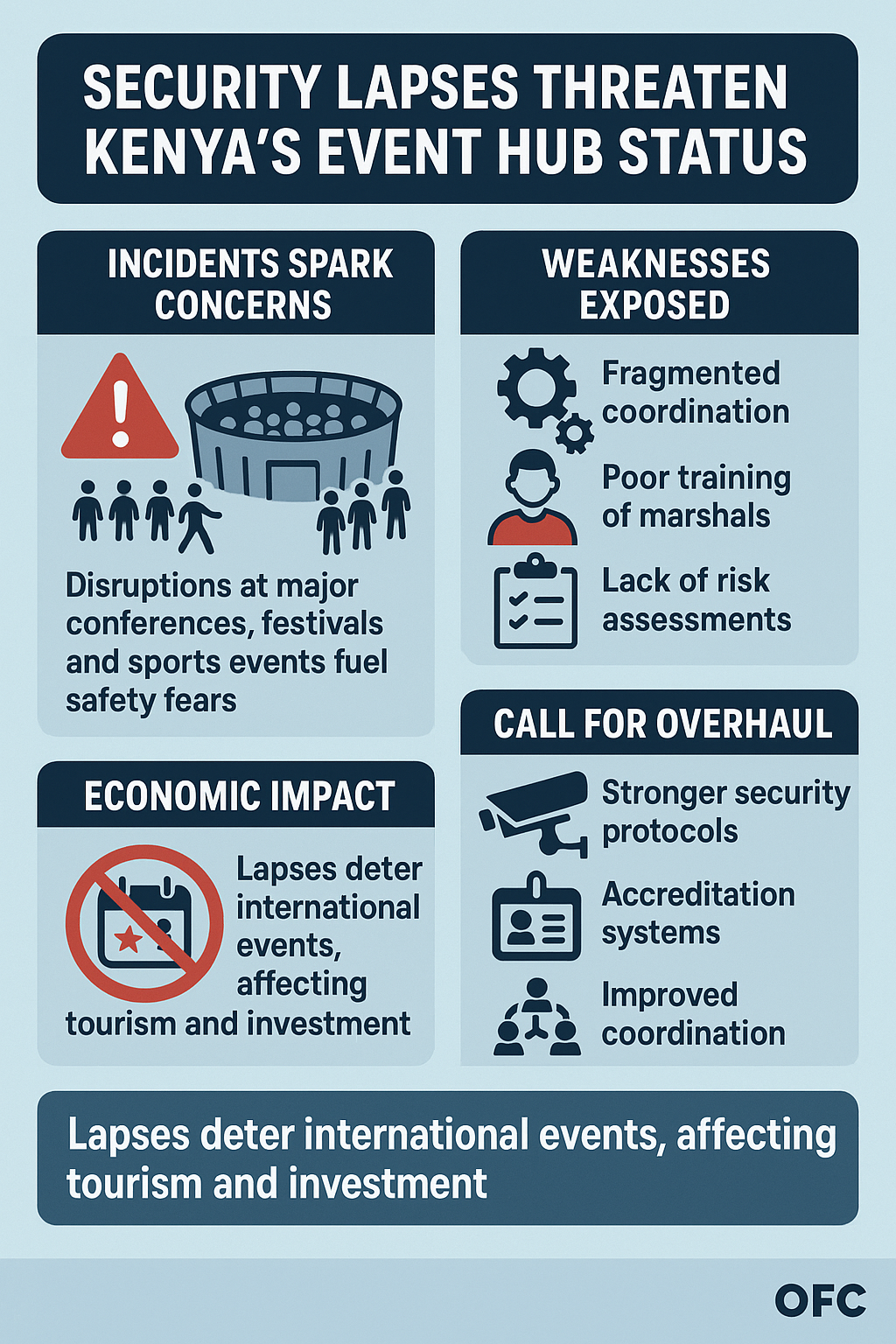
At the core of the problem lies a combination of fragmented coordination among security agencies, inadequate training for event marshals, and a lack of robust, preemptive risk assessments. Large-scale events—from global athletics meets to high-profile music festivals—often depend on ad hoc arrangements, with security strategies being reactive rather than proactive. This has led to avoidable breaches, where unruly crowd surges, unauthorized access, and even petty crime have disrupted otherwise well-planned programs. For international guests, especially those attending for the first time, such lapses create a lasting negative impression, overshadowing the event’s core purpose and undermining Kenya’s pitch as a safe, reliable host. Stakeholders in the hospitality, transport, and retail sectors warn that the ripple effects of diminished confidence could translate into real economic losses, especially in cities like Nairobi and Mombasa where event-linked tourism forms a major income stream.

The solution requires more than isolated fixes—it demands a systemic overhaul anchored in professionalism, technology, and accountability. Kenya must invest in event-specific security protocols that integrate crowd science, digital surveillance, and emergency response drills into every planning phase. Clear chains of command, mandatory accreditation systems, and cross-agency coordination hubs should be standard practice, not aspirational goals. Without this, the “Africa’s Meeting Place” narrative risks collapsing under the weight of recurring security failures. The opportunity cost is immense: from losing bids to host continental championships, to deterring corporate conventions, to stalling the growth of cultural tourism. Kenya’s position as an event destination of choice is not guaranteed; it must be earned and safeguarded through consistent, visible competence. If the country cannot put its house in order, it may soon find the world taking its events—and its investment—elsewhere.

References:

Jijuze How CHAN 2024 is Boosting Tourism and Infrastructure in East Africa

The Kenyan Wall Street Legacy or Liability? Putting Kenya’s CHAN 2024 Moment Under the Lens

GhanaWeb Crowd disorder at CHAN raises concerns in Kenya

Pulse Sports Protect the Game: How CHAN 2024 Fans Can Keep Big Tournaments Coming to Kenya

FlashScore 2024 CHAN: Kenya fined by CAF again over multiple safety and security breaches

The Standard CHAN 2024: Why Kenya could lose quarterfinal hosting rights

Combatting Fraud in Kenya’s Tourism: A Growing Threat

Kenya’s tourism industry, a vital pillar of the economy and a top foreign exchange earner, is now battling a growing reputational threat: sophisticated fraud targeting unsuspecting travelers. According to the latest sector review, a surge in fake booking websites, impersonated tour operators, and fraudulent payment channels is eroding visitor trust and undermining the gains made in post-pandemic recovery. Many of these scams operate with alarming polish—using stolen branding, cloned websites, and even counterfeit licenses to lure victims into paying for non-existent safaris, hotel stays, or cultural tours. Victims, often diaspora Kenyans and international tourists planning high-value itineraries, only discover the deceit upon arrival, when their bookings prove fake and their funds unrecoverable. The Kenya Tourism Board (KTB) and sector associations have flagged these schemes as a systemic risk that, if unchecked, could tarnish Kenya’s image as a safe, reliable destination.

Industry stakeholders stress that the challenge is compounded by gaps in regulatory oversight, slow cross-border law enforcement cooperation, and limited consumer awareness in key source markets. Fraudsters exploit these vulnerabilities, targeting peak travel seasons and leveraging digital marketing channels to reach large audiences with minimal traceability. Tour operators report that such scams not only cause financial loss but also drive potential travelers toward competing destinations perceived as safer or better regulated. Its important to note that while Kenya’s tourism marketing campaigns have successfully reignited global interest, this momentum risks being reversed if fraud-related horror stories dominate travel forums and social media. Experts recommend a multi-pronged response: real-time verification systems for operators, a central registry of licensed tourism businesses accessible to the public, stronger digital fraud policing, and targeted awareness campaigns in both domestic and foreign markets.

To its credit, the government has begun aligning with these recommendations, with the Ministry of Tourism working alongside the Communications Authority, cybercrime units, and private-sector stakeholders to roll out verification platforms and consumer education drives. Pilots for an online “Tourism Trust Mark” are already underway, enabling travelers to authenticate operators before making payments. Additionally, diplomatic missions are being engaged to circulate fraud alerts in high-risk markets, while tourism associations are exploring partnerships with payment processors to flag suspicious transactions. These initiatives, if scaled and sustained, could restore confidence and reinforce Kenya’s brand as a secure, trustworthy destination. In an increasingly competitive global tourism landscape, safeguarding the integrity of the travel experience is no longer optional—it’s a prerequisite for growth. Kenya’s long-term competitiveness will hinge not just on the beauty of its landscapes, but on the trustworthiness of the path visitors take to reach them.

References:

Kenyans.co.ke DCI Arrest Suspect After Greek Tourist Loses Ksh3.6 Million in Maasai Mara Scam

Government of Canada Kenya travel advice

Action Fraud Kenya Romance Scam

Shian Safaris How to Avoid Being Conned on Your Travels in Kenya

Lake Nakuru’s New Waters: From Flamingo Spectacle to Tourism Uncertainty

Lake Nakuru, once Kenya’s unrivaled icon of flamingo tourism and a UNESCO World Heritage Site, is undergoing an environmental transformation that is quietly redefining its future. The dramatic shift from a shallow, alkaline soda lake to a swelling freshwater body—driven by climate change, deforestation, urban runoff, and persistent pollution—has reshaped not just the lake’s ecology, but also its economic and cultural purpose. Once celebrated as the “Lake of a Million Flamingos,” the site now faces a tourism identity crisis as its signature attraction—the vibrant flocks of Lesser Flamingos—has largely vanished due to the disappearance of Spirulina platensis, the algae they feed on. This ecological transition is not a fleeting anomaly; it signals a long-term reset, potentially stripping Kenya of one of its most iconic natural tourism assets.

The implications for Kenya’s tourism economy are profound. Flamingo migration has dealt a blow to the local hospitality industry, with ripple effects felt from Nakuru to Elementaita and Naivasha. The park’s submerged infrastructure—gates, roads, and buildings—has necessitated a KSh 38 million investment in repairs and relocation, eating into Kenya Wildlife Service’s already stretched budget. Yet amid this disruption, opportunity glimmers. Kenya has a chance to reframe Lake Nakuru not as a site of lost heritage, but as a blueprint for adaptive, resilient tourism in the age of climate change. KWS has already introduced new water-compatible experiences, including adjusted game-viewing routes and potential boating attractions. With careful investment, storytelling, and conservation marketing, this shift can usher in a new kind of eco-tourism centered on freshwater biodiversity, migratory birds, and climate adaptation success stories.

But realizing this vision demands urgency, strategy, and inclusivity. Conservation and tourism authorities must actively engage displaced communities, whose turn to illegal fishing underscores a deeper social fragility tied to the lake’s changes. Tourism policy must evolve to support heritage resilience—protecting UNESCO designation through scientific reinterpretation of the site’s ecological value, not just nostalgia for what it once was. Lake Nakuru stands at the frontline of global climate impact on natural heritage. If Kenya can lead the world in repurposing this park’s brand while safeguarding its ecosystems and communities, it won’t just save a destination—it will create a model for climate-smart tourism across Africa and beyond.

References:

Scientific Research Assessment of Spatial Expansion of Rift Valley Lakes Using Satellite Data

The Standard State of three Rift Valley Lakes worry experts

Talk Africa Lake Nakuru’s Water levels Expected to Cause More Havoc During The Rainy Season, Experts Say  

Jijuze Is Lake Nakuru’s Ecosystem at Risk Due to Pollution and Illegal Fishing?

Rironi-Mau Summit Road Upgrade: A Game Changer for Kenya’s Economy

The impending transformation of the Rironi – Mau Summit road is generating considerable excitement across Kenya and the East African region, promising a significant leap forward in connectivity and economic prosperity. This ambitious infrastructure project, upgrading the existing congested two-lane highway into a modern four-lane dual carriageway spanning approximately 175 kilometers, is not just about easing traffic; it’s a strategic move to solidify Kenya’s position as a pivotal trade and transport hub . As a crucial segment of the Northern Corridor, this road links the bustling port of Mombasa to landlocked neighbors like Uganda, Rwanda, Burundi, South Sudan, and the Democratic Republic of Congo, making its upgrade a matter of regional economic significance . For the millions who rely on this route, the promise of drastically reduced travel times, potentially halving the journey between major centers like Nakuru and Nairobi, offers not just convenience but also increased productivity and access to opportunities . This development follows a somewhat turbulent path, with an initial agreement with a French consortium being cancelled before the project was recently awarded to a Chinese firm, signaling a shifting landscape in Kenya’s infrastructure partnerships . The groundbreaking, slated for June 2025 with a targeted completion by June 2027, marks a renewed commitment to tackling the persistent congestion that has long plagued this vital artery.

A Report by Citizen Digital

The ripple effects of this enhanced connectivity are expected to extend far beyond smoother commutes, significantly boosting Kenya’s tourism and manufacturing sectors. Western Kenya boasts an array of natural wonders, from the flamingo-filled Lake Nakuru National Park to the vast plains of the Maasai Mara, attractions that will become more accessible with reduced travel times . This improved access is anticipated to draw more domestic and international tourists, injecting vital revenue into local economies and creating employment opportunities in the hospitality and service industries . Simultaneously, the manufacturing sector stands to gain immensely from a more efficient transportation network . The seamless movement of raw materials and finished goods is crucial for industrial growth, and the upgraded Rironi – Mau Summit road promises to streamline supply chains, lower logistics costs, and enhance the competitiveness of Kenyan-made products . This project aligns with the government’s broader vision for infrastructure-led economic growth, recognizing that efficient transport links are fundamental to unlocking the full potential of various sectors and fostering both national and regional trade . The anticipated creation of approximately 1,500 jobs during the construction phase and another 200 during operation further underscores the project’s potential to empower local communities.

Beyond the immediate economic benefits, the Rironi – Mau Summit road upgrade is poised to deliver significant social advantages, improving the quality of life for countless Kenyans. Enhanced connectivity translates to better access to essential services such as healthcare and education, particularly for those living in the regions along the corridor . For instance, the Rongai Level 4 Hospital in Nakuru County is expected to provide more timely care to accident victims due to its proximity to the upgraded highway . Moreover, improved road infrastructure in rural areas has been shown to positively impact household well-being and facilitate access to markets for farmers and small businesses, potentially increasing incomes and reducing social isolation . While the project has undergone environmental and social impact assessments, ensuring mitigation measures are in place will be crucial to address potential negative impacts such as land acquisition and disruption to local livelihoods . Overall, the Rironi – Mau Summit road project represents a transformative undertaking with the potential to catalyze economic growth, enhance regional integration, and deliver tangible improvements to the lives of Kenyans by providing safer, faster, and more reliable transportation .  

References:

Nation Construction of Rironi-Mau summit four lane road begins in June

Nation Ruto: Dualling of Nairobi-Nakuru highway to start next year

Nation Murkomen: We will build Rironi-Mau Summit highway without toll fees, debt

The Eastleigh Voice Rironi-Mau Summit road upgrade to begin in June, completion set for 2027

Kenyans.co.ke KeNHA to Expand Nairobi-Nakuru-Mau Summit Highway to Four Lanes, Completion Set for 2027

KBC Rironi-Mau Summit Road expansion to begin in June after Cabinet nod


Etihad Airways Restarts UAE-Kenya Flights: Boosting Tourism

A few weeks into the resumption of Etihad Airways’ direct flights between Abu Dhabi and Nairobi, the positive impact on regional connectivity and tourism is becoming increasingly evident. After a four-year hiatus due to the COVID-19 pandemic, Etihad has reestablished this crucial air link, operating four weekly flights with its Airbus A320. The airline’s commitment to enhancing economic and cultural ties between the UAE and Kenya is already bearing fruit, with heightened travel activity and renewed interest in the bustling routes between these vibrant cities. This strategic move not only reaffirms Abu Dhabi’s status as a global aviation hub but also provides a significant boost to Kenya’s growing tourism sector, which is key to the country’s economic resurgence.

Business Daily Africa Report

The timing of Etihad’s relaunch synchronizes perfectly with Kenya’s burgeoning tourism industry, which is well on its way to achieving its ambitious goal of welcoming five million visitors in the near future. This development complements Kenya Airways’ forthcoming direct flights from Nairobi to London Gatwick, beginning in July 2025, thereby positioning Nairobi as a pivotal axis for international travel. With accessible routes now open to travelers from the UAE and soon from the UK, Kenya stands ready to offer its rich tapestry of experiences—from the iconic Great Migration in the Maasai Mara to the tranquil sands of Diani and Lamu. The country’s diverse attractions are drawing international tourists eager to explore its natural beauty and vibrant culture, confirming Kenya as a must-visit destination.

Etihad’s return to Nairobi has also spurred significant employment opportunities locally, with the airline actively recruiting Kenyan crew members and pilots. This initiative is in line with the Kenyan government’s objectives to create jobs and enhance economic growth, further underscoring the importance of strong international partnerships. As these new flight routes gain momentum and more visitors flock to Kenya, the increasing air traffic through Nairobi is set to solidify the city’s role as a major travel and commerce hub in sub-Saharan Africa. The ongoing enhancements to both Etihad’s and Kenya Airways’ international networks are not only connecting travelers to unforgettable African adventures but also weaving Nairobi into the broader tapestry of global travel destinations.

References:

The Standard Etihad launches direct flights between Nairobi and Abu Dhabi

AirlineGeeks Etihad Relaunches Nairobi Service

ARGS Etihad Airways opens a new gateway to Kenya with launch of Nairobi flights

Business Daily Etihad Airways postpones return of Abu Dhabi-Nairobi flights

The Kenyan Wall Street Etihad Airways Extends Suspension of Scheduled Flights

Reuters Etihad Airways flights suspended due to coronavirus


Explore Kenya: New Direct Flights from Nairobi to London

Kenya Airways’ new direct flights from Nairobi to London Gatwick, launching on July 2, 2025, offer UK travelers not only convenient access to East Africa but also an invitation to experience Kenya’s world-class tourism. The route, operating three times weekly on a Boeing 787-8 Dreamliner, ensures a premium travel experience with 30 business class and 204 economy class seats. The flights are perfectly timed for traveler convenience, departing Nairobi at night on Wednesdays, Fridays, and Sundays, with morning arrivals at Gatwick. Return flights from Gatwick depart during the day on Mondays, Thursdays, and Saturdays. And with return tickets starting at approximately £720, exploring Kenya’s breathtaking landscapes has never been more accessible.

A nice review of the Boeing 787-8 dreamliner by Dave Mani

Kenya is a land of wonders, offering travelers unforgettable experiences in every corner. As the home of safari tourism, the country is globally renowned for its majestic wildlife encounters, including the awe-inspiring Great Migration in the Maasai Mara. For those seeking tranquility, the sun-kissed beaches of Diani and Lamu provide luxurious coastal retreats, while thrill-seekers can hike the rugged trails of Mount Kenya or indulge in thrilling water sports along the Indian Ocean. Kenya’s cultural vibrancy adds depth to its beauty, with its rich traditions, local cuisines, and the renowned warmth of its people ensuring every traveler feels welcome. With seamless connections from Gatwick to Nairobi and an extensive network across sub-Saharan Africa, Kenya Airways opens the door not only to Kenya’s treasures but to Africa’s diverse destinations.

The addition of Gatwick to Kenya Airways’ UK operations reflects the airline’s vision of positioning Kenya as a premium travel destination for the global market. The new service increases London connectivity to 10 weekly flights, complementing the existing daily Heathrow service. As Allan Kilavuka, CEO of Kenya Airways, highlights, Kenya is not just a destination but a gateway to unforgettable adventures, whether you’re seeking luxury, exploration, or cultural immersion. With direct flights, affordable fares, and an optimized schedule, it has never been easier for UK travelers to answer the call of Kenya. Let this new chapter in connectivity be your gateway to an extraordinary African journey.

References:

ATTA Kenya Airways announces new direct flights between Nairobi and London Gatwick

Kenya Airways Kenya Airways Announces New Route, Nairobi to Gatwick Direct Flights Beginning July 2025

KATA Kenya Airways announces new route, Nairobi to Gatwick direct flights beginning July 2025

MSN Kenya Airways Announces New International Route From Nairobi

Capital Business KQ to launch second London flight hub at Gatwick in 2025