The AI Awakening — Safaricom’s New War on Illicit Finance

When Safaricom quietly switched on its new artificial intelligence engine earlier this year, no one expected it to rattle the country’s most powerful industry — or expose a side of M-Pesa no one was supposed to see. Within days, the system began lighting up with digital red flags: strange betting transactions looping through ordinary wallets, micro-deposits disguised as gaming payouts, and accounts moving small amounts in patterns too precise to be random. What the algorithms were seeing wasn’t play — it was laundering. Billions of shillings were silently being rinsed through Kenya’s favorite mobile platform, hidden beneath the guise of everyday betting. For weeks, engineers watched in disbelief as the AI’s alerts mapped a web of financial deception so intricate it blurred the line between entertainment and organized crime. The revelation shook Safaricom’s compliance teams — and soon after, the regulators who realized that Kenya’s most celebrated innovation had also become its most sophisticated laundering highway.
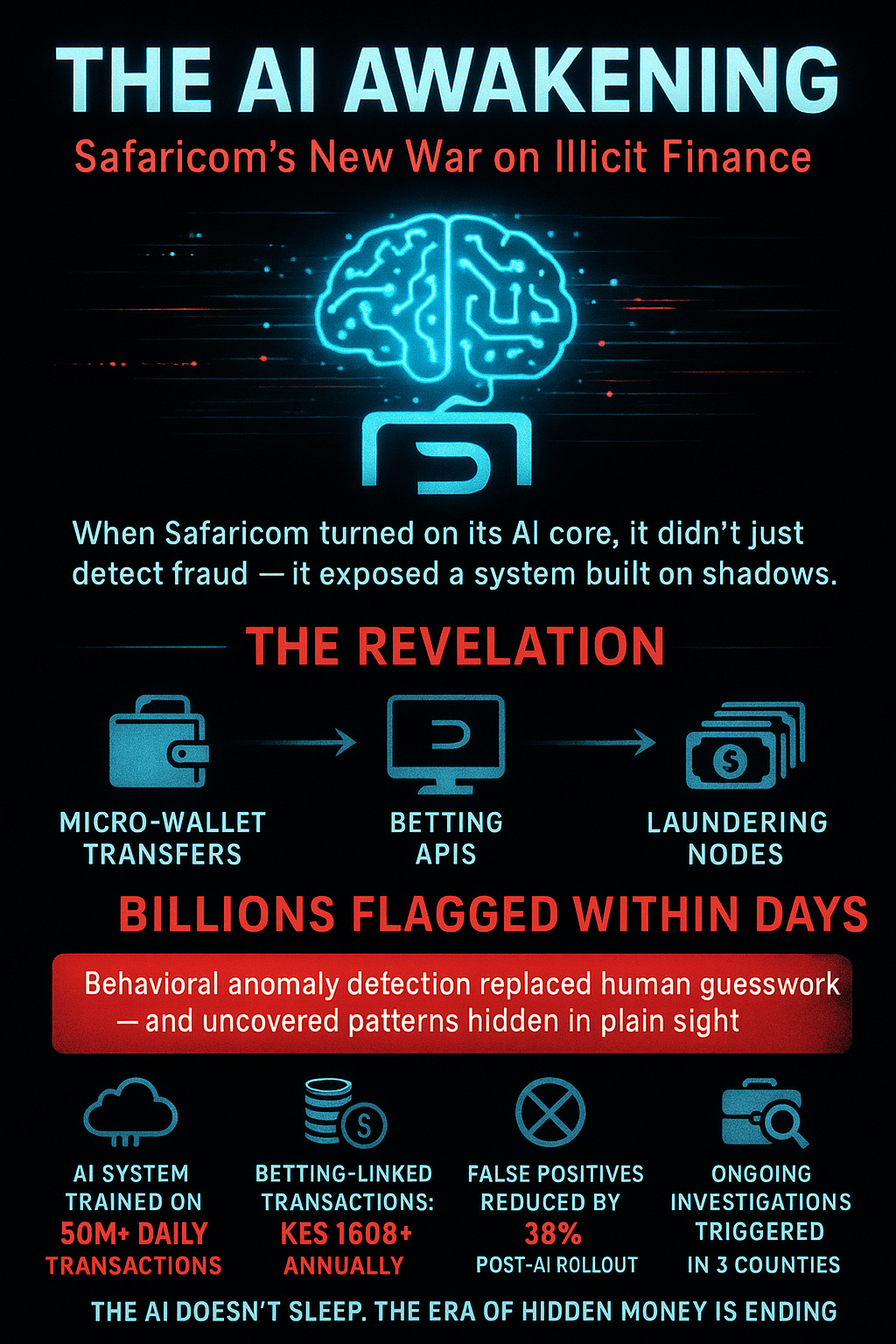
Inside Safaricom, a quiet revolution had begun. The company wasn’t just fighting fraud — it was reprogramming its financial DNA. The AI core, built in partnership with advanced compliance auditors and data scientists, doesn’t merely track transactions; it learns human behavior. It detects hesitation, timing anomalies, and wallet relationships that no manual audit could ever spot. What began as a compliance upgrade quickly turned into a forensic awakening — a self-learning system capable of catching what criminals believed was invisible. But the move also triggered backlash. Betting firms, some major ones, protested account freezes and accused Safaricom of overreach. Yet for Safaricom, this was no longer about risk — it was about survival. The same technology that made M-Pesa a lifeline for millions had made it a target for laundering syndicates. Turning AI loose on that frontier was less a choice than an inevitability.

Now, the discovery has thrown Kenya’s digital economy into uncharted territory. Regulators are scrambling to keep up, data privacy watchdogs are asking hard questions, and compliance officers are quietly celebrating the first real glimpse into the scale of illicit flows buried within mobile money. For the first time, artificial intelligence isn’t just assisting Kenya’s war on financial crime — it’s leading it. The system doesn’t sleep, doesn’t flinch, and doesn’t forget. And as it continues to learn, one thing is certain: the era of hidden money on M-Pesa is ending — but the reckoning it has triggered is only beginning. Stay tuned for the next post in this six-part series, where we will delve deeper into the implications of these changes.

References:

Techcabal How Safaricom’s AI exposed money laundering in Kenya’s betting boom

The Kenyan Wall Street How Safaricom is Leveraging AI to Bolster M-Pesa Security and Efficiency

Citizen Digital Father, son arrested for conning M-Pesa operators over Ksh.200K in Nairobi

KBC M-pesa outage on Monday as Safaricom adopts AI to tame fraud

Mobile ‘Market Share’ Strategy

Essar Telkom’s Yu brand, announced on July 12, a free on-net tariff within its network, active between 6 A.M and 6 P.M daily, to run for three months.

Madhur Taneja, the C.E.O, was reported saying “the offer is aimed at building market share, adding that profits are not their priority in the short-term as they seek numbers to

New offer by Yu

grow revenues in the long term.” The C.E.O presented that “the offer is absolutely free. There are no hidden charges or subscription charges per day. We take this seriously and our competitors should know that we are in the market to stay.” The Standard reported. Recently, President Kibaki issued a directive to Communications Commission of Kenya, to suspend implementation of the Mobile Termination Rates (MTRs), which would see a further drop in interconnection charges.  “This is a big blow to Airtel Kenya, which has been pushing for a further fall in the termination rates as its business strategy, just like that of Essar Telkom’s Yu…” which both depend on a “low-cost mass market model.” allAfrica.com reported. Safaricom and Telkom Orange opposed the reduction in (MTRs) warning that “a further cut would have a negative effect on the sectors profitability, risk of job losses, curtail new capital investments, reduce government revenue and competitiveness.” allAfrica.com reported. In August 2010, CCK cut termination rates by half from Sh. 4.42 to Sh. 2.21, which experts have directly linked to the price wars that saw Safaricom’s market share drop to “69.9% from 75.9% as rival Airtel and Orange, “increased their market share to 15.2% from 13.5% and 8.5% from 4.0% respectively.” However Essar Telkom’s Yu “edged down 0.3% to 6.4%”, Dyer & Blair Investment Bank website reported. From an economic analyst perspective, “it is flawed to assume that lower mobile termination rates will automatically lead to lower overall retail prices and to higher consumer welfare.” However, “this is not to say that the level of mobile termination rates (MTR) does not matter or that high MTRs are necessarily good, as there is a level of termination rates, usually cost based, which maximizes total (consumer plus producer) welfare.” Assessing the impact of lowering mobile termination rates, (July 2008).

That said, Essar Telkom’s Yu latest maneuver (having in mind mobile number portability) to woo over new and existing subscribers from rival networks by offering a free on-net tariff within its network all day, could be viewed as the game-changer in the mobile telephony industry. But is it?

What’s Your Say?

The Conversation begins…

References:

‘yu’ offers free daytime calls for three months Business Daily July 12, 2011

Yu free calls cause ripples in market The Standard (As of) July 17, 2011

Lower Mobile Phone Calling Rates Put On Ice After Intense Lobbying allAfrica.com June 14, 2011

Safaricom’s Stand On Interlink Fee Triggers New Battle With Regulator allAfrica.com April 27, 2011

Safaricom loses market share to smaller players Dyer & Blair Investment Bank June 10, 2011

Assessing the impact of lowering mobile termination rates Frontier Economics July, 2008