The Physics of Failure—Understanding Peak Discharge

Nairobi’s drowning is not merely a matter of bad luck; it is a mathematical certainty dictated by the hydrological principle of peak discharge. Defined by the formula Q=CiA, the volume of water rushing through our streets (Q) is a direct product of rainfall intensity (i), the drainage area (A), and the runoff coefficient (C). In a natural landscape, the earth acts as a sponge, but Nairobi’s rapid transformation into a “concrete jungle” has spiked the runoff coefficient to lethal levels. When surfaces become impermeable, water that should have been absorbed is instead weaponized into destructive surface runoff.
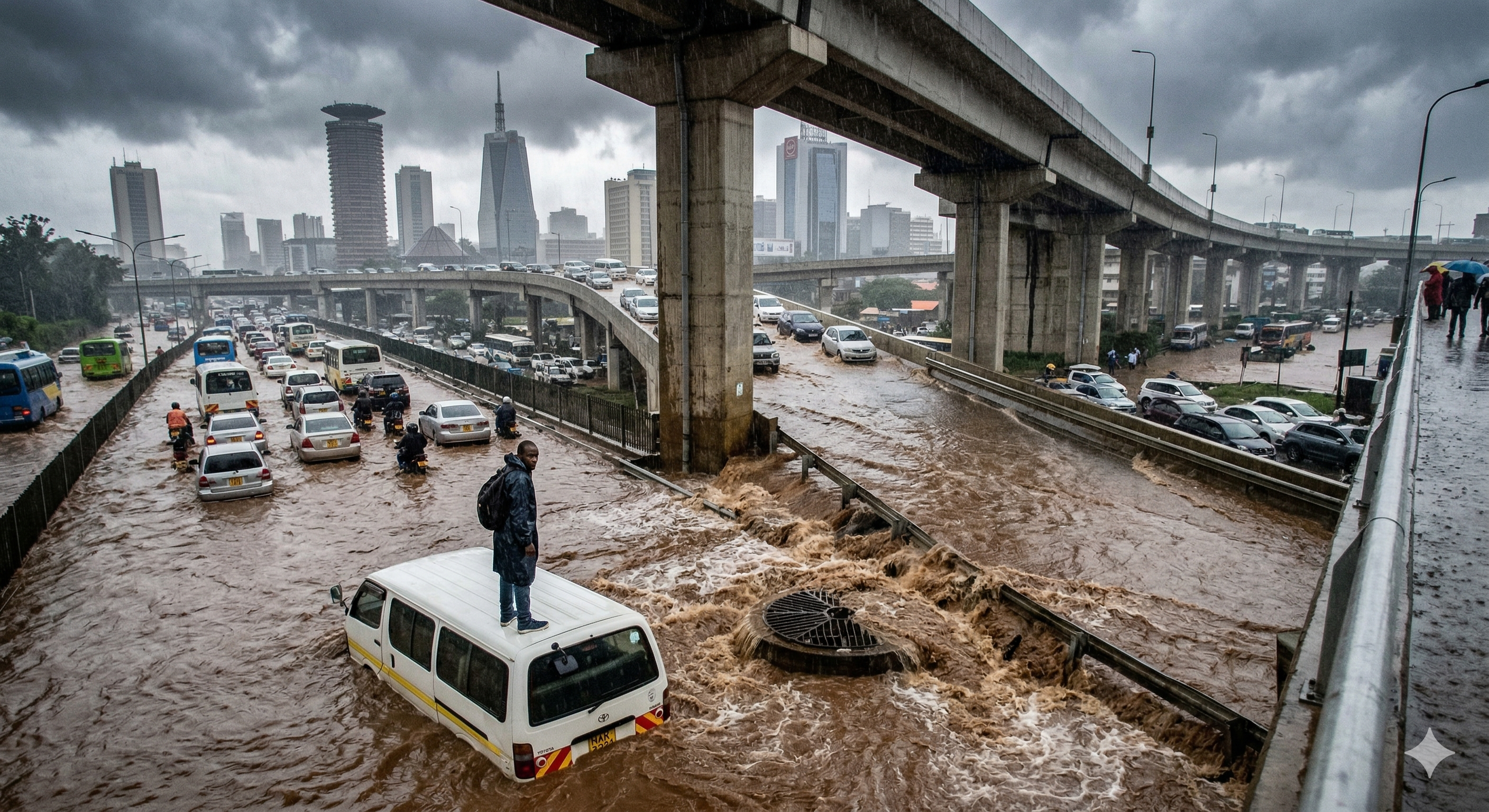
The catastrophic flash floods of March 2026 provided a grim laboratory for this principle. Within a single 24-hour window, a staggering 112mm of rain fell on the capital—representing over 120% of the entire monthly average for March. Because the city’s expansion has prioritized high-density “non-porous” development, the runoff has nowhere to go but down, inundating low-lying informal settlements. This technical reality means that even moderate rains now generate peak flows that exceed the capacity of archaic culverts designed decades ago for a much smaller, greener city.

As the Nairobi River repeatedly bursts its banks, the “fragmented responsibility” between national and county governments ensures that these bottlenecks remain unaddressed. While the science of Q=CiA is clear, the governance of drainage maintenance is anything but, with conflicting schedules and a lack of digitized master plans. Without a fundamental shift in how we manage the city’s surface permeability, Nairobi remains a city where the next rainstorm is not just a weather event, but a predictable hydrological disaster.

References

Assessment of Flash Floods in the Streets of Nairobi A Research Paper by Wachira Silvia Wanjiru, Nairobi University

Streamline Drowning In Neglect: The Urgent Battle For Nairobi’s Drainage Systems

The Guardian Weather tracker: At least 10 dead in Nairobi after a month’s rain falls in 24 hours

The Seed Survival Guide (ASAL Special)

🌱 Stop! Don’t Bury Your Money: The Seeds That Will Survive the 2026 “Insignificant Rains”

Farmers in Arid and Semi-Arid Lands (ASALs) are walking a tightrope. With the Met Department warning of “intermittent dry spells” and poor distribution, planting standard 6-month maize is a gamble you will likely lose.

The “Smart Farm” Swap:

  1. Swap H614 for SC Sungura 301: If you must plant maize, use ultra-early varieties. SC Sungura 301 matures in just 75-85 days and thrives on less than 250mm of rain.
  2. Swap Beans for Mbaazi-6: Traditional pigeon peas take 10 months. The new Mbaazi-6 variety from KALRO is ready in under 3 months. It needs rain only during flowering; after that, it uses deep roots to survive the heat.
  3. Check Dryland Varieties: Look for the DH Series (DH04, DH08) which are specifically bred for these conditions.

References:

Farm Biz Africa Crops that can reach harvest in 2024’s dry short rains

KALRO Climate Smart Agricultural Technologies,Innovations and Management Practices for Green Gram Value Chain

Kenya Seed Dryland Varieties – Maize Varieties

The “Two Kenyas” Forecast – Know Your Zone Before You Hoe

🌦️ Wet West, Dry East: Why One Strategy Won’t Work for All in MAM 2026

The Kenya Meteorological Department (KMD) has dropped its forecast for the March-April-May (MAM) long rains, and it paints a picture of two very different planting seasons.

  • The Good News: If you are in the Highlands West of the Rift (Trans Nzoia, Uasin Gishu, Kericho) or the Lake Victoria Basin, get your tractors ready. The forecast predicts near-average to above-average rainfall. This is the green light for high-yield maize farming.
  • The Warning: For farmers in the Southeastern Lowlands (Kitui, Makueni), Northeastern, and the Coast, the forecast is tough. You are facing “near-average to below-average” rainfall, with a high chance of insignificant rains—meaning showers that wet the dust but don’t sustain a crop.

The Takeaway: Don’t copy your neighbor in Eldoret if you live in Machakos. The government is urging everyone to plant, but what you plant matters more than ever.

  • West: Go for maximum yield (600 series maize).
  • East/North: Go for survival (fast-maturing crops).

References:

Nairobi Leo Kenya Met Issues March-May 2026 Long Rains Forecast

Daily Nation End of drought in sight, but coming rains will be insignificant for arid regions

All Africa Above-Average Rains Expected in Key Regions, Weatherman Warns of Dry Spells Elsewhere