Kenya’s Event Security Challenges: A Wake-Up Call

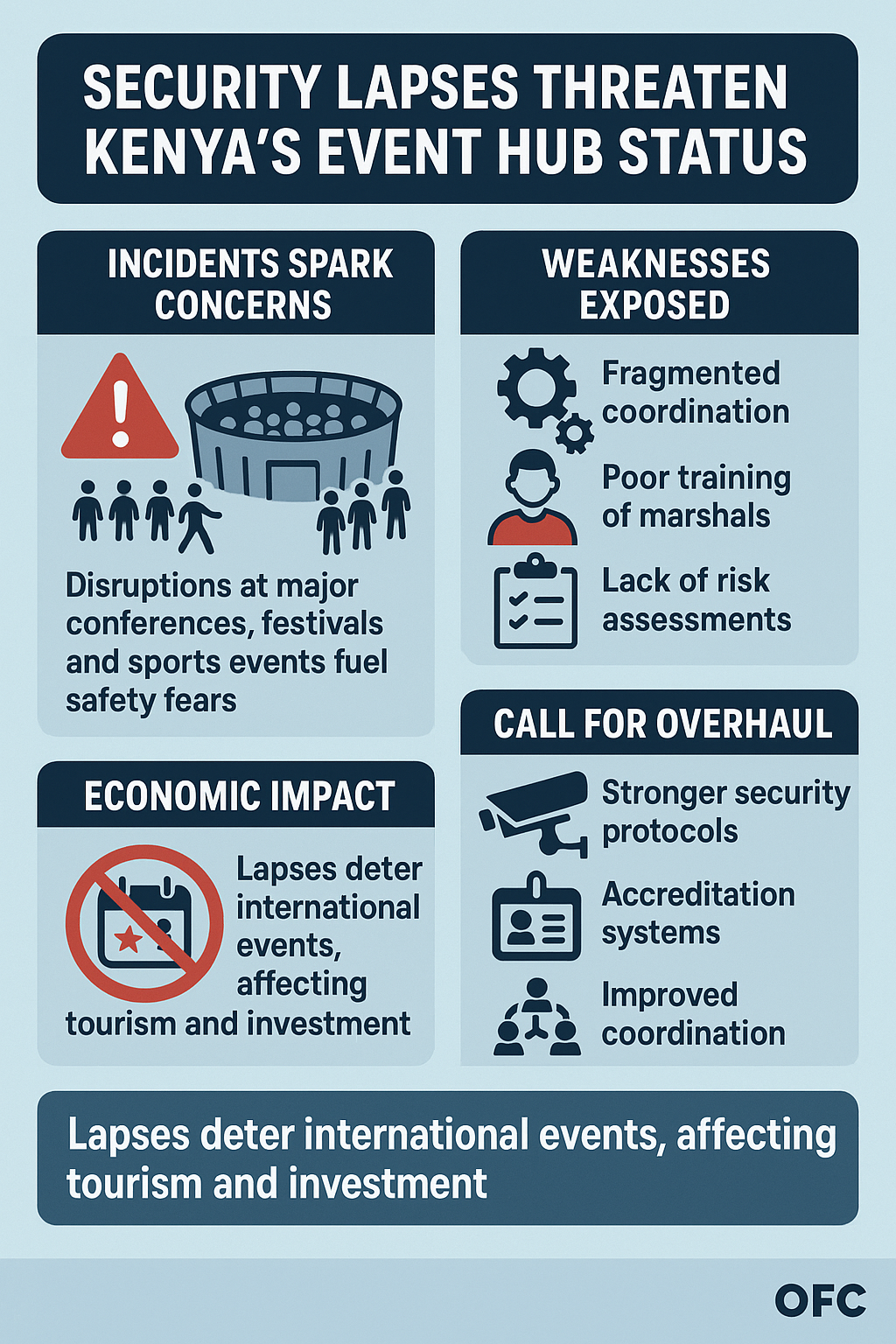
Kenya’s growing profile as a hub for international conferences, cultural festivals, and major sporting events hangs in the balance, threatened by a persistent and damaging weakness—event security lapses. The recent spate of high-profile disruptions, from chaotic crowd control failures to delayed emergency responses, has reignited fears that the country’s infrastructure and management systems are not keeping pace with its ambitions. While Kenya has successfully hosted large-scale gatherings in the past, these successes are increasingly overshadowed by incidents that put both safety and the nation’s reputation at risk. For a tourism and investment-driven economy, where marquee events serve as global shop windows, the stakes could not be higher. Any perception that Kenya cannot guarantee the safety of participants and spectators risks deterring international organizers, sponsors, and attendees, redirecting both revenue and influence to competing destinations.

At the core of the problem lies a combination of fragmented coordination among security agencies, inadequate training for event marshals, and a lack of robust, preemptive risk assessments. Large-scale events—from global athletics meets to high-profile music festivals—often depend on ad hoc arrangements, with security strategies being reactive rather than proactive. This has led to avoidable breaches, where unruly crowd surges, unauthorized access, and even petty crime have disrupted otherwise well-planned programs. For international guests, especially those attending for the first time, such lapses create a lasting negative impression, overshadowing the event’s core purpose and undermining Kenya’s pitch as a safe, reliable host. Stakeholders in the hospitality, transport, and retail sectors warn that the ripple effects of diminished confidence could translate into real economic losses, especially in cities like Nairobi and Mombasa where event-linked tourism forms a major income stream.

The solution requires more than isolated fixes—it demands a systemic overhaul anchored in professionalism, technology, and accountability. Kenya must invest in event-specific security protocols that integrate crowd science, digital surveillance, and emergency response drills into every planning phase. Clear chains of command, mandatory accreditation systems, and cross-agency coordination hubs should be standard practice, not aspirational goals. Without this, the “Africa’s Meeting Place” narrative risks collapsing under the weight of recurring security failures. The opportunity cost is immense: from losing bids to host continental championships, to deterring corporate conventions, to stalling the growth of cultural tourism. Kenya’s position as an event destination of choice is not guaranteed; it must be earned and safeguarded through consistent, visible competence. If the country cannot put its house in order, it may soon find the world taking its events—and its investment—elsewhere.

References:

Jijuze How CHAN 2024 is Boosting Tourism and Infrastructure in East Africa

The Kenyan Wall Street Legacy or Liability? Putting Kenya’s CHAN 2024 Moment Under the Lens

GhanaWeb Crowd disorder at CHAN raises concerns in Kenya

Pulse Sports Protect the Game: How CHAN 2024 Fans Can Keep Big Tournaments Coming to Kenya

FlashScore 2024 CHAN: Kenya fined by CAF again over multiple safety and security breaches

The Standard CHAN 2024: Why Kenya could lose quarterfinal hosting rights

Understanding Kenya’s eTA Troubles: What Travelers Need to Know

Kenya’s ambitious shift to a universal Electronic Travel Authorization (eTA) system on January 1, 2024, was meant to be a game-changer for tourism, projecting an image of digital efficiency and openness. The vision—replacing traditional visas with an online pre-authorization—was sold as “visa-free” travel for the world, echoing President William Ruto’s promise of easier entry and smoother travel. Yet, what travelers encountered was a reality at odds with the marketing: mandatory paid applications, detailed documentation requirements, and unpredictable processing times. For visitors from over 40 countries that once enjoyed genuine visa-free access, the change felt less like liberation and more like an unexpected hurdle. Industry insiders describe the rollout as a “bait and switch” that has not only dented Kenya’s reputation but also triggered fears of retaliatory entry restrictions abroad. This mismatch between promise and practice was compounded in March 2025 when the government quietly replaced a stable Swiss-developed system with a locally built platform plagued by downtimes, payment failures, and technical glitches—sparking a multi-million dollar lawsuit and months of operational chaos.

A Report by iVisa

The fallout has been costly. Tour operators, hotels, and airlines have all reported significant losses as delays, application failures, and the absence of a functional support framework have disrupted itineraries and led to cancellations. Airlines face fines of KES 1 million per passenger without valid eTA documentation, a policy that has left many travelers stranded at departure gates. While Kenya recorded a record-breaking Sh 452 billion in tourism revenue in 2024—driven largely by post-pandemic recovery and aggressive marketing—the eTA crisis has cast a long shadow. The country’s visa openness ranking plunged from 29th to 46th in Africa, eroding hard-earned goodwill and weakening its competitive edge against rivals like Ghana and Rwanda, which have fully opened their borders. Industry leaders, including the Kenya Association of Travel Agents (KATA) and the Kenya Tourism Federation (KTF), warn that unless systemic fixes are made, Kenya’s target of five million annual visitors by 2027 could be jeopardized. Their calls range from establishing an emergency “crisis desk” for stranded travelers to temporarily reinstating visas on arrival while the digital system is repaired.

In response to mounting pressure, the government has introduced notable policy reversals, exempting most African and Caribbean nationals from eTA requirements and promising faster approvals for others. At the same time, industry stakeholders and the Tourism Ministry are working to embed risk management into the process—introducing contingency measures such as backup server capacity, offline verification protocols at airports, and dedicated “rapid response” teams to assist travelers facing last-minute clearance issues. While KATA’s August 2025 meeting with Tourism CS Rebecca Miano confirmed that some operational bottlenecks remain for non-exempt travelers, these interventions are designed to ensure that no visitor’s trip is derailed by system errors or delays. The emphasis now is on creating a safety net that preserves the integrity of Kenya’s digital entry framework while protecting the traveler’s experience. In an era where seamless digital access is part of a destination’s brand, these safeguards—paired with transparent communication—are key to restoring confidence and reinforcing Kenya’s identity as a warm, accessible, and world-class destination.

References:

The Permanent Mission of the Republic of Kenya to the United Nations Implementation of Electronic Travel Authorization (eTA) in Kenya

Kenya Association of Travel Agents Tourism industry raises concerns over ETA system delays

eVisa How Foreigners Will Apply For Kenya ETA Before Visiting (Visa-Free Kenya)

Aljazeera ‘Bait and switch’: Why Kenya’s no-visa policy is drawing pushback

Kenya Association of Travel Agents KATA Meets Tourism CS Rebecca Miano to Address Sector Challenges and Strengthen Collaboration


How CHAN 2024 is Boosting Tourism and Infrastructure in East Africa

As the African Nations Championship (CHAN) 2024 shifts its focus to East Africa, the co-hosting of the tournament by Kenya, Tanzania, and Uganda represents a significant shift in leveraging sports for economic transformation. For Kenya, this is a vital opportunity to recover its sporting integrity after a disappointing bid in 2018, underscored by considerable investments in stadium infrastructure, notably in Nairobi’s Nyayo Stadium and Eldoret’s Kipchoge Keino facility. These venues serve not just as football fields but as epicenters for urban redevelopment, spurring enhancements in transportation, hospitality, and small business interactions. The rising bookings in Nairobi’s hospitality sector indicate that CHAN is influencing broader economic dynamics, while also acting as a political lever to expedite long-delayed public works, showcasing the power of football in aligning with national development agendas.

Tanzania’s strategy for CHAN 2024 is meticulously crafted around intentional, brand-driven national development, where the Benjamin Mkapa Stadium in Dar es Salaam is being promoted as a pivotal regional hub for intertwining sports, tourism, and diplomacy. The government is tying the tournament to a larger tourism revival initiative, highlighting not only Dar es Salaam but also related destinations such as Arusha, Zanzibar, and Kilimanjaro to attract visitors. With a projected TSh 85 billion anticipated to flow into the economy as a direct result of the events, Tanzania seeks to boost its visibility as a potential future AFCON bidder. This emphasis on long-term tourism sustainability and attractive international offerings is designed to craft a narrative of lasting impact that transcends the tournament.

As Uganda joins its neighbors in this collaborative effort, it is focusing on a community-centered approach despite logistical challenges concerning stadium upgrades. The government is investing in public-private partnerships that engage local artisans, vendors, and cultural showcases to ensure wider community involvement in the festivities. Investments in essential infrastructure, including public transport and sanitation, aim to position CHAN as a catalyst for enduring urban renewal. By pairing match experiences with unique local attractions like gorilla trekking and cultural tours, the Ugandan Tourism Board is working to transition CHAN visitors into long-term tourists. Overall, while the three nations unite to present East Africa as a cohesive travel destination, the urgent challenge lies in translating the tournament’s temporary excitement into lasting benefits for the region, effectively establishing their collective identity as a forward-thinking economic bloc.

References:

Citizen Digital Why CHAN 2024 is not just a tournament, but a catalyst for East Africa integration

The Standard CHAN 2024, Kenya’s opportunity to boost economy, tourism

Nile Post Uganda Co-Hosting CHAN 2024 is a Landmark Achievement in the Country’s Sports

EAC EAC to promote the region as a unified tourism destination at ITB Berlin 2025

IPP Media Zanzibar hotels overflow with tourists ahead of CHAN match

Aftershock: The Collateral Damage of USAID’s Exit from Kenya

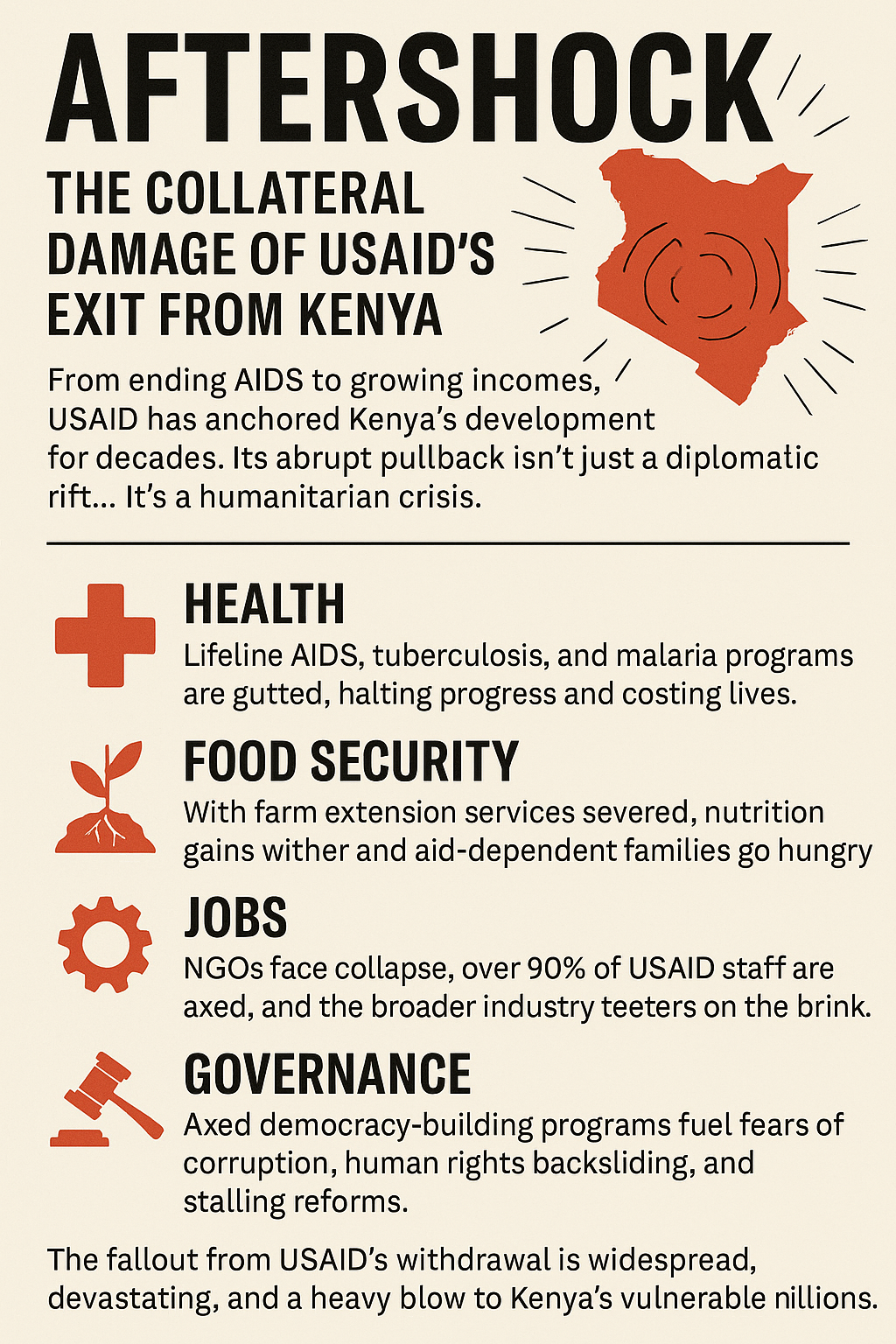
The abrupt dissolution of USAID, catalyzed by the U.S. government’s sweeping “America First” foreign aid policy pivot, has left Kenya reeling from a vacuum of support once critical to its public health, agriculture, and economic systems. With over $2.5 billion in planned investments between 2020 and 2025, the agency was more than just a donor—it was woven into the fabric of Kenyan service delivery. The termination of 83% of USAID’s programs and the layoff of 94% of its staff effectively ended over six decades of robust U.S. development engagement. For Kenya, this rupture came without a viable transitional plan. Clinics shuttered, medicines vanished, and 40,000 jobs tied to health services evaporated. Programs such as PEPFAR, which had sustained over a million Kenyans on antiretroviral treatment, have been gutted, with HIV/AIDS funding slashed from $846M in 2023 to just $66M in 2025. Maternal health, malaria prevention, and reproductive health services now teeter at the edge of collapse, with service cuts exceeding 90% in some areas. Kenya’s health infrastructure, already strained, is now buckling under a loss that is not merely financial—but fatal.

The economic blowback extends far beyond healthcare. USAID had supported Kenya’s agriculture sector through subsidies, training, and innovation, all now dismantled. Smallholder farmers are especially vulnerable. With the termination of the Famine Early Warning Systems Network (FEWS NET) after four decades of operation, Kenya has lost its primary mechanism for forecasting and responding to food insecurity. Meanwhile, tax reforms in the proposed 2025 Finance Bill—removing VAT exemptions on farm inputs and raising fuel duties—compound the crisis, inflating production costs and shrinking rural margins. The convergence of aid withdrawal, policy shocks, and climate threats is deepening food insecurity and threatening to reverse years of agricultural gains. Simultaneously, the Kenyan startup ecosystem and governance reform sectors face a projected $100 million funding shortfall. Civil society actors, often powered by USAID support, now risk losing their watchdog capacity. In areas such as conflict prevention and refugee education, where USAID once acted as a stabilizing force, the vacuum could be exploited by extremist recruiters, echoing conflict patterns seen in past aid shock cases in West Africa.

Kenya’s response has been urgent but encumbered. The government has committed to repatriating its health data from U.S.-hosted systems and shifting toward local infrastructure, yet faces severe capacity shortfalls. The fiscal strain is formidable: a KSh 52 billion health budget hole and a broader KSh 66.9 billion gap across affected sectors. While the Bottom-Up Economic Transformation Agenda (BETA) reflects ambition for self-reliance through tax reforms and private investment, execution remains constrained by weak systems and widespread corruption. Still, civil society and policymakers are beginning to reframe the crisis as a wake-up call for domestic revenue mobilization and governance renewal. If there is a path forward, it lies in converting dependency into resilience—not just by replacing funding streams, but by rethinking national priorities, protecting human capital, and investing in sovereign, accountable systems that can withstand future geopolitical shocks.

References:

Citizen Digital Over 40,000 Kenyans jobless after USAID-funded health facilities shut down

The Voice of Africa USAID Shuts Down After 63 Years, Leaving Africa in Crisis

The Star Civil society calls for self-reliance as foreign aid dwindles

Africa.com Kenya to Reclaim Health Data After Trump Administration’s USAID Cuts

Jijuze Kenya Faces Crisis After USAID Funding Withdrawal

Capital Business USAID funding halt to hit Kenya’s economy, social sectors – report

Audit vs. Austerity: The IMF’s Role in Kenya’s Recovery

Kenya is on the edge of a pivotal financial reckoning. In the wake of the 2024 Finance Bill’s withdrawal and amid a battered economy, the International Monetary Fund (IMF) has demanded a sweeping corruption audit before any further disbursement of financial aid. At stake is more than KSh 100 billion in support tied to Kenya’s Extended Fund Facility, Extended Credit Facility, and Resilience and Sustainability Facility—aid that could help stabilize an economy reeling from debt, inflation, and political distractions. The collapse of the 2024 Finance Bill, triggered by nationwide protests over tax hikes, left a gaping fiscal hole. Now, the IMF wants answers before money moves. Between June 16 and 30, a Governance Diagnostic mission wrapped up in Nairobi. While Treasury insists the audit is not a precondition for funding, international observers say its findings will heavily influence future negotiations. The IMF has drawn a clear line: no serious anti-corruption reforms, no fresh credit.

IMF Demands corruption audit on Kenya

The Kenyan public feels the consequences every day. For ordinary wananchi, the stalled billions aren’t just digits on a spreadsheet—they represent hospital beds without medicine, classrooms without books, roads that end in dust, and a tax burden growing heavier on already strained shoulders. Years of unchecked corruption have gutted public institutions, forcing citizens to pay more for less while a well-connected elite evades accountability. The protests of June 2024 were not merely about a finance bill—they were about a social contract broken. Corruption doesn’t just steal money; it steals opportunity, trust, and dignity. It pushes more families below the poverty line and leaves critical sectors like education and healthcare in permanent crisis. Every act of embezzlement is a tax on hope. And now, Kenya must confront that cost head-on.

Yet as this economic standoff unfolds, the political class seems to be campaigning rather than governing. With two years until the 2027 general elections, the air is already thick with premature rallies and succession battles. This relentless politicking is not just tone-deaf—it undermines policy coherence and economic recovery. Critics argue that Kenya risks squandering a historic opportunity to reset its governance priorities. The IMF’s demand for a corruption audit is not just a bureaucratic checkbox; it is a test of political will. Whether the government embraces or evades the findings of the Governance Diagnostic will speak volumes. Kenya is at a crossroads. What lies ahead will depend on whether its leaders prioritize reform over rhetoric, the public over politics, and accountability over access to short-term cash. The world is watching. But more importantly, Kenyans are waiting.

References:

Mariblock Kenya fails IMF review, forfeits $850M disbursement

International Monetary Fund IMF Staff Completes Governance Diagnostic Mission to Kenya

Transparency International – Kenya Debate on Kenya’s economy must include a cure to the endemic corruption

The Standard Bitter IMF austerity pill return overshadows budget unveiling

The Standard Why IMF is demanding corruption audit on Kenya


Kenya’s Escalating Security and Civic Rights Crisis

Kenya is staring down a security crisis that can no longer be blamed on bandits or activists alone. From the shocking murder of Catholic priest Fr. Alois Bett in Kerio Valley to the arrest of digital activist Rose Njeri, recent events expose a breakdown of trust, law, and legitimacy in the very institutions meant to protect the public. In Kerio, teachers, doctors, and missionaries have fled as armed groups tighten their grip — filling the vacuum left by a state that shows up too late, with too little. More than 70 schools have been shut down, a major hospital has closed, and even church leaders now speak of “a valley of death.” What’s worse: when the state does intervene, its methods are often coercive rather than restorative — issuing ultimatums to entire communities under threat of “all necessary force.” This is not security. It’s collective punishment masquerading as policy, and it only deepens fear and fuels defiance. The government’s inability to distinguish bandits from residents or treat citizens as partners in peace risks entrenching a cycle of violence. This is not a crisis of capacity. It’s a crisis of credibility.

A Report by Citizen TV Kenya

The response to civic dissent has been equally chilling. The arrest and weekend detention of Rose Njeri — a software developer who created a digital tool for citizens to email objections to the Finance Bill — was a stark reminder that Kenya’s democratic space is narrowing fast. Her crime? Enabling public participation. This is not just an affront to digital freedoms — it’s a direct violation of Article 33 (freedom of expression) and Article 35 (access to information) of Kenya’s Constitution. Even more damning is the pattern. Detaining citizens over weekends to avoid court oversight has become an authoritarian reflex. This violates the legal standard upheld in Coalition for Reform and Democracy (CORD) & 2 others v Republic of Kenya & another [2015] eKLR, where the court held that prolonged detentions without charge constitute unconstitutional abuse of state power. Yet the tactic continues — often against youth activists, journalists, and tech-savvy organizers. These are not enemies of the state. They are its conscience. If the state treats code like a crime and civic tech as terrorism, it signals a descent into digital authoritarianism — one that no PR campaign or presidential handshake can disguise.

What Kenya needs now is more than investigations and operations. It needs political courage — and jurisprudential discipline. The government must fully implement existing rulings and international obligations. The IPOA’s mandate must be respected, and police accountability pursued with vigor, not rhetoric. Parliament must hold the executive to account when it violates rights under the guise of national security. The courts have laid the foundation. In Independent Policing Oversight Authority v Attorney General & 4 others [2020] eKLR, the High Court affirmed IPOA’s role as the sole lawful investigator of police misconduct. The Executive must respect that boundary. Meanwhile, civil society must continue challenging digital repression and pushing for laws that protect activists, not silence them. Kenya’s youth are not the threat — they are the firewall against authoritarian drift. From Kerio to Kibera, from code to constitution, Kenya’s real security will only be built when the state values trust more than force, and justice more than optics.

References:

Kenya News Agency County Commissioner Leads Madaraka Day with Tough Message on Illegal Brews

The Star Key suspect in murder of Catholic priest Allois Bett arrested

BBC Outrage in Kenya over detention of software developer

The Star Gachagua calls for immediate release of activist Rose Njeri

The Eastleigh Voice Kenya’s security at risk as regional instability grows, warns NIS boss

BBC Pressure mounts to probe Kenya police and army after BBC exposé

Kenya News Agency State declare a nationwide crackdown on organized criminal gangs

Evaluating Kenya’s Affordable Housing Program: Benefits and Risks

Kenya’s Affordable Housing Programme (AHP) has been framed by the government as a historic solution to the nation’s urban housing deficit — a bold, transformative plan to put 250,000 new housing units into the hands of low- and middle-income earners each year. It’s the crown jewel of the Kenya Kwanza administration’s economic agenda, wrapped in promises of job creation, urban renewal, and dignity for the working class. But behind the polished press briefings and televised groundbreakings, the cracks are showing. Critics argue the housing levy — a mandatory deduction from all salaried workers — amounts to taxation without representation, especially when access to the houses is uncertain and the projected costs remain largely unaffordable for the very people funding them. Worse still, the rollout has sparked deep anxiety over forced evictions, unclear beneficiary selection processes, and the growing fear that without proper planning, these “affordable” units may become vertical slums stacked over broken infrastructure. For many Kenyans, the project feels less like a social contract and more like a speculative bet — one where the house always wins, and it’s not the public holding the keys.

A Report by Citizen Digital

The legal and structural questions around the housing project are mounting. In 2023, the High Court ruled parts of the Affordable Housing Act unconstitutional — particularly the centralized levy collection through the Kenya Revenue Authority, which bypassed public participation and legislative oversight. While the government quickly responded with legislative tweaks, the shadow of that ruling lingers. Public trust in housing delivery remains fragile, especially given Kenya’s history with failed or stalled housing programs and ghost estates like the infamous Nyayo House projects. Though the state touts the initiative as “inclusive,” it is heavily reliant on public-private partnerships where the private sector bears little risk, while taxpayers shoulder both the capital and the consequences. Key policy watchdogs argue that the financing model lacks transparency, and that the absence of social safeguards could lead to gentrification and displacement, particularly in areas like Mukuru, Kibera, and Mathare where informal settlements sit on prime land now targeted for redevelopment. The big risk? That homes built in the name of the poor end up benefiting civil servants, politicians, and private investors — not the mama mboga or jua kali artisan.

If Kenya’s affordable housing dream is to succeed, it must move beyond brick-and-mortar targets and confront the human realities of affordability, transparency, and equity. The price tags on many units still outpace the average urban worker’s income. The so-called “affordable” category often starts at KSh 1.5M — a figure out of reach for most informal sector workers who make up over 80% of Kenya’s labor force. Meanwhile, the digitized application and allocation model, while meant to enhance fairness, risks excluding those without access to mobile money, smartphones, or stable identification — particularly the urban poor it claims to prioritize. Additionally, new housing developments are outpacing investments in transport, sewerage, schools, and hospitals, raising fears that these estates will quickly deteriorate into overpopulated, under-serviced high-rises. The government must urgently clarify allocation policies, invest in supporting infrastructure, and put people — not politics — at the center of the housing agenda. Because if “affordable housing” becomes just another ambitious slogan without delivery, it won’t just fail to fix the housing crisis — it will deepen Kenya’s already fractured urban future.

References:

KBC Completed number of affordable housing units down by half

The Eastleigh Voice Govt raises affordable housing research budget to Sh2.8bn amid credibility concerns

Capital News Ruto says handing over Housing units the most consequential day of his political career.

NTV Who got Ruto Mukuru houses? Not us, residents now claim

Citizen Digital Vertical slums: How new crop of apartments in Kilimani, Kileleshwa is affecting Nairobi’s infrastructure

Job Scams in Kenya: A Growing Crisis

Kenya’s job seekers are under siege. As economic pressures push more young people to chase opportunities abroad or online, fraudsters are sharpening their traps — and the stakes are deadly. Sophisticated job scams, often orchestrated by transnational crime rings, are landing unsuspecting Kenyans in forced labor operations across Southeast Asia. Many are lured with fake offers, issued tourist visas instead of work permits, and end up trapped in scam compounds under brutal, enslaving conditions. Despite repeated government warnings, the scams persist, exploiting systemic weaknesses like rampant youth unemployment, weak digital literacy, and sluggish protections around labor migration. While officials stress the importance of individual due diligence — verifying agencies, double-checking job offers, demanding proper contracts — the scale of trafficking shows that better-informed individuals alone can’t stop a crisis this large. It’s a systemic failure — and it’s costing lives.

A Report by Citizen TV Kenya

At the heart of the vulnerability is a perfect storm: soaring unemployment, heavy informal sector reliance, and a government labor export strategy that prioritizes remittances over robust citizen protection. Kenya’s policies encourage labor migration — but enforcement lags behind, leaving workers exposed. Digital platforms, once hailed as tools of empowerment, have become weapons for scammers: Facebook pages, WhatsApp groups, even fake LinkedIn listings are used to lure victims. The Kenyan government’s countermeasures — the NEAIMS verification portal, bilateral labor deals, and pre-departure training — help but are patchy and slow. Civil society groups and media investigations have done much to highlight the dangers, but without aggressive enforcement and diplomatic intervention, Kenyans will keep falling prey. This is not just about digital fraud anymore; it’s about modern slavery, forced criminality, and human suffering on an industrial scale.

Solving this crisis demands a collective rethink. Government agencies must dramatically tighten recruitment regulations, shut down illegal operators, and prosecute traffickers — including those hiding behind legitimate fronts. Embassies abroad must step up protections for Kenyans, while local authorities crack down on rogue recruiters. Civil society must keep exposing the networks exploiting desperate youth, and tech companies must purge their platforms of scam ads and pages. Meanwhile, citizens must be empowered — not just blamed — with real tools to verify job offers and report suspicious activity. But real safety will only come when the Kenyan economy offers enough decent, secure jobs at home, removing the desperation that drives risky migration. Until then, job scammers will continue to thrive — and Kenyans will continue to pay the price.

References:

The Standard Job scams: Some Kenyans aiding their own smuggling, says PS Njogu

Business & Human Rights Resource Centre Kenya’s labor export model exposes workers to exploitation and other labour rights abuses

Kenyans.co.ke Govt Outlines Verification Process for Jobs Abroad as Scams Surge

The Eastleigh Voice Job scam alert: Government cautions Kenyans on fake overseas opportunities

Jijuze Rethinking Kenya’s Job Strategy: From Exports to Domestic Growth

Jijuze Kenyans Trapped: The Dark Reality of Job Scams in Myanmar

2024 KCSE Certificates Release: Urgent Action Required

The Ministry of Education has announced the release of 2024 KCSE certificates, kicking off the week of April 27, 2025, a deadline that couldn’t come at a more critical time. Education CS Julius Ogamba has pressed students and guardians to pick up certificates urgently, warning that the Kenya Universities and Colleges Central Placement Service (KUCCPS) portal closes on April 30. With over 962,000 candidates having sat the exams and only 246,391 securing the minimum C+ grade needed for university admission, timely collection is non-negotiable for those hoping to lock in their higher education spots. Yet, this milestone is clouded by a stubborn and illegal practice: the continued withholding of certificates by school principals chasing unpaid fees, despite the Kenya National Examinations Council (KNEC) Act of 2012 outlawing the behavior. Top education leaders, including PS Julius Bitok and Government Spokesperson Isaac Mwaura, have slammed the practice as a violation of students’ rights, but many principals remain defiant. PS Bitok has now issued a blunt circular demanding immediate certificate release and compliance reporting within 14 days, reflecting the Ministry’s boiling frustration with rogue school heads who continue to treat legal orders as suggestions.

A Report by Kisii TV

Fed up with defiance, the Ministry is now raising the stakes, moving from warnings to hard action. CS Ogamba has made it plain: starting the week after certificates are released, principals who still withhold them will face disciplinary and legal consequences. This marks a sharp turn — no more polite memos, no more ignored directives. But even more critical is a deeper systemic fix in the works: plans are advancing to pull certificate collection entirely out of schools’ hands. Under the new model, students will pick up their documents directly from Sub-County Directors of Education (SCDE) offices, a shift that aims to kill the problem at its root. It’s a bold move, built on the successful pilot earlier this year when KCSE result slips were sent through SCDE offices. Stripping principals of the power to hold certificates hostage cuts out the middleman and restores certificates to their rightful owners — the students. Beyond logistics, this strategy is about restoring trust in the education system itself: showing that once a student earns a certificate, no one — not even a principal — should stand between them and their future.

The next few weeks will be the true test of whether this shake-up delivers real change. For the 2024 KCSE candidates, quick access to certificates is the key that unlocks university admission, job applications, and life plans that can’t wait. For principals who defy orders, this time the consequences are meant to be real — legal action, career-ending sanctions, public accountability. And for the education system as a whole, the shift to SCDE offices could become a model for breaking down entrenched administrative abuses that have long crippled student mobility. But this won’t happen automatically: it’ll require tight coordination across counties, clear instructions to SCDEs, public communication campaigns, and a Ministry willing to enforce its own rules without flinching. If it works, it will not just be a victory for this year’s candidates — it will set a new standard for fairness and efficiency in how Kenyan education treats its students. Either way, the clock is ticking, and the Ministry’s next moves will show if it’s serious about turning bold words into bold action.

References:

The Standard KCSE Certificates to be collected from government offices, not schools

Daily Nation KCSE 2024: Highest university qualifiers recorded in eight years

Kenyans.co.ke KNEC to Release 2024 KCSE Certificates This Week As KUCCPS Portal Closes

Kenyans.co.ke KCSE Certificates to Be Collected from Govt Offices Instead of Schools

Easter 2025: Voices of Conscience from Kenyan Clergy

Easter 2025 in Kenya unfolded not only as a celebration of Christ’s resurrection but as a moment of reckoning for the soul of the nation, with clergy across the country using the pulpit to deliver searing messages that reached far beyond theology. Falling on April 20th—a rare alignment for both Western and Eastern Christian calendars—the holy day became a stage for calls to conscience, unity, and reform. While sermons across denominations upheld traditional themes of resurrection, hope, and renewal, several clergy, particularly from the Catholic Church, stepped into the fray of national discourse with unapologetic candor. Bishop Simon Peter Kamomoe, delivering his homily at Nairobi’s Holy Family Basilica, did not mince words. He blamed Kenya’s ongoing suffering on the “sins” of its people, drawing a direct and controversial link to the choices made during the 2022 general elections. He named rising corruption, domestic violence, and a disturbing trend in unethical healthcare practices—particularly organ theft—as symptoms of a moral crisis engulfing the nation. His warning to congregants to “be careful with your surgery” hinted at a deep public fear of a broken healthcare system and underscored his broader message that spiritual and societal decay were intertwined.

A Report by Citizen TV Kenya

In Mombasa, Archbishop Martin Kivuva struck a similarly critical tone, directing his Easter sermon at the government’s economic policies. With President Ruto preparing to travel to China for talks with one of Kenya’s major lenders, Kivuva’s timing was pointed as he decried the government’s unchecked appetite for loans. He questioned whether borrowed billions were being used to serve the people or to fund untraceable ventures, voicing a concern that has simmered among Kenyans grappling with a rising cost of living and dwindling faith in public accountability. But the Archbishop’s critique didn’t stop at debt; he rebuked politicians for engaging in premature campaigns for the 2027 elections and stoking tribal tensions, warning that such actions risked pulling the country further apart. His words reflected a growing anxiety about Kenya’s political culture—one increasingly marked by performative leadership and ethnic division rather than national unity. Meanwhile, in the rural town of Elburgon, Fr. Gideon Korir turned the spotlight inward, condemning the infiltration of politics into sacred spaces. He expressed deep dismay over chaotic scenes witnessed on church pulpits, where rival politicians turned places of worship into arenas of confrontation. His impassioned plea was for churches to be preserved as sanctuaries of peace, healing, and moral guidance—not hijacked for political expedience.

These sermons reveal a critical shift in Kenya’s ecclesiastical tone—one that reflects an increasingly assertive clergy willing to challenge the political establishment and speak directly to the hardships of ordinary citizens. What emerges is a portrait of the church not merely as a spiritual institution, but as a potent voice in Kenya’s public square. The critiques delivered during Easter 2025 resonated because they mirrored real anxieties: from economic inequality and corrupt governance to deteriorating healthcare and the erosion of moral values. While the media gave these messages significant attention—particularly the stinging remarks about debt and governance—government responses remained conspicuously absent, possibly signaling discomfort or strategic avoidance. Yet, the Easter pulpit’s impact was undeniable, reaffirming the church’s enduring role as a moral compass and social conscience. The voices of Kamomoe, Kivuva, and Korir stood not just as isolated acts of courage, but as part of a broader ecclesiastical momentum demanding a better Kenya—one that upholds justice, integrity, and compassion. In a time of crisis, their sermons were more than words; they were calls to action, prayers for accountability, and reminders that even amid despair, the resurrection message remains one of transformation and hope.

References:

Anglican Ink Kenyan Anglican Church backs criticism of government

The Eastleigh Voice 30 Pentecostal Churches criticise Ruto over runaway corruption, governance issues

Capital News Archbishop Kivuva urges political tolerace to avert violence

Capital News Anglican Church joins Catholic Bishops in calling for govt accountability

Vatican News Kenyan bishops emphasize collective responsibility to transform nation