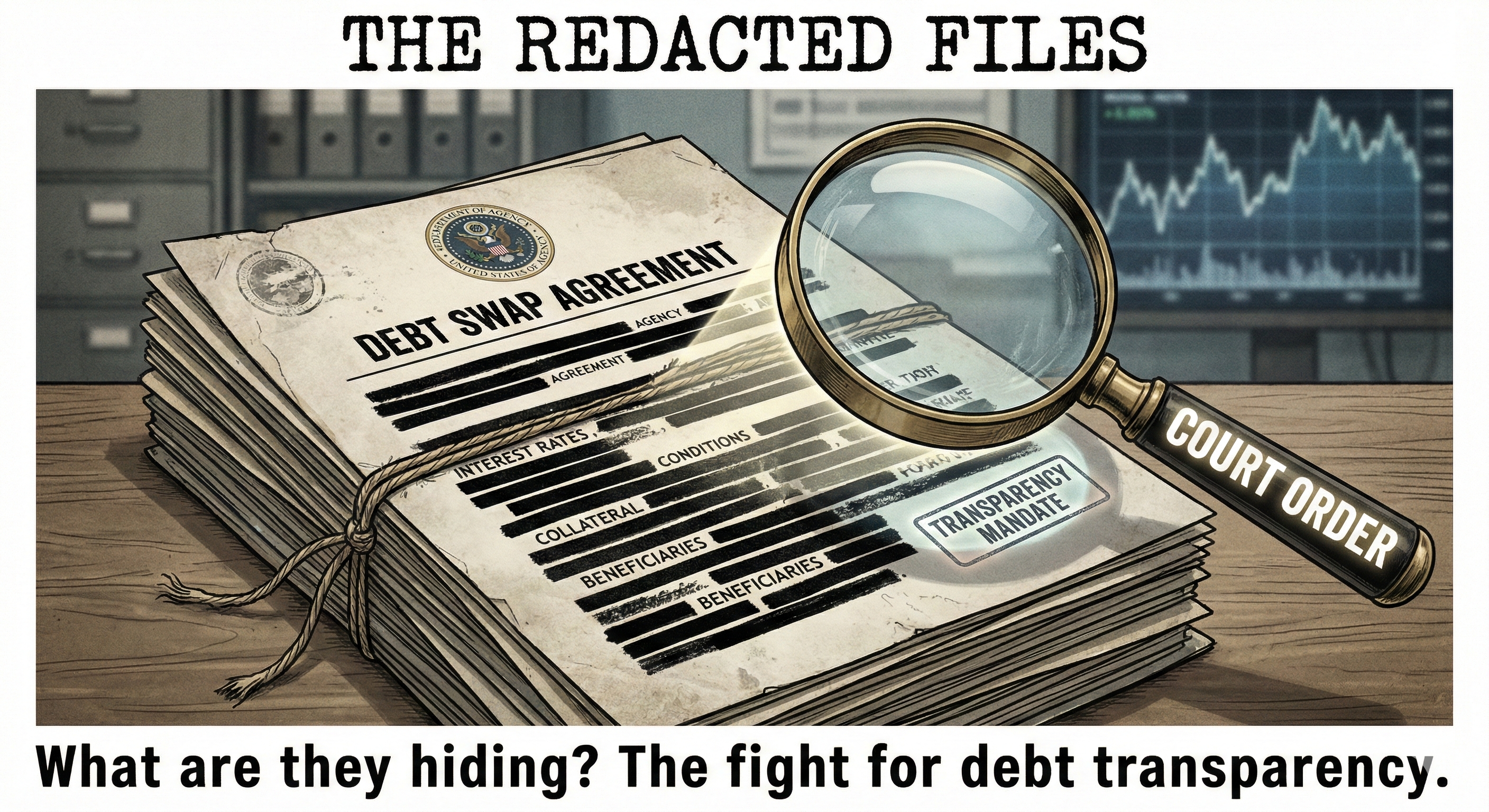
Despite the high stakes, the specific terms of the debt-for-food swap remain shrouded in secrecy, sparking legal battles and civil society alarm. A case filed at the East African Court of Justice, Wanjiru Gikonyo v The Attorney General, challenges the government’s refusal to disclose the full details of sovereign debt agreements. Litigants argue that committing future tax revenues and “savings” to long-term projects without public participation is unconstitutional. The lack of a public dashboard detailing exactly how the Sh129 billion will be spent creates a “transparency deficit” that invites mismanagement.
This opacity exacerbates the “sovereignty paradox.” By allowing the US-DFC and WFP to dictate the terms of expenditure, Kenya is effectively admitting that its own institutions cannot be trusted. While external conditionality acts as a safeguard against local corruption, the public remains in the dark about what exactly has been signed away. Are there hidden fees? What are the penalties for non-compliance? Without full disclosure, the Kenyan taxpayer is a passenger in a vehicle being driven by foreign creditors.
Transparency is not just a legal formality; it is the only disinfectant strong enough to prevent the “bureaucratic consignment” of funds. Civil society is demanding that the Treasury publish every shilling of the “savings” and every project beneficiary. Until then, the debt swap remains a “black box”—a deal negotiated in boardrooms in Washington and Nairobi, with the bill sent to the citizen who has no say in the menu.
References:
Afronomics Law Sovereign Debt News Update No. 147: The Promises and Transparency Pitfalls of Kenya’s $1 Billion Debt-for-Food Swap
The Institute for Social Accountability The High Court has ordered the National Treasury to disclose critical information on Kenya’s bilateral loans and sovereign bonds.
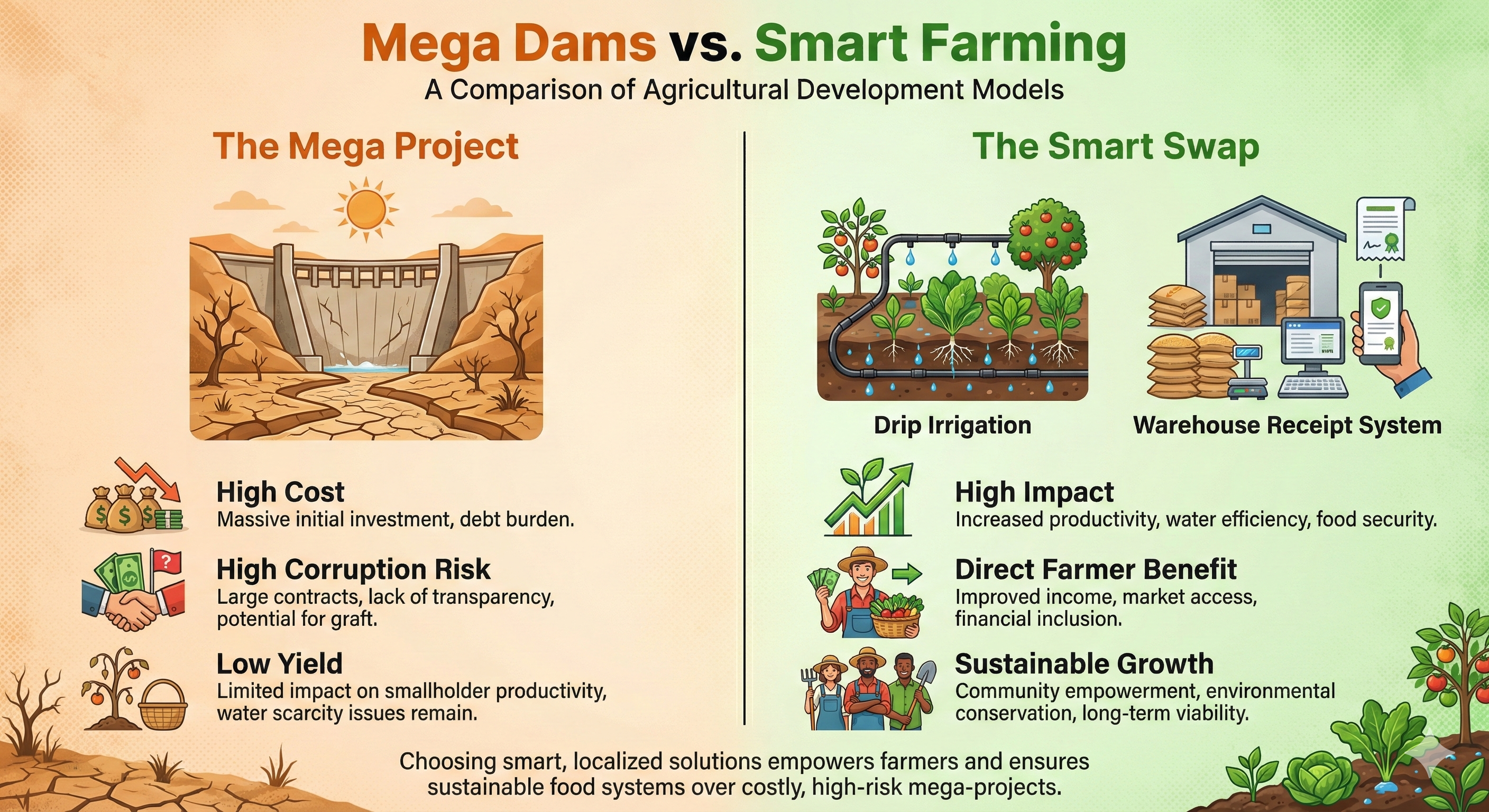
As the government targets 2 million acres for irrigation under the new debt swap initiative, the ghost of the Galana Kulalu project looms large. Just days ago, on January 26, 2026, the government announced plans for six new mega dams, signaling a return to the large-scale infrastructure strategy that failed so spectacularly in 2014. The original Galana Kulalu pilot consumed Sh7 billion to produce maize at costs higher than market price, collapsing under poor planning and corruption. Critics argue that repeating this “big dam” strategy ignores the hard-learned lessons of the past.
The disconnect is palpable. While the state plans mega-projects in arid lands, small-scale farmers—who produce the bulk of Kenya’s food—are struggling with basic input costs and lack of market access. The “savings” from the debt swap would likely yield higher returns if invested in decentralized solutions: household water pans, small-scale drip irrigation kits, and the Warehouse Receipt System (WRS) to help farmers store grain and avoid price exploitation by middlemen.
If the Sh129 billion is poured into another series of mega-dams, the funds risk being absorbed by contractors and consultants, leaving the country with more debt and no food. The success of this swap depends on shifting focus from concrete structures to the actual economics of farming—lowering production costs and ensuring profitability. Without this shift, we are merely “mixing oil and water” again, hoping that high-finance infrastructure will somehow trickle down to the grassroots.
References:
Capital Business Govt plans six mega dams, targets 2mn acres in irrigation push
The Star Government plans six mega dams, targets 2 million acres for irrigation push
🌦️ Wet West, Dry East: Why One Strategy Won’t Work for All in MAM 2026
The Kenya Meteorological Department (KMD) has dropped its forecast for the March-April-May (MAM) long rains, and it paints a picture of two very different planting seasons.
The Good News: If you are in the Highlands West of the Rift (Trans Nzoia, Uasin Gishu, Kericho) or the Lake Victoria Basin, get your tractors ready. The forecast predicts near-average to above-average rainfall. This is the green light for high-yield maize farming.
The Warning: For farmers in the Southeastern Lowlands (Kitui, Makueni), Northeastern, and the Coast, the forecast is tough. You are facing “near-average to below-average” rainfall, with a high chance of insignificant rains—meaning showers that wet the dust but don’t sustain a crop.
The Takeaway: Don’t copy your neighbor in Eldoret if you live in Machakos. The government is urging everyone to plant, but what you plant matters more than ever.
West: Go for maximum yield (600 series maize).
East/North: Go for survival (fast-maturing crops).
References:
Nairobi Leo Kenya Met Issues March-May 2026 Long Rains Forecast
Daily Nation End of drought in sight, but coming rains will be insignificant for arid regions
All Africa Above-Average Rains Expected in Key Regions, Weatherman Warns of Dry Spells Elsewhere
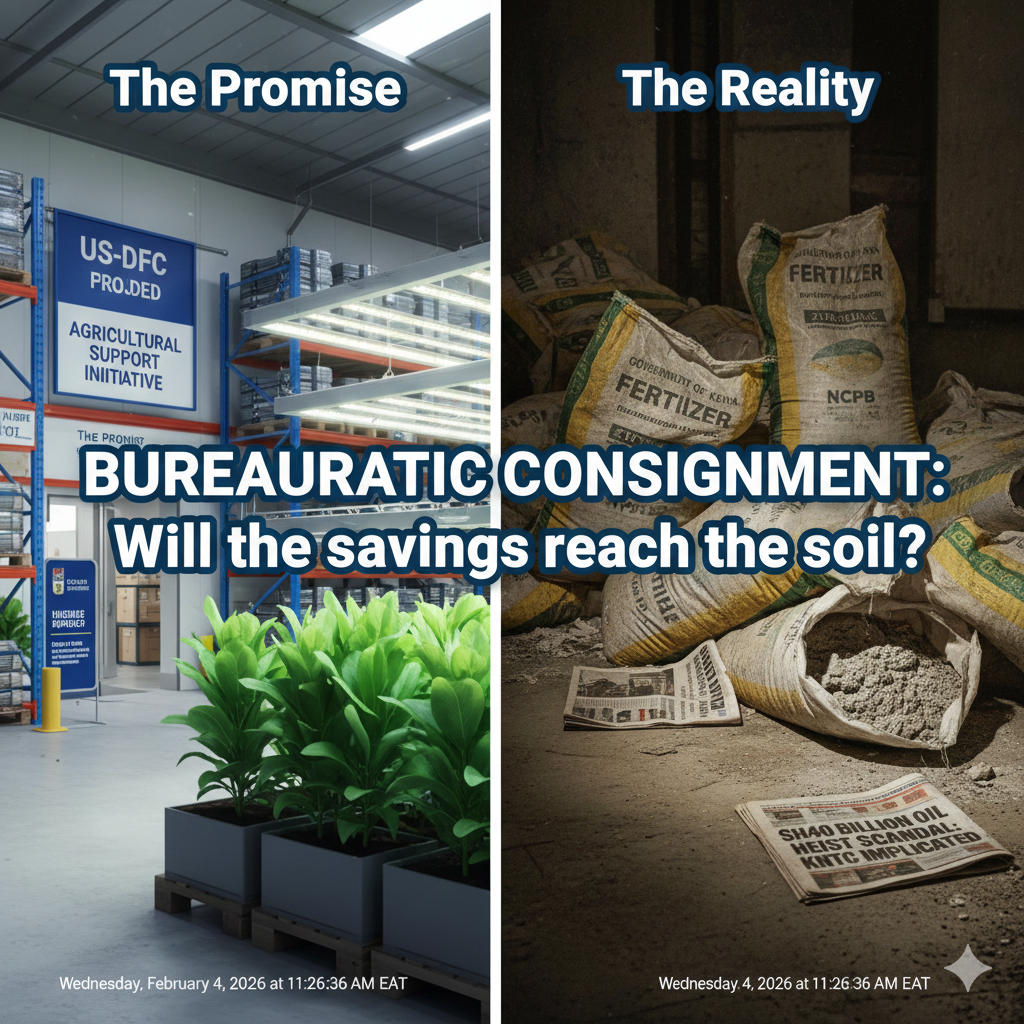
The “Food-for-Eurobond” deal relies on a dangerous assumption: that savings from international debt relief can navigate the treacherous waters of Kenya’s local bureaucracy without being looted. History suggests this is an “oil and water” scenario—liquid finance attempting to mix with a rigid, opaque system. The recent scandals at the Kenya National Trading Corporation (KNTC) and the National Cereals and Produce Board (NCPB) serve as grim warnings. In the KNTC edible oils scandal, tax waivers meant to lower prices were captured by politically connected firms, resulting in a Sh16.5 billion loss with no benefit to the consumer.
Similarly, the NCPB’s recent distribution of “fake fertilizer”—bags filled with quarry dust—demonstrates how easily “agricultural support” can be weaponized against the farmers it is meant to help. If the swap funds are channeled through these same “bureaucratic consignments,” the initiative risks becoming another slush fund for cartels. The involvement of the World Food Programme (WFP) is intended to act as an “emulsifier,” forcing accountability into the system, but their oversight powers will be tested against deeply entrenched patronage networks.
Experts warn that without a radical overhaul of state agencies, the “savings” will evaporate before they buy a single bag of genuine fertilizer or build a working silo. The structural disconnect between the Treasury’s high-level deal-making and the Ministry of Agriculture’s operational failures remains the single biggest risk. Unless the government bypasses these compromised intermediaries, perhaps by funding private sector credit guarantees instead of direct procurement, the “oil” of finance will float to the top, leaving the “water” of development murky and stagnant.
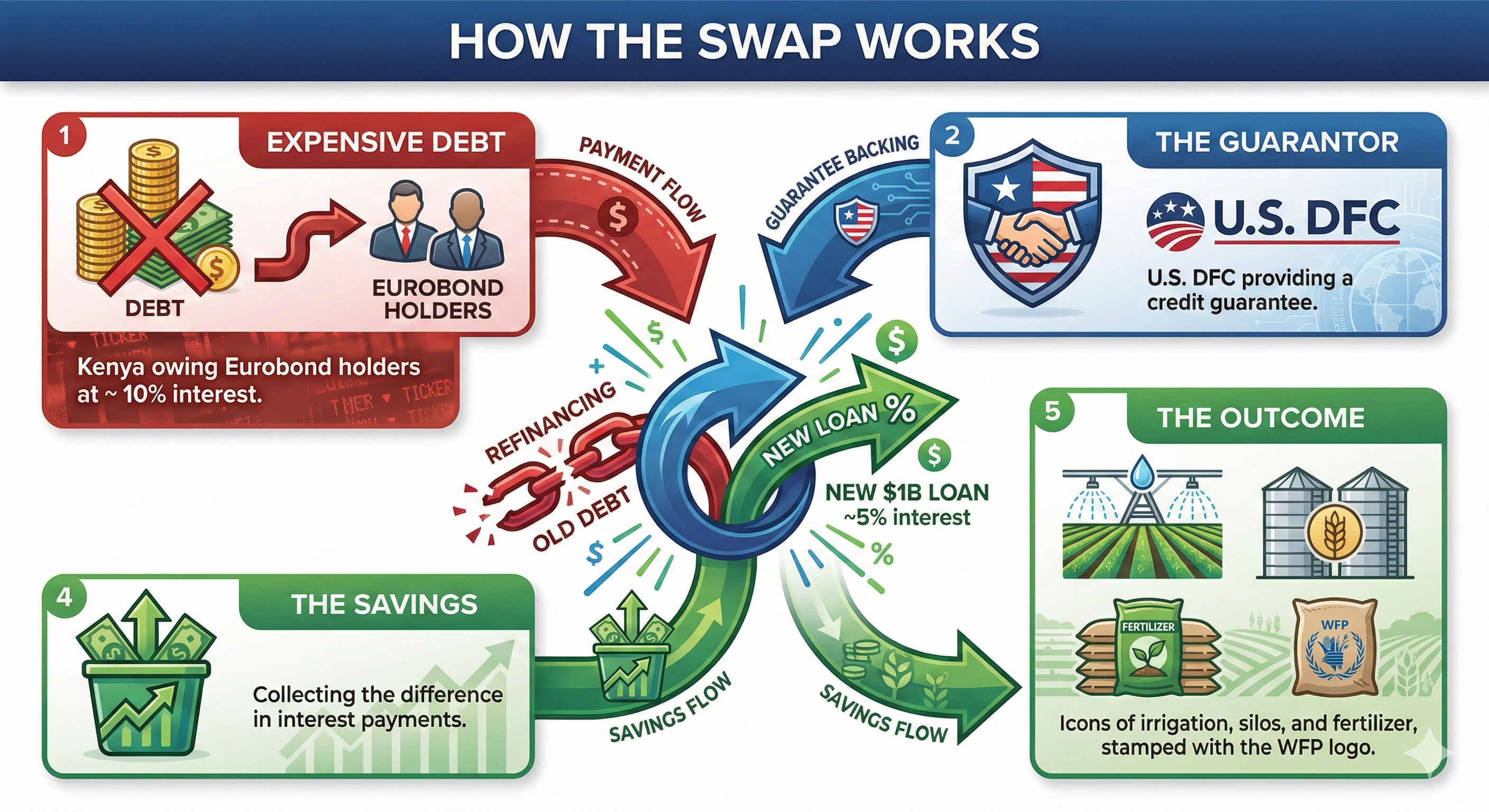
Kenya is on the verge of finalizing a landmark $1 billion (Sh129 billion) debt-for-food security swap, a sophisticated financial maneuver designed to rescue the country from a suffocating liquidity crunch. By leveraging a guarantee from the U.S. International Development Finance Corporation (DFC), the Treasury intends to refinance expensive Eurobond debt with cheaper, concessional loans. The plan is financially astute: it swaps high-interest commercial debt for lower-interest obligations, a move that prompted Moody’s to upgrade Kenya’s credit rating to B3 and stabilize the outlook on the nation’s sovereign debt.
However, the deal comes with a catch that transforms it from a simple refinancing operation into a complex development experiment. The interest “savings” generated from this swap must be ring-fenced and funneled directly into food security projects, managed in partnership with the World Food Programme (WFP). This arrangement effectively outsources a portion of national planning to an international body, admitting that the state needs external discipline to ensure funds aren’t diverted. While this stabilizes the shilling and pleases bondholders, it raises a fundamental question: is this a genuine strategy to feed the nation, or simply financial engineering to avoid default?
The stakes could not be higher. With 3.4 million Kenyans facing acute food insecurity and public debt service consuming over two-thirds of tax revenue, the government is betting that this “financial oil” can mix with the “water” of local agriculture without separating. If successful, it provides fiscal breathing room and lowers input costs for farmers; if it fails, Kenya will be left with the same debt burden and no improvement in the cost of living for the average wananchi.
What’s something you believe everyone should know.
One of the greatest truths in both physics and politics is this: power never disappears—it merely changes form. Just as energy can neither be created nor destroyed, political power, too, is a conserved force that shifts, mutates, and re-emerges. Tanzania’s recent history is a masterclass in this invisible law. Under the late President John Magufuli, the country witnessed a deliberate compression of democratic energy. Opposition rallies were banned, media voices silenced, and civil liberties choked under an increasingly authoritarian grip. The 2020 general elections—tainted by accusations of fraud and intimidation—did not destroy dissent; they simply converted it into dormant potential energy, locked within the state’s total control. What appeared as political dominance was, in essence, the gathering of immense pressure beneath the surface of the republic.
When Magufuli passed away in 2021 and Vice President Samia Suluhu Hassan took over, that compressed energy found a new expression. For a moment, Tanzania seemed to exhale. Political dialogue resumed, exiled opposition leaders like Tundu Lissu returned, and the media regained a measure of freedom. Yet this was not the dismantling of power but its phase shift—a transformation from brute coercion to soft diplomacy. The ruling party, CCM, maintained its institutional grip, only trading kinetic repression for the subtler currency of legitimacy and international goodwill. Tanzania’s newfound openness was real, but it was carefully managed; the core quantum of control remained untouched. The machinery of power, having changed its form, retained its full magnitude, calibrated now for persuasion instead of fear.
By 2023, the cycle completed itself. The language of reform gave way once more to the mechanics of control. Opposition figures were again entangled in legal webs, critics silenced through procedural precision, and the state’s energy of dominance reappeared cloaked in legality. The lesson is universal: no political power is ever destroyed—it only transforms. What matters is not whether power exists, but how it is expressed, shared, and held accountable. Citizens must therefore act as the catalysts of transformation, ensuring that this energy—inevitable, immense, and perpetual—remains a force for justice rather than repression. The equation, always, must balance.
Kenya is watching itself — pixel by pixel. Over the last five years, the country has built an unseen digital nervous system linking thousands of Huawei-powered Safe City cameras, police databases, and social-media monitoring tools. From downtown Nairobi to Mombasa’s seafront, every movement can be captured and cross-checked within seconds at the National Police Service Command Centre. Officials hail this as “smart security”; critics call it the birth of an algorithmic state. It is now evident that Kenya’s system is among the most extensive in sub-Saharan Africa — facial recognition, automatic number-plate readers, and voice analytics feeding a real-time surveillance web. Civil-rights groups such as Article 19 Eastern Africa warn that the same technologies meant to protect citizens are increasingly used to watch them, often without consent or transparency.
The legal architecture meant to contain this power is full of blind spots. The Cybercrimes (Amendment) Act 2024 widened government interception powers and allowed the Communications Authority to pull down online content on loosely defined “security” grounds. Meanwhile, the National Intelligence Service runs data-fusion platforms that combine SIM registration, mobile-money, and tax records — none of which fall under the Data Protection Act’s civilian oversight. The Office of the Data Protection Commissioner cannot audit national-security operations, leaving surveillance programs completely opaque. As the Kenya Human Rights Commission noted in an April 2024 brief, “privacy protections collapse precisely where the State holds the most data.” In the name of safety, a culture of monitoring has replaced a culture of accountability.
Kenya’s experiment is shaping regional norms. The Huawei model first tested in Nairobi has now appeared in Ethiopia, Uganda, and Tanzania, while Western donors — from the EU to Interpol — fund “cyber-capacity” projects that quietly expand the same infrastructure. Analysts describe this as a surveillance compromise: Eastern hardware, Western money, African data. What began as a modernization effort has become a mirror of global power politics — a democracy borrowing the tools of autocracy to stay secure. Unless Parliament enacts a Surveillance Oversight Law and empowers independent audits, Kenya risks institutionalizing fear as policy. The technology that promised protection now records obedience, and in this new digital republic one truth persists: the cameras no longer blink — they remember.
References:
Article 19 Eastern Africa Surveillance, data protection, and freedom of expression in Kenya and Uganda during COVID-19
The Kenyan Wall Street Kenya Upgrades Cybercrime Law to Hand Gov’t Sweeping Powers to Block Websites
The Star Controversial Cybercrime Act: What they said
Huawei Safaricom:Enhancing Security in Kenya with Huawei’s Converged Command & Control Solution
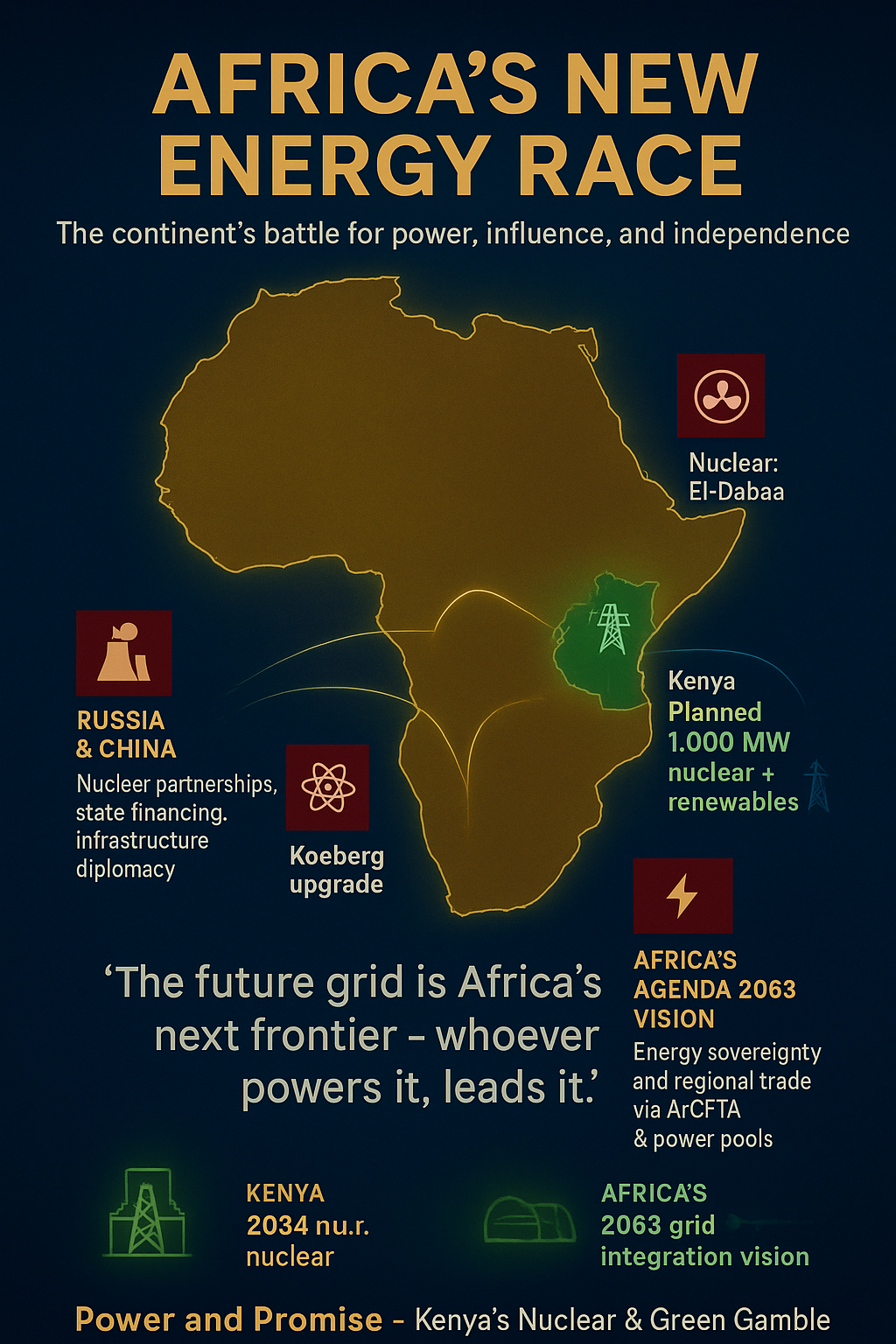
Africa’s energy landscape is shifting faster than at any time in its postcolonial history. From North Africa’s nuclear ventures to Southern Africa’s hydrogen ambitions, the continent is quietly constructing a new map of power — one defined not by oil reserves, but by grid capacity and global alliances. Russia and China are embedding influence through nuclear partnerships; the United States and Europe counter with renewables and clean-tech financing. Across the continent, energy has become the new currency of diplomacy. The story is no longer about light bulbs and power stations — it’s about sovereignty, soft power, and survival. And in this unfolding drama, Kenya stands at the intersection of ambition and caution, armed with geothermal prowess, nuclear dreams, and the burden of fiscal fragility.
Kenya’s choices now echo far beyond its borders. Once hailed as Africa’s renewable beacon, the nation’s dual pursuit of nuclear energy and grid modernization could redefine East Africa’s energy future — or divide it. Egypt’s El-Dabaa reactor is already nearing completion; South Africa is upgrading its Koeberg plant; and Uganda and Ghana are moving from feasibility to formal partnerships. Kenya, strategically perched in the Eastern Africa Power Pool, holds the potential to become a regional energy exporter, a stabilizer in a volatile market. Yet that promise hinges on policy discipline and trust — two currencies Kenya is struggling to sustain. Its fiscal instability, opaque power contracts, and political indecision risk eroding the credibility needed to lead the continental transition. The dream of an integrated African grid may depend less on megawatts and more on governance — and Kenya’s ability to align vision with viability.
The next decade will determine whether Kenya emerges as a powerful nation or merely a powered one. To lead Africa’s energy race, it must balance ambition with accountability, geopolitics with pragmatism. This is not just about building reactors or expanding wind farms — it’s about mastering the grid as an instrument of economic independence and continental diplomacy. The nuclear plant, if realized, will stand not merely as a symbol of technological progress, but as a test of strategic maturity. For Africa, and Kenya especially, the energy race is no longer about who generates power — it’s about who commands it. The atom, the turbine, and the tariff are now the instruments of influence. Kenya’s gamble could define not just its own future, but the direction of Africa’s entire energy destiny.
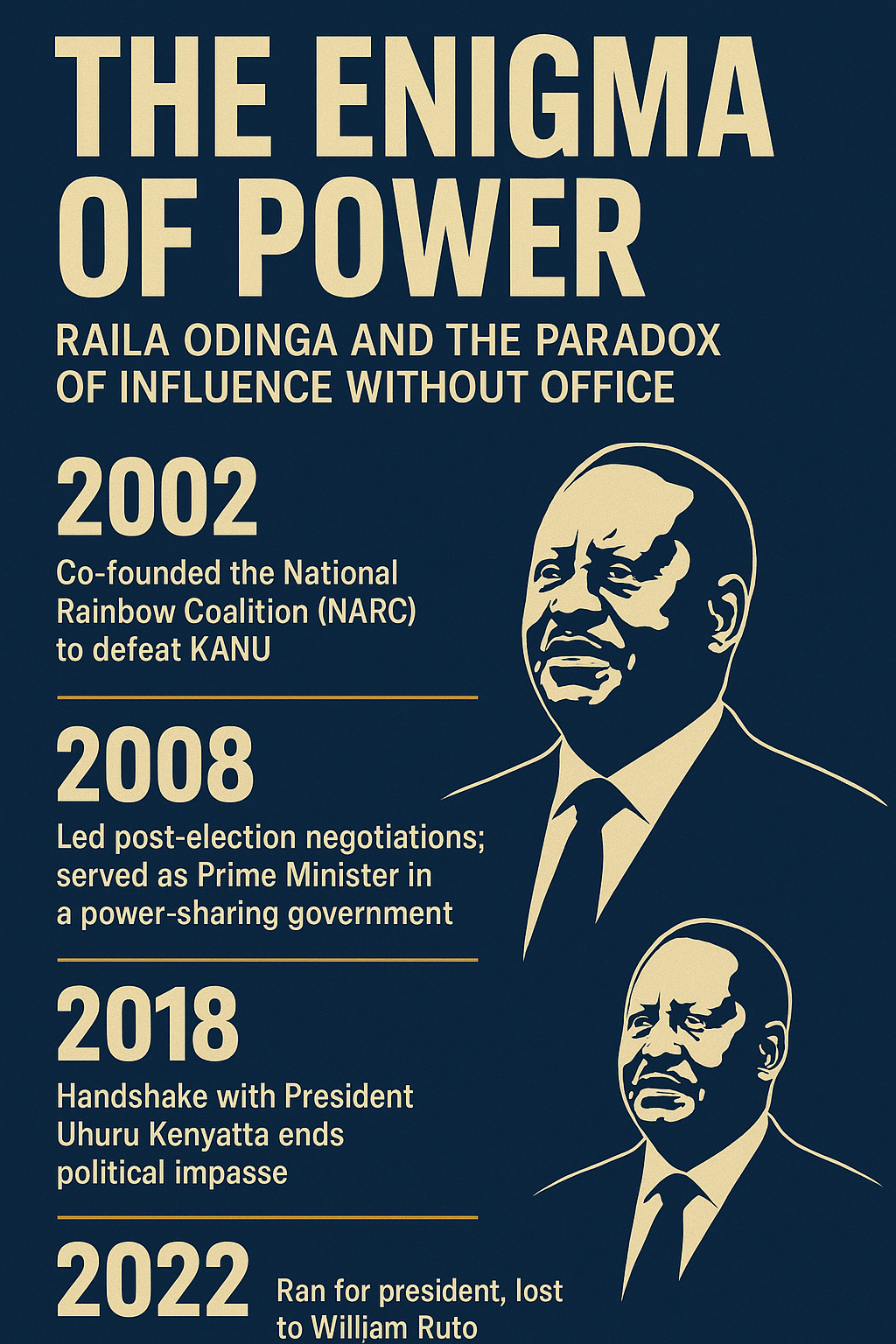
History rarely rewards those who come close — but in Raila Odinga’s case, proximity itself became the point of power. For more than four decades, Raila lived at the edge of power yet shaped every regime from within the shadows of opposition. He was, as The Africa Report aptly put it, “the man who lost every election but won Kenya’s democracy.” From the twilight of Daniel arap Moi’s rule to the dawn of Kenya’s multiparty renaissance, Raila’s defiance never waned — earning him both fear and reverence in equal measure. In 2002, when KANU’s dominance finally cracked, it was his dramatic declaration of “Kibaki Tosha” that propelled Mwai Kibaki to State House and ushered in the first peaceful transfer of power in Kenya’s history. Yet even in victory, Raila remained the outsider: betrayed by broken coalition promises, sidelined by those he helped elect. Still, he never relinquished the moral authority of the people’s voice. In 2005, his “Orange” movement defeated Kibaki’s draft constitution — a rare case of an opposition leader reshaping national destiny without holding office. And when the 2007 elections collapsed into violence, it was again Raila’s resilience that forced Kenya back from the brink, transforming a disputed vote into a dialogue for survival. Through pain, loss, and endurance, he became less a politician and more a barometer of Kenya’s democratic conscience — the man who could lose and still lead.
Raila’s power was never institutional; it was cultural, narrative, and profoundly human. He understood Kenya’s pulse — and weaponised symbolism like few before him. His aliases — Agwambo, Tinga, Baba — transcended politics, morphing into collective identities of resistance, belonging, and hope. His supporters saw in him their own unfulfilled promise; his rivals, a reminder that legitimacy cannot be decreed. Each administration that followed — from Kibaki to Kenyatta to Ruto — has been shaped, challenged, or legitimised by Raila’s political presence. As Prime Minister in the 2008 Grand Coalition, he co-supervised the nation’s reconstruction after post-election chaos and championed reforms that birthed the 2010 Constitution — arguably his greatest institutional legacy. That charter redefined Kenyan governance, devolving power to the counties and embedding civil rights into law, echoing the principles for which he had once been jailed. Later, his controversial 2018 “Handshake” with President Uhuru Kenyatta ended months of unrest following the disputed 2017 polls and restored political calm — though it also fractured his traditional support base. Yet, even that act reinforced his lifelong philosophy: that peace, not position, defines statesmanship. His later appointment as the African Union’s High Representative for Infrastructure confirmed his continental stature — a statesman recognised beyond Kenya’s borders for blending political endurance with technocratic vision.
In the end, Raila Odinga’s paradox was not that he failed to capture the presidency, but that he redefined what power itself means in a fragile democracy. His defeats never diminished his influence; they amplified it. Every president who took office did so under the long shadow of his moral authority. He forced institutions to evolve, compelled courts to assert independence, and transformed the vocabulary of opposition into the grammar of governance. In his twilight years, even adversaries acknowledged that Kenya’s political story could not be told without him — that every victory or reform bore his fingerprints somewhere beneath the surface. He was both architect and agitator, healer and heretic, rebel and reformer. Raila Odinga never occupied State House, but he changed what it stood for — from a fortress of fear to a house answerable to its citizens. And as the nation continues to wrestle with the legacy of leadership and legitimacy, his life offers a sobering truth: that true power is not seized, but earned — and sometimes, it lives longest in the hands of those who never hold the crown.
References:
The Africa Report Raila Odinga: The man who lost every election but won Kenya’s democracy
The Star Raila Odinga: The man who changed Kenya without ever ruling it
The Star Most consequential politician in history of Kenya bows out
All Africa Kenya Mourns Raila Odinga ‘The President’ It Never Had
TRT World Raila Odinga: Kenya’s political enigma never left the stage
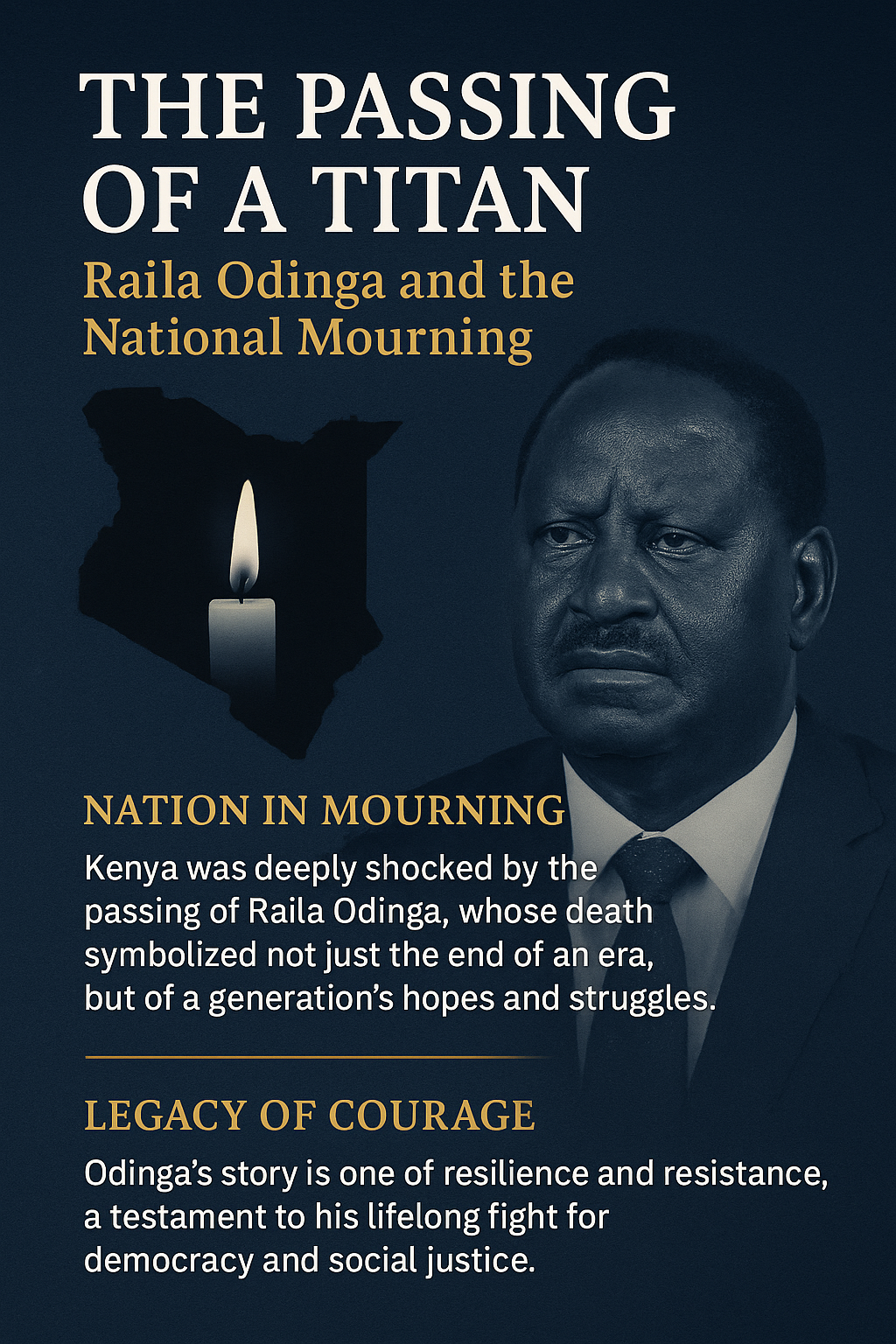
When the news broke that Raila Amolo Odinga had breathed his last, Kenya did not just lose a leader — it lost a paradox made flesh. He was the man who never won the presidency, yet arguably won the soul of Kenya’s democracy — the one who lost every major election but gained the moral authority few in power ever matched. Across towns and villages, in markets and offices, a shared stillness settled like evening dew — part disbelief, part reverence. Television stations turned monochrome; social feeds filled with memories of rallies, reform, and resilience. From Kibera to Kisumu, from Nairobi to Namanga, Raila’s name echoed in chants of grief and gratitude. He was more than a politician; he was the pulse of a people who found in him the courage to speak, to dissent, and to dream. To many, Raila Odinga was Kenya’s moral compass — the man who, even in loss, made millions believe in the promise of justice.
As the state prepared to honour him, the weight of history pressed against the walls of memory. Here was a man who had been imprisoned for ideals, tortured for his convictions, yet emerged each time more resolute than before. The tributes flowing in from across Africa captured this paradox of pain and purpose — Tanzania’s President calling him “the conscience of East Africa,” Nigeria’s Senate hailing him as “a reformer who saw power as duty, not privilege.” In Nairobi, the national flag flew at half-mast, while Parliament prepared to host what may be the most emotionally charged state funeral in decades. But behind the ceremonies lay a deeper reckoning — the realization that Kenya’s democratic soul was, in many ways, shaped by one man’s endurance. To chronicle Raila’s life is to trace the country’s long struggle between oppression and reform, silence and voice, fear and freedom.
And now, in death, his story returns to the people who carried him for half a century — the voters who called him “Baba,” the youth who painted his slogans, the rivals who feared yet respected him. His passing is not just a political event; it is a national rite of reflection — a chance for Kenya to measure how far it has come, and how far it still must go to realize the ideals he fought for. In the coming posts of this legacy series, we will explore those ideals — from his days in detention to his time as Prime Minister, from his Pan-African mission to his unfinished democratic dream. Raila Odinga’s journey did not end with his last breath; it endures in the conscience of a nation still learning to live up to the ideals he refused to abandon. Stay with us as we begin this national remembrance — a chronicle of courage, conviction, and continuity.
References:
BBC ‘Father of our democracy’: Kenya’s Raila Odinga dies in India aged 80
The Standard Raila Odinga’s death: What the world is saying
France 24 Kenya opposition leader Raila Odinga dies, sparking emotion, uncertainty


 Jijuze