Trust Deficit: Kenya’s Labor Crisis Explained

Kenya’s recurring waves of labor strikes reveal a crisis far deeper than wage disputes or delayed allowances—they point to a fundamental trust deficit between workers, their unions, and the state. From teachers to doctors, nearly every major sector has, at some point, downed tools in protest. Each time, negotiations end with government signing collective bargaining agreements (CBAs) it struggles—or refuses outright—to honor. The result is a vicious cycle: unions mobilize, the government promises, arrears pile up, and new strikes erupt. This perpetual conflict has eroded the credibility of institutions meant to safeguard industrial harmony, leaving both service delivery and economic stability hostage to distrust.

Trust deficit as Kenya's Undoing

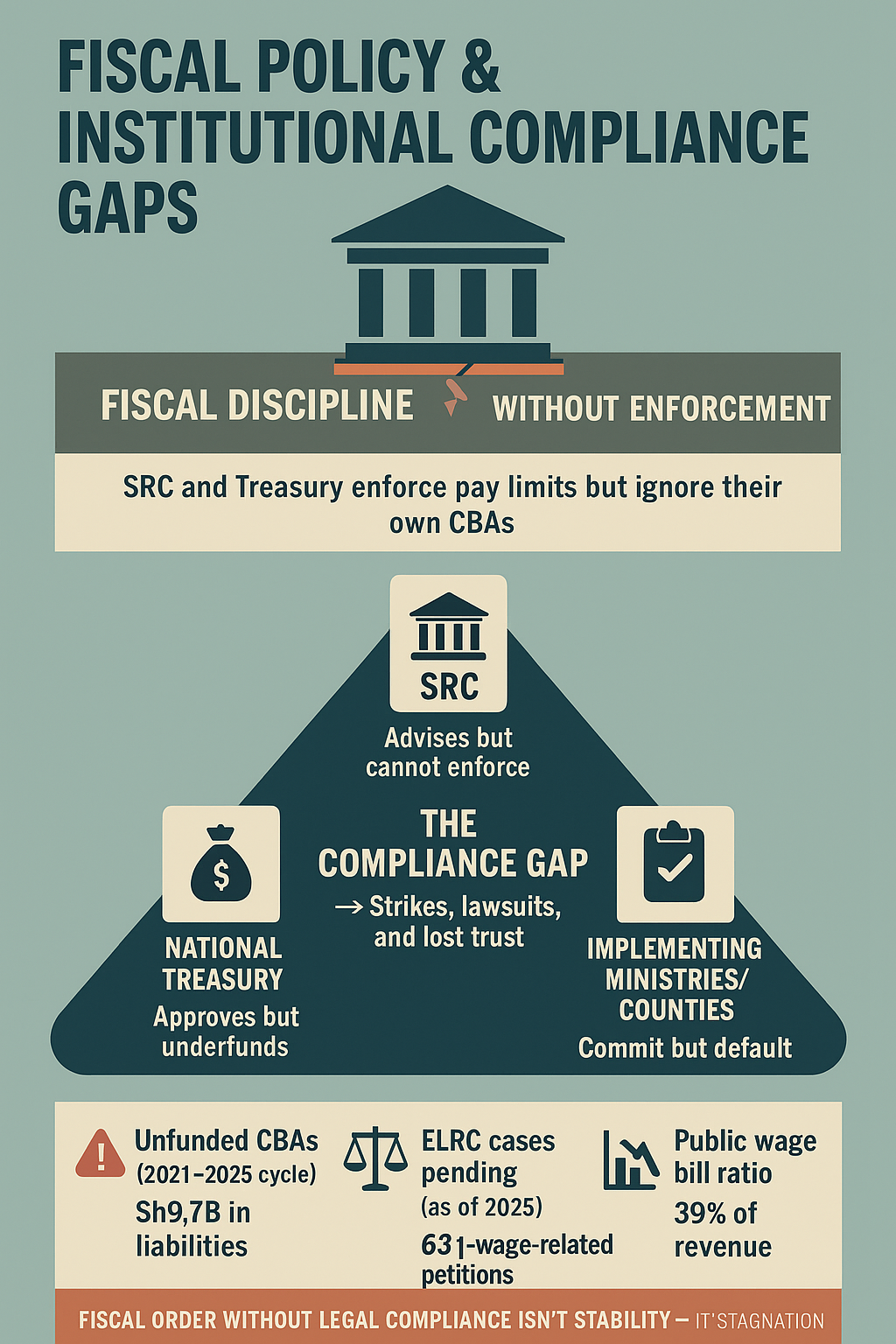
At the heart of the matter is governance failure. Ministries, parastatals, and the National Treasury routinely blame one another for delayed payments or stalled promotions, creating an accountability vacuum. The Salaries and Remuneration Commission (SRC), meant to be the fiscal referee, is shackled by lack of enforcement powers, reducing it to a “recommendations desk” with little bite. This gap between policy pronouncements and actual execution has not only fueled suspicion among workers but also entrenched cynicism among citizens. When doctors or teachers take to the streets, the public sees not just disgruntled professionals but a state apparatus incapable of keeping its word. In such an environment, even genuine calls for fiscal restraint sound hollow, because credibility has already been squandered.

The trust deficit is not an abstract concept; it’s Kenya’s undoing. A nation cannot build a resilient education system if teachers constantly fear stalled promotions, nor can it deliver universal healthcare when doctors are unsure if their salaries will come through. Investors, too, read these signals—constant strikes flag an unstable labor environment, making Kenya a costlier and riskier place to do business. To restore confidence, government must urgently bridge the gap between rhetoric and reality: fund agreements it signs, empower regulatory bodies to enforce compliance, and practice transparency in fiscal commitments. Until then, Kenya’s labor landscape will remain a theatre of promises made and promises broken, with the trust deficit at its core.

References:

KMPDU Promise Made, Promise Kept As Doctors Receive Full 2017–2024 CBA Arrears

BMJ Global Health Tackling health professionals’ strikes: an essential part of health system strengthening in Kenya

TV47 Kenya “Trust deficit is Kenya Kwanza’s greatest undoing” – MP Makali Mulu


Understanding Kenya’s Investment Landscape Amid Fiscal Strain

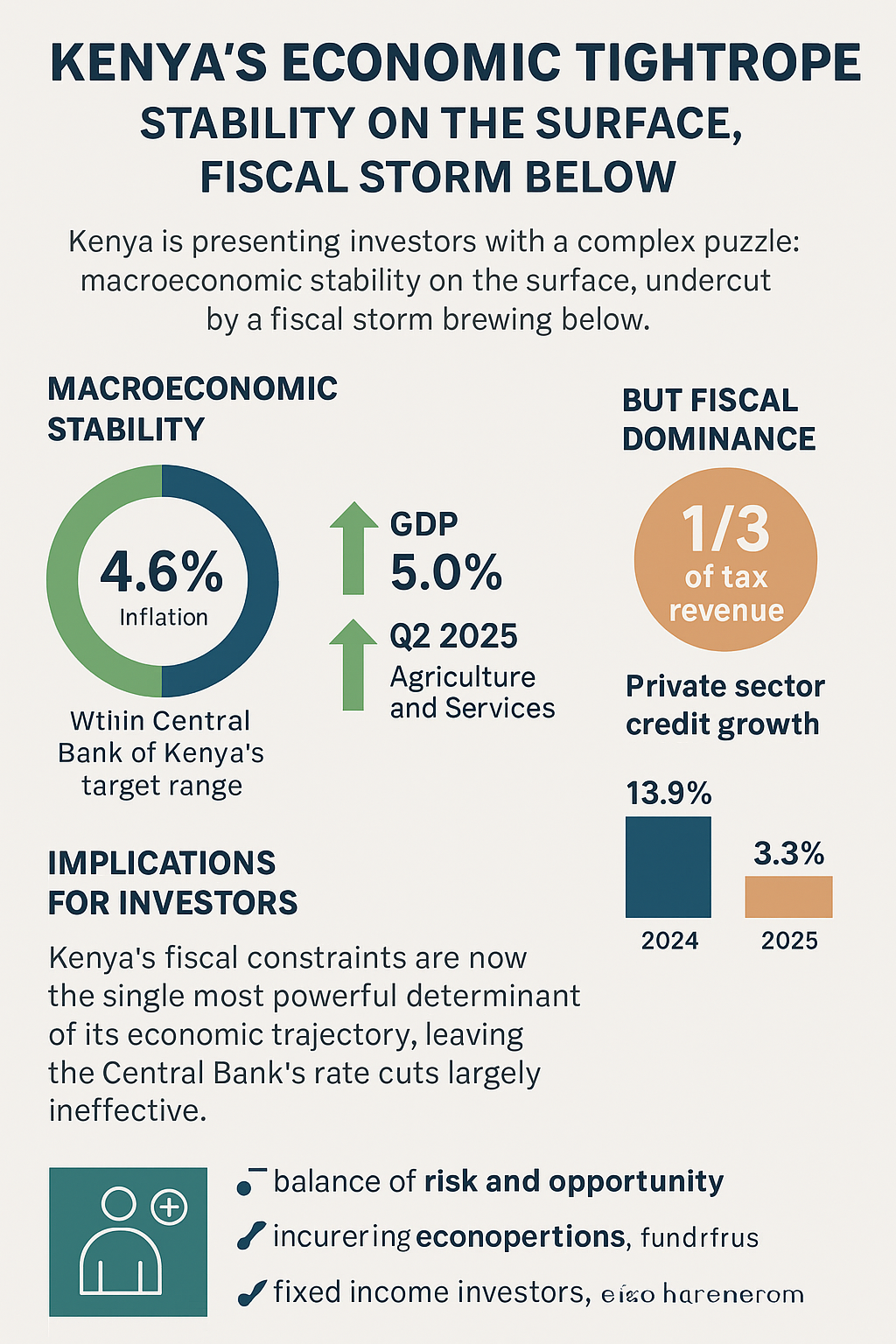
Kenya’s economy is presenting investors with one of its most complex puzzles yet: macroeconomic stability on the surface, undercut by a fiscal storm brewing beneath. Inflation stands at a steady 4.6%—comfortably within the Central Bank of Kenya’s target range—granting policymakers room for monetary easing. GDP data also reflects resilience, with Q2 2025 growth at 5.0%, led by agriculture and a robust services sector. Yet behind these encouraging numbers lies a sobering reality: fiscal dominance. With interest payments now consuming roughly a third of all tax revenue, the government’s borrowing appetite is crowding out private credit. Commercial banks, chasing high-yield government paper, have little incentive to lower lending rates for businesses, leaving private sector credit growth crippled at barely 3.3%, down from 13.9% just a year ago.

This squeeze is not just an abstract statistic; it defines the contours of Kenya’s medium-term investment landscape. The government projects a 5.3% full-year expansion, but global institutions remain unconvinced. The IMF and World Bank forecast growth at 4.8% and 4.5% respectively, citing weak private sector consumption, a sluggish credit channel, and a high risk of debt distress. Kenya’s fiscal constraints are now the single most powerful determinant of its economic trajectory, leaving the Central Bank’s rate cuts largely ineffective. The implication for investors is clear: headline GDP growth masks a structural imbalance where state borrowing sets the price of credit and private enterprise takes a back seat.

The balance of risk and opportunity lies in how investors position themselves. Kenya’s external buffers—rising remittances, strong agricultural exports, and narrowed current account deficit—are encouraging, but remain fragile, as all three are highly exposed to global downturns. For fixed income investors, short-duration government paper offers yield but carries sovereign risk that cannot be ignored. For equities, defensive plays in export-driven agribusiness, technology, and digital services stand out, while firms reliant on domestic mass-market credit may falter. Direct investment opportunities exist in renewable energy, climate-linked finance, and tech, sectors less tied to domestic fiscal strain. For corporate strategists, survival hinges on operational efficiency, alternative financing, and robust risk management to cushion external shocks. Kenya stands at a decisive juncture: without credible fiscal consolidation, its growth story risks becoming a cycle of constrained resilience. For investors, the key lies not just in reading the numbers, but in recognizing the limits of resilience when credit and capital are structurally captured by the state.

References:

KNBS Inflation Rate (CPI)

CNBC Africa Kenya’s inflation rises slightly in September on food, transport

World Bank Group Despite Improvements, Kenya’s Fiscal Path is Fragile Amid High Debt Vulnerabilities and Weak Revenue Growth

Corruption Shockwaves: Ruto’s Bold Claims on Kenya’s Legislative Integrity

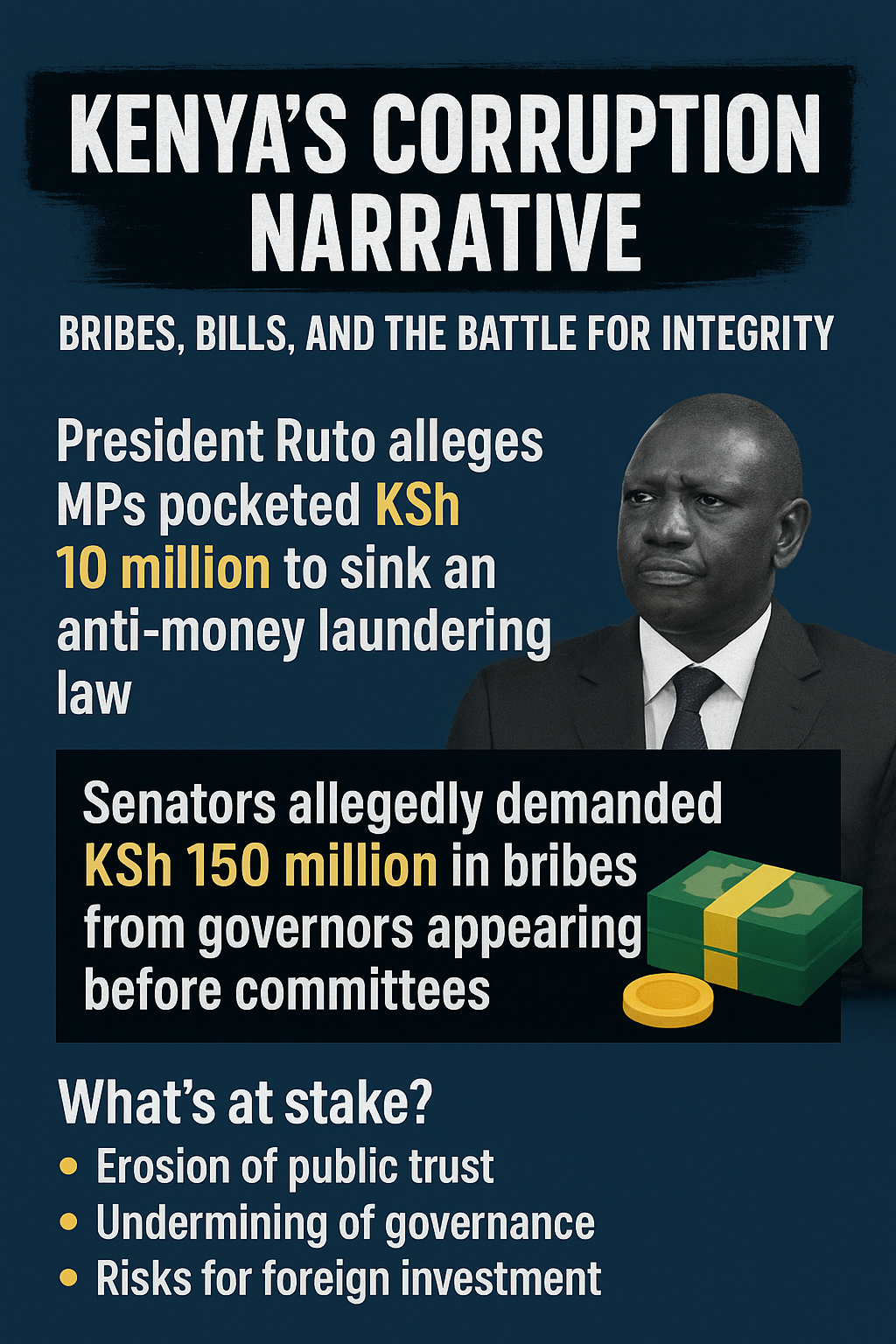
When President William Ruto stood before UDA and ODM legislators on August 18, 2025, and declared that MPs had pocketed KSh 10 million to sink an anti-money laundering bill, while senators allegedly demanded up to KSh 150 million from governors under probe, it marked a seismic moment in Kenya’s corruption narrative. Unlike broad platitudes, these allegations were laced with precision—figures, targets, and the President’s insistence that he was a “consumer of raw intelligence” with knowledge of what was happening behind closed doors. For a country where the shadow of graft often hovers without names or numbers, Ruto’s bluntness pulled corruption out of abstraction and into the raw theatre of governance. The fallout is immense. It not only raises fundamental questions about the integrity of Kenya’s legislative processes but also highlights how deep-rooted corruption risks sabotaging reforms critical to stabilizing the economy, securing donor confidence, and reinforcing Kenya’s democratic fabric.

Such high profile claims cannot be dismissed as political theatre. They expose systemic vulnerabilities where the very guardians of accountability—parliamentary watchdog committees—become gatekeepers of extortion. By placing a price tag on oversight, lawmakers distort the balance of power, weaken enforcement of financial transparency laws, and compromise Kenya’s commitments to international anti-money laundering standards. In practical terms, this jeopardizes more than just the passage of bills: it risks the credibility of Kenya’s financial system, threatening remittance flows, investor trust, and even compliance with IMF and FATF benchmarks. The long-term stakes are enormous. If parliamentarians are perceived as auctioneers of governance, global institutions will tighten their scrutiny, and Kenya’s economy—already weighed down by debt and unemployment—will carry the burden of political impunity.

The President’s vow to arrest both givers and takers of bribes presents a moment of reckoning. Rhetoric without enforcement risks deepening public cynicism rather than rebuilding confidence. What hangs in the balance is Kenya’s ability to demonstrate that governance is not negotiable, and that the fight against corruption is not a selective weapon but a consistent national ethic. Civil society and international observers are watching closely, and the diaspora too remains alert to how corruption narratives shape Kenya’s global reputation. At stake is not just legislative credibility, but the country’s standing as a functional democracy and competitive economy. If Kenya cannot confront and dismantle these entrenched practices, the corruption narrative will continue to define—not just distort—its future.

References:

The Star Some MPs received Sh10 million to sink anti-money laundering law – Ruto

The Star MP Makilap wants Ruto to publicly name corrupt lawmakers

Transparency International Kenya 2024 CORRUPTION PERCEPTIONS INDEX REVEALS HOW WEAK ANTI-CORRUPTION MEASURES UNDERMINE CLIMATE ACTION AND CONTRIBUTE TO THE VIOLATION OF HUMAN RIGHTS

Econfin Agency Kenya Creates Multi-Agency Task Force to Fight Corruption

Citizen Digital East Africa’s investment potential: Why leaders need to tackle corruption

Jijuze Combatting Fraud in Kenya’s Tourism: A Growing Threat


Kenya’s Event Security Challenges: A Wake-Up Call

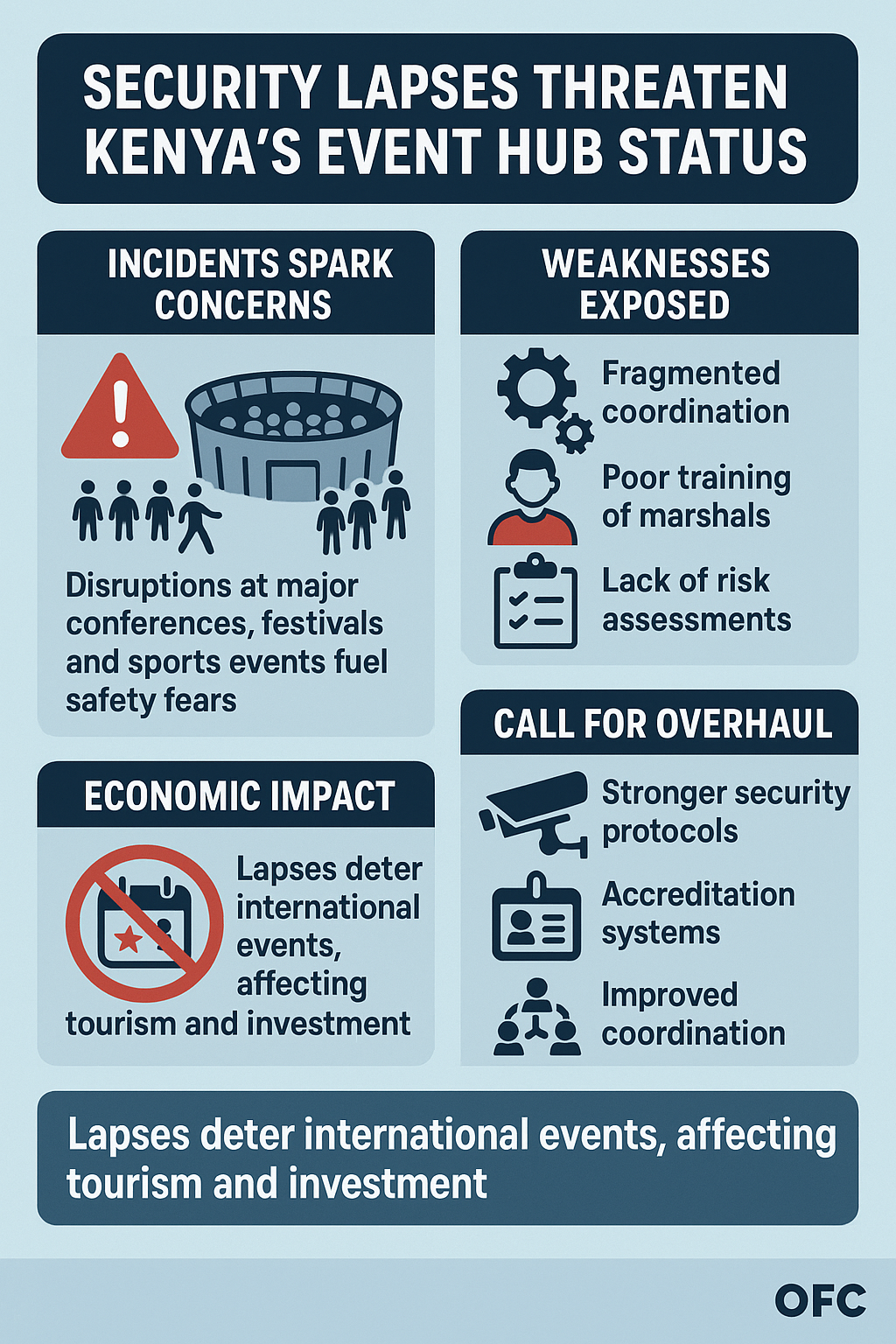
Kenya’s growing profile as a hub for international conferences, cultural festivals, and major sporting events hangs in the balance, threatened by a persistent and damaging weakness—event security lapses. The recent spate of high-profile disruptions, from chaotic crowd control failures to delayed emergency responses, has reignited fears that the country’s infrastructure and management systems are not keeping pace with its ambitions. While Kenya has successfully hosted large-scale gatherings in the past, these successes are increasingly overshadowed by incidents that put both safety and the nation’s reputation at risk. For a tourism and investment-driven economy, where marquee events serve as global shop windows, the stakes could not be higher. Any perception that Kenya cannot guarantee the safety of participants and spectators risks deterring international organizers, sponsors, and attendees, redirecting both revenue and influence to competing destinations.

At the core of the problem lies a combination of fragmented coordination among security agencies, inadequate training for event marshals, and a lack of robust, preemptive risk assessments. Large-scale events—from global athletics meets to high-profile music festivals—often depend on ad hoc arrangements, with security strategies being reactive rather than proactive. This has led to avoidable breaches, where unruly crowd surges, unauthorized access, and even petty crime have disrupted otherwise well-planned programs. For international guests, especially those attending for the first time, such lapses create a lasting negative impression, overshadowing the event’s core purpose and undermining Kenya’s pitch as a safe, reliable host. Stakeholders in the hospitality, transport, and retail sectors warn that the ripple effects of diminished confidence could translate into real economic losses, especially in cities like Nairobi and Mombasa where event-linked tourism forms a major income stream.

The solution requires more than isolated fixes—it demands a systemic overhaul anchored in professionalism, technology, and accountability. Kenya must invest in event-specific security protocols that integrate crowd science, digital surveillance, and emergency response drills into every planning phase. Clear chains of command, mandatory accreditation systems, and cross-agency coordination hubs should be standard practice, not aspirational goals. Without this, the “Africa’s Meeting Place” narrative risks collapsing under the weight of recurring security failures. The opportunity cost is immense: from losing bids to host continental championships, to deterring corporate conventions, to stalling the growth of cultural tourism. Kenya’s position as an event destination of choice is not guaranteed; it must be earned and safeguarded through consistent, visible competence. If the country cannot put its house in order, it may soon find the world taking its events—and its investment—elsewhere.

References:

Jijuze How CHAN 2024 is Boosting Tourism and Infrastructure in East Africa

The Kenyan Wall Street Legacy or Liability? Putting Kenya’s CHAN 2024 Moment Under the Lens

GhanaWeb Crowd disorder at CHAN raises concerns in Kenya

Pulse Sports Protect the Game: How CHAN 2024 Fans Can Keep Big Tournaments Coming to Kenya

FlashScore 2024 CHAN: Kenya fined by CAF again over multiple safety and security breaches

The Standard CHAN 2024: Why Kenya could lose quarterfinal hosting rights

Combatting Fraud in Kenya’s Tourism: A Growing Threat

Kenya’s tourism industry, a vital pillar of the economy and a top foreign exchange earner, is now battling a growing reputational threat: sophisticated fraud targeting unsuspecting travelers. According to the latest sector review, a surge in fake booking websites, impersonated tour operators, and fraudulent payment channels is eroding visitor trust and undermining the gains made in post-pandemic recovery. Many of these scams operate with alarming polish—using stolen branding, cloned websites, and even counterfeit licenses to lure victims into paying for non-existent safaris, hotel stays, or cultural tours. Victims, often diaspora Kenyans and international tourists planning high-value itineraries, only discover the deceit upon arrival, when their bookings prove fake and their funds unrecoverable. The Kenya Tourism Board (KTB) and sector associations have flagged these schemes as a systemic risk that, if unchecked, could tarnish Kenya’s image as a safe, reliable destination.

Industry stakeholders stress that the challenge is compounded by gaps in regulatory oversight, slow cross-border law enforcement cooperation, and limited consumer awareness in key source markets. Fraudsters exploit these vulnerabilities, targeting peak travel seasons and leveraging digital marketing channels to reach large audiences with minimal traceability. Tour operators report that such scams not only cause financial loss but also drive potential travelers toward competing destinations perceived as safer or better regulated. Its important to note that while Kenya’s tourism marketing campaigns have successfully reignited global interest, this momentum risks being reversed if fraud-related horror stories dominate travel forums and social media. Experts recommend a multi-pronged response: real-time verification systems for operators, a central registry of licensed tourism businesses accessible to the public, stronger digital fraud policing, and targeted awareness campaigns in both domestic and foreign markets.

To its credit, the government has begun aligning with these recommendations, with the Ministry of Tourism working alongside the Communications Authority, cybercrime units, and private-sector stakeholders to roll out verification platforms and consumer education drives. Pilots for an online “Tourism Trust Mark” are already underway, enabling travelers to authenticate operators before making payments. Additionally, diplomatic missions are being engaged to circulate fraud alerts in high-risk markets, while tourism associations are exploring partnerships with payment processors to flag suspicious transactions. These initiatives, if scaled and sustained, could restore confidence and reinforce Kenya’s brand as a secure, trustworthy destination. In an increasingly competitive global tourism landscape, safeguarding the integrity of the travel experience is no longer optional—it’s a prerequisite for growth. Kenya’s long-term competitiveness will hinge not just on the beauty of its landscapes, but on the trustworthiness of the path visitors take to reach them.

References:

Kenyans.co.ke DCI Arrest Suspect After Greek Tourist Loses Ksh3.6 Million in Maasai Mara Scam

Government of Canada Kenya travel advice

Action Fraud Kenya Romance Scam

Shian Safaris How to Avoid Being Conned on Your Travels in Kenya

Understanding Kenya’s eTA Troubles: What Travelers Need to Know

Kenya’s ambitious shift to a universal Electronic Travel Authorization (eTA) system on January 1, 2024, was meant to be a game-changer for tourism, projecting an image of digital efficiency and openness. The vision—replacing traditional visas with an online pre-authorization—was sold as “visa-free” travel for the world, echoing President William Ruto’s promise of easier entry and smoother travel. Yet, what travelers encountered was a reality at odds with the marketing: mandatory paid applications, detailed documentation requirements, and unpredictable processing times. For visitors from over 40 countries that once enjoyed genuine visa-free access, the change felt less like liberation and more like an unexpected hurdle. Industry insiders describe the rollout as a “bait and switch” that has not only dented Kenya’s reputation but also triggered fears of retaliatory entry restrictions abroad. This mismatch between promise and practice was compounded in March 2025 when the government quietly replaced a stable Swiss-developed system with a locally built platform plagued by downtimes, payment failures, and technical glitches—sparking a multi-million dollar lawsuit and months of operational chaos.

A Report by iVisa

The fallout has been costly. Tour operators, hotels, and airlines have all reported significant losses as delays, application failures, and the absence of a functional support framework have disrupted itineraries and led to cancellations. Airlines face fines of KES 1 million per passenger without valid eTA documentation, a policy that has left many travelers stranded at departure gates. While Kenya recorded a record-breaking Sh 452 billion in tourism revenue in 2024—driven largely by post-pandemic recovery and aggressive marketing—the eTA crisis has cast a long shadow. The country’s visa openness ranking plunged from 29th to 46th in Africa, eroding hard-earned goodwill and weakening its competitive edge against rivals like Ghana and Rwanda, which have fully opened their borders. Industry leaders, including the Kenya Association of Travel Agents (KATA) and the Kenya Tourism Federation (KTF), warn that unless systemic fixes are made, Kenya’s target of five million annual visitors by 2027 could be jeopardized. Their calls range from establishing an emergency “crisis desk” for stranded travelers to temporarily reinstating visas on arrival while the digital system is repaired.

In response to mounting pressure, the government has introduced notable policy reversals, exempting most African and Caribbean nationals from eTA requirements and promising faster approvals for others. At the same time, industry stakeholders and the Tourism Ministry are working to embed risk management into the process—introducing contingency measures such as backup server capacity, offline verification protocols at airports, and dedicated “rapid response” teams to assist travelers facing last-minute clearance issues. While KATA’s August 2025 meeting with Tourism CS Rebecca Miano confirmed that some operational bottlenecks remain for non-exempt travelers, these interventions are designed to ensure that no visitor’s trip is derailed by system errors or delays. The emphasis now is on creating a safety net that preserves the integrity of Kenya’s digital entry framework while protecting the traveler’s experience. In an era where seamless digital access is part of a destination’s brand, these safeguards—paired with transparent communication—are key to restoring confidence and reinforcing Kenya’s identity as a warm, accessible, and world-class destination.

References:

The Permanent Mission of the Republic of Kenya to the United Nations Implementation of Electronic Travel Authorization (eTA) in Kenya

Kenya Association of Travel Agents Tourism industry raises concerns over ETA system delays

eVisa How Foreigners Will Apply For Kenya ETA Before Visiting (Visa-Free Kenya)

Aljazeera ‘Bait and switch’: Why Kenya’s no-visa policy is drawing pushback

Kenya Association of Travel Agents KATA Meets Tourism CS Rebecca Miano to Address Sector Challenges and Strengthen Collaboration


How CHAN 2024 is Boosting Tourism and Infrastructure in East Africa

As the African Nations Championship (CHAN) 2024 shifts its focus to East Africa, the co-hosting of the tournament by Kenya, Tanzania, and Uganda represents a significant shift in leveraging sports for economic transformation. For Kenya, this is a vital opportunity to recover its sporting integrity after a disappointing bid in 2018, underscored by considerable investments in stadium infrastructure, notably in Nairobi’s Nyayo Stadium and Eldoret’s Kipchoge Keino facility. These venues serve not just as football fields but as epicenters for urban redevelopment, spurring enhancements in transportation, hospitality, and small business interactions. The rising bookings in Nairobi’s hospitality sector indicate that CHAN is influencing broader economic dynamics, while also acting as a political lever to expedite long-delayed public works, showcasing the power of football in aligning with national development agendas.

Tanzania’s strategy for CHAN 2024 is meticulously crafted around intentional, brand-driven national development, where the Benjamin Mkapa Stadium in Dar es Salaam is being promoted as a pivotal regional hub for intertwining sports, tourism, and diplomacy. The government is tying the tournament to a larger tourism revival initiative, highlighting not only Dar es Salaam but also related destinations such as Arusha, Zanzibar, and Kilimanjaro to attract visitors. With a projected TSh 85 billion anticipated to flow into the economy as a direct result of the events, Tanzania seeks to boost its visibility as a potential future AFCON bidder. This emphasis on long-term tourism sustainability and attractive international offerings is designed to craft a narrative of lasting impact that transcends the tournament.

As Uganda joins its neighbors in this collaborative effort, it is focusing on a community-centered approach despite logistical challenges concerning stadium upgrades. The government is investing in public-private partnerships that engage local artisans, vendors, and cultural showcases to ensure wider community involvement in the festivities. Investments in essential infrastructure, including public transport and sanitation, aim to position CHAN as a catalyst for enduring urban renewal. By pairing match experiences with unique local attractions like gorilla trekking and cultural tours, the Ugandan Tourism Board is working to transition CHAN visitors into long-term tourists. Overall, while the three nations unite to present East Africa as a cohesive travel destination, the urgent challenge lies in translating the tournament’s temporary excitement into lasting benefits for the region, effectively establishing their collective identity as a forward-thinking economic bloc.

References:

Citizen Digital Why CHAN 2024 is not just a tournament, but a catalyst for East Africa integration

The Standard CHAN 2024, Kenya’s opportunity to boost economy, tourism

Nile Post Uganda Co-Hosting CHAN 2024 is a Landmark Achievement in the Country’s Sports

EAC EAC to promote the region as a unified tourism destination at ITB Berlin 2025

IPP Media Zanzibar hotels overflow with tourists ahead of CHAN match

Aftershock: The Collateral Damage of USAID’s Exit from Kenya

The abrupt dissolution of USAID, catalyzed by the U.S. government’s sweeping “America First” foreign aid policy pivot, has left Kenya reeling from a vacuum of support once critical to its public health, agriculture, and economic systems. With over $2.5 billion in planned investments between 2020 and 2025, the agency was more than just a donor—it was woven into the fabric of Kenyan service delivery. The termination of 83% of USAID’s programs and the layoff of 94% of its staff effectively ended over six decades of robust U.S. development engagement. For Kenya, this rupture came without a viable transitional plan. Clinics shuttered, medicines vanished, and 40,000 jobs tied to health services evaporated. Programs such as PEPFAR, which had sustained over a million Kenyans on antiretroviral treatment, have been gutted, with HIV/AIDS funding slashed from $846M in 2023 to just $66M in 2025. Maternal health, malaria prevention, and reproductive health services now teeter at the edge of collapse, with service cuts exceeding 90% in some areas. Kenya’s health infrastructure, already strained, is now buckling under a loss that is not merely financial—but fatal.

The economic blowback extends far beyond healthcare. USAID had supported Kenya’s agriculture sector through subsidies, training, and innovation, all now dismantled. Smallholder farmers are especially vulnerable. With the termination of the Famine Early Warning Systems Network (FEWS NET) after four decades of operation, Kenya has lost its primary mechanism for forecasting and responding to food insecurity. Meanwhile, tax reforms in the proposed 2025 Finance Bill—removing VAT exemptions on farm inputs and raising fuel duties—compound the crisis, inflating production costs and shrinking rural margins. The convergence of aid withdrawal, policy shocks, and climate threats is deepening food insecurity and threatening to reverse years of agricultural gains. Simultaneously, the Kenyan startup ecosystem and governance reform sectors face a projected $100 million funding shortfall. Civil society actors, often powered by USAID support, now risk losing their watchdog capacity. In areas such as conflict prevention and refugee education, where USAID once acted as a stabilizing force, the vacuum could be exploited by extremist recruiters, echoing conflict patterns seen in past aid shock cases in West Africa.

Kenya’s response has been urgent but encumbered. The government has committed to repatriating its health data from U.S.-hosted systems and shifting toward local infrastructure, yet faces severe capacity shortfalls. The fiscal strain is formidable: a KSh 52 billion health budget hole and a broader KSh 66.9 billion gap across affected sectors. While the Bottom-Up Economic Transformation Agenda (BETA) reflects ambition for self-reliance through tax reforms and private investment, execution remains constrained by weak systems and widespread corruption. Still, civil society and policymakers are beginning to reframe the crisis as a wake-up call for domestic revenue mobilization and governance renewal. If there is a path forward, it lies in converting dependency into resilience—not just by replacing funding streams, but by rethinking national priorities, protecting human capital, and investing in sovereign, accountable systems that can withstand future geopolitical shocks.

References:

Citizen Digital Over 40,000 Kenyans jobless after USAID-funded health facilities shut down

The Voice of Africa USAID Shuts Down After 63 Years, Leaving Africa in Crisis

The Star Civil society calls for self-reliance as foreign aid dwindles

Africa.com Kenya to Reclaim Health Data After Trump Administration’s USAID Cuts

Jijuze Kenya Faces Crisis After USAID Funding Withdrawal

Capital Business USAID funding halt to hit Kenya’s economy, social sectors – report

Audit vs. Austerity: The IMF’s Role in Kenya’s Recovery

Kenya is on the edge of a pivotal financial reckoning. In the wake of the 2024 Finance Bill’s withdrawal and amid a battered economy, the International Monetary Fund (IMF) has demanded a sweeping corruption audit before any further disbursement of financial aid. At stake is more than KSh 100 billion in support tied to Kenya’s Extended Fund Facility, Extended Credit Facility, and Resilience and Sustainability Facility—aid that could help stabilize an economy reeling from debt, inflation, and political distractions. The collapse of the 2024 Finance Bill, triggered by nationwide protests over tax hikes, left a gaping fiscal hole. Now, the IMF wants answers before money moves. Between June 16 and 30, a Governance Diagnostic mission wrapped up in Nairobi. While Treasury insists the audit is not a precondition for funding, international observers say its findings will heavily influence future negotiations. The IMF has drawn a clear line: no serious anti-corruption reforms, no fresh credit.

IMF Demands corruption audit on Kenya

The Kenyan public feels the consequences every day. For ordinary wananchi, the stalled billions aren’t just digits on a spreadsheet—they represent hospital beds without medicine, classrooms without books, roads that end in dust, and a tax burden growing heavier on already strained shoulders. Years of unchecked corruption have gutted public institutions, forcing citizens to pay more for less while a well-connected elite evades accountability. The protests of June 2024 were not merely about a finance bill—they were about a social contract broken. Corruption doesn’t just steal money; it steals opportunity, trust, and dignity. It pushes more families below the poverty line and leaves critical sectors like education and healthcare in permanent crisis. Every act of embezzlement is a tax on hope. And now, Kenya must confront that cost head-on.

Yet as this economic standoff unfolds, the political class seems to be campaigning rather than governing. With two years until the 2027 general elections, the air is already thick with premature rallies and succession battles. This relentless politicking is not just tone-deaf—it undermines policy coherence and economic recovery. Critics argue that Kenya risks squandering a historic opportunity to reset its governance priorities. The IMF’s demand for a corruption audit is not just a bureaucratic checkbox; it is a test of political will. Whether the government embraces or evades the findings of the Governance Diagnostic will speak volumes. Kenya is at a crossroads. What lies ahead will depend on whether its leaders prioritize reform over rhetoric, the public over politics, and accountability over access to short-term cash. The world is watching. But more importantly, Kenyans are waiting.

References:

Mariblock Kenya fails IMF review, forfeits $850M disbursement

International Monetary Fund IMF Staff Completes Governance Diagnostic Mission to Kenya

Transparency International – Kenya Debate on Kenya’s economy must include a cure to the endemic corruption

The Standard Bitter IMF austerity pill return overshadows budget unveiling

The Standard Why IMF is demanding corruption audit on Kenya


The Impact of SHA on Health Access in Kenya

When Kenya launched the Social Health Authority (SHA) as the cornerstone of universal health coverage, the promise was clear: to ensure every citizen could access essential health services without facing financial ruin. Yet today, that promise faces a serious credibility test. Recent developments indicate that many Kenyans, particularly the unemployed and low-income earners, are being turned away from public hospitals unless they first settle their full-year SHA premium in advance. This development contradicts the October 2024 assurance that eliminated upfront payments, and it has created uncertainty and distress for millions who had hoped the new system would ease their access to care. While the government’s “Lipa SHA Pole Pole” initiative was introduced as a flexible payment model, its application has exposed a difficult paradox—patients unable to pay full premiums are being directed to loan facilities such as the Hustler Fund, raising concerns about equity and affordability in health access.

A Report by K24TV

The data reinforces the gravity of this policy gap. As of May 2025, around 22 million Kenyans were registered under SHA. However, only 4 to 5 million were actively contributing. This stark difference highlights a growing segment of the population—nearly 17 million—who are nominally enrolled but effectively excluded from coverage. Field reports indicate cases where patients who had made partial payments through monthly KSh 1,030 contributions were still denied treatment unless they completed the full annual sum of KSh 12,460. This shift from previous messaging has created confusion within the public and among healthcare providers alike. Hospitals are left navigating between policy directives and practical enforcement realities, while patients face an impossible choice between debt and delayed care. The concern here is not just administrative inconsistency but a fundamental disconnect between the objectives of health reform and its practical execution.

Efforts to finance the health sector sustainably must not eclipse the foundational goal of protecting all citizens—especially the most vulnerable. Leveraging loan facilities to pay for health premiums, even under a well-meaning “pay slowly” framework, may alleviate cash flow challenges temporarily, but risks increasing personal debt burdens among already struggling households. Basic principles of household economics do not support taking on credit to finance routine health coverage costs—particularly when such expenses are meant to be predictable and pooled through public insurance schemes. Moreover, legal challenges have already resulted in court rulings that bar exclusion from emergency services based on insurance status, underscoring the constitutional imperative of inclusive care. For SHA to regain public confidence, there must be a renewed focus on clarity, consistency, and compassion. Equity must guide implementation just as much as fiscal planning. Universal health coverage cannot be achieved by design alone—it must be delivered through systems that align with the economic realities of those it intends to serve.

References:

The Standard Why most Kenyans cannot access SHA services

Kenyans.co.ke Kenyans Frustrated as SHA Scraps Monthly Payments, Demands Full Year Upfront

GeoPoll Understanding Kenyans’ Perception of the Social Health Authority (SHA) and Social Health Insurance Fund (SHIF)

The Star Jua Kali Kenyans paying Sh600 to SHA—double the promised rate