Nairobi Rising—A Multi-Billion Shilling Gamble on the Future

Nairobi is currently undergoing an Sh80 billion transformation under the “Nairobi Rising” agenda, an ambitious intergovernmental pact designed to pull the capital out of its cycle of disaster. The roadmap includes a Sh25 billion overhaul of the city’s drainage and a Sh33 billion investment in expanding sewer systems and restoring polluted waterways. This represents the most significant attempt in recent history to decouple the city’s stormwater from its sewage, a move intended to end the perennial outbreaks of cholera and typhoid that follow every flood.
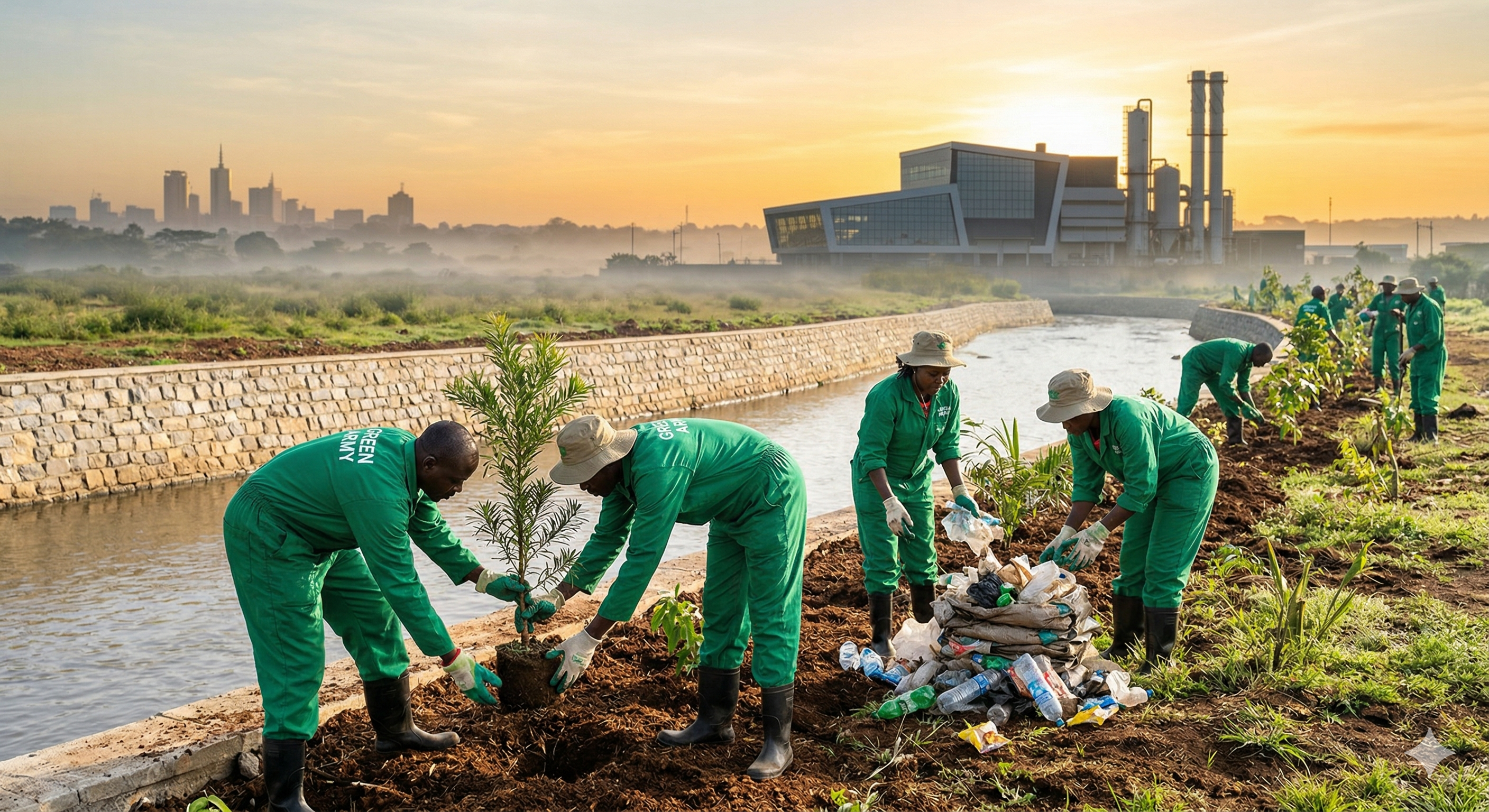
A central pillar of this new vision is the decommissioning of the notorious Dandora dumpsite. Long a source of environmental and health risks, Dandora is slated to be replaced by a modern waste-to-energy plant in Ruai that will generate between 45 and 70 megawatts of electricity. By transitioning to a circular economy, the government hopes to eliminate the plastic debris that currently chokes the city’s drains, which costs an estimated KES 4.5 billion annually in reactive mitigation.

However, the success of “Nairobi Rising” hinges on institutional reform and accountability. The plan includes the creation of a specialized Nairobi Metropolitan Police Unit to enforce zoning laws and protect reclaimed riparian land, but critics warn of the “financial hangover” left by previous interventions. For the residents of Nairobi, the stakes could not be higher; as the April 2026 waste management launch approaches, the city is betting billions that it can finally build the resilience needed to survive its own growth.

References:

Capital News Sewerage and Sanitation Take Centre Stage in Nairobi’s Sh80bn Development Plan

People Daily Ruto unveils plan for a major overhaul of Dandora dumpsite

Big 3 Africa Nairobi Waste to Energy Transformation

THE STATE OF DROUGHT IN KENYA | Turning Adversity into Opportunity

A recent report by the government indicated that, livestock worth 64.2 billion in the ASAL areas, has been wiped out as the region experiences the worst drought in 60 years. “A quarter of the country’s zebu herd in ASAL areas of 14 million animals is lost and the worst is possibly yet to come” Daily Nation reported.

A brief on investment opportunities available in Kenya, accredited by the Ministry of State for Planning National Development and Vision 2030 stated that, “livestock production in the ASAL accounts for nearly 90% of the employment opportunities and nearly 95% of the family incomes. It also accounts for about 45% of the Agricultural GDP.”  Though natural calamities such as drought cannot be controlled, its effects can be anticipated, thus loss of people’s lives and property as a result of the same can adequately be subdued. Isn’t it wrong in the face of the fact that, 75% of Kenya’s livestock are in the ASAL areas, whereas they are served with less than 10% of livestock service staff? What sense is in losing 64bn on one hand, and soliciting for aid funds to a tune of 1bn on the other? If that is anything to go by, then we have surely settled for less than survival. It is envisioned in the Kenya’s Vision 2030, to increase farmers income, create employment, and reduce malnutrition and food insecurity. Investing in the livestock sector, especially in the North Eastern Province (NEP), may be a good place to begin. “The development of a fully fledged export industry for processed livestock products, would doubtless have the greatest impact on the economy, and welfare of the NEP and its people” ReSAKSS, 2008. The article titled, Investment Opportunities for Livestock in the North Eastern Province of Kenya: A Synthesis of Existing Knowledge, further points out that strengthening of the institutions that, “ensure political stability, public security and protection of investment and ownership would induce investors to contribute to the development of the NEP through investment in the livestock sector.”

Mandera Livestock Market


It is not too late to begin, for all is not lost. It is true that one doesn’t appreciate the value of what they have, till it is lost. But the fool is the one who sits back and stands to lose, even more. Challenges are there, for the ones who are ready to take them. Turning the current drought adversity into an opportunity for growth, can begin with just a simple step as laying down commercially oriented road networks, into the NEP.


What’s Your Say?

References:

Drought wipes out herd worth Sh64bn Daily Nation August 7, 2011

Investment Opportunities Google Docs (as of) August 10, 2011

Investment Opportunities for Livestock in the North Eastern Province of Kenya: A Synthesis of Existing Knowledge ReSAKSS, 2008