No Bus Fare to the Podium: The Crisis Facing School Sports
The Ministry of Education released the 2026 National Co-Curricular Activities Calendar this week, signaling the return of rugby, athletics, and drama festivals to the school term. On paper, the stage is set for Kenya to groom the next generation of stars ahead of the Glasgow 2026 Commonwealth Games. However, a look at the school bank accounts reveals a disconnect that threatens to cripple Kenya’s sports pipeline. While the Ministry has disbursed capitation—including a “Games Fund” vote head—school heads argue that the money is effectively already spent. With debts from 2025 accumulating and the real value of capitation eroded by inflation, principals are reportedly diverting these “luxury” funds to essentials like electricity and food just to keep schools open.
Government releases over Shs 44 billion in capitation for term one | KBC Channel 1
The situation is compounded by the “Strict Compliance” directive that has outlawed the traditional “Bus Levies” and “Motivation Fees” parents used to pay. Previously, if the government funds ran dry, a principal could ask parents for Sh2,000 to fuel the school bus for the Regional Games. That lifeline is now illegal. This creates a scenario where a talented sprinter in a C4 day school in Turkana might qualify for the nationals but fail to attend because the school cannot legally raise the fare. Athletics Kenya has already kickstarted the 2026 season early to prepare for Glasgow, but if the grassroots feeder system—the schools—is paralyzed by austerity, the talent will never reach the national trials.
Furthermore, the National Olympic Committee of Kenya (NOCK) has indicated that its 2026 budget excludes expenses for the Glasgow Games, expecting these to be “funded separately by the government.” This passes the buck back to a Treasury that is already squeezing the Ministry of Education. We are witnessing a high-stakes gamble where the government expects gold-medal results from a system it is actively defunding. As KESSHA Chairman Willy Kuria warns of schools “running on fumes,” it is becoming clear that without a ring-fenced budget for school sports, Kenya’s anthem might be missing from the podium in Scotland.
What’s something you believe everyone should know.
One of the greatest truths in both physics and politics is this: power never disappears—it merely changes form. Just as energy can neither be created nor destroyed, political power, too, is a conserved force that shifts, mutates, and re-emerges. Tanzania’s recent history is a masterclass in this invisible law. Under the late President John Magufuli, the country witnessed a deliberate compression of democratic energy. Opposition rallies were banned, media voices silenced, and civil liberties choked under an increasingly authoritarian grip. The 2020 general elections—tainted by accusations of fraud and intimidation—did not destroy dissent; they simply converted it into dormant potential energy, locked within the state’s total control. What appeared as political dominance was, in essence, the gathering of immense pressure beneath the surface of the republic.
When Magufuli passed away in 2021 and Vice President Samia Suluhu Hassan took over, that compressed energy found a new expression. For a moment, Tanzania seemed to exhale. Political dialogue resumed, exiled opposition leaders like Tundu Lissu returned, and the media regained a measure of freedom. Yet this was not the dismantling of power but its phase shift—a transformation from brute coercion to soft diplomacy. The ruling party, CCM, maintained its institutional grip, only trading kinetic repression for the subtler currency of legitimacy and international goodwill. Tanzania’s newfound openness was real, but it was carefully managed; the core quantum of control remained untouched. The machinery of power, having changed its form, retained its full magnitude, calibrated now for persuasion instead of fear.
By 2023, the cycle completed itself. The language of reform gave way once more to the mechanics of control. Opposition figures were again entangled in legal webs, critics silenced through procedural precision, and the state’s energy of dominance reappeared cloaked in legality. The lesson is universal: no political power is ever destroyed—it only transforms. What matters is not whether power exists, but how it is expressed, shared, and held accountable. Citizens must therefore act as the catalysts of transformation, ensuring that this energy—inevitable, immense, and perpetual—remains a force for justice rather than repression. The equation, always, must balance.
Kenya’s labor unrest cannot be fully explained by the Kenya Kwanza administration’s missteps alone. The deeper roots of today’s incessant strikes lie in structural shifts unleashed by the 2010 Constitution. By embedding strong labor rights—including the freedom to unionize, collectively bargain, and strike—while simultaneously devolving key government functions, the Constitution created both an empowered workforce and a fragmented system of accountability. These changes reshaped labor relations across education and health, planting the seeds for recurrent clashes between workers, unions, and the state.
Nowhere is this clearer than in the health sector. When the 2010 Constitution devolved primary and secondary health services to 47 county governments, it fractured the once-unified employer-employee relationship between health unions and the state. Doctors, nurses, and other medical professionals suddenly faced a dual negotiation front: the national Ministry of Health and individual county governors. This decentralization introduced ambiguity about who should fund or enforce collective bargaining agreements (CBAs), fueling a wave of prolonged nationwide strikes. The infamous 2016–2017 standoff—where doctors and nurses collectively downed tools for nearly a year, resulting in 250 lost strike days—exemplified how devolution multiplied points of conflict rather than streamlining accountability.
By contrast, the education sector retained a centralized structure under the Teachers Service Commission (TSC). While this avoided the maze of devolved negotiations, it meant that disputes often escalated into high-stakes, nationwide confrontations. Teachers’ unions, dealing with a single employer, have consistently locked horns with the TSC over promotions, career progression, and salary schemes. Despite this centralization, the state has still failed to fund signed CBAs adequately, proving that the conflict is not just about institutional design but also about political will. Ultimately, the post-2010 constitutional settlement entrenched a dual dilemma: fragmentation in devolved sectors like health, and high-stakes concentration in centralized sectors like education—both of which ensure that labor unrest remains baked into Kenya’s governance model.
References:
KMPDU Promise Made, Promise Kept As Doctors Receive Full 2017–2024 CBA Arrears
BMJ Global Health Tackling health professionals’ strikes: an essential part of health system strengthening in Kenya
Health Business Ministry of Health signs agreement with KMPDU in new deal
Finn Partners The Evolution of Healthcare in Kenya Amidst Doctor’s Strike and the Rise of Digital Health Innovations
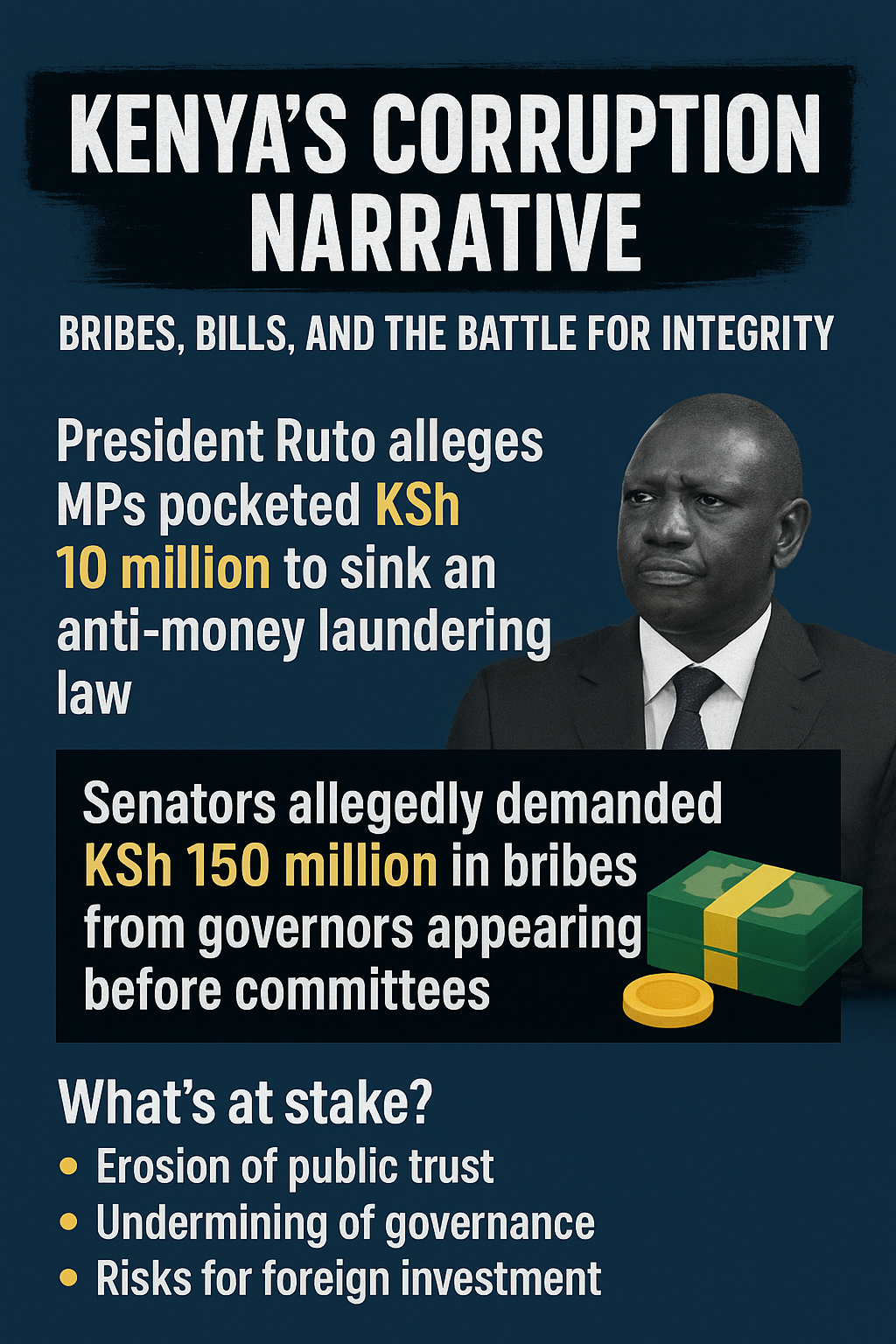
When President William Ruto stood before UDA and ODM legislators on August 18, 2025, and declared that MPs had pocketed KSh 10 million to sink an anti-money laundering bill, while senators allegedly demanded up to KSh 150 million from governors under probe, it marked a seismic moment in Kenya’s corruption narrative. Unlike broad platitudes, these allegations were laced with precision—figures, targets, and the President’s insistence that he was a “consumer of raw intelligence” with knowledge of what was happening behind closed doors. For a country where the shadow of graft often hovers without names or numbers, Ruto’s bluntness pulled corruption out of abstraction and into the raw theatre of governance. The fallout is immense. It not only raises fundamental questions about the integrity of Kenya’s legislative processes but also highlights how deep-rooted corruption risks sabotaging reforms critical to stabilizing the economy, securing donor confidence, and reinforcing Kenya’s democratic fabric.
Such high profile claims cannot be dismissed as political theatre. They expose systemic vulnerabilities where the very guardians of accountability—parliamentary watchdog committees—become gatekeepers of extortion. By placing a price tag on oversight, lawmakers distort the balance of power, weaken enforcement of financial transparency laws, and compromise Kenya’s commitments to international anti-money laundering standards. In practical terms, this jeopardizes more than just the passage of bills: it risks the credibility of Kenya’s financial system, threatening remittance flows, investor trust, and even compliance with IMF and FATF benchmarks. The long-term stakes are enormous. If parliamentarians are perceived as auctioneers of governance, global institutions will tighten their scrutiny, and Kenya’s economy—already weighed down by debt and unemployment—will carry the burden of political impunity.
The President’s vow to arrest both givers and takers of bribes presents a moment of reckoning. Rhetoric without enforcement risks deepening public cynicism rather than rebuilding confidence. What hangs in the balance is Kenya’s ability to demonstrate that governance is not negotiable, and that the fight against corruption is not a selective weapon but a consistent national ethic. Civil society and international observers are watching closely, and the diaspora too remains alert to how corruption narratives shape Kenya’s global reputation. At stake is not just legislative credibility, but the country’s standing as a functional democracy and competitive economy. If Kenya cannot confront and dismantle these entrenched practices, the corruption narrative will continue to define—not just distort—its future.
References:
The Star Some MPs received Sh10 million to sink anti-money laundering law – Ruto
The Star MP Makilap wants Ruto to publicly name corrupt lawmakers
Transparency International Kenya 2024 CORRUPTION PERCEPTIONS INDEX REVEALS HOW WEAK ANTI-CORRUPTION MEASURES UNDERMINE CLIMATE ACTION AND CONTRIBUTE TO THE VIOLATION OF HUMAN RIGHTS
Econfin Agency Kenya Creates Multi-Agency Task Force to Fight Corruption
Citizen Digital East Africa’s investment potential: Why leaders need to tackle corruption
Jijuze Combatting Fraud in Kenya’s Tourism: A Growing Threat
Kenya is staring down a security crisis that can no longer be blamed on bandits or activists alone. From the shocking murder of Catholic priest Fr. Alois Bett in Kerio Valley to the arrest of digital activist Rose Njeri, recent events expose a breakdown of trust, law, and legitimacy in the very institutions meant to protect the public. In Kerio, teachers, doctors, and missionaries have fled as armed groups tighten their grip — filling the vacuum left by a state that shows up too late, with too little. More than 70 schools have been shut down, a major hospital has closed, and even church leaders now speak of “a valley of death.” What’s worse: when the state does intervene, its methods are often coercive rather than restorative — issuing ultimatums to entire communities under threat of “all necessary force.” This is not security. It’s collective punishment masquerading as policy, and it only deepens fear and fuels defiance. The government’s inability to distinguish bandits from residents or treat citizens as partners in peace risks entrenching a cycle of violence. This is not a crisis of capacity. It’s a crisis of credibility.
A Report by Citizen TV Kenya
The response to civic dissent has been equally chilling. The arrest and weekend detention of Rose Njeri — a software developer who created a digital tool for citizens to email objections to the Finance Bill — was a stark reminder that Kenya’s democratic space is narrowing fast. Her crime? Enabling public participation. This is not just an affront to digital freedoms — it’s a direct violation of Article 33 (freedom of expression) and Article 35 (access to information) of Kenya’s Constitution. Even more damning is the pattern. Detaining citizens over weekends to avoid court oversight has become an authoritarian reflex. This violates the legal standard upheld in Coalition for Reform and Democracy (CORD) & 2 others v Republic of Kenya & another [2015] eKLR, where the court held that prolonged detentions without charge constitute unconstitutional abuse of state power. Yet the tactic continues — often against youth activists, journalists, and tech-savvy organizers. These are not enemies of the state. They are its conscience. If the state treats code like a crime and civic tech as terrorism, it signals a descent into digital authoritarianism — one that no PR campaign or presidential handshake can disguise.
What Kenya needs now is more than investigations and operations. It needs political courage — and jurisprudential discipline. The government must fully implement existing rulings and international obligations. The IPOA’s mandate must be respected, and police accountability pursued with vigor, not rhetoric. Parliament must hold the executive to account when it violates rights under the guise of national security. The courts have laid the foundation. In Independent Policing Oversight Authority v Attorney General & 4 others [2020] eKLR, the High Court affirmed IPOA’s role as the sole lawful investigator of police misconduct. The Executive must respect that boundary. Meanwhile, civil society must continue challenging digital repression and pushing for laws that protect activists, not silence them. Kenya’s youth are not the threat — they are the firewall against authoritarian drift. From Kerio to Kibera, from code to constitution, Kenya’s real security will only be built when the state values trust more than force, and justice more than optics.
References:
Kenya News Agency County Commissioner Leads Madaraka Day with Tough Message on Illegal Brews
The Star Key suspect in murder of Catholic priest Allois Bett arrested
BBC Outrage in Kenya over detention of software developer
The Star Gachagua calls for immediate release of activist Rose Njeri
The Eastleigh Voice Kenya’s security at risk as regional instability grows, warns NIS boss
BBC Pressure mounts to probe Kenya police and army after BBC exposé
Kenya News Agency State declare a nationwide crackdown on organized criminal gangs
Easter 2025 in Kenya unfolded not only as a celebration of Christ’s resurrection but as a moment of reckoning for the soul of the nation, with clergy across the country using the pulpit to deliver searing messages that reached far beyond theology. Falling on April 20th—a rare alignment for both Western and Eastern Christian calendars—the holy day became a stage for calls to conscience, unity, and reform. While sermons across denominations upheld traditional themes of resurrection, hope, and renewal, several clergy, particularly from the Catholic Church, stepped into the fray of national discourse with unapologetic candor. Bishop Simon Peter Kamomoe, delivering his homily at Nairobi’s Holy Family Basilica, did not mince words. He blamed Kenya’s ongoing suffering on the “sins” of its people, drawing a direct and controversial link to the choices made during the 2022 general elections. He named rising corruption, domestic violence, and a disturbing trend in unethical healthcare practices—particularly organ theft—as symptoms of a moral crisis engulfing the nation. His warning to congregants to “be careful with your surgery” hinted at a deep public fear of a broken healthcare system and underscored his broader message that spiritual and societal decay were intertwined.
A Report by Citizen TV Kenya
In Mombasa, Archbishop Martin Kivuva struck a similarly critical tone, directing his Easter sermon at the government’s economic policies. With President Ruto preparing to travel to China for talks with one of Kenya’s major lenders, Kivuva’s timing was pointed as he decried the government’s unchecked appetite for loans. He questioned whether borrowed billions were being used to serve the people or to fund untraceable ventures, voicing a concern that has simmered among Kenyans grappling with a rising cost of living and dwindling faith in public accountability. But the Archbishop’s critique didn’t stop at debt; he rebuked politicians for engaging in premature campaigns for the 2027 elections and stoking tribal tensions, warning that such actions risked pulling the country further apart. His words reflected a growing anxiety about Kenya’s political culture—one increasingly marked by performative leadership and ethnic division rather than national unity. Meanwhile, in the rural town of Elburgon, Fr. Gideon Korir turned the spotlight inward, condemning the infiltration of politics into sacred spaces. He expressed deep dismay over chaotic scenes witnessed on church pulpits, where rival politicians turned places of worship into arenas of confrontation. His impassioned plea was for churches to be preserved as sanctuaries of peace, healing, and moral guidance—not hijacked for political expedience.
These sermons reveal a critical shift in Kenya’s ecclesiastical tone—one that reflects an increasingly assertive clergy willing to challenge the political establishment and speak directly to the hardships of ordinary citizens. What emerges is a portrait of the church not merely as a spiritual institution, but as a potent voice in Kenya’s public square. The critiques delivered during Easter 2025 resonated because they mirrored real anxieties: from economic inequality and corrupt governance to deteriorating healthcare and the erosion of moral values. While the media gave these messages significant attention—particularly the stinging remarks about debt and governance—government responses remained conspicuously absent, possibly signaling discomfort or strategic avoidance. Yet, the Easter pulpit’s impact was undeniable, reaffirming the church’s enduring role as a moral compass and social conscience. The voices of Kamomoe, Kivuva, and Korir stood not just as isolated acts of courage, but as part of a broader ecclesiastical momentum demanding a better Kenya—one that upholds justice, integrity, and compassion. In a time of crisis, their sermons were more than words; they were calls to action, prayers for accountability, and reminders that even amid despair, the resurrection message remains one of transformation and hope.
References:
Anglican Ink Kenyan Anglican Church backs criticism of government
The Eastleigh Voice 30 Pentecostal Churches criticise Ruto over runaway corruption, governance issues
Capital News Archbishop Kivuva urges political tolerace to avert violence
Capital News Anglican Church joins Catholic Bishops in calling for govt accountability
Vatican News Kenyan bishops emphasize collective responsibility to transform nation
Kenya has long positioned itself as a key mediator in East Africa, with a foreign policy prioritizing peaceful coexistence and regional stability, evidenced by its involvement in organizations like IGAD and the EAC . While historically successful in mediating conflicts, such as the Sudanese Comprehensive Peace Agreement in 2005, recent diplomatic forays under President Ruto have encountered significant headwinds . Initiatives in the Democratic Republic of Congo, including bringing the DRC into the EAC and leading the EAC Regional Force, have been marred by accusations of bias and a lack of trust from Kinshasa, particularly concerning the handling of rebel groups . Similarly, Kenya’s hosting of Sudanese Rapid Support Forces meetings has drawn strong condemnation from the Sudanese government, which views it as a hostile act, further damaging Kenya’s image as a neutral broker in regional disputes . These challenges underscore a potential shift in regional perceptions of Kenya’s diplomatic impartiality, which could have implications for its ongoing efforts in other conflict zones.
A Report by Citizen Digital
Against this backdrop, Kenya launched the Tumaini Initiative in May 2024, a high-level mediation process aimed at addressing the protracted crisis in South Sudan by engaging hold-out groups that did not sign the 2018 peace agreement . Led by veteran mediator General Lazarus Sumbeiywo, the initiative seeks to reboot the existing peace deal, extend its implementation timeline, and potentially pave the way for delayed elections . While initial talks saw agreement on a negotiation agenda focusing on the root causes of the conflict, the identity of parties, the relationship with the existing peace agreement, and power-sharing arrangements, the process has faced significant hurdles . Key opposition groups, such as the South Sudan Opposition Movement Alliance (SSOMA), have rejected the Kenyan mediation, arguing that it fails to address the fundamental issues fueling the conflict . This skepticism, coupled with the deep-seated political instability, the ongoing humanitarian crisis exacerbated by the war in Sudan, and the slow progress in implementing the 2018 agreement, casts a shadow over the potential for the Tumaini Initiative to achieve a comprehensive and lasting peace.
The effectiveness of Kenya’s diplomatic mission in South Sudan hinges on several critical factors, including its ability to rebuild trust and demonstrate neutrality, foster a truly inclusive dialogue that addresses the grievances of all stakeholders, and secure sustained commitment from South Sudanese leaders . International reaction to the Tumaini Initiative has been cautiously supportive, with organizations like the UN emphasizing the importance of regional support from Kenya while also expressing growing concern over the deteriorating situation in South Sudan . Expert analysis suggests that while the initiative offers a glimmer of hope by aiming to address the root causes of the conflict, the history of failed peace talks and the persistent lack of political will among South Sudanese leaders remain significant obstacles . Ultimately, for Kenya’s efforts to yield lasting results, a concerted and collaborative approach involving regional and international partners, coupled with a genuine commitment from all South Sudanese parties to prioritize peace and stability over political gains, will be essential to navigate the complex landscape and break the cycle of conflict.
References:
Aljazeera Peacemaker or peacebreaker? Why Kenya’s good neighbour reputation is marred
Kosovo’s journey to full international acceptance has been a protracted one since its declaration of independence from Serbia in 2008. While the newly formed nation garnered significant early recognition, the momentum has noticeably slowed in recent years, marked by a near five-year lull in any new countries formally acknowledging its sovereignty. This period of stagnation ended abruptly with Kenya’s announcement on March 26, 2025, making it the latest nation to recognize Kosovo. This diplomatic move, however, has not been without its challenges. Serbia, which continues to view Kosovo as its own territory, reacted with strong condemnation, accusing Kenya of violating international law and United Nations resolutions. This development throws a spotlight on the complex web of international relations surrounding Kosovo and the delicate balance countries must strike when deciding on recognition.
A Report by WawamuStats
The primary reasons for the limited and slowing recognition of Kosovo are deeply rooted in the ongoing opposition from Serbia, which views Kosovo’s independence as a direct assault on its territorial integrity and national sovereignty. This stance is powerfully supported by Serbia’s allies, Russia and China, both of whom hold veto power in the UN Security Council, effectively blocking Kosovo’s membership in the United Nations. This lack of UN membership significantly hinders Kosovo’s full integration into the global community. Furthermore, several European Union member states, including Spain, Slovakia, Cyprus, Romania, and Greece, have also withheld recognition, often citing concerns about territorial integrity and potential precedents for their own domestic issues. This intricate geopolitical landscape, where historical ties, strategic alliances, and concerns about sovereignty intersect, has created a significant hurdle for Kosovo in its pursuit of universal recognition.
Kenya’s decision to break the prolonged silence on Kosovo’s recognition has been met with immediate diplomatic fallout. Serbia has vehemently criticized the move, warning of damage to the long-standing friendly relations between the two nations and vowing to take diplomatic and political measures in response. Domestically, in Kenya, concerns have been raised about potential economic and diplomatic repercussions, with some fearing that this decision could isolate the country on the global stage. While Kenya’s government has defended its recognition by citing the International Court of Justice’s advisory opinion that Kosovo’s declaration of independence did not violate international law, the move underscores the contentious nature of Kosovo’s statehood and the potential diplomatic minefield that nations navigate when choosing to recognize its independence.
References:
Aljazeera Which countries recognise Kosovo’s statehood?
Capital News Serbia vows diplomatic response to Kenya’s recognition of Kosovo
Capital News Foreign Relations Committee member faults Kosovo recognition
Kosovapress Recognition from Kenya brings back criticism of the government: Four years of lobbying failure at the international level
Cabinet reshuffles, a common feature in many developing democracies, often reflect a complex interplay between the need for governmental competence and the pressures of political maneuvering, as evidenced by the recent changes in the Kenyan administration. Defined as alterations in the executive branch’s composition, these reshuffles can be driven by various factors, including the desire to enhance government performance, address corruption, consolidate political power, reward loyalty, respond to public pressure, or signal policy shifts. The Kenyan cabinet reshuffle of March 2025, which saw key figures like Aden Duale moved to the Ministry of Health and Justin Muturi dismissed from his role in Public Service, exemplifies this dynamic. While the stated reasons often revolve around improving service delivery and aligning with the government’s agenda, underlying motivations frequently involve political considerations such as managing internal dissent, rewarding allies, and strategically positioning individuals within the executive. This constant reshuffling raises fundamental questions about the balance between appointing technically skilled individuals and ensuring political loyalty in the pursuit of effective governance.
A Report by Citizen Digital
The motivations behind frequent cabinet reshuffles in developing democracies are multifaceted, often stemming from a blend of administrative and political imperatives. In the Kenyan context, the reassignment of Aden Duale to the Health Ministry to address challenges within the Social Health Authority suggests an attempt to improve government performance in a critical sector. However, the dismissal of Justin Muturi, following his public criticism of the government and subsequent accusations of incompetence from President Ruto, highlights the significance of political loyalty and the management of dissenting voices within the cabinet. Academic literature supports this observation, noting that leaders in developing democracies often prioritize consolidating political power and rewarding loyalty, sometimes at the expense of technical competence. This “loyalty-competence trade-off” is a recurring dilemma where leaders balance the need for effective governance with the imperative of maintaining political stability and control. The Kenyan reshuffle, with its mix of stated performance objectives and apparent political motivations, underscores this complex dynamic.
The frequent occurrence of cabinet reshuffles can have significant consequences for governance and public perception in developing democracies like Kenya. While intended to inject new impetus or address specific challenges, these changes can also lead to instability within government ministries, disrupting policy continuity and hindering the development of long-term strategic planning. When ministers are frequently moved or replaced, the time required for new appointees to gain expertise and build effective working relationships can impede the overall effectiveness of governance. Furthermore, if the public perceives these reshuffles as being driven primarily by political expediency rather than a genuine commitment to improved governance, it can erode public trust in government institutions and the democratic process. The Kenyan example, with its swift dismissal of a cabinet secretary after public disagreement, risks reinforcing perceptions of a system where loyalty trumps competence, potentially impacting public confidence and the long-term stability of the nation’s governance.
References:
The Star Duale moved to Health ministry in new Cabinet changes
KBC President Ruto drops Muturi in new cabinet changes
The Court of Appeal’s recent intervention in the ongoing university funding dispute in Kenya has further complicated an already volatile situation. On March 26, 2025, the appellate court suspended the High Court’s ruling that had previously declared the Variable Scholarship Loan Funding (VSLF) model unconstitutional. This decision temporarily reinstated the controversial funding framework, allowing the government to resume its implementation while the appeal is heard. The suspension was granted based on arguments from the Higher Education Loans Board (HELB) and the Universities Fund (UF), both of which warned that halting the VSLF model would cripple their ability to allocate funds, potentially leading to financial instability and even the closure of multiple institutions. Former HELB Acting CEO Mary Muchoki emphasized in an affidavit that the High Court’s ruling could result in the indefinite closure of universities, underscoring the gravity of the situation. Similarly, former Universities Fund CEO Geoffrey Monari defended the VSLF model as a more equitable and cost-effective funding mechanism, cautioning that the previous decision could trigger a crisis in university financing. By suspending the High Court’s ruling, the Court of Appeal sought to balance the urgent need to sustain university funding with the concerns raised regarding the legality and fairness of the model. However, this move introduces another layer of uncertainty, as universities, students, and policymakers must now navigate an unpredictable legal landscape while awaiting a final resolution.
A Report by KTN News Kenya
To mitigate the immediate fallout and provide transparency, the Court of Appeal issued several directives aimed at ensuring that students, universities, and other stakeholders remain informed about the potential implications of the ongoing legal battle. The court instructed the Attorney General, HELB, and the Kenya Universities and Colleges Central Placement Service (KUCCPS) to disseminate detailed information about the VSLF model to all relevant parties within 14 days. This included clear communication to current beneficiaries and prospective applicants that the funding framework could still be subject to further changes. Additionally, the appellate court mandated the establishment of an appeals mechanism within the same timeframe, allowing students dissatisfied with their funding allocations or categorization to seek redress. These directives were an attempt to address the concerns raised by the High Court regarding the lack of transparency and due process in the implementation of the VSLF model. Nonetheless, the broader financial challenges facing Kenyan universities persist, as public institutions continue to struggle with substantial funding deficits while private universities remain burdened by unpaid government sponsorship funds. Although the temporary reinstatement of the VSLF model might alleviate some immediate financial pressures, the long-term sustainability of higher education funding in Kenya remains a pressing issue that requires a more comprehensive and permanent solution. The shift towards increased household contributions under the VSLF model raises additional concerns about affordability, particularly for students from low-income backgrounds, who now face the prospect of significant debt accumulation through student loans.
The current funding controversy is part of a broader historical shift in Kenya’s higher education financing strategy, transitioning from the Differentiated Unit Cost (DUC) model, which had been in place since 1995, to a more individualized, means-tested approach. Under the DUC model, public universities received block funding based on student enrollment and the costs associated with different academic programs, with the government initially expected to cover 80% of the unit cost. However, persistent underfunding led to financial distress for universities, necessitating alternative approaches. In May 2023, the government introduced the VSLF model, which sought to provide direct funding to students through a combination of scholarships, loans, and household contributions, assessed via a Means Testing Instrument (MTI). While this shift was designed to target financial aid to the most economically vulnerable students and encourage universities to diversify their revenue sources, it has sparked concerns about access and equity. The ongoing legal uncertainties surrounding the VSLF model have further exacerbated these concerns, as students remain unsure about their financial obligations, and universities continue to grapple with inconsistent funding. Moving forward, Kenya must establish a stable, transparent, and equitable university financing system that balances institutional sustainability with student accessibility. This requires strengthening legal frameworks, improving the MTI to ensure fairness, enhancing government investment, and exploring diversified funding sources such as public-private partnerships and alumni contributions. Without such reforms, the country risks entrenching financial instability in its higher education sector, limiting opportunities for students, and undermining national development objectives.
References:
Jijuze Impact of Kenya’s Court Decision on University Funding
The Standard Court of Appeal suspends ruling on university funding model
Kenya News Agency Govt reaffirms commitment to new varsity funding model
All Africa Kenya: COA Temporarily Allows Impementation of New University Funding Model

 Jijuze