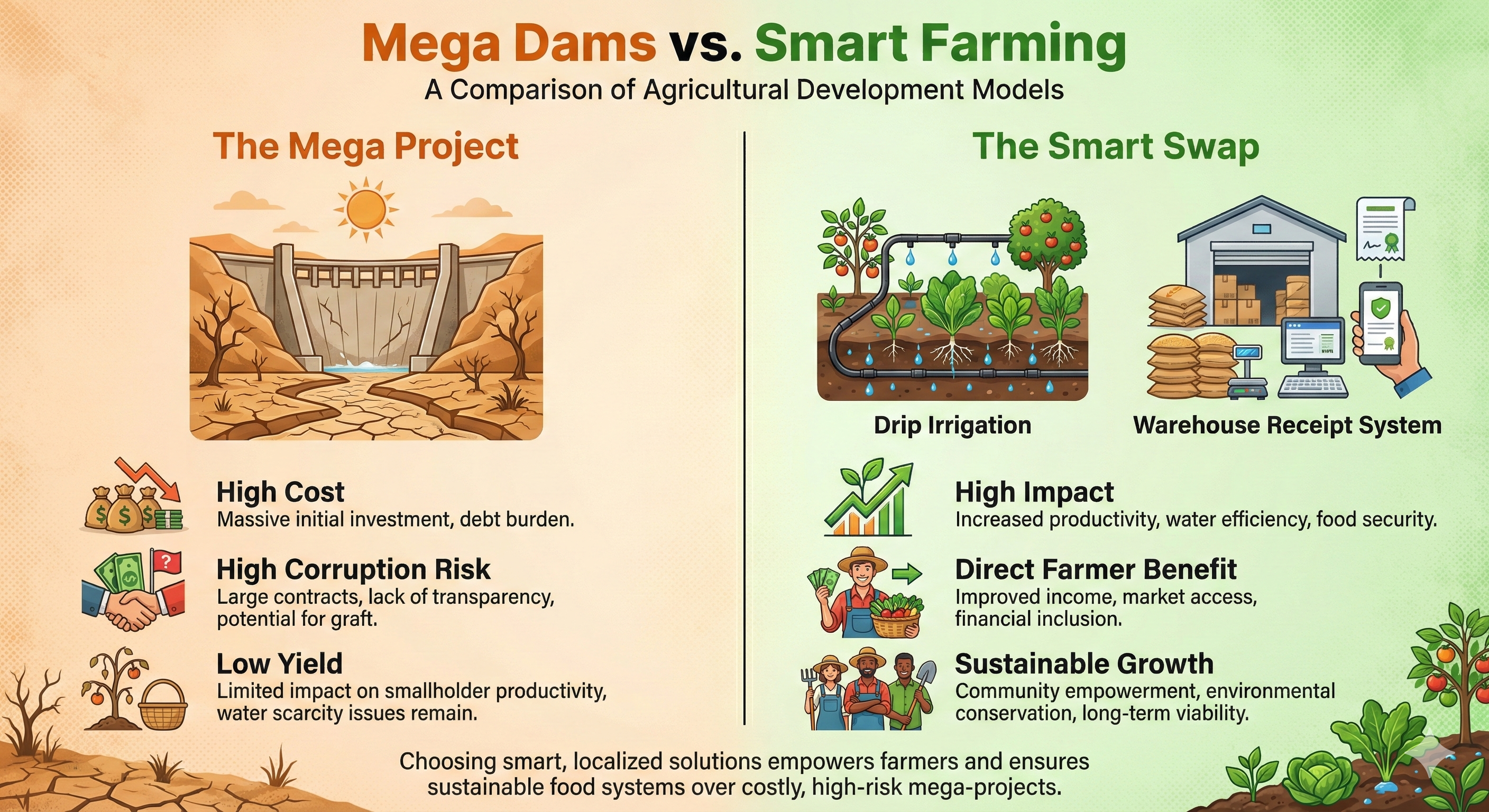
As the government targets 2 million acres for irrigation under the new debt swap initiative, the ghost of the Galana Kulalu project looms large. Just days ago, on January 26, 2026, the government announced plans for six new mega dams, signaling a return to the large-scale infrastructure strategy that failed so spectacularly in 2014. The original Galana Kulalu pilot consumed Sh7 billion to produce maize at costs higher than market price, collapsing under poor planning and corruption. Critics argue that repeating this “big dam” strategy ignores the hard-learned lessons of the past.
The disconnect is palpable. While the state plans mega-projects in arid lands, small-scale farmers—who produce the bulk of Kenya’s food—are struggling with basic input costs and lack of market access. The “savings” from the debt swap would likely yield higher returns if invested in decentralized solutions: household water pans, small-scale drip irrigation kits, and the Warehouse Receipt System (WRS) to help farmers store grain and avoid price exploitation by middlemen.
If the Sh129 billion is poured into another series of mega-dams, the funds risk being absorbed by contractors and consultants, leaving the country with more debt and no food. The success of this swap depends on shifting focus from concrete structures to the actual economics of farming—lowering production costs and ensuring profitability. Without this shift, we are merely “mixing oil and water” again, hoping that high-finance infrastructure will somehow trickle down to the grassroots.
References:
Capital Business Govt plans six mega dams, targets 2mn acres in irrigation push
The Star Government plans six mega dams, targets 2 million acres for irrigation push
🌦️ Wet West, Dry East: Why One Strategy Won’t Work for All in MAM 2026
The Kenya Meteorological Department (KMD) has dropped its forecast for the March-April-May (MAM) long rains, and it paints a picture of two very different planting seasons.
The Good News: If you are in the Highlands West of the Rift (Trans Nzoia, Uasin Gishu, Kericho) or the Lake Victoria Basin, get your tractors ready. The forecast predicts near-average to above-average rainfall. This is the green light for high-yield maize farming.
The Warning: For farmers in the Southeastern Lowlands (Kitui, Makueni), Northeastern, and the Coast, the forecast is tough. You are facing “near-average to below-average” rainfall, with a high chance of insignificant rains—meaning showers that wet the dust but don’t sustain a crop.
The Takeaway: Don’t copy your neighbor in Eldoret if you live in Machakos. The government is urging everyone to plant, but what you plant matters more than ever.
West: Go for maximum yield (600 series maize).
East/North: Go for survival (fast-maturing crops).
References:
Nairobi Leo Kenya Met Issues March-May 2026 Long Rains Forecast
Daily Nation End of drought in sight, but coming rains will be insignificant for arid regions
All Africa Above-Average Rains Expected in Key Regions, Weatherman Warns of Dry Spells Elsewhere
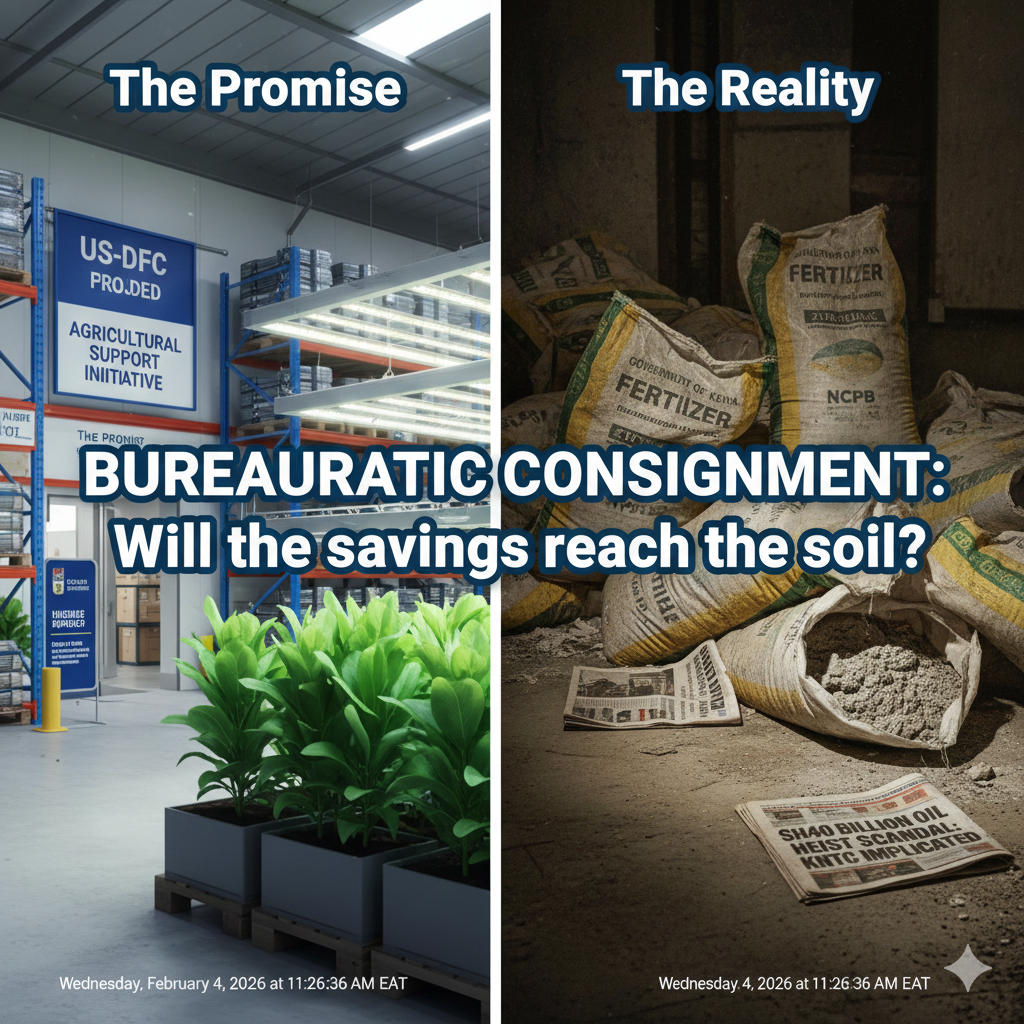
The “Food-for-Eurobond” deal relies on a dangerous assumption: that savings from international debt relief can navigate the treacherous waters of Kenya’s local bureaucracy without being looted. History suggests this is an “oil and water” scenario—liquid finance attempting to mix with a rigid, opaque system. The recent scandals at the Kenya National Trading Corporation (KNTC) and the National Cereals and Produce Board (NCPB) serve as grim warnings. In the KNTC edible oils scandal, tax waivers meant to lower prices were captured by politically connected firms, resulting in a Sh16.5 billion loss with no benefit to the consumer.
Similarly, the NCPB’s recent distribution of “fake fertilizer”—bags filled with quarry dust—demonstrates how easily “agricultural support” can be weaponized against the farmers it is meant to help. If the swap funds are channeled through these same “bureaucratic consignments,” the initiative risks becoming another slush fund for cartels. The involvement of the World Food Programme (WFP) is intended to act as an “emulsifier,” forcing accountability into the system, but their oversight powers will be tested against deeply entrenched patronage networks.
Experts warn that without a radical overhaul of state agencies, the “savings” will evaporate before they buy a single bag of genuine fertilizer or build a working silo. The structural disconnect between the Treasury’s high-level deal-making and the Ministry of Agriculture’s operational failures remains the single biggest risk. Unless the government bypasses these compromised intermediaries, perhaps by funding private sector credit guarantees instead of direct procurement, the “oil” of finance will float to the top, leaving the “water” of development murky and stagnant.
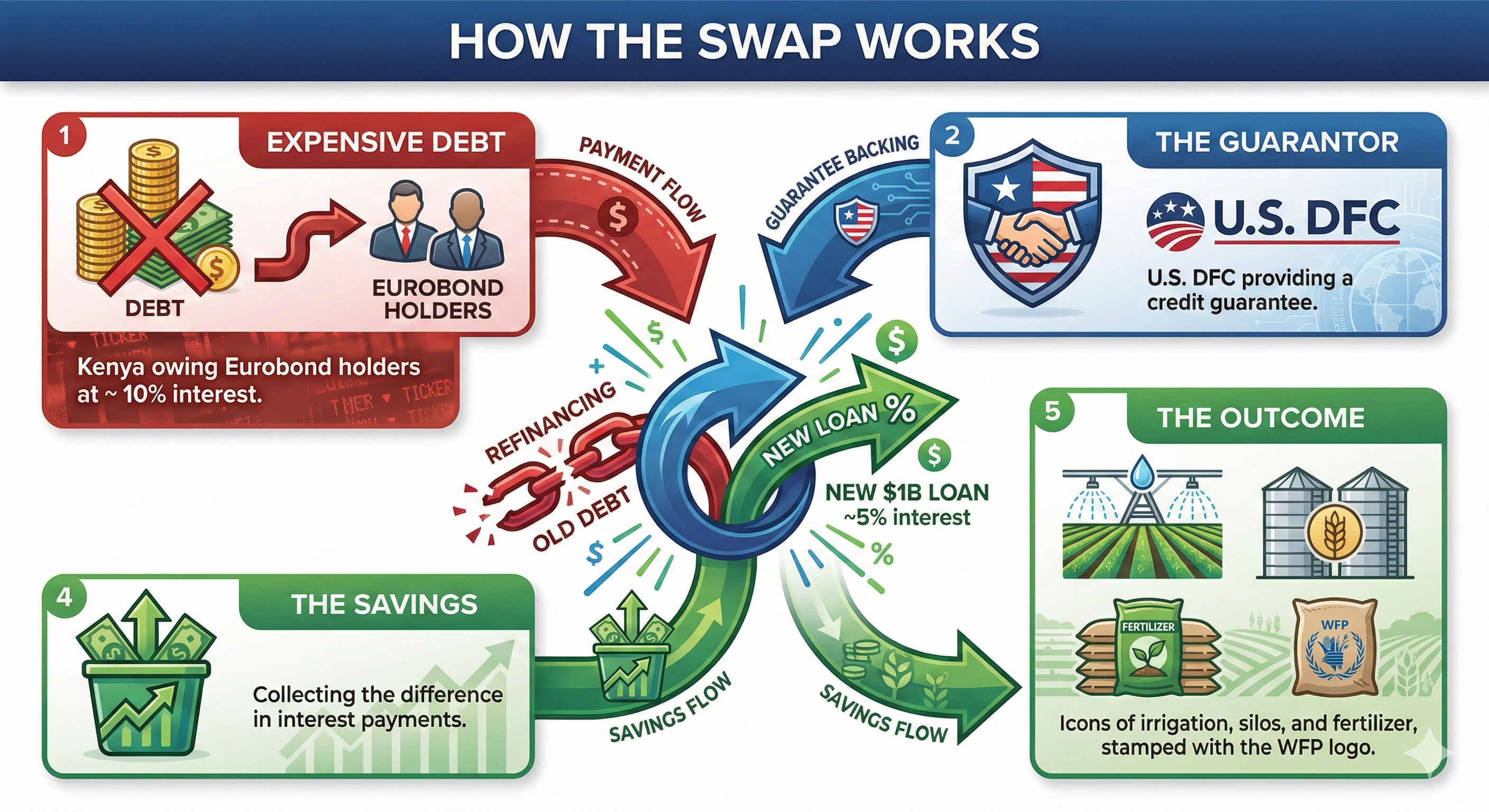
Kenya is on the verge of finalizing a landmark $1 billion (Sh129 billion) debt-for-food security swap, a sophisticated financial maneuver designed to rescue the country from a suffocating liquidity crunch. By leveraging a guarantee from the U.S. International Development Finance Corporation (DFC), the Treasury intends to refinance expensive Eurobond debt with cheaper, concessional loans. The plan is financially astute: it swaps high-interest commercial debt for lower-interest obligations, a move that prompted Moody’s to upgrade Kenya’s credit rating to B3 and stabilize the outlook on the nation’s sovereign debt.
However, the deal comes with a catch that transforms it from a simple refinancing operation into a complex development experiment. The interest “savings” generated from this swap must be ring-fenced and funneled directly into food security projects, managed in partnership with the World Food Programme (WFP). This arrangement effectively outsources a portion of national planning to an international body, admitting that the state needs external discipline to ensure funds aren’t diverted. While this stabilizes the shilling and pleases bondholders, it raises a fundamental question: is this a genuine strategy to feed the nation, or simply financial engineering to avoid default?
The stakes could not be higher. With 3.4 million Kenyans facing acute food insecurity and public debt service consuming over two-thirds of tax revenue, the government is betting that this “financial oil” can mix with the “water” of local agriculture without separating. If successful, it provides fiscal breathing room and lowers input costs for farmers; if it fails, Kenya will be left with the same debt burden and no improvement in the cost of living for the average wananchi.
Kenya’s public health system is once again on the operating table — but this time, the diagnosis points beyond fiscal failure to institutional betrayal. The government’s May 2024 payout of KSh 3.5 billion in doctors’ arrears briefly restored faith in the state’s willingness to honor past commitments under the 2017–2024 CBA. Yet, beneath the celebration, cracks widened. Barely weeks later, the same administration plunged the sector into chaos over the medical interns’ stipend standoff, slashing agreed pay from KSh 206,400 to 70,000 under the guise of “limited fiscal space.” The ensuing paralysis—interns idled, courts flooded with petitions, hospitals short-staffed—signaled not financial constraint but a governance culture that governs by deferral, treating legality and professionalism as expendable luxuries. What should have been a steady reform agenda has degenerated into episodic crisis management, where every partial solution simply queues up the next emergency.
The deterioration has now metastasized to the counties, where devolved power has mutated into deflection and denial. In Kiambu County, doctors have been on strike for months, accusing the governor of presiding over a “battle of egos” instead of a rescue plan. (The Standard) The Kenya Medical Practitioners, Pharmacists and Dentists Union (KMPDU) has condemned county governments for “derailing progress” by ignoring CBAs, delaying salaries, and politicizing healthcare delivery. The union’s outrage spiked after reports that 131 newborns died amid the Kiambu crisis, a tragedy the Council of Governors publicly dismissed as “false publication.” (Citizen Digital) The KMPDU now demands accountability, an apology, and an independent investigation—warning of a nationwide strike on October 25 if county impunity persists. What began as a county dispute has evolved into a national indictment of how devolution, once hailed as reform, has devolved into an administrative minefield where human life becomes collateral to political vanity.
This crisis extends far beyond Kiambu — it is metastasizing across the entire devolved health network, revealing a structural rot that no press release can conceal. Health workers in Nairobi, Isiolo, Marsabit, and other counties are already on edge over delayed salaries, missing allowances, and ignored CBAs, while local leaders deflect responsibility with ritual blame games. Each county now operates like a fiefdom, where governors weaponize fiscal autonomy to evade national accountability. The result is a patchwork of suffering: hospitals running without drugs, maternity wards closing for lack of staff, and patients dying quietly as politicians trade televised barbs. In this grotesque inversion of priorities, doctors and nurses must fight court battles simply to be paid, while the state spends millions staging health summits and PR drives about universal care. The moral decay runs deeper than bureaucratic failure — it is ethical bankruptcy. Devolution was meant to bring services closer to the people; instead, it has brought corruption closer to the patient. The Council of Governors, once the face of localized empowerment, now functions as a shield for negligence, dismissing human tragedies as “falsehoods” even when families bury their dead. A government that forces doctors back to work through court orders, instead of dialogue, has abdicated the very essence of governance. Every delayed salary and every stillborn infant is a symptom of a political elite desensitized to suffering — one that governs not through service, but through spectacle. Unless the state reclaims discipline, compassion, and coherence in health governance, Kenya’s pursuit of universal healthcare will remain a hollow slogan floating over a silent emergency ward.
References:
The Standard Battle of egos: Counties accused of derailing progress in health sector
Citizen Digital KMPDU slams Governors over Kiambu health crisis, issues demands amid looming national strike
The Standard Doctors to join their striking Kiambu colleagues starting Wednesday
Finn Partners The Evolution of Healthcare in Kenya Amidst Doctor’s Strike and the Rise of Digital Health Innovations
TV47 Kenya Trust deficit is Kenya Kwanza’s greatest undoing” – MP Makali Mulu
Cabinet reshuffles, a common feature in many developing democracies, often reflect a complex interplay between the need for governmental competence and the pressures of political maneuvering, as evidenced by the recent changes in the Kenyan administration. Defined as alterations in the executive branch’s composition, these reshuffles can be driven by various factors, including the desire to enhance government performance, address corruption, consolidate political power, reward loyalty, respond to public pressure, or signal policy shifts. The Kenyan cabinet reshuffle of March 2025, which saw key figures like Aden Duale moved to the Ministry of Health and Justin Muturi dismissed from his role in Public Service, exemplifies this dynamic. While the stated reasons often revolve around improving service delivery and aligning with the government’s agenda, underlying motivations frequently involve political considerations such as managing internal dissent, rewarding allies, and strategically positioning individuals within the executive. This constant reshuffling raises fundamental questions about the balance between appointing technically skilled individuals and ensuring political loyalty in the pursuit of effective governance.
A Report by Citizen Digital
The motivations behind frequent cabinet reshuffles in developing democracies are multifaceted, often stemming from a blend of administrative and political imperatives. In the Kenyan context, the reassignment of Aden Duale to the Health Ministry to address challenges within the Social Health Authority suggests an attempt to improve government performance in a critical sector. However, the dismissal of Justin Muturi, following his public criticism of the government and subsequent accusations of incompetence from President Ruto, highlights the significance of political loyalty and the management of dissenting voices within the cabinet. Academic literature supports this observation, noting that leaders in developing democracies often prioritize consolidating political power and rewarding loyalty, sometimes at the expense of technical competence. This “loyalty-competence trade-off” is a recurring dilemma where leaders balance the need for effective governance with the imperative of maintaining political stability and control. The Kenyan reshuffle, with its mix of stated performance objectives and apparent political motivations, underscores this complex dynamic.
The frequent occurrence of cabinet reshuffles can have significant consequences for governance and public perception in developing democracies like Kenya. While intended to inject new impetus or address specific challenges, these changes can also lead to instability within government ministries, disrupting policy continuity and hindering the development of long-term strategic planning. When ministers are frequently moved or replaced, the time required for new appointees to gain expertise and build effective working relationships can impede the overall effectiveness of governance. Furthermore, if the public perceives these reshuffles as being driven primarily by political expediency rather than a genuine commitment to improved governance, it can erode public trust in government institutions and the democratic process. The Kenyan example, with its swift dismissal of a cabinet secretary after public disagreement, risks reinforcing perceptions of a system where loyalty trumps competence, potentially impacting public confidence and the long-term stability of the nation’s governance.
References:
The Star Duale moved to Health ministry in new Cabinet changes
KBC President Ruto drops Muturi in new cabinet changes
In a significant blow to the government’s media policy, the High Court has resoundingly declared as unconstitutional a directive that sought to channel all public sector advertising exclusively through the state-owned Kenya Broadcasting Corporation (KBC). This landmark ruling, delivered by Justice Lawrence Mugambi, effectively nullifies the order issued by the ICT Principal Secretary, Edward Kisiang’ani, in March 2024, which mandated that all government ministries, agencies, and parastatals place their advertising solely with the national broadcaster. The court’s decisive action underscores the judiciary’s commitment to upholding the tenets of the Kenyan Constitution, particularly those safeguarding media freedom, equality, and the principles of good governance, thereby setting a crucial precedent for the relationship between the state and the media landscape.
A Report by KTN News Kenya
The High Court’s judgment hinged on the finding that the directive contravened several fundamental articles of the Constitution. Justice Mugambi meticulously detailed how the policy violated Article 10, which enshrines good governance and integrity, Article 27, which guarantees equality and freedom from discrimination, and Article 34, which protects the freedom of the media. The court reasoned that limiting government advertising to a single entity constituted an indirect form of control over the media, potentially stifling dissenting voices and undermining the independence of the press. Furthermore, the judge pointed out a critical procedural flaw, asserting that the ICT Principal Secretary had overstepped his legal authority, as the power to make such a significant policy decision regarding public procurement of advertising services rests solely with the Treasury Cabinet Secretary. This lack of legal mandate rendered the directive void from its inception, highlighting the importance of adherence to established legal frameworks in government operations.
The implications of this ruling extend far beyond a mere legal victory; it serves as a powerful reaffirmation of the critical role of a diverse and independent media in a democratic society. Had the directive been allowed to stand, it would have created an uneven playing field, unfairly disadvantaging private media houses that rely heavily on government advertising revenue for their sustainability. Critics had argued that such a policy would not only threaten the financial viability of independent media outlets, potentially leading to job losses and closures, but also limit the public’s access to a plurality of voices and perspectives. The court’s decision safeguards against the potential for government influence through financial leverage, ensuring that the media can continue to operate as a watchdog, holding power to account and providing the public with the information necessary for informed participation in national discourse.
References:
Citizen Digital High Court declares gov’t advertising monopoly unconstitutional
Nation ‘Non-existent powers’: Court quashes PS Kisiang’ani order restricting State advertising to KBC
Kenyans.co.ke High Court Rules That Kisiang’ani Directive Moving Govt Advertising to KBC is Unconstitutional
The Eastleigh Voice High Court declares ICT PS Kisiang’ani has no powers to decide who gets govt advertising
The Standard State cancels adverts to Standard Media as court set to rule on ad monopoly case
Kenya’s ambitious new university funding model, intended to revolutionize higher education financing, remains in a state of uncertainty following a decisive blow from the High Court, which declared it unconstitutional in December 2024. Justice Chacha Mwita cited a lack of legal framework, discriminatory elements based on financial ability, school type, age, and ambiguous criteria like “household income,” and insufficient public participation as key reasons for the ruling, a decision hailed as a victory by students and civil society groups who had long protested the model’s perceived unfairness. The National Student Caucus celebrated the ruling as an opportunity for national reflection on tertiary education funding, echoing the sentiments of thousands of students who had earlier taken to the streets in September 2024, decrying the increased financial burden placed on them and their families, with over 10,000 students even appealing their assigned funding allocations. Parents, too, voiced relief, having expressed fears that the new model would lock out deserving students due to unaffordable costs and flawed categorization through the Means Testing Instrument (MTI). The Kenya Human Rights Commission (KHRC), a key petitioner in the case alongside the Elimu Bora Working Group and a Students’ Caucus, framed the model as a manifestation of “neoliberal” policies that commodify education, emphasizing the need for a funding approach that prioritizes accessibility and equity for all Kenyans, as education is considered a fundamental public good.
A Report by Citizen Digital
Despite the High Court’s firm stance, the government has swiftly appealed the decision, with Education Cabinet Secretary (CS) Julius Ogamba reaffirming the commitment to the model’s core principles of ensuring no needy student is left behind and highlighting that the government had doubled funding to universities in the past two years. While acknowledging the initial challenges and inaccuracies in the Means Testing Instrument (MTI), the government is actively working on revisions, with a special committee appointed by President William Ruto submitting a preliminary report proposing changes and aiming for a re-introduction by September to coincide with the admission of new first-year students. However, this legal tug-of-war has created a significant impasse, leaving universities in a precarious financial situation. Professor Daniel Mugendi, chair of the Public Universities Vice Chancellors’ Committee, warned of an impending crisis if the matter is not resolved promptly, highlighting the difficulties in running institutions with delayed fund disbursements, especially for first and second-year students who cannot access government support as the allocated funds are held by the Higher Education Loans Board (HELB) and the Universities Fund (UF) awaiting court direction. The Universities Fund (UF) Chief Executive Officer (CEO), Geoffrey Monari, also voiced concerns that the suspension could exacerbate the already mounting public debt for universities, emphasizing the intended benefits of the new model in alleviating financial strain and granting universities independence to commercialize research. Currently, universities are navigating the uncertainty by agreeing not to demand fees from first and second-year students until the issue is resolved through the courts, while relying on the older Differentiated Unit Cost (DUC) model for continuing students.
As the legal battle continues, stakeholders are actively proposing alternative solutions and voicing their concerns about the long-term implications. Private universities, through the National Association of Private Universities in Kenya (NAPUK), have seized this moment to advocate for a fundamental shift towards a loan-based funding model, suggesting the establishment of a unified National Students Financial Aid Corporation (NSFAC) to streamline financial assistance across both public and private institutions and move away from a “social-welfare orientation.” This proposal reflects a broader debate about the sustainability and equity of higher education financing in Kenya, especially considering historical funding disparities where private universities received significantly less government support under the DUC model. The ongoing uncertainty has left many first and second-year students in limbo, unsure of the fees they will ultimately be required to pay, with some even facing difficulties in enrolling or sitting for exams due to the funding crisis, as universities demand outstanding fees based on the now-unconstitutional band system. Furthermore, an audit report revealed significant operational challenges and management flaws in the initial implementation of the new funding model, including a lack of coordination between key agencies like the UF, HELB, and the Kenya Universities and Colleges Central Placement Service (KUCCPS), raising concerns about the efficiency and fairness of fund allocation and the long-term sustainability of the fund given low loan repayment rates. The path forward remains unclear, but the need for a resolution that addresses both the financial sustainability of universities and the accessibility of higher education for all qualified Kenyan students is more pressing than ever.
References:
People’s Dispatch Kenya’s High Court delivers blow to neoliberal university funding model
Business Daily Hundreds of students locked out of varsities as finance woes persist
KBC Private Universities offer middle ground proposals on funding model
Nation Ogamba: Improved draft for new varsity funding model ready
Capital News High Court declines to lift orders quashing new University Funding Model
Nation Hundreds fail to report to universities over funding crisis
Six months after its nationwide launch in October 2024, Kenya’s ambitious transition from the National Health Insurance Fund (NHIF) to the Social Health Authority (SHA) and its financing arm, the Social Health Insurance Fund (SHIF), is facing significant challenges, casting a shadow over the nation’s pursuit of Universal Health Coverage (UHC). An early assessment reveals a concerning decline in the implementation’s performance score, dropping from 46 percent in December to a meager 44 percent by February 2025, earning a “poor grade of D” . This regression, highlighted by the Rural and Urban Private Hospitals Association of Kenya (Rupha), points to a deterioration in crucial service delivery areas, notably the financial health of healthcare providers, the functionality of the new system, and the efficiency of outpatient reimbursements . While some progress has been noted in areas like e-contracting and patient verification, these minor advancements are struggling to offset the growing difficulties in critical domains such as claims management and ensuring the financial stability of hospitals and clinics across the country .
A Report by Citizen Digital
A major stumbling block in the initial phase of SHA/SHIF has been the glaring financial instability plaguing healthcare providers due to inconsistent and delayed payments . Alarmingly, nearly half of all healthcare facilities reported receiving irregular payments as of February 2025, with the situation particularly dire for smaller, level two and three hospitals, where a staggering 64 percent reported receiving no payments at all . This precarious financial situation is compounded by a substantial inherited debt of Sh30.9 billion from the NHIF, further straining the already limited resources of the SHA . The significant funding gap between the projected Ksh168 billion needed for full implementation and the mere Ksh6.1 billion allocated to the SHA in the current budget raises serious questions about the long-term sustainability of the scheme . Operational inefficiencies are also hindering progress, with increasing difficulties reported in claims management and the effectiveness of new reimbursement models . Moreover, ongoing system updates and persistent challenges in navigating the SHA portal are impacting service delivery, while public hospitals are grappling with long waiting times and service delays .
Public perception and adoption of the new healthcare system also present considerable hurdles. Despite the mandatory nature of the scheme, registration and active contribution rates remain worryingly low, with only 3.3 million Kenyans actively contributing out of the 19.4 million registered . This is further underscored by the fact that initial voluntary registration fell far short of the government’s target . Public resistance has been fueled by concerns over the new contribution model, which sees salaried workers contributing a higher percentage of their income compared to the previous flat rate under NHIF . This has led to calls for a fairer system, particularly for low-income households . Furthermore, reports indicate a concerning rise in out-of-pocket expenses for patients, particularly in private and faith-based facilities, contradicting the very aim of UHC to reduce the financial burden of healthcare . Coupled with reports of limited coverage and lower reimbursement rates for specialized treatments compared to the NHIF, the initial performance of SHA/SHIF suggests that significant challenges must be urgently addressed to ensure its effectiveness in providing equitable and quality healthcare for all Kenyans .
References:
Nation Explainer: How to make Kenya’s NHIF-SHIF transition less painful
Nation Healthcare reforms suffer setback as SHA performance declines
Nation Bold commitment to Kenya’s healthcare equity and growth
Kenya’s economic trajectory has recently demonstrated remarkable resilience, particularly through the strengthening of the Kenyan shilling, a development largely attributed to the country’s evolving fiscal policies. The government’s strategic economic management, guided by a mix of tax reforms and regional trade initiatives, has played a crucial role in stabilizing the currency and bolstering investor confidence. A centerpiece of this approach is the National Tax Policy, designed to create a stable and predictable tax environment. By addressing inefficiencies within the tax system, policymakers aim to widen the tax base and attract more foreign investment, fostering a climate of economic predictability and long-term growth. These reforms align with the broader objectives of the Bottom-Up Economic Transformation Agenda (BETA), which seeks to lower the cost of living, generate employment, and enhance social security, positioning Kenya on a path toward sustainable economic development.
A Citizen Digital Report
Kenya’s tax system has undergone significant transformation since independence, evolving from a narrow and regressive structure into a more sophisticated framework incorporating income tax, excise duties, and customs levies. The landmark 1973 Income Tax Act has continuously been revised to match international best practices, ensuring that the country remains competitive in a globalized economic environment. More recently, the government introduced a Medium-Term Revenue Strategy aimed at broadening the tax base and ensuring fair taxation across various economic sectors. These administrative and policy-driven reforms are expected to enhance revenue collection, reducing reliance on external borrowing and strengthening national financial stability. Such fiscal discipline is essential not only for economic resilience but also for sustaining long-term development goals, as outlined in Kenya Vision 2030’s Fourth Medium-Term Plan (2023-2027).
Beyond domestic fiscal policies, Kenya has increasingly leveraged regional economic integration to bolster its financial standing. As a key player in the East African Community (EAC), Kenya has prioritized strengthening trade and investment ties within the region, reinforcing its role as an economic powerhouse. These regional partnerships have not only expanded market access for Kenyan businesses but also contributed to currency stability, as cross-border trade boosts foreign exchange reserves. By balancing domestic fiscal discipline with a proactive regional economic strategy, Kenya continues to enhance its economic resilience, demonstrating the potential of well-executed policy frameworks in navigating global financial uncertainties.


 Jijuze