Redefining Financial Success in Kenya: From Access to Wellness

Kenya’s financial revolution has been celebrated globally, particularly for its high level of financial inclusion, which has seen mobile money platforms like M-Pesa bring banking to the fingertips of millions. Yet, the 2024 FinAccess Household Survey paints a less rosy picture, with over 81.7% of Kenyans still struggling to achieve financial health. The emphasis on access has not translated into the ability to save, invest, or absorb shocks. Many households are burdened by daily financial stress, leaving them vulnerable to crises and unable to plan for long-term goals. This imbalance underscores the need to redefine success in financial systems from mere inclusion to fostering holistic financial wellness.

Bloomberg TV Report

The influx of mobile loans, driven by the proliferation of digital lenders, reveals the challenges of unregulated financial innovation. While these platforms provide crucial access to credit, their high interest rates and predatory practices exacerbate financial stress, particularly for low-income households. The lack of proper consumer protection has trapped many in debt cycles, undermining the benefits of financial inclusion. Treasury CS John Mbadi’s call for banking reforms to lower lending costs aligns with the need to create a more equitable financial environment. Addressing these issues requires not just regulatory measures but also partnerships between financial institutions, government, and fintech players to design fair and sustainable credit solutions.

CNBC Report

Despite Kenya’s improving macroeconomic indicators, such as reduced inflation and currency stabilization, the benefits have yet to trickle down to the majority of households. Achieving financial health will require targeted interventions, including promoting financial literacy, fostering savings habits, and addressing systemic inequities. By focusing on affordability, education, and consumer protection, Kenya can create a financial ecosystem that empowers its citizens to not only access but thrive within the system. Closing the gap between inclusion and health is not just an economic imperative but a pathway to improving the overall well-being of millions.

References:

KIPPRA Building Kenya’s Financial Health Amidst Increasing Financial Inclusion

Bank of America Financial health vs. financial wellness—are they the same?

FSD Kenya 2024 FinAccess Household Survey: Key insights into Kenya’s financial landscape

Xinhua Kenya’s financial inclusion hit 84 percent amid policy reforms, digitization: report

The Standard Majority of Kenyans in poor financial health – survey

The Kenyan Wall Street CS Mbadi Turns the Heat on Banks on Borrowing Costs

The Star Stakeholders call for partnerships to enhance financial inclusion


Building Fiscal Buffers: Strategies for Economic Stability

The outcomes of economic reform efforts depend heavily on the ability to manage fiscal risks effectively. One potential path to success is the stabilization of national debt through renegotiation and prudent fiscal management. Drawing from global best practices, a key strategy is to build fiscal buffers—reserves that can cushion the economy against future shocks. By setting aside funds during periods of economic stability, nations can better manage external crises without resorting to unsustainable borrowing. Additionally, diversifying revenue streams and improving tax collection efficiency can reduce reliance on debt while boosting domestic resources.

2 Minute Economics Report

To mitigate risks from the financial sector, stronger regulatory oversight is essential. Insights from international fiscal strategies suggest that adopting a risk-based approach to financial supervision—focusing on systemically important institutions—can help manage vulnerabilities. Ensuring that banks and financial institutions maintain robust capital reserves can safeguard the economy from financial instability that might arise from exposure to public debt. This approach emphasizes prevention and resilience, reducing the likelihood of fiscal shocks originating from the financial sector.

In terms of international partnerships, promoting public-private partnerships (PPPs) offers a pathway to attracting foreign investment while maintaining control over national assets. Transparent PPP frameworks that involve local stakeholders can increase the legitimacy of large infrastructure projects and ensure that benefits are widely shared. Structured renegotiation clauses in international deals allow nations to retain strategic control over critical infrastructure, minimizing risks of foreign overreach. A clear communication strategy that explains the long-term benefits of such projects can also help manage public expectations and build political consensus. For emerging economies, these strategies provide a balanced approach to navigating fiscal and economic challenges in a globalized world.

References:

Nairobi Leo How Cancelling Adani Deal Unprocedurally Will Hurt Kenya – CS John Mbadi

The Star JKIA-Adani project is in negotiation phase, says CS Mbadi

The Kenyan Wall Street CS Mbadi Seeks Public Views on Kenya’s Economic Situation

Political Pressures and Fiscal Policies in Kenya

Despite Mbadi’s progressive ideas, the broader challenges he faces are immense, multi-layered and deeply rooted in fiscal imbalances. Kenya’s public debt has reached unsustainable levels, consuming a large percentage of national GDP. Debt restructuring efforts are often constrained by the need to continue funding development projects, putting nations like Kenya in a difficult position as they attempt to service debts while fostering growth. This creates a constrained fiscal space, limiting the capacity to implement reforms without triggering further economic downturns. Balancing debt management with development needs is a central issue for many emerging economies.

Citizen Digital Report

Political pressures also compound economic challenges. In countries where parliamentary or legislative scrutiny of fiscal policies is intense, any missteps or delays in implementing reforms can lead to significant political fallout. For example, debates over tax reforms and budgetary decisions often spark fierce opposition, with questions being raised about fairness, transparency, and long-term impact. This political friction is further complicated by the need to maintain public trust amid rising inflation and the high cost of living. Public sentiment around austerity measures or new tax regimes can easily turn negative, making it harder to implement necessary but unpopular policies.

International partnerships and foreign investments present additional complexities, especially when critical national assets are involved. Ongoing negotiations with foreign companies over infrastructure projects—like the management of airports or other strategic assets—can become flashpoints of political and public concern. Transparency and clear communication around such deals are essential to mitigate backlash. The challenge for governments lies in securing the economic benefits of foreign investment while protecting national interests and maintaining public support. Ensuring that these partnerships are structured in a way that benefits the domestic economy without compromising national control is key.

References:

The Standard Adani deal: Treasury CS Mbadi to appear before Senate

The Kenyan Wall Street CS Mbadi Seeks Public Views on Kenya’s Economic Situation

The Star I’m shocked! Sifuna censures CS Mbadi for failing to appear in Senate

How John Mbadi is Shaping Kenya’s Economic Future

Since taking the helm as Kenya’s Treasury CS, John Mbadi has advocated for progressive economic reforms aimed at restoring stability to a fragile economy. A key element of these reforms is the reinstatement of the progressive aspects of the Finance Bill 2024, which had previously been rejected. The proposal focuses on recalibrating tax policy to create a fairer system. By increasing taxes on corporations and higher-income earners, while providing relief for lower- and middle-income groups, the aim is to reduce income inequality and foster a more inclusive recovery. This progressive taxation approach acknowledges that long-term economic stability must be built on a foundation of fairness.

Kenya Digital News Report

In addition to structural tax reforms, there has been a notable shift toward public engagement in economic policymaking. Opening up channels for public input into the economic discourse is seen as a move toward transparency and accountability. This engagement allows diverse perspectives to be considered, fostering a stronger connection between government policies and the needs of the people. Increased dialogue between the public and policy-makers is critical in an era where trust in government institutions is often low, particularly in countries facing severe economic pressures.

On the global stage, efforts to balance international partnerships with domestic interests are also coming to the fore. Negotiations with foreign investors—such as in infrastructure projects—highlight the importance of maintaining national sovereignty while attracting crucial capital inflows. Ensuring that international deals are mutually beneficial, transparent, and legally sound is central to fostering trust and securing the necessary resources for development. This balance between foreign investment and national control reflects the broader challenge of managing globalization in ways that support long-term national prosperity.

References

Nation I’ll reinstate ‘progressive’ parts of rejected Finance Bill, 2024, says Treasury CS John Mbadi

Business Daily Mbadi says to reinstate ‘progressive’ provisions in the rejected Finance Bill 2024

Citizen Digital Treasury CS Mbadi hints at reinstating clauses of rejected Finance Bill 2024

Capital Business Treasury plans to reinstate suspended provisions in 2024 Finance Bill

Investor Anxiety in Kenya as Treasury Bond Auction Falls Short

The recent Treasury bond auction by the Central Bank of Kenya (CBK) has highlighted significant investor anxiety, as only KSh 486 million was raised against a target of KSh 20 billion. Treasury bonds, which are debt securities issued by the government to support spending, typically offer a reliable return over a fixed period. However, the stark shortfall in this auction indicates a substantial shift in investor confidence, reflecting broader economic uncertainties and market dynamics.

A key factor behind this shortfall is the ongoing anti-government demonstrations led by Generation Z. These protests, marked by their intensity and widespread participation, have created a politically unstable environment that has spooked investors. The unrest casts doubts on the government’s ability to maintain long-term stability, prompting investors to seek safer or higher-yielding alternatives. This is particularly concerning as government bonds are usually considered a safe investment, providing predictable returns and security. The drastic underperformance in the bond auction suggests that investors are now wary of the political risks associated with the current administration.

The economic backdrop further complicates the situation. Rising inflation and global economic uncertainties add layers of risk that make long-term investments in government bonds less attractive. The stark difference between the KSh 20 billion target and the actual KSh 486 million raised underscores the severity of investor apprehension. To address this, decision-makers should consider implementing robust economic reforms, ensuring political stability, and engaging with youth movements to understand and address their concerns. These steps are crucial to restoring investor confidence and stabilizing the financial markets amid ongoing unrest.

References:

Business Daily CBK misses bond sale target amid standoff with investors

Kenyans.co.ke CBK Raises Ksh 488M in Disappointing Treasury Bonds Sale Targeted at Ksh 20B

The Kenyan Wall Street CBK Misses Target by 51% in the July Bond Auction

Pulse Live Gov’t Sh20billion bond misses target by 97%, signaling investor jitters

Strategies to Stabilize Kenya’s Economy Amid Rising Debt-to-GDP Ratio

The debt-to-GDP ratio is a crucial metric for assessing a country’s economic health. It is calculated by dividing a nation’s total public debt by its gross domestic product (GDP), then multiplying by 100 to get a percentage. This ratio indicates how much debt a country has relative to its economic output. The formula for the debt-to-GDP ratio is:

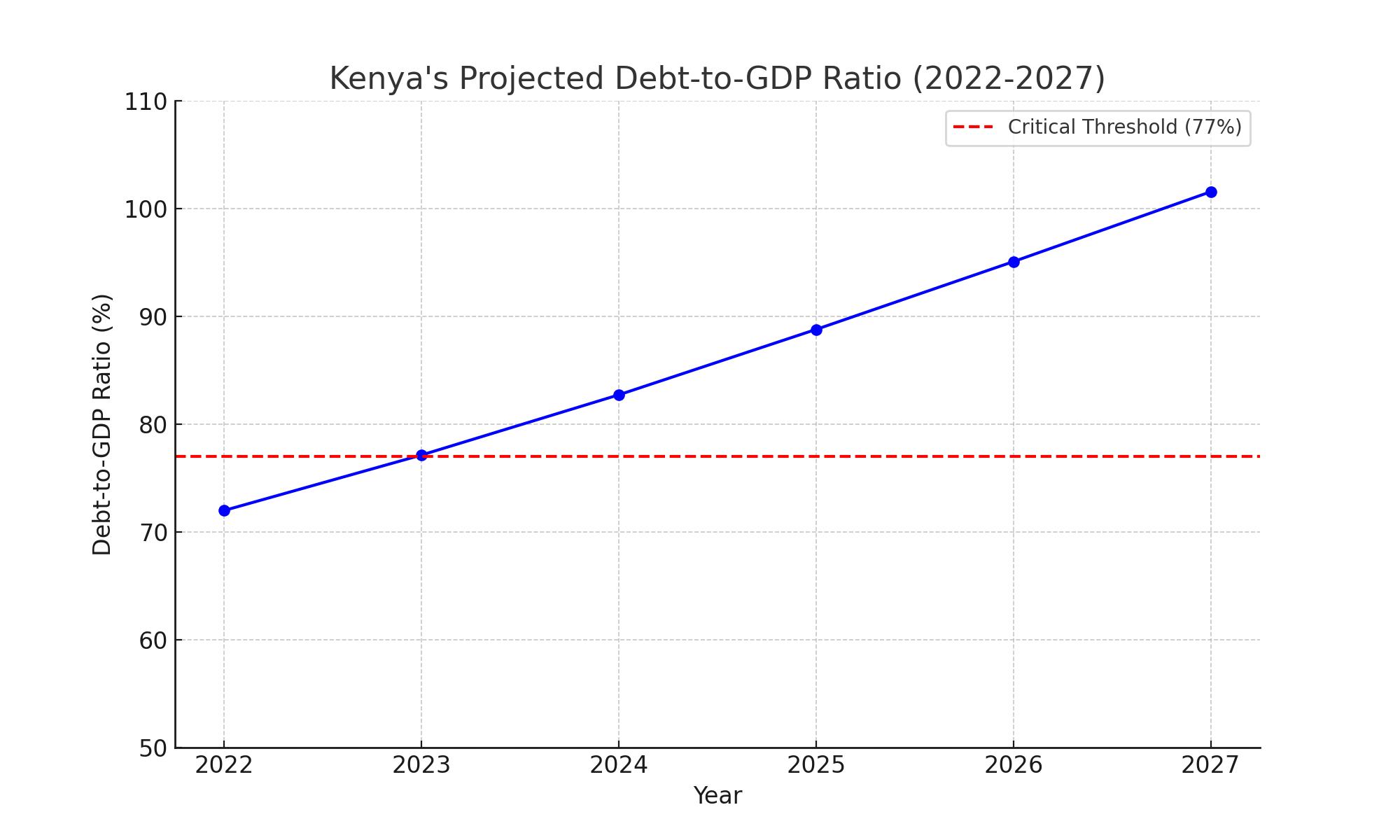
A high ratio suggests that a country may struggle to repay its debts, potentially leading to financial instability. For instance, Kenya’s debt-to-GDP ratio has been rising, with projections indicating it will exceed 100% by 2027.

In the context of Kenya, the debt-to-GDP ratio provides a snapshot of the nation’s financial challenges. According to the Corporate Finance Institute, a ratio above 77% can hamper economic growth. Kenya’s increasing debt, as highlighted in reports by Business Daily Africa and Reuters, signifies growing financial burdens, potentially leading to a debt repayment crunch. The high cost of debt servicing and external borrowing exacerbates these challenges, indicating a need for strategic financial management to avoid economic stagnation. The chart below indicates that Kenya’s public debt stands at KES 9.1 trillion as of early 2024, and projections from the Treasury expect it to cross KES 13 trillion by 2027.

Kenya’s Projected Debt-to-GDP ratio

To mitigate Kenya’s rising debt-to-GDP ratio without increasing taxes, several strategies can be employed:

  1. Boosting Exports: Enhancing the competitiveness of Kenyan goods and services can increase foreign exchange earnings, reducing the need for external borrowing.
  2. Encouraging Foreign Direct Investment (FDI): Attracting FDI can provide the necessary capital for development projects without increasing debt.
  3. Improving Public Sector Efficiency: Streamlining government expenditures and reducing wastage can free up resources for debt repayment and development initiatives.
  4. Diversifying the Economy: Investing in various sectors, such as technology and agriculture, can create new revenue streams and reduce reliance on debt.

Implementing these strategies can help stabilise Kenya’s economy and reduce its debt burden, fostering sustainable growth. Effective management of public resources, coupled with strategic economic policies, is essential to achieving a healthier debt-to-GDP ratio and ensuring long-term economic stability for Kenya.

References:

Business Daily Treasury expects debt to cross Sh13trn by 2027

Economist Intelligence Kenya faces a potential debt repayment crunch in 2024
Reuters Kenya’s double-digit debt costs sign of the tough times

CFI Debt-to-GDP Ratio

The Commonwealth Blog: Rising government debt-to-GDP ratios need urgent response

TheStreet What Is a Debt-to-GDP Ratio? Definition, Calculation & Importance

Cytonn Kenya’s Public Debt Review 2023: Is Kenya’s Public Debt Level Sustainable?