Balancing IMF Demands: Kenya’s Economic Challenges and Public Unrest

Kenya’s relationship with the International Monetary Fund (IMF) has been a contentious topic, especially due to the economic conditions tied to IMF loans that impact ordinary Kenyans. The tension has escalated recently with protests against tax hikes, which many Kenyans view as a direct consequence of the IMF’s conditions. This unrest highlights the public’s frustration with both the government’s economic policies and the IMF’s role in shaping them. The IMF’s involvement in Kenya is seen as a double-edged sword; while it provides necessary financial assistance, it also imposes stringent conditions that many feel exacerbate economic inequality and hardship. Public outcry has particularly focused on how these conditions seem to undermine national sovereignty, with citizens questioning the long-term implications for Kenya’s economic independence.

The IMF has a long history of providing financial assistance to Kenya, most recently through a $2.34 billion arrangement aimed at supporting economic recovery from the COVID-19 pandemic, addressing debt vulnerabilities, and fostering inclusive growth. However, the stringent conditions attached, including austerity measures and increased taxes, have been deeply unpopular. The proposed Finance Bill 2024/2025, which sought to introduce new taxes to meet fiscal targets under the IMF program, became a flashpoint, leading to widespread protests and fatal clashes, ultimately forcing the government to withdraw the bill. These protests, largely driven by the Gen-Z demographic, reflect broader issues of governance, corruption, and public expenditure management. There are growing calls for the government to focus more on reducing wastage and corruption rather than increasing taxes, highlighting the public’s demand for more responsible and transparent governance.

Kenya’s economic challenges are multifaceted, with high debt levels and public debt nearing 70% of GDP. While the IMF’s involvement is seen as crucial for maintaining financial stability, its prescriptions are often viewed as disproportionately affecting the poor and middle class. President William Ruto’s government is in a difficult position, needing to balance the IMF’s demands with public discontent. Following the protests, Ruto had to assure both the IMF and his citizens that Kenya would still meet its fiscal goals through alternative means, such as budget cuts and increased borrowing. This situation underscores the complex dynamics between national policies and international financial institutions’ requirements. The IMF’s influence in Kenya has become a rallying point for various social and political movements, with many feeling that its programs benefit financial stability at the cost of social stability and public welfare. Protesters see the IMF as an external force imposing harsh economic policies without fully understanding the local context and hardships faced by ordinary Kenyans, echoing a broader critique of the IMF’s role in developing countries. This sentiment underscores the need for sustainable economic growth that maintains social harmony and effectively addresses public grievances.

References:

The National Treasury and Economic Planning KENYA-IMF PROGRAM

International Monetary Fund IMF Statement on Kenya

Strategies to Stabilize Kenya’s Economy Amid Rising Debt-to-GDP Ratio

The debt-to-GDP ratio is a crucial metric for assessing a country’s economic health. It is calculated by dividing a nation’s total public debt by its gross domestic product (GDP), then multiplying by 100 to get a percentage. This ratio indicates how much debt a country has relative to its economic output. The formula for the debt-to-GDP ratio is:

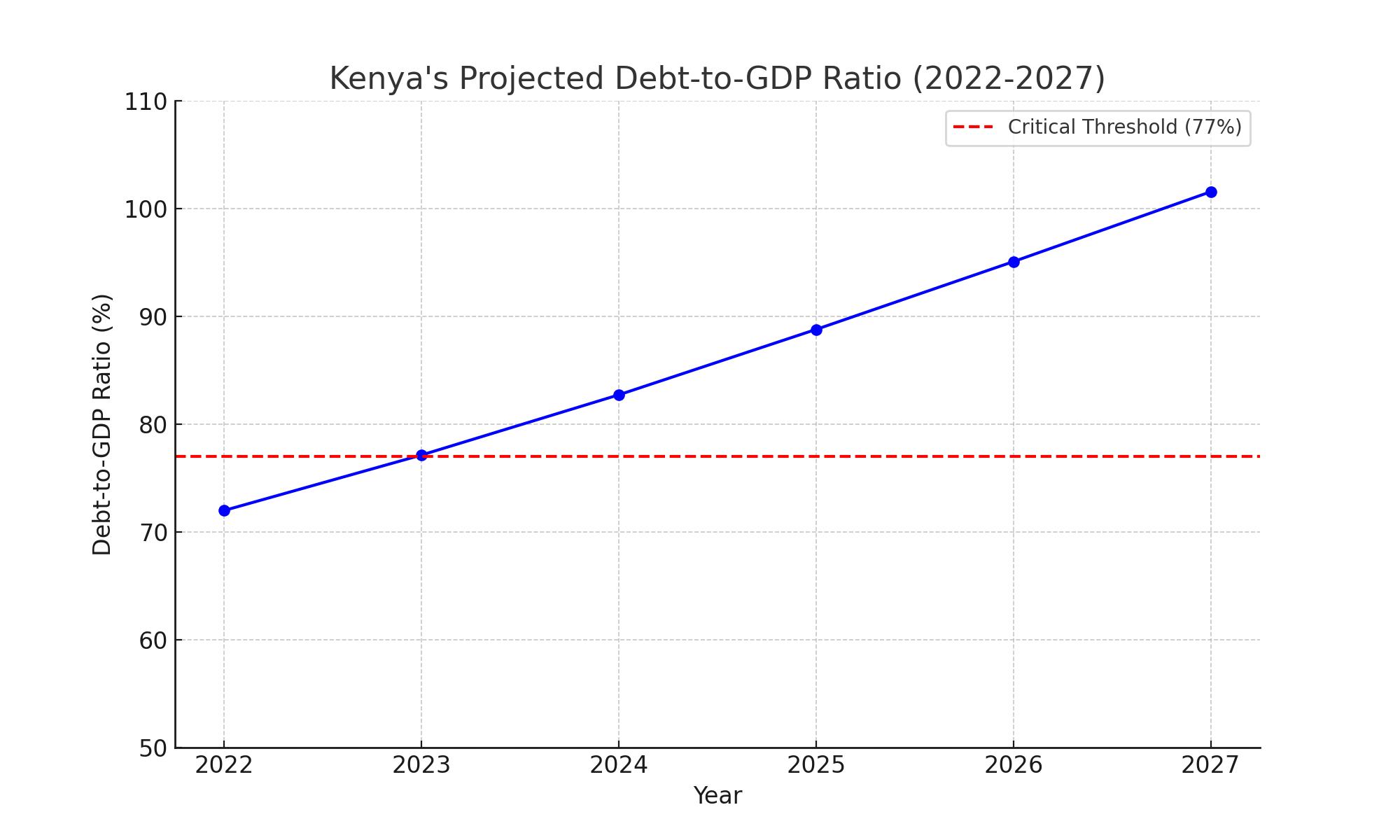
A high ratio suggests that a country may struggle to repay its debts, potentially leading to financial instability. For instance, Kenya’s debt-to-GDP ratio has been rising, with projections indicating it will exceed 100% by 2027.

In the context of Kenya, the debt-to-GDP ratio provides a snapshot of the nation’s financial challenges. According to the Corporate Finance Institute, a ratio above 77% can hamper economic growth. Kenya’s increasing debt, as highlighted in reports by Business Daily Africa and Reuters, signifies growing financial burdens, potentially leading to a debt repayment crunch. The high cost of debt servicing and external borrowing exacerbates these challenges, indicating a need for strategic financial management to avoid economic stagnation. The chart below indicates that Kenya’s public debt stands at KES 9.1 trillion as of early 2024, and projections from the Treasury expect it to cross KES 13 trillion by 2027.

Kenya’s Projected Debt-to-GDP ratio

To mitigate Kenya’s rising debt-to-GDP ratio without increasing taxes, several strategies can be employed:

  1. Boosting Exports: Enhancing the competitiveness of Kenyan goods and services can increase foreign exchange earnings, reducing the need for external borrowing.
  2. Encouraging Foreign Direct Investment (FDI): Attracting FDI can provide the necessary capital for development projects without increasing debt.
  3. Improving Public Sector Efficiency: Streamlining government expenditures and reducing wastage can free up resources for debt repayment and development initiatives.
  4. Diversifying the Economy: Investing in various sectors, such as technology and agriculture, can create new revenue streams and reduce reliance on debt.

Implementing these strategies can help stabilise Kenya’s economy and reduce its debt burden, fostering sustainable growth. Effective management of public resources, coupled with strategic economic policies, is essential to achieving a healthier debt-to-GDP ratio and ensuring long-term economic stability for Kenya.

References:

Business Daily Treasury expects debt to cross Sh13trn by 2027

Economist Intelligence Kenya faces a potential debt repayment crunch in 2024
Reuters Kenya’s double-digit debt costs sign of the tough times

CFI Debt-to-GDP Ratio

The Commonwealth Blog: Rising government debt-to-GDP ratios need urgent response

TheStreet What Is a Debt-to-GDP Ratio? Definition, Calculation & Importance

Cytonn Kenya’s Public Debt Review 2023: Is Kenya’s Public Debt Level Sustainable?

KENYA FOOD SECURITY | A critical view

Co-Author :  Victor Daniels

On February 22, 2010, a senior policy analyst with the Kenya Institute for Public Policy Research and Analysis (KIPPRA), was quoted saying, “we have a challenge in the management of our public affairs [and] the management of our food stocks. Sometimes we are exporting food yet we later need to import. There is failure to learn from best practices, to invest in knowledge and transform that knowledge into action.”

According to OneWorld UK, the UN “estimates that 3.5 million Kenyans will require food assistance, a figure that may rise before the end of 2011.” However, the assessments updated on July, 2011, “exclude the Somali refugees located in the Dadaab camps in eastern Kenya whose plight is managed as an international refugee crisis, as distinct from Kenya’s national food insecurity.” Scholars have blamed the looming food crisis in Kenya, not only on the failure of successive seasonal rains, but also on poor standards of governance, and mismanagement of the agriculture sector, coupled with lack of political goodwill. Providing credit facilities to farmers, setting up micro-irrigation schemes, and cash transfers to poor farmers, as well as effecting input subsidies are just but a few ways to begin the comprehensive process, to realize food security in Kenya.
Kenya Food Security

In light of the above, an economy should be based on a long-lasting, reliable system, not on slavery, and coercion. Our economy relies on greed, and a serious lack of thought about consequences. That is a very unstable sort of economy. A lucid socio-economic analysis of the mechanisms of exploitative processes in the Kenyan economy brings out Kenya’s predicament in the light of under-hand shady policy making, which is not exclusively Marxist, but still draws heavily on that school of thought. Even before the fall of the KANU regime, the prices of prime commodities such as tea, sugar, rice, and maize, have constantly been rising, which creates a conflict of interests considering we locally produce the same. Where does the buck stop? Can we still interpret this, as Kenya’s success story? Are the Kenyan food policies a success in terms of growth, or total output? The time has come to reappraise agricultural pricing policies in general, so that agriculture makes its optimum contribution to maximizing gross national production. For maize, the Kenyan staple grain, the producer’s selling price should be reviewed, and be set at the relevant export parity price. The consumer price should be down to a comfortable level, thus, the price should be set at the producer’s selling price, plus marketing costs- incurred in distributing the maize to consumers. It is true that costs are rising, but then, if a justified investment policy was directed for export, we would expect the abolition of domestic marketing, thus, providing comfortable floor and ceiling prices. Starvation in most Kenyan regions remains to haunt us due to the government’s sub-standard reckoning, without political goodwill for the Kenyan people. Well known Members of Parliament, politicians, senior civil servants, and business men affiliated to high echelons of power, have repeatedly been accused with controversial maize and sugar imports and exports, but still, calls to prosecute the alleged suspects, go unheeded. Impunity and indecisiveness, thrives at high levels of governance, and on the miseries of the citizenry, where justice refers to how deep your pockets are. Budgetary allocation for the Ministry of State for Development of Northern Kenya and Other Arid Lands is irrelevant, if the people meant to be protected by the same, are dying of acute food shortage, and malnutrition. The chronic famine situation in Kenya, signals a malfunction in the governance of the Kenyan democracy. Kenya truly needs, a decentralized system, of running State affairs. Focus should be on the people and their strengths, instead of importing western innovations, and ideologies. Since we should be the change we want to see, we should put an end to popularistic politics, and deal with real issues affecting Kenyans on the ground, in a comprehensive manner.

References:

Food Security in Kenya-briefing OneWorld UK, July, 2011

Experts voice food security concerns IRIN Africa, February 22, 2010

Outrage over rising food and fuel prices IRIN Africa, April 20, 2011