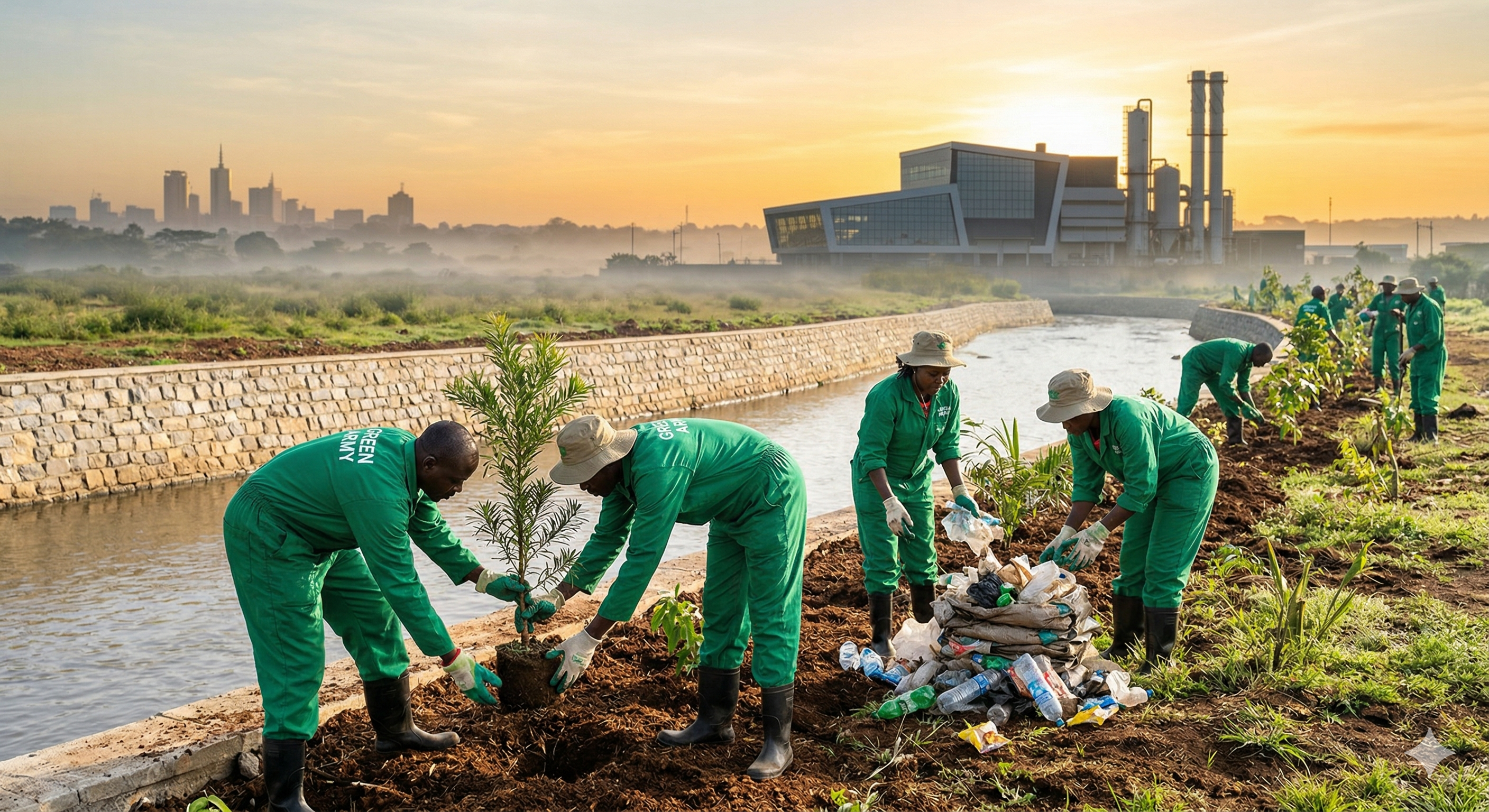
Nairobi is currently undergoing an Sh80 billion transformation under the “Nairobi Rising” agenda, an ambitious intergovernmental pact designed to pull the capital out of its cycle of disaster. The roadmap includes a Sh25 billion overhaul of the city’s drainage and a Sh33 billion investment in expanding sewer systems and restoring polluted waterways. This represents the most significant attempt in recent history to decouple the city’s stormwater from its sewage, a move intended to end the perennial outbreaks of cholera and typhoid that follow every flood.
A central pillar of this new vision is the decommissioning of the notorious Dandora dumpsite. Long a source of environmental and health risks, Dandora is slated to be replaced by a modern waste-to-energy plant in Ruai that will generate between 45 and 70 megawatts of electricity. By transitioning to a circular economy, the government hopes to eliminate the plastic debris that currently chokes the city’s drains, which costs an estimated KES 4.5 billion annually in reactive mitigation.
However, the success of “Nairobi Rising” hinges on institutional reform and accountability. The plan includes the creation of a specialized Nairobi Metropolitan Police Unit to enforce zoning laws and protect reclaimed riparian land, but critics warn of the “financial hangover” left by previous interventions. For the residents of Nairobi, the stakes could not be higher; as the April 2026 waste management launch approaches, the city is betting billions that it can finally build the resilience needed to survive its own growth.
References:
Capital News Sewerage and Sanitation Take Centre Stage in Nairobi’s Sh80bn Development Plan
People Daily Ruto unveils plan for a major overhaul of Dandora dumpsite
Big 3 Africa Nairobi Waste to Energy Transformation
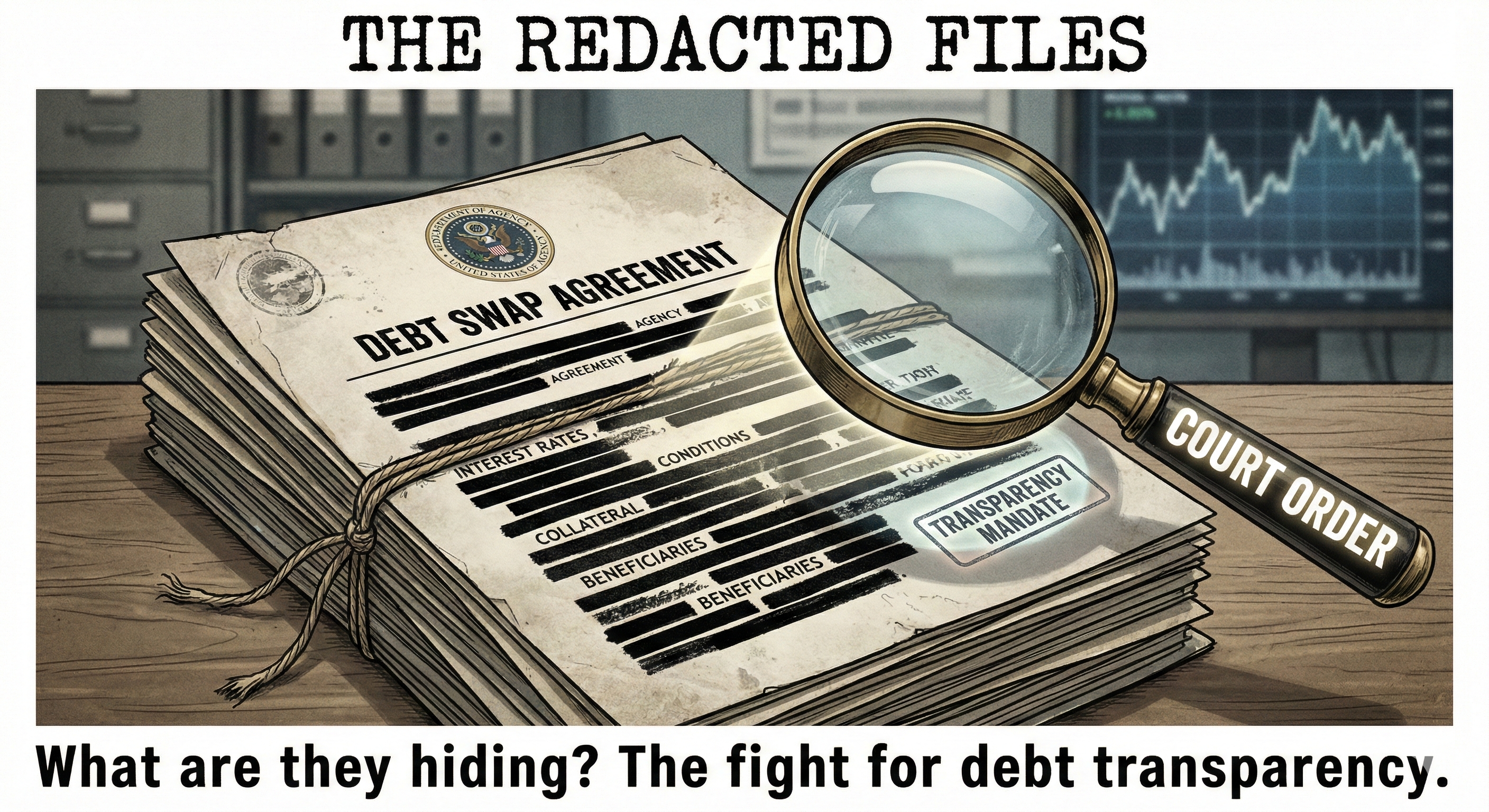
Despite the high stakes, the specific terms of the debt-for-food swap remain shrouded in secrecy, sparking legal battles and civil society alarm. A case filed at the East African Court of Justice, Wanjiru Gikonyo v The Attorney General, challenges the government’s refusal to disclose the full details of sovereign debt agreements. Litigants argue that committing future tax revenues and “savings” to long-term projects without public participation is unconstitutional. The lack of a public dashboard detailing exactly how the Sh129 billion will be spent creates a “transparency deficit” that invites mismanagement.
This opacity exacerbates the “sovereignty paradox.” By allowing the US-DFC and WFP to dictate the terms of expenditure, Kenya is effectively admitting that its own institutions cannot be trusted. While external conditionality acts as a safeguard against local corruption, the public remains in the dark about what exactly has been signed away. Are there hidden fees? What are the penalties for non-compliance? Without full disclosure, the Kenyan taxpayer is a passenger in a vehicle being driven by foreign creditors.
Transparency is not just a legal formality; it is the only disinfectant strong enough to prevent the “bureaucratic consignment” of funds. Civil society is demanding that the Treasury publish every shilling of the “savings” and every project beneficiary. Until then, the debt swap remains a “black box”—a deal negotiated in boardrooms in Washington and Nairobi, with the bill sent to the citizen who has no say in the menu.
References:
Afronomics Law Sovereign Debt News Update No. 147: The Promises and Transparency Pitfalls of Kenya’s $1 Billion Debt-for-Food Swap
The Institute for Social Accountability The High Court has ordered the National Treasury to disclose critical information on Kenya’s bilateral loans and sovereign bonds.
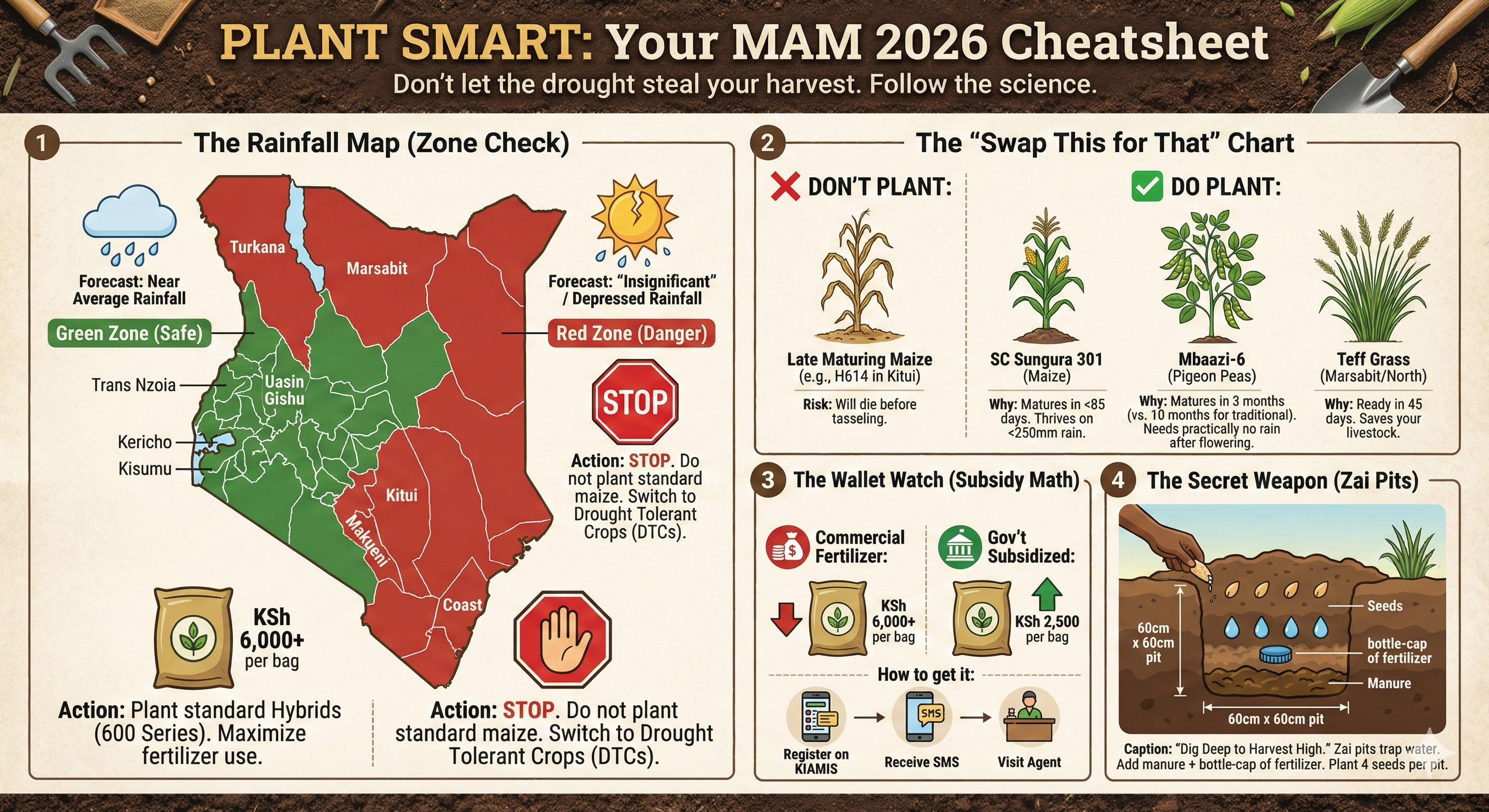
🌱 Stop! Don’t Bury Your Money: The Seeds That Will Survive the 2026 “Insignificant Rains”
Farmers in Arid and Semi-Arid Lands (ASALs) are walking a tightrope. With the Met Department warning of “intermittent dry spells” and poor distribution, planting standard 6-month maize is a gamble you will likely lose.
The “Smart Farm” Swap:
Swap H614 for SC Sungura 301: If you must plant maize, use ultra-early varieties. SC Sungura 301 matures in just 75-85 days and thrives on less than 250mm of rain.
Swap Beans for Mbaazi-6: Traditional pigeon peas take 10 months. The new Mbaazi-6 variety from KALRO is ready in under 3 months. It needs rain only during flowering; after that, it uses deep roots to survive the heat.
Check Dryland Varieties: Look for the DH Series (DH04, DH08) which are specifically bred for these conditions.
References:
Farm Biz Africa Crops that can reach harvest in 2024’s dry short rains
KALRO Climate Smart Agricultural Technologies,Innovations and Management Practices for Green Gram Value Chain
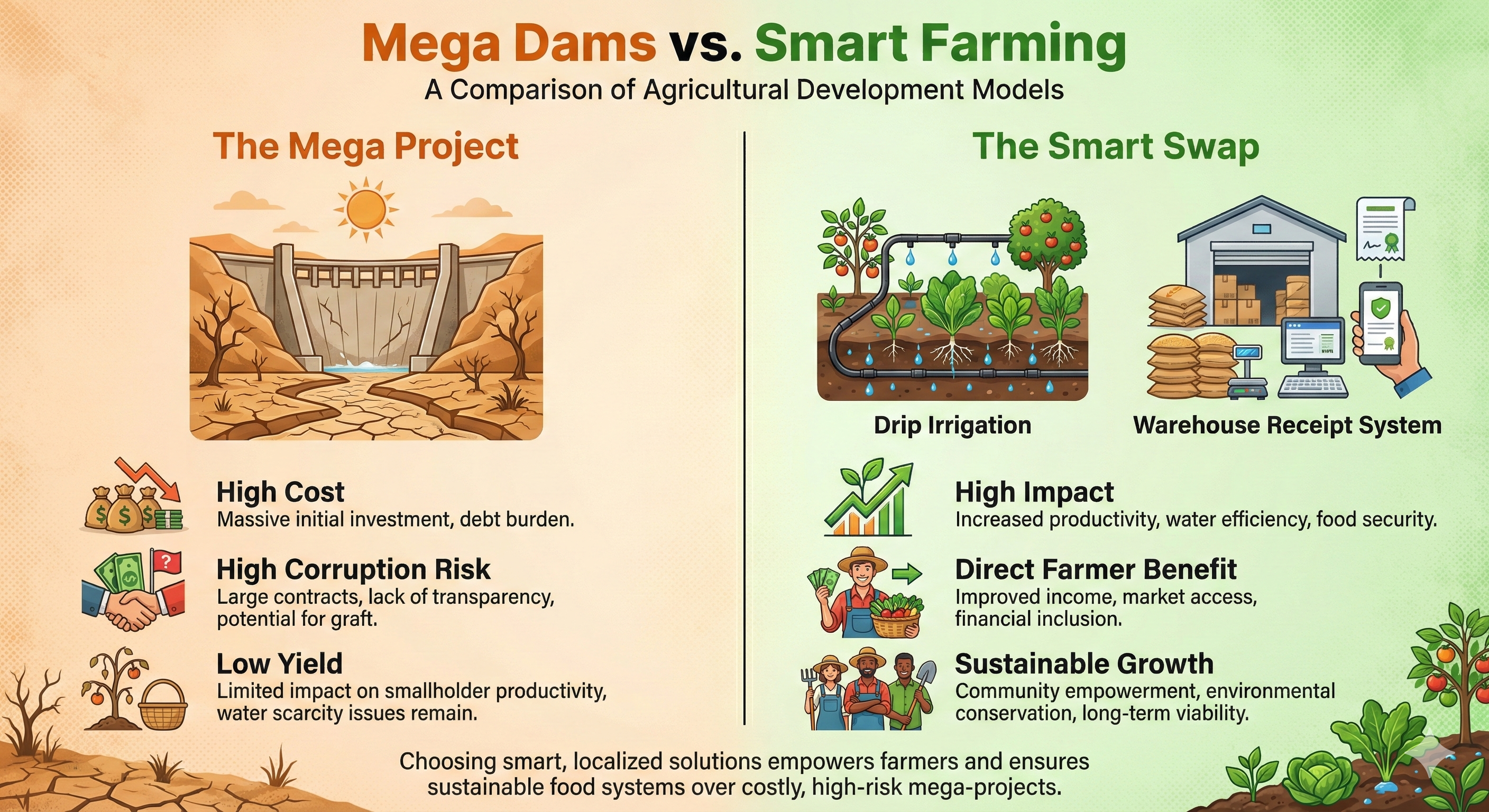
As the government targets 2 million acres for irrigation under the new debt swap initiative, the ghost of the Galana Kulalu project looms large. Just days ago, on January 26, 2026, the government announced plans for six new mega dams, signaling a return to the large-scale infrastructure strategy that failed so spectacularly in 2014. The original Galana Kulalu pilot consumed Sh7 billion to produce maize at costs higher than market price, collapsing under poor planning and corruption. Critics argue that repeating this “big dam” strategy ignores the hard-learned lessons of the past.
The disconnect is palpable. While the state plans mega-projects in arid lands, small-scale farmers—who produce the bulk of Kenya’s food—are struggling with basic input costs and lack of market access. The “savings” from the debt swap would likely yield higher returns if invested in decentralized solutions: household water pans, small-scale drip irrigation kits, and the Warehouse Receipt System (WRS) to help farmers store grain and avoid price exploitation by middlemen.
If the Sh129 billion is poured into another series of mega-dams, the funds risk being absorbed by contractors and consultants, leaving the country with more debt and no food. The success of this swap depends on shifting focus from concrete structures to the actual economics of farming—lowering production costs and ensuring profitability. Without this shift, we are merely “mixing oil and water” again, hoping that high-finance infrastructure will somehow trickle down to the grassroots.
References:
Capital Business Govt plans six mega dams, targets 2mn acres in irrigation push
The Star Government plans six mega dams, targets 2 million acres for irrigation push
🌦️ Wet West, Dry East: Why One Strategy Won’t Work for All in MAM 2026
The Kenya Meteorological Department (KMD) has dropped its forecast for the March-April-May (MAM) long rains, and it paints a picture of two very different planting seasons.
The Good News: If you are in the Highlands West of the Rift (Trans Nzoia, Uasin Gishu, Kericho) or the Lake Victoria Basin, get your tractors ready. The forecast predicts near-average to above-average rainfall. This is the green light for high-yield maize farming.
The Warning: For farmers in the Southeastern Lowlands (Kitui, Makueni), Northeastern, and the Coast, the forecast is tough. You are facing “near-average to below-average” rainfall, with a high chance of insignificant rains—meaning showers that wet the dust but don’t sustain a crop.
The Takeaway: Don’t copy your neighbor in Eldoret if you live in Machakos. The government is urging everyone to plant, but what you plant matters more than ever.
West: Go for maximum yield (600 series maize).
East/North: Go for survival (fast-maturing crops).
References:
Nairobi Leo Kenya Met Issues March-May 2026 Long Rains Forecast
Daily Nation End of drought in sight, but coming rains will be insignificant for arid regions
All Africa Above-Average Rains Expected in Key Regions, Weatherman Warns of Dry Spells Elsewhere
The “Food-for-Eurobond” deal relies on a dangerous assumption: that savings from international debt relief can navigate the treacherous waters of Kenya’s local bureaucracy without being looted. History suggests this is an “oil and water” scenario—liquid finance attempting to mix with a rigid, opaque system. The recent scandals at the Kenya National Trading Corporation (KNTC) and the National Cereals and Produce Board (NCPB) serve as grim warnings. In the KNTC edible oils scandal, tax waivers meant to lower prices were captured by politically connected firms, resulting in a Sh16.5 billion loss with no benefit to the consumer.
Similarly, the NCPB’s recent distribution of “fake fertilizer”—bags filled with quarry dust—demonstrates how easily “agricultural support” can be weaponized against the farmers it is meant to help. If the swap funds are channeled through these same “bureaucratic consignments,” the initiative risks becoming another slush fund for cartels. The involvement of the World Food Programme (WFP) is intended to act as an “emulsifier,” forcing accountability into the system, but their oversight powers will be tested against deeply entrenched patronage networks.
Experts warn that without a radical overhaul of state agencies, the “savings” will evaporate before they buy a single bag of genuine fertilizer or build a working silo. The structural disconnect between the Treasury’s high-level deal-making and the Ministry of Agriculture’s operational failures remains the single biggest risk. Unless the government bypasses these compromised intermediaries, perhaps by funding private sector credit guarantees instead of direct procurement, the “oil” of finance will float to the top, leaving the “water” of development murky and stagnant.
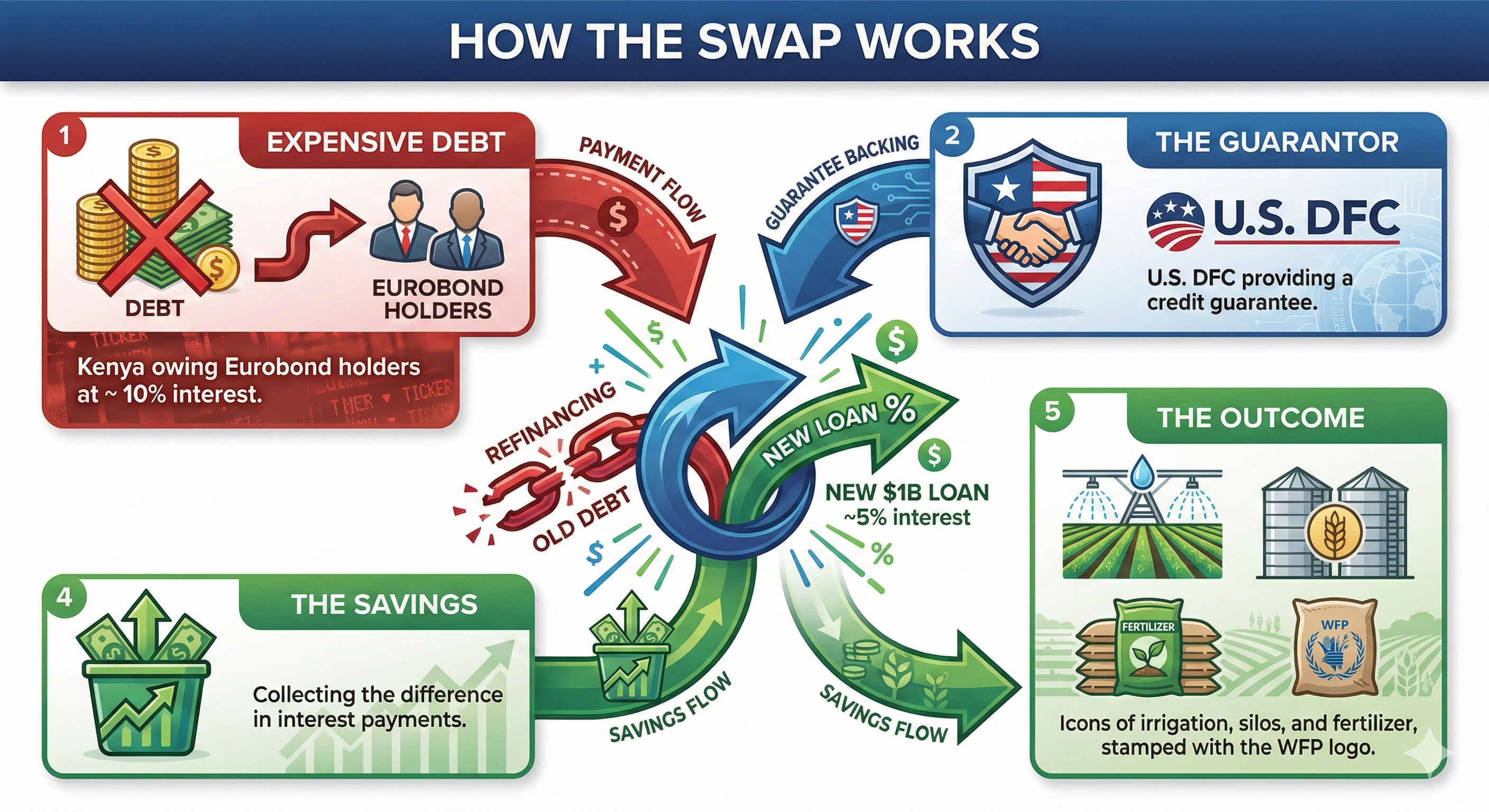
Kenya is on the verge of finalizing a landmark $1 billion (Sh129 billion) debt-for-food security swap, a sophisticated financial maneuver designed to rescue the country from a suffocating liquidity crunch. By leveraging a guarantee from the U.S. International Development Finance Corporation (DFC), the Treasury intends to refinance expensive Eurobond debt with cheaper, concessional loans. The plan is financially astute: it swaps high-interest commercial debt for lower-interest obligations, a move that prompted Moody’s to upgrade Kenya’s credit rating to B3 and stabilize the outlook on the nation’s sovereign debt.
However, the deal comes with a catch that transforms it from a simple refinancing operation into a complex development experiment. The interest “savings” generated from this swap must be ring-fenced and funneled directly into food security projects, managed in partnership with the World Food Programme (WFP). This arrangement effectively outsources a portion of national planning to an international body, admitting that the state needs external discipline to ensure funds aren’t diverted. While this stabilizes the shilling and pleases bondholders, it raises a fundamental question: is this a genuine strategy to feed the nation, or simply financial engineering to avoid default?
The stakes could not be higher. With 3.4 million Kenyans facing acute food insecurity and public debt service consuming over two-thirds of tax revenue, the government is betting that this “financial oil” can mix with the “water” of local agriculture without separating. If successful, it provides fiscal breathing room and lowers input costs for farmers; if it fails, Kenya will be left with the same debt burden and no improvement in the cost of living for the average wananchi.
When a private company’s neural nets began to unmask the hidden flows inside M-Pesa, the discovery jolted more than the fintech sector — it forced Kenya to confront a systemic question: who watches the watchers, and on what rules? The rollout of AI-driven compliance tools at Safaricom was never merely a tech upgrade; it arrived as part of a national emergency — a response to international pressure, spiralling fraud, and regulatory failure. The Financial Action Task Force’s increased-monitoring designation and months of global scrutiny had already pushed lawmakers and regulators into a sprint of reforms; industry actors answered with models that could learn patterns humans could not. But those same models required data — vast, granular, and often personal — and the legal scaffolding for such access was changing in real time. Kenya’s recent cyber-law overhaul and parliamentary amendments to the Computer Misuse and Cybercrime Act expanded state powers over online infrastructure, tightened penalties for SIM-swap and phishing offences, and gave the National Computer and Cybercrimes Coordination Committee sweeping directive authority over platforms and applications. Those moves addressed real harms — SIM swap fraud, phishing, and mass laundering — but they also recalibrated the balance between surveillance and rights.
Video Courtesy: The Kenyan Wall Street Youtube Channel
That recalibration is tested in the day-to-day rub of enforcement. Regulators and the ODPC have begun to draw lines: the Data Protection Commissioner’s recent ruling against a major betting operator for excessive data demands underscores the point that AML objectives cannot be a carte blanche for limitless intrusion. In the Betika case the ODPC found the company’s demand for three months of a user’s M-Pesa statements at account-closure to be disproportionate and ordered compensation, signalling that data-minimisation and privacy remain legally enforceable even amid AML pressures. At the same time, FATF’s 2025 monitoring guidance — and independent analysis from ISS Africa — make plain that Kenya must also show measurable results in prosecutions, beneficial-ownership transparency, and risk-based supervision of non-financial entities (including gambling and virtual assets) if it is to repair global confidence. The practical implication is blunt: Kenya cannot satisfy international partners by papering laws alone; enforcement and proportionate procedural safeguards must accompany technical surveillance. Otherwise the country risks swapping one reputational problem (grey-listing) for another — a domestic legitimacy crisis born of heavy-handed data practices.
So where does Kenya go from here? The answer lies in design choices — legal, technical, and institutional — that make accountability a feature, not an afterthought. We recommend three urgent, interlocking reforms that turn the AI question into a governance opportunity: (1) Purpose-bound, time-limited data access. AML or security queries should be scoped narrowly and logged; full transaction histories must not be a default feed into private models. (2) Explainability + redress. Any automated decision that materially affects a person (account freezes, cash-outs blocked, KYC escalations) must carry a succinct, non-technical rationale and a fast appeals channel routed through an independent body. (3) Joint independent oversight. Operationalize a statutory ODPC–FRC technical review board with public reporting obligations, the power to audit both models and data requests, and a mandate to publish redaction and retention metrics. These are not frictionless reforms — they will slow some processes and impose costs — but that trade-off is precisely the point: legitimacy costs less than lost trust. If Kenya stitches these protections into law and practice — and couples them with meaningful prosecution of financial crimes and improved beneficial-ownership registers — it can convert the awkward moment of global scrutiny into a first-mover advantage: an African model of rights-based, explainable AI governance for financial systems. The choices made now will decide whether Kenya’s algorithms become instruments of accountability or mechanisms that hollow out public trust.
References:
Business Daily Security or surveillance? How amended cyber law could reshape Kenya’s online space
Daily Nation How AI can close trust gaps in Africa’s financial systems
The Kenyan Wall Street How Safaricom is Leveraging AI to Bolster M-Pesa Security and Efficiency
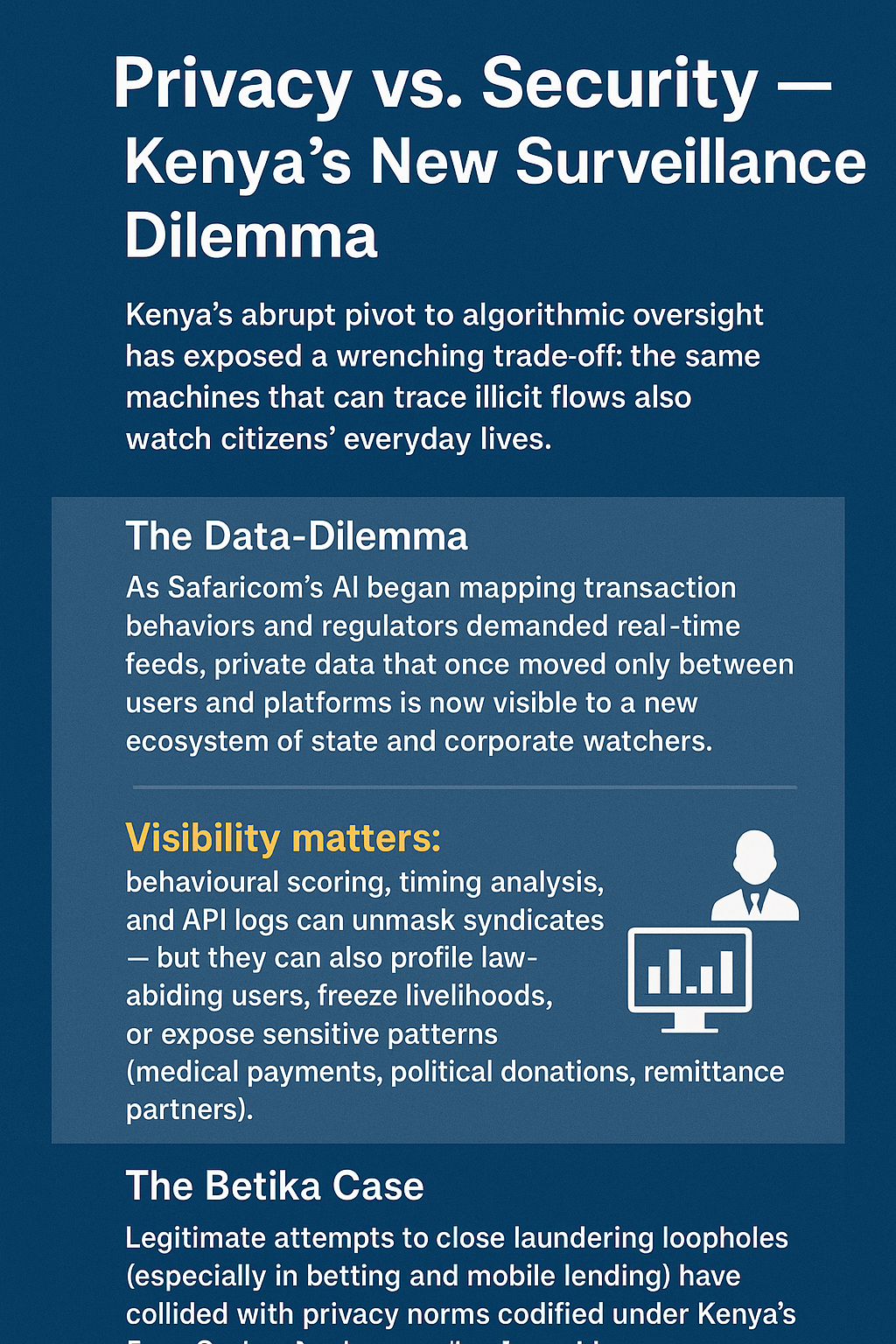
Kenya’s abrupt pivot to algorithmic oversight has exposed a wrenching trade-off: the same machines that can trace illicit flows also watch citizens’ everyday lives. As Safaricom’s AI began mapping transaction behaviors and regulators demanded real-time feeds, private data that once moved only between users and platforms is now visible to a new ecosystem of state and corporate watchers. That visibility matters: behavioural scoring, timing analysis, and API logs can unmask syndicates — but they can also profile law-abiding users, freeze livelihoods, or expose sensitive patterns (medical payments, political donations, remittance partners). In practice, this tension has a name and a face: legitimate attempts to close laundering loopholes (especially in betting and mobile lending) have collided with privacy norms codified under Kenya’s Data Protection laws and enforced by the Data Protection Commissioner. The friction is no longer theoretical — it plays out in court rulings and public grievances, where an automated alert can instantly strand a small-business owner awaiting payroll, or a migrant worker trying to send school fees home.
One high-profile example is the case involving Betika, which was ordered to pay KSh 250,000 for breaching data privacy rules. The ruling found that Betika had improperly processed users’ personal data without sufficient protections or lawful grounds. This case highlights a critical danger: when betting platforms (already under AML scrutiny) become nodes of state data demand, weak privacy compliance means corporate actors — not just regulators — can overreach data collection and usage, compounding surveillance risk. The Betika ruling proved that courts are willing to hold fintech operators accountable, but the scale of risk grows when those same APIs feed into AI-driven compliance systems without clear limits or safeguards.
The policy question is therefore blunt: how do you operationalize intrusive yet effective AML tools without creating a surveillance grid that punishes innocents? The answer requires more than slogans. It begins with strict, purpose-limited access: authorities and private partners should get only the minimal data needed to investigate a flagged flow — not full transaction histories. It requires explainable AI, where users receive understandable notices about why their wallet was flagged, and a clear appeals process exists. It demands robust oversight: the ODPC and FRC must enforce audit protocols, redress mechanisms, and limits on data retention and use. The Betika precedent is a warning: tightening oversight without privacy guardrails risks turning compliance into exclusion and exposing digital citizens to data abuse. Kenya now stands at a critical juncture: Will it build a system where enforcement respects rights — or drift into a regime where surveillance becomes default, and trust becomes collateral damage? In our next post, we’ll explore how to build explainable AI and regulatory harmony — practical steps to reconcile compliance, innovation, and rights.
References:
iGamingToday Betika ordered to pay KSh 250,000 for breaching data privacy rules
Subex How AI and Analytics Are Revolutionizing Fraud Detection in Mobile Money
Thomson Reuters AML challenges in evolving threat landscape, says ACAMS report
Techcabal How Safaricom’s AI exposed money laundering in Kenya’s betting boom
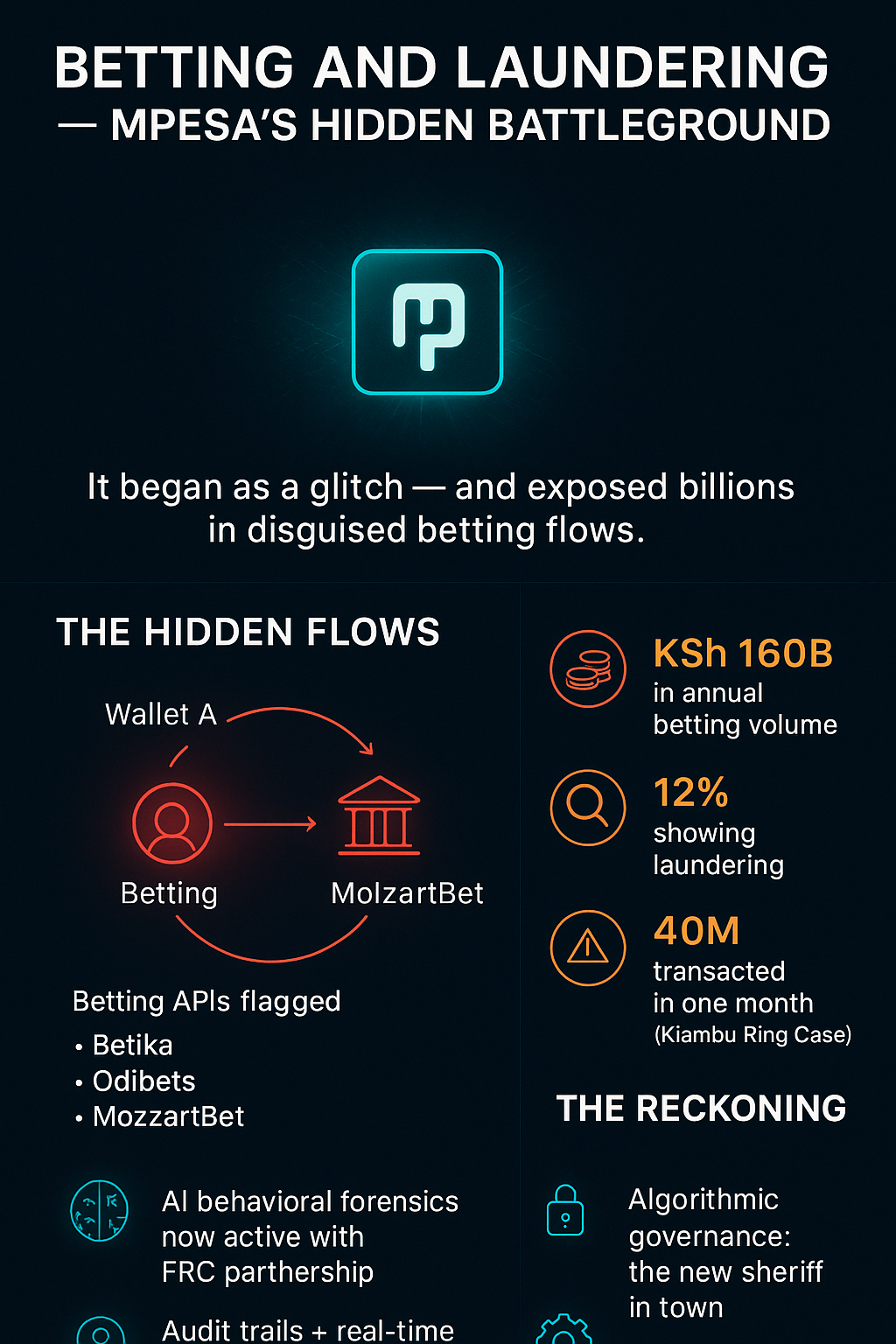
It began as a flicker of digital noise deep within Safaricom’s new artificial intelligence compliance system — a pattern so strange, even the engineers thought it was a software glitch. Betting wallets were trading in micro-loops, small deposits bouncing across networks at impossible speed, masquerading as gaming wins. But when the algorithm slowed the data stream, it exposed the truth: this wasn’t gambling; it was laundering. In days, Safaricom’s AI had flagged dozens of high-traffic betting APIs — among them Betika, Odibets, and MozzartBet — for suspicious activity, their systems pulsing with repeated micro-transactions that defied legitimate gaming behavior. What the model revealed was staggering. Ordinary player wallets had become conduits for billions of shillings, circulating under the guise of lucky streaks. Behind every spin, every small bet, was a meticulously choreographed web of digital cash-washing. The machine had finally confirmed what regulators long suspected but could not prove: Kenya’s fast-rising betting culture had evolved into the perfect laundromat — one hidden in plain sight inside the M-Pesa ecosystem.
The numbers told their own story. In the Kiambu Betting Ring case, investigators uncovered agents processing over KSh 40 million in just one month, using layered deposits and false payout slips to disguise dirty money as betting gains. Similar patterns appeared in the MozzartBet compliance freeze of mid-2024, where offshore cash-outs linked to unverified wallet owners triggered intervention by the Financial Reporting Centre (FRC) and Central Bank’s AML unit. By then, the data was irrefutable. AI modeling suggested that nearly 12 percent of Kenya’s annual betting volume — roughly KSh 160 billion — showed characteristics of laundering or structured fraud. The algorithms traced wallet behaviors that no manual audit could — bettors who “won” every day without ever placing bets, agents whose transaction volumes exceeded physical limits, and accounts that went dark after a single large payout. These were not random outliers; they were engineered identities, designed to game a system built for speed, not scrutiny. For years, M-Pesa’s success story — its promise of instant, borderless convenience — had inadvertently created the perfect storm: a seamless digital infrastructure exploited by syndicates more agile than the law itself.
Now, that same infrastructure is being weaponized against them. Safaricom’s AI partnership with the FRC has ushered in a new era of behavioral forensics — algorithms that don’t just track money but interpret motion, timing, and correlation. Yet this technological awakening has sparked backlash. Betting firms accuse Safaricom of overreach, freezing legitimate transactions and blurring the line between compliance and surveillance. Regulators, meanwhile, are tightening the screws: audit trails for all gaming wallets, mandatory KYC verification, and real-time data access for AML enforcement. The ripple effects extend far beyond gaming. Kenya’s digital economy now stands at an inflection point, where algorithmic oversight has become both protector and disruptor. In exposing how entertainment masked economic deceit, the AI has done more than flag fraudulent wallets — it has held up a mirror to the fragility of digital trust in a cashless nation. The house may always win, but in this new frontier, so does the machine — and its vision is only getting sharper.
References:
Techcabal Safaricom fires 113 employees over fraud as internal cases rise
KBC Channel 1 Kenya’s gambling industry set for shake-up after President Ruto signs into law Gambling Control Bill (Youtube)
The Kenyan Wall Street How Safaricom is Leveraging AI to Bolster M-Pesa Security and Efficiency
KBC M-pesa outage on Monday as Safaricom adopts AI to tame fraud

 Jijuze