Understanding Kenya’s Investment Landscape Amid Fiscal Strain

Kenya’s economy is presenting investors with one of its most complex puzzles yet: macroeconomic stability on the surface, undercut by a fiscal storm brewing beneath. Inflation stands at a steady 4.6%—comfortably within the Central Bank of Kenya’s target range—granting policymakers room for monetary easing. GDP data also reflects resilience, with Q2 2025 growth at 5.0%, led by agriculture and a robust services sector. Yet behind these encouraging numbers lies a sobering reality: fiscal dominance. With interest payments now consuming roughly a third of all tax revenue, the government’s borrowing appetite is crowding out private credit. Commercial banks, chasing high-yield government paper, have little incentive to lower lending rates for businesses, leaving private sector credit growth crippled at barely 3.3%, down from 13.9% just a year ago.
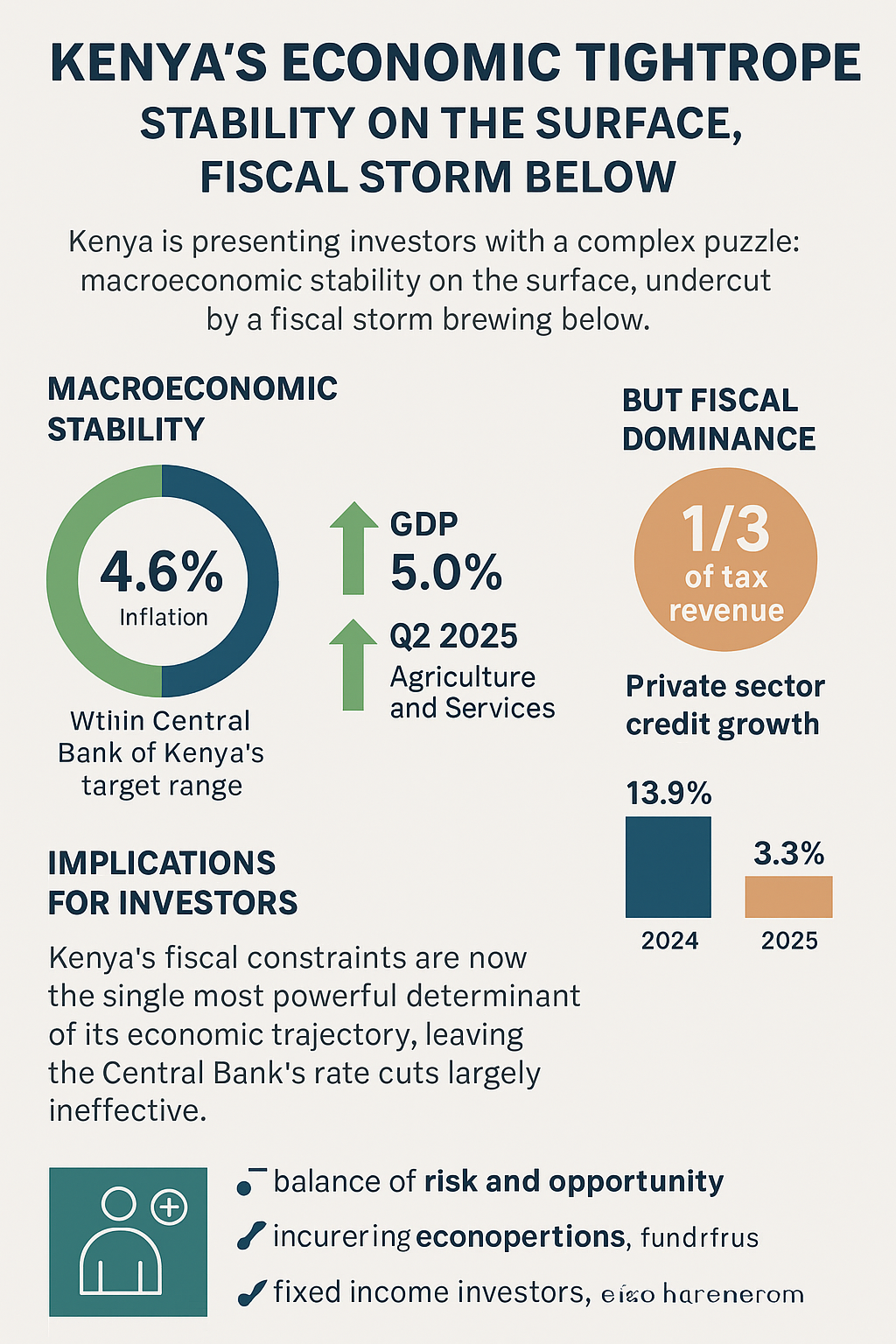
This squeeze is not just an abstract statistic; it defines the contours of Kenya’s medium-term investment landscape. The government projects a 5.3% full-year expansion, but global institutions remain unconvinced. The IMF and World Bank forecast growth at 4.8% and 4.5% respectively, citing weak private sector consumption, a sluggish credit channel, and a high risk of debt distress. Kenya’s fiscal constraints are now the single most powerful determinant of its economic trajectory, leaving the Central Bank’s rate cuts largely ineffective. The implication for investors is clear: headline GDP growth masks a structural imbalance where state borrowing sets the price of credit and private enterprise takes a back seat.

The balance of risk and opportunity lies in how investors position themselves. Kenya’s external buffers—rising remittances, strong agricultural exports, and narrowed current account deficit—are encouraging, but remain fragile, as all three are highly exposed to global downturns. For fixed income investors, short-duration government paper offers yield but carries sovereign risk that cannot be ignored. For equities, defensive plays in export-driven agribusiness, technology, and digital services stand out, while firms reliant on domestic mass-market credit may falter. Direct investment opportunities exist in renewable energy, climate-linked finance, and tech, sectors less tied to domestic fiscal strain. For corporate strategists, survival hinges on operational efficiency, alternative financing, and robust risk management to cushion external shocks. Kenya stands at a decisive juncture: without credible fiscal consolidation, its growth story risks becoming a cycle of constrained resilience. For investors, the key lies not just in reading the numbers, but in recognizing the limits of resilience when credit and capital are structurally captured by the state.

References:

KNBS Inflation Rate (CPI)

CNBC Africa Kenya’s inflation rises slightly in September on food, transport

World Bank Group Despite Improvements, Kenya’s Fiscal Path is Fragile Amid High Debt Vulnerabilities and Weak Revenue Growth

Kenya Ends $3.6 Billion IMF Loan: A Turning Point

Kenya’s decision to mutually end its $3.6 billion loan arrangement with the International Monetary Fund (IMF) marks a significant shift in the nation’s approach to economic management, primarily driven by a confluence of unmet fiscal targets and mounting public discontent . The existing Extended Fund Facility (EFF) and Extended Credit Facility (ECF) arrangement, while having disbursed a substantial $3.12 billion, faced a critical juncture with its ninth review, which ultimately was not pursued . The core issue stemmed from Kenya’s inability to meet specific fiscal obligations stipulated under the program, leading to the cancellation of a significant $850 million payment . This failure to adhere to the agreed-upon spending and revenue collection benchmarks highlighted the challenges President Ruto’s administration encountered in balancing the demands of fiscal discipline with the socio-political realities on the ground . Compounding these difficulties were the widespread public protests against the Finance Bill of 2024, a piece of legislation designed to boost government revenue in line with IMF recommendations but which proposed tax hikes on essential goods, triggering significant public outcry and ultimately its withdrawal . Despite this setback, Kenya has already initiated discussions with the IMF for a new loan agreement, indicating a continued recognition of the necessity for external financial support as the nation grapples with a considerable debt burden.  

A Report by NTV Kenya

The abrupt termination of the IMF program carries significant implications for Kenya’s already strained economic landscape, particularly concerning its high levels of debt and the stability of its financial markets . With a debt-to-GDP ratio exceeding sustainable thresholds and a substantial portion of government revenue already committed to debt servicing, the discontinuation of IMF funding introduces a potential funding gap that could further exacerbate these vulnerabilities . While the government has sought alternative financing through a loan from the UAE and the restructuring of Eurobonds, these measures may come with increased borrowing costs and potential foreign exchange risks . Experts also anticipate that the absence of the IMF program’s oversight could lead to renewed pressure on the Kenyan Shilling and the external sector, potentially impacting inflation and investor confidence . The IMF itself had previously assessed Kenya’s public debt as being at a high risk of distress, and the termination of the program could intensify these concerns, making future access to international capital markets more challenging and potentially increasing the long-term risk of default .  

Looking ahead, Kenya faces a period of economic uncertainty that will require careful navigation and strategic policy decisions . The government will likely need to implement further austerity measures, including budget cuts and enhanced domestic revenue collection, to compensate for the lost IMF funding and maintain fiscal credibility . The success of these measures, coupled with the ongoing negotiations for a new IMF loan agreement targeted for finalization by November 2025, will be crucial in determining Kenya’s economic trajectory . Building public trust and ensuring transparency in the implementation of fiscal reforms will be paramount, especially in light of the recent widespread protests against IMF-backed austerity measures . Ultimately, Kenya’s ability to achieve long-term economic stability and inclusive growth will depend on its commitment to fiscal discipline, equitable revenue mobilization, and sound governance practices in the absence of the previous IMF program.

References:

News Central Kenya Abandons Existing IMF Programme in Pursuit of New Loan Agreement

Further Africa Kenya and IMF Drop Loan Review and Move Toward New Financing Deal

Daba Finance Kenya Faces IMF Setback After $800M Review Falls Through

Aljazeera What do the IMF and foreign debt have to do with Kenya’s current crisis?

The Eastleigh Voice Gen Z anti-tax demos dented Kenya’s GDP growth prospect for 2025 – IMF

African Business IMF exit and eurobonds raise questions over Kenyan debt


Understanding Kenya’s Currency Strength: Factors and Risks

The Kenyan shilling has exhibited impressive resilience, marking a significant appreciation against major international currencies in recent years. In 2024 alone, the shilling surged by 17.4% against the US dollar, climbing from Ksh 160 per dollar in early 2024 to around Ksh 132 by the year’s end. This remarkable turnaround has been driven by improved foreign exchange reserves, which expanded by 28.2% to USD 9.3 billion, providing a 4.7-month import cover. Key drivers include a surge in diaspora remittances—totaling USD 5.2 billion in 2024—a thriving agricultural export sector, and a narrowing current account deficit supported by strategic trade policies. The currency has remained relatively stable in early 2025, with the exchange rate hovering around Ksh 128–130 per dollar, reinforcing investor confidence and bolstering Kenya’s economic standing.

A Report by the Monetary Policy Committee of the Central Bank of Kenya

A crucial factor in the shilling’s performance has been the Central Bank of Kenya’s (CBK) prudent monetary policies. In early 2025, CBK reduced the Central Bank Rate (CBR) by 50 basis points to 10.75%, aiming to stimulate economic activity while maintaining currency stability. Lower interest rates have enhanced market liquidity, making Kenyan assets more attractive to investors. Additionally, declining treasury bill rates—from an average of 17% in late 2024 to around 15.5% in early 2025—have eased pressure on borrowing costs while reinforcing confidence in local debt markets. Analysts attribute the shilling’s strength to these monetary adjustments, coupled with external factors such as reduced global oil prices and expectations of a new Eurobond issuance. However, concerns persist that the shilling’s appreciation could be overvalued, with some experts warning of potential corrections if CBK interventions ease or external economic conditions shift.

Despite the currency’s strength, several risks threaten its stability in the long run. Slowing economic growth, political uncertainty, and external shocks—such as fluctuating global commodity prices—could put pressure on the shilling. Kenya’s high external debt, exceeding USD 70 billion, remains a critical concern, with recent credit rating downgrades by Fitch and Moody’s raising alarms over the country’s fiscal health. Additionally, while forex reserves are currently robust, sustained stability will depend on Kenya’s ability to maintain strong export performance and remittance inflows. To preserve its gains, the government must prioritize fiscal discipline, economic diversification, and prudent debt management. By addressing these structural challenges, Kenya can ensure a resilient and stable currency, reinforcing its position as a key player in regional and global markets.

References:

CNBC Africa Kenyan shilling firms slightly, traders see more gains ahead

CEIC Kenya Exchange Rate against USD

Cytonn Kenya Currency and Interest Rates Review 2025

BNN Bloomberg Kenyan Shilling Strength Masks Underlying Risks to Economy

FRONTIER VIEW The Kenyan shilling will slowly lose value

CNBC Africa What’s behind the resurgence of the Kenyan shilling in 2024?


Building Fiscal Buffers: Strategies for Economic Stability

The outcomes of economic reform efforts depend heavily on the ability to manage fiscal risks effectively. One potential path to success is the stabilization of national debt through renegotiation and prudent fiscal management. Drawing from global best practices, a key strategy is to build fiscal buffers—reserves that can cushion the economy against future shocks. By setting aside funds during periods of economic stability, nations can better manage external crises without resorting to unsustainable borrowing. Additionally, diversifying revenue streams and improving tax collection efficiency can reduce reliance on debt while boosting domestic resources.

2 Minute Economics Report

To mitigate risks from the financial sector, stronger regulatory oversight is essential. Insights from international fiscal strategies suggest that adopting a risk-based approach to financial supervision—focusing on systemically important institutions—can help manage vulnerabilities. Ensuring that banks and financial institutions maintain robust capital reserves can safeguard the economy from financial instability that might arise from exposure to public debt. This approach emphasizes prevention and resilience, reducing the likelihood of fiscal shocks originating from the financial sector.

In terms of international partnerships, promoting public-private partnerships (PPPs) offers a pathway to attracting foreign investment while maintaining control over national assets. Transparent PPP frameworks that involve local stakeholders can increase the legitimacy of large infrastructure projects and ensure that benefits are widely shared. Structured renegotiation clauses in international deals allow nations to retain strategic control over critical infrastructure, minimizing risks of foreign overreach. A clear communication strategy that explains the long-term benefits of such projects can also help manage public expectations and build political consensus. For emerging economies, these strategies provide a balanced approach to navigating fiscal and economic challenges in a globalized world.

References:

Nairobi Leo How Cancelling Adani Deal Unprocedurally Will Hurt Kenya – CS John Mbadi

The Star JKIA-Adani project is in negotiation phase, says CS Mbadi

The Kenyan Wall Street CS Mbadi Seeks Public Views on Kenya’s Economic Situation

Political Pressures and Fiscal Policies in Kenya

Despite Mbadi’s progressive ideas, the broader challenges he faces are immense, multi-layered and deeply rooted in fiscal imbalances. Kenya’s public debt has reached unsustainable levels, consuming a large percentage of national GDP. Debt restructuring efforts are often constrained by the need to continue funding development projects, putting nations like Kenya in a difficult position as they attempt to service debts while fostering growth. This creates a constrained fiscal space, limiting the capacity to implement reforms without triggering further economic downturns. Balancing debt management with development needs is a central issue for many emerging economies.

Citizen Digital Report

Political pressures also compound economic challenges. In countries where parliamentary or legislative scrutiny of fiscal policies is intense, any missteps or delays in implementing reforms can lead to significant political fallout. For example, debates over tax reforms and budgetary decisions often spark fierce opposition, with questions being raised about fairness, transparency, and long-term impact. This political friction is further complicated by the need to maintain public trust amid rising inflation and the high cost of living. Public sentiment around austerity measures or new tax regimes can easily turn negative, making it harder to implement necessary but unpopular policies.

International partnerships and foreign investments present additional complexities, especially when critical national assets are involved. Ongoing negotiations with foreign companies over infrastructure projects—like the management of airports or other strategic assets—can become flashpoints of political and public concern. Transparency and clear communication around such deals are essential to mitigate backlash. The challenge for governments lies in securing the economic benefits of foreign investment while protecting national interests and maintaining public support. Ensuring that these partnerships are structured in a way that benefits the domestic economy without compromising national control is key.

References:

The Standard Adani deal: Treasury CS Mbadi to appear before Senate

The Kenyan Wall Street CS Mbadi Seeks Public Views on Kenya’s Economic Situation

The Star I’m shocked! Sifuna censures CS Mbadi for failing to appear in Senate