Combatting Fraud in Kenya’s Tourism: A Growing Threat

Kenya’s tourism industry, a vital pillar of the economy and a top foreign exchange earner, is now battling a growing reputational threat: sophisticated fraud targeting unsuspecting travelers. According to the latest sector review, a surge in fake booking websites, impersonated tour operators, and fraudulent payment channels is eroding visitor trust and undermining the gains made in post-pandemic recovery. Many of these scams operate with alarming polish—using stolen branding, cloned websites, and even counterfeit licenses to lure victims into paying for non-existent safaris, hotel stays, or cultural tours. Victims, often diaspora Kenyans and international tourists planning high-value itineraries, only discover the deceit upon arrival, when their bookings prove fake and their funds unrecoverable. The Kenya Tourism Board (KTB) and sector associations have flagged these schemes as a systemic risk that, if unchecked, could tarnish Kenya’s image as a safe, reliable destination.
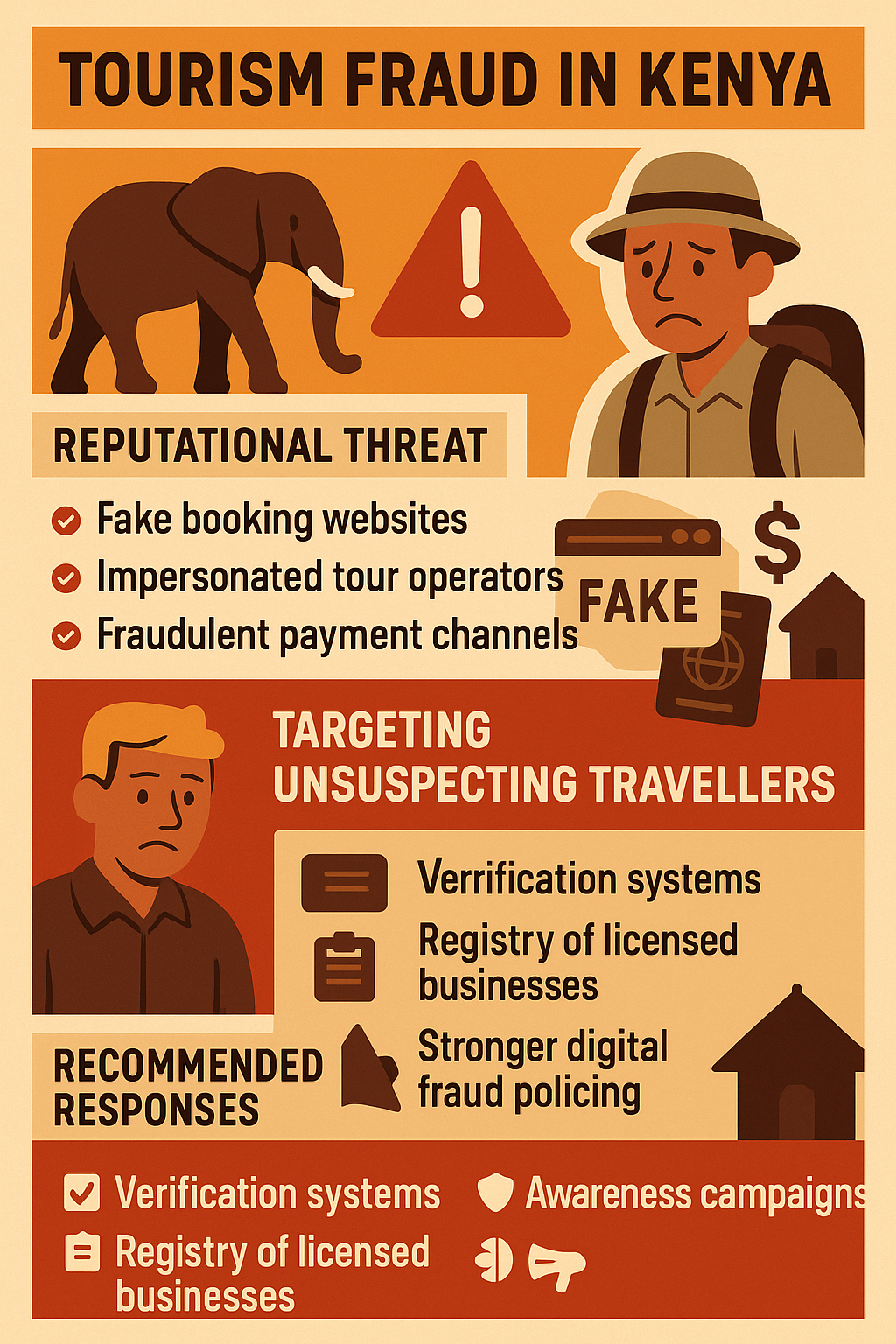
Industry stakeholders stress that the challenge is compounded by gaps in regulatory oversight, slow cross-border law enforcement cooperation, and limited consumer awareness in key source markets. Fraudsters exploit these vulnerabilities, targeting peak travel seasons and leveraging digital marketing channels to reach large audiences with minimal traceability. Tour operators report that such scams not only cause financial loss but also drive potential travelers toward competing destinations perceived as safer or better regulated. Its important to note that while Kenya’s tourism marketing campaigns have successfully reignited global interest, this momentum risks being reversed if fraud-related horror stories dominate travel forums and social media. Experts recommend a multi-pronged response: real-time verification systems for operators, a central registry of licensed tourism businesses accessible to the public, stronger digital fraud policing, and targeted awareness campaigns in both domestic and foreign markets.

To its credit, the government has begun aligning with these recommendations, with the Ministry of Tourism working alongside the Communications Authority, cybercrime units, and private-sector stakeholders to roll out verification platforms and consumer education drives. Pilots for an online “Tourism Trust Mark” are already underway, enabling travelers to authenticate operators before making payments. Additionally, diplomatic missions are being engaged to circulate fraud alerts in high-risk markets, while tourism associations are exploring partnerships with payment processors to flag suspicious transactions. These initiatives, if scaled and sustained, could restore confidence and reinforce Kenya’s brand as a secure, trustworthy destination. In an increasingly competitive global tourism landscape, safeguarding the integrity of the travel experience is no longer optional—it’s a prerequisite for growth. Kenya’s long-term competitiveness will hinge not just on the beauty of its landscapes, but on the trustworthiness of the path visitors take to reach them.

References:

Kenyans.co.ke DCI Arrest Suspect After Greek Tourist Loses Ksh3.6 Million in Maasai Mara Scam

Government of Canada Kenya travel advice

Action Fraud Kenya Romance Scam

Shian Safaris How to Avoid Being Conned on Your Travels in Kenya

EACOP Insights: Funding Strategies for Kenya’s Oil Sector

In a significant stride for East African energy, Uganda’s ambitious East African Crude Oil Pipeline (EACOP) project has recently secured a crucial funding boost, signaling a move towards the realization of this multi-billion dollar infrastructure. This development offers a wealth of insights for neighboring Kenya, which also harbors considerable aspirations in the oil and gas sector. While Uganda’s EACOP has navigated a complex landscape of financing challenges and environmental concerns to reach this milestone, Kenya’s own oil development plans, particularly in the South Lokichar basin, have faced delays and the withdrawal of key investors. The contrasting progress underscores a valuable opportunity for Kenya to learn from Uganda’s experience, especially in securing the necessary financial backing and managing the intricate environmental and social considerations that come with large-scale energy projects. As Kenya seeks to tap into its hydrocarbon resources for economic growth, the strategies employed and the hurdles overcome by the EACOP project provide a compelling case study in the realities of the regional energy landscape.

A Report by EACOP (March 2025)

Several key lessons emerge for Kenya from Uganda’s journey. Securing funding in an era of increasing climate consciousness requires a diversified approach, potentially looking beyond traditional Western financial institutions to engage with regional banks and explore partnerships with entities that have different investment priorities. Furthermore, proactively addressing environmental and social concerns through transparent impact assessments, robust mitigation plans, and genuine community engagement is paramount to minimize opposition and enhance project bankability. Uganda’s experience highlights the critical need for a strong and consistent government commitment, coupled with a stable and predictable regulatory environment, to build investor confidence. For Kenya, this means streamlining regulatory processes, ensuring policy consistency, and prioritizing the implementation of stringent environmental standards and community-focused initiatives from the outset. Building strong and stable relationships with international oil companies, ensuring transparency in agreements, and investing in essential infrastructure are also crucial takeaways for Kenya as it navigates the complexities of developing its oil and gas sector.

However, Uganda’s EACOP project has not been without its challenges, facing significant environmental opposition and concerns about social displacement. These potential pitfalls offer further learning points for Kenya. Proactive engagement with environmental stakeholders, prioritizing fair compensation and resettlement plans for affected communities, and striving for maximum transparency in all aspects of the oil and gas sector are essential to avoid similar controversies. Kenya must also be mindful of the broader risks associated with resource extraction, such as the “resource curse,” and implement sound economic policies to ensure long-term sustainable development. By carefully analyzing Uganda’s experience – both its successes in securing funding and the controversies it has faced – Kenya can strategically refine its own approach to oil and gas development, aiming for a path that is both economically beneficial and environmentally and socially responsible, ultimately positioning itself as a stable and attractive player in the regional energy market.

References:

Reuters Uganda’s $5 billion EACOP pipeline gets funding boost

Monitor EACOP secures funding as Uganda eyes oil production next year 

Jijuze Kenya’s Oil and Gas Ambitions: Opportunities and Challenges

Pumps Africa Kenya to restart licensing of oil and gas blocks

UN Environment Programme Greasing the wheels of Kenya’s nascent oil and gas sector

Pipeline & Gas Journal EACOP Secures First Tranche of Funding for $5 Billion Uganda-Tanzania Pipeline

Corporate Investment Driving Kenya’s Fintech Innovations

Kenya’s financial technology sector has emerged as a dominant force in the nation’s economy, fueled by a remarkable surge in corporate investment aimed at fostering innovation and supporting the growth of Micro, Small, and Medium Enterprises (MSMEs). This thriving ecosystem is built upon the bedrock of widespread mobile money adoption, with Kenya boasting one of the highest penetration rates globally, making digital financial transactions a common practice for a vast majority of the population. Recognizing this fertile ground, the corporate sector has stepped in as a crucial catalyst, injecting substantial capital into fintech startups through various avenues, including direct equity investments, the establishment and backing of incubation and acceleration programs, and the formation of strategic alliances. These concerted efforts have not only driven significant investment inflows but have also empowered fintech companies to develop and scale cutting-edge solutions specifically designed to address the unique needs of MSMEs, which form the backbone of the Kenyan economy by employing over 80% of the workforce.

A Report by KTN News Kenya

The impact of this corporate-driven investment in fintech is being felt profoundly by MSMEs across Kenya, primarily through enhanced access to vital financial services that were previously out of reach for many. Fintech innovations, often nurtured and funded by corporate initiatives, are providing working capital solutions, facilitating the adoption of digital payment systems, and offering essential business management tools. Leading corporations such as Safaricom, through its Spark Venture Fund and collaborations like the Spark Accelerator, alongside M-Pesa Africa’s partnerships with Microsoft for digital skills training and Mastercard for expanding digital payment infrastructure, are at the forefront of this transformation. The Co-operative Bank of Kenya’s collaboration with the International Finance Corporation (IFC) to launch tailored financial solutions for MSMEs further underscores the commitment of established financial institutions to this sector. These strategic partnerships and investments are enabling small businesses to overcome traditional barriers to growth, streamline their operations, and tap into broader markets, ultimately contributing to job creation and economic prosperity.

Despite the remarkable progress, the journey of corporate investment in Kenyan fintech and its support for MSMEs is not without its hurdles. Challenges such as navigating the evolving regulatory landscape, managing increasing competition within the fintech space, securing sufficient capital for scaling, and mitigating the ever-present threat of cybersecurity remain significant considerations. However, the opportunities that lie ahead are equally compelling, with fintech possessing the inherent ability to achieve greater reach in underserved areas, foster continuous innovation in financial service delivery, and significantly enhance financial inclusion for individuals and businesses alike. The continued collaboration between corporations and agile fintech startups, exemplified by successful partnerships that are already delivering tangible benefits to MSMEs, signals a promising future for the sector, paving the way for sustained growth, further technological advancements, and a more financially empowered and inclusive Kenyan economy.

References:

The Star Fintech, digital content startups compete for investor backing

FinTech Africa Fintech Emerges as Kenya’s Most Prevalent Tech Startup Sub-Sector

International Finance Corporation ‘Thanks to My Smartphone, Business is Booming’

Safaricom Building The Future With Daring Founders

Startup Blink 445 Top startups in Kenya for March 2025

What Fueled Kenya Airways’ Profits After Years of Losses?

Kenya Airways, long dubbed the “Pride of Africa,” has finally soared back into profitability in 2024 after an arduous eleven-year drought, reporting a net profit of Sh5.4 billion. This remarkable financial resurgence, a stark contrast to the Sh22.6 billion loss in the previous year, begs the question: what confluence of events truly orchestrated this dramatic turnaround? Was it solely the much-touted “Project Kifaru,” the airline’s recovery strategy emphasizing operational performance and customer service, or did external tailwinds, such as favorable foreign exchange gains amounting to a staggering Sh10.5 billion, play an equally significant role? While passenger numbers and cargo volumes saw encouraging increases, contributing to a rise in revenue, the sustainability of this newfound profitability in the face of ongoing global aviation challenges, including shortages of aircraft and spare parts, remains a key point of inquiry. Could this profit be a fleeting moment of relief, or does it genuinely signal a long-term stabilization for the national carrier?

A Report by Kenya Airways

Delving deeper, a complex web of strategic maneuvers and external market forces that appear to have influenced Kenya Airways’ financial trajectory are evident. The airline’s aggressive cost-cutting measures, including the innovative transformation of Msafiri House into a centralized operations hub and the implementation of a fuel hedging strategy, undoubtedly contributed to the improved bottom line. However, the crucial role of government intervention was significant, with substantial debt restructuring efforts providing much-needed financial alleviation. This raises further questions about the extent to which Kenya Airways’ profitability is dependent on continued state support and whether the airline can truly achieve long-term financial independence. Moreover, with plans for fleet modernization and route expansion underway, how will these ambitious initiatives be financed, and will they ultimately translate into sustained profitability in an intensely competitive African aviation market?

Looking ahead, the future of Kenya Airways remains a subject of both optimism and uncertainty. While the return to profitability has undoubtedly boosted investor confidence, as evidenced by the doubling of the airline’s share price, experts caution that significant challenges persist. The airline’s historical financial instability and the lingering substantial debt burden continue to cast a shadow, prompting questions about the feasibility of attracting a strategic investor by 2025, a key objective for long-term sustainability. Furthermore, the financial woes of its subsidiary, Precision Air, add another layer of complexity, raising concerns about potential risks to Kenya Airways’ investment. As the airline navigates the dynamic landscape of the global and African aviation industries, marked by fluctuating fuel prices and geopolitical tensions, the fundamental question remains: can Kenya Airways truly break free from its legacy of losses and establish a consistently profitable and sustainable future?

References:

The Star KQ’s turnaround: National Carrier posts Sh5.4 billion profit after a decade of losses

Business Insider Africa Kenya Airways posts profit in 2024 after over a decade of losses

Trading View Kenya Airways records profit after more than a decade of losses

Kenya Airways Kenya Airways Records an Operating Profit of KShs 10.5 Billion in Full Year Results


AI Revolution in Kenya: Challenges and Opportunities

Kenya is riding the wave of an AI revolution, with the technology rapidly being adopted across various sectors, including healthcare, agriculture, and finance . The country boasts the highest AI readiness ranking in East Africa and 84th globally, driven by increased internet penetration, a young tech-savvy population, and government support. Initiatives like the National AI Strategy 2025–2030 aim to establish Kenya as a regional AI hub . The recent AI Innovation Summit in Nairobi brought together industry leaders and innovators to discuss the transformative potential of AI in driving efficiency, innovation, and sustainable growth . Speakers emphasized the need for organizations to develop comprehensive AI strategies, invest in infrastructure and talent development, and foster collaboration to remain competitive in a rapidly evolving digital economy .  

A Report by DW

However, this rapid growth also brings significant challenges. A major concern is the exploitation of Kenyan workers on online platforms for data labeling. Reports reveal that these workers, often lured by the promise of stable employment, face low wages, poor working conditions, and a lack of job security. Some are even exposed to harmful content, including graphic violence and sexual abuse, leading to mental health issues. These findings highlight the urgent need for ethical frameworks and regulations to protect AI workers in Kenya and ensure that the benefits of AI are shared equitably.

Furthermore, there are concerns about the potential for AI-driven automation to displace low-skilled workers and exacerbate existing inequalities . The use of AI for disinformation and the government’s efforts to regulate AI-generated content raise concerns about freedom of expression and potential censorship . Addressing these challenges through ethical frameworks, robust regulations, and public awareness campaigns will be crucial to ensuring that AI benefits all of Kenyan society .  

References:

Research Leap The Adoption of Generative AI in Kenya: A Critical Analysis of Opportunities, Challenges, and Strategic Imperatives

CIO Africa AI Innovation Summit Calls For AI Adoption To Drive Business Growth

Citizen Digital AI Innovation Summit urges AI adoption to drive business growth

Vellum Highlights of the Kenya National AI Strategy 2025–2030


Kenya’s Trade Challenges Amid Political Instability

Kenya’s economic landscape has recently been overshadowed by an incessant wave of political drama and populist rhetoric, which has undeniably diverted attention from fundamental economic issues, particularly in the realm of cross-border trade. At the heart of these economic shifts is the Democratic Republic of Congo (DRC), which has emerged as a fast-growing export market for Kenya and a key player in East African regional trade. With the DRC joining the East African Community (EAC), Kenya expected to solidify its dominance in the region’s export landscape. However, the country’s engagement in political theatrics, combined with challenges in policy implementation, has led to a noticeable decline in its trade performance. This has opened the door for other nations, especially Tanzania, to make substantial gains in the DRC, overtaking both Kenya and Uganda as major trade partners.

KTN News Report

In recent times, Tanzania’s strategic focus on improving trade corridors with the DRC, notably the $2.2 billion trade route investment, has paid off handsomely. The expansion of Tanzanian exports to the DRC threatens Kenya’s traditional influence, particularly in the lucrative mining sector, which is now pivoting toward renewables​. In contrast, Kenya’s trade policy has lacked the same degree of focus and innovation, partially due to the country’s internal struggles with political stability and governance. According to a 2023 briefing by the European Parliament on Kenya’s trade relations, the country has historically played a significant role in intra-African trade. Still, political gridlock has stymied its ability to capitalize on emerging opportunities​. While Kenya remains a strong regional player, its recent trade surplus of Ksh42 billion with Africa does little to mask the under-performance compared to its regional peers, with Tanzania poised to make further gains.

The DRC’s rapid growth as Kenya’s key export destination within the EAC bloc is a double-edged sword. On one hand, Kenya has benefited from increased exports to the DRC, driven by agricultural products like tea and other raw materials​. On the other, political instability, rising costs of doing business, and Kenya’s deteriorating trade policy framework have limited the country’s ability to leverage its geographic and economic position fully. Instead, countries like Tanzania, which have been more focused on infrastructure and logistics, are edging out Kenya in the competition for dominance in Central African markets. In a time of internal strife, Kenya risks losing further ground unless immediate corrective action is taken to refocus on economic fundamentals.

References:

The Citizen DRC overtakes Kenya, Uganda as Tanzania’s leading export market

The EastAfrican DRC overtakes Kenya, Uganda as Tanzania’s leading export market

The EastAfrican DRC now Kenya’s fastest-growing EAC export market

Business Daily Why DRC is fertile hunting ground for Kenyan firms

Somali Magazine Congo (DRC) Ranked the most Rapidly Expanding export Market for Kenya within EAC

Buni.ai: Revolutionizing AI Accessibility in Emerging Markets

Artificial Intelligence as a Service (AIaaS) is reshaping business operations by providing scalable, cloud-based AI solutions that reduce the need for companies to build or maintain expensive infrastructure. This model allows organizations to integrate AI-driven insights into their operations, from automating customer interactions to enhancing data analytics, all via user-friendly cloud interfaces. Large enterprises like Amazon and Google offer AIaaS solutions that democratize access to powerful AI tools, enabling businesses to leverage machine learning, natural language processing, and predictive analytics without deep technical expertise.

InnovationXplorers Report

The impact of AIaaS has grown across industries, as companies look for cost-effective ways to harness AI’s transformative potential. Buni.ai exemplifies this shift by offering specialized AI-powered services designed for businesses in emerging markets, particularly in Africa. Through its no-code platform, Buni.ai (https://www.buni.ai/) allows users to create USSD and SMS applications quickly by simply describing them in natural language. This is especially significant in regions where mobile-first solutions are essential, and technical expertise or infrastructure may be limited. By lowering the barriers to AI adoption, platforms like Buni.ai offer vital tools for both small and large enterprises to innovate and remain competitive.

Buni.ai’s focus on accessibility and ease of use stands out in the AIaaS landscape. It empowers users to design complex applications without needing technical knowledge, making AI more practical and accessible. By offering AI-driven solutions tailored to local needs, Buni.ai addresses a critical gap in the market, enabling businesses to enhance customer engagement, improve operational efficiency, and build applications that meet the unique demands of their environment. As AIaaS continues to drive innovation globally, Buni.ai’s localized, AI-powered approach offers a compelling solution for businesses seeking to expand their digital capabilities.

References:

Zendesk Blog What is AI as a service?

TechTarget Artificial Intelligence as a Service (AIaaS)

InTuit Mailchimp AI as a Service: The Latest Business Model

SEAMGEN What Is AI As a Service?

Techopedia AI-as-a-Service (AIaaS)

BuniAI Introducing BuniAI


Nvidia Surpasses Microsoft as Most Valuable Company in 2024

Nvidia (NVDA.O) has become the world’s most valuable company, surpassing Microsoft (MSFT.O) with a market capitalization of $3.335 trillion. Nvidia’s shares climbed 3.5% to $135.58 on June 18, driven by the booming demand for its AI chips. This feat comes just days after the company overtook Apple (AAPL.O) to become the second most valuable company. Microsoft’s market value now stands at $3.32 trillion after a 0.45% dip, while Apple’s value is $3.29 trillion following a 1.1% drop.

Photo Credit: Reuters

Nvidia’s rise has been meteoric, with its stock up nearly 182% this year and more than ninefold since the end of 2022, fueled by the surge in generative artificial intelligence. The company’s GPUs are crucial for AI development, dominating about 80% of the market for AI chips used in data centers. This dominance has propelled Nvidia’s revenue in the data center business to $22.6 billion, accounting for about 86% of its total sales. Since its stock market debut in 1999, Nvidia shares have skyrocketed 591,078%, turning a $10,000 investment into $59,107,800 today.

Founded as a niche player in the gaming community, Nvidia has transformed into a central figure in the tech industry. Under CEO Jensen Huang’s leadership, the company pivoted in the 2000s to develop GPUs for broader applications beyond gaming, setting the stage for its current AI boom. Despite its rapid ascent, Nvidia has yet to be added to the Dow Jones Industrial Average. To appeal to individual investors, Nvidia recently executed a 10-for-1 stock split. The company’s stunning growth has also elevated Huang’s net worth to over $117 billion, making him one of the world’s richest individuals.

References:

CNBC Nvidia passes Microsoft in market cap to become most valuable public company

Reuters Nvidia eclipses Microsoft as world’s most valuable company

Aljazeera Nvidia becomes world’s most valuable company, dethroning Microsoft