The Impact of Digital Activism: Gen Z Protests Reshape Political Engagement in Kenya

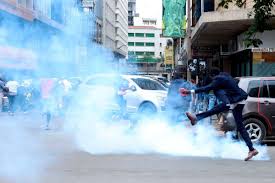
The recent protests in Kenya against the Finance Bill 2024 highlight a significant shift in political activism, driven largely by Gen Z. These protests, organized under the banner of “Occupy Parliament,” leveraged digital platforms and social media to mobilize widespread participation across major cities. Digital tools, including AI-generated content and crowdfunding, played a crucial role in spreading information and organizing logistics. This wave of digital activism marks a departure from traditional ethnic-based mobilization to issue-based activism, as noted by Job Mwaura, a postdoctoral researcher at the Wits Centre for Journalism. The spontaneity and grassroots nature of these protests underscore a new era of political engagement in Kenya.

Government spokesperson Isaac Mwaura has suggested that foreign powers might be influencing these protests, citing President William Ruto’s international stances on issues like Russia’s aggression against Ukraine and calls for global financial reforms. Mwaura’s claims highlight the complex interplay between local discontent and international politics. The digital activism fueling these protests demonstrates a sophisticated use of technology, with young Kenyans employing strategies like AI to educate the public and hacking to draw attention to their cause. This digital-driven movement has successfully transitioned from online platforms to real-world actions, compelling political leaders to listen and even amend parts of the Finance Bill before its passage.

To resolve the conflict, the Kenyan government must enact legislative reforms that address the economic and social grievances of the youth. Firstly, a review and possible amendment of the Finance Bill 2024 should be undertaken to reduce the burden of punitive taxes on young people and marginalized communities. Additionally, legislation that promotes transparency and accountability in government spending could build trust. Establishing a Youth Advisory Council to provide input on policies affecting young people could ensure their voices are heard in the legislative process. Finally, creating legal frameworks to protect digital activism and free speech can foster an environment where the youth feel empowered to engage constructively in political discourse. These measures can bridge the gap between the government and its youth, ensuring stability and progress while maintaining the momentum of positive political change driven by a digitally empowered generation.

References:

The Star Foreign powers behind Gen Z protests, Isaac Mwaura alleges

Nation Angry and unafraid: When Gen Z storm country’s streets

The Conversation Kenya protests: Gen Z shows the power of digital activism – driving change from screens to the streets

US-Kenya Relations Strengthened: President Biden Designates Kenya as Major Non-NATO Ally

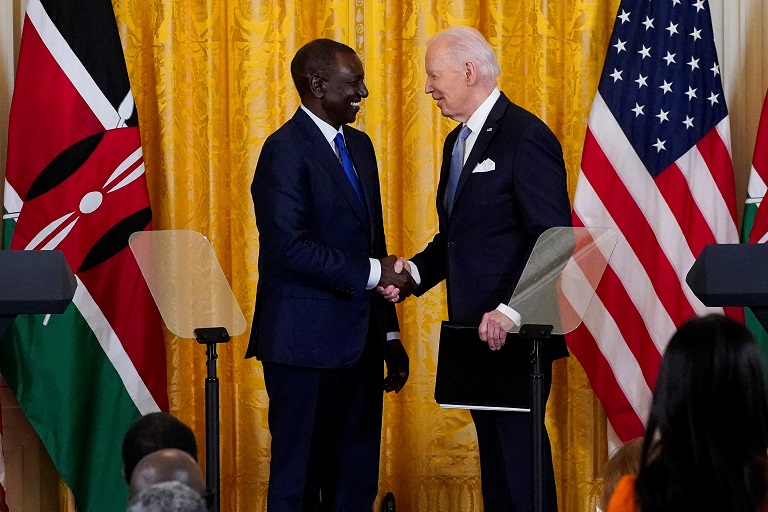
On 23rd last month, President Joe Biden hosted a grand White House dinner to honour Kenyan President William Ruto , marking the first state visit by an African leader in nearly 20 years. The event featured a surprise appearance by former US president Barack Obama, emphasising the significance of US-Kenya relations.

Photo Courtesy: Reuters

The state dinner underscored the significance of US-Kenya relations, with President Biden praising Ruto’s bold leadership and announcing Kenya’s designation as a major non-NATO ally, a first for sub-Saharan Africa. This move aims to bolster bilateral ties and recognise Kenya’s growing influence on the global stage. Biden and Ruto also unveiled the “Nairobi-Washington Vision,” a collaborative effort to support debt relief for developing nations and enhance cooperation on critical issues such as health, security, economic stability, cybersecurity, and climate change.

Former President Obama, whose father was born in Kenya, briefly attended the dinner, emphasising the personal and historical significance of the event. His presence symbolised the deep connections between the two nations. The evening’s celebrations not only honoured the longstanding friendship between the US and Kenya but also looked forward to a future of enhanced collaboration and mutual support in tackling global challenges.

References

Independent Barack is back! Obama stops by Biden’s lavish state dinner for Kenyan president

The East African Ruto, Biden announce new investment deals as they seek deeper ties

BBC Biden welcomes Kenya’s leader as US under pressure in Africa


Coast Governors Veto Muguka Sale

President William Ruto has reversed a ban on Muguka, a stimulant linked to drug abuse among young people, which was previously announced by three coastal leaders in Kenya. Ruto directed the Ministry of Agriculture to engage all stakeholders, emphasizing the economic importance of muguka for Embu County, where it brings in significant income. Agriculture CS Mithika Linturi declared the ban by the three governors as invalid, noting that Muguka is legally recognized as a cash crop under existing regulations.

Considering that the County Governor serves as the chief executive officer of the county government in Kenya, and recognizing the dual-level structure of governance comprising the national and county governments, it is within the purview of the County Governor to exercise legislative and executive powers at the county level. In accordance with the principles of devolution enshrined in the Constitution of Kenya, County Governors possess the authority to promulgate and enforce ordinances and regulations that address the specific needs and welfare of their respective communities. Consequently, in situations where such local enactments are demonstrably in the best interest of the county’s populace, the authority of the County Governor to override or modify national legislation may be justified, ensuring that local governance is responsive and tailored to the unique socio-economic and cultural context of the county.

Calls for tougher penalties to combat the sale of illicit brews in Kenya are amplified, emphasizing the need for comprehensive measures from both the Executive and Parliament. The surge in criminal activities linked to the trade is a cause for concern, prompting advocates for stricter enforcement of laws regulating alcoholic beverages. Meanwhile, the Nakuru Bar Owners Association supports government initiatives to eliminate illicit liquor sales, citing concerns over public health and legitimate businesses. In contrast, the sale and consumption of Muguka, a psychotropic substance, present growing concerns, particularly in coastal regions. Pressure mounts on the government to address the social and health consequences associated with Muguka use, including addiction and criminal activities. Efforts to regulate Muguka sales and consumption are underway, but challenges persist in enforcing restrictions and combating its proliferating trade.

In the same way that the unwavering dedication of law enforcement in Bahati, Nakuru County, has tackled the scourge of second-generation alcohol, so too must this steadfast commitment be mirrored at the coast to combat the sale of Muguka. True progress in safeguarding our communities lies in applying consistent zeal and resolve across all regions, recognising that the health and future of our society depend on our collective and equal efforts.

References

The Africa Report Kenya: Ruto’s reversal of muguka ban in coastal region draws criticism

AfroCave Role and Functions of a County Governor in Kenya

Kenya News Agency Ex-MP Calls For Stiffer Penalties To Curb Sale, Consumption Of Illicit Brews

AFRICA CUP OF NATIONS QUALIFIER | Oliech gives the Stars a glimmer of hope

Dennis Oliech scored a wonder goal 2 minutes into injury time to restore Kenya’s slim chances of qualifying for the Africa Cup of nations. The stars  went into the match knowing that only a win would ensure they remain in the race for the 2012 tournament.  The stars dominated early possession but the Western African side-Guinea Bissau, who beat them in the first leg by a solitary goal, defended well to deny the stars an early goal.

Coach Zedekiah Otieno made a double attacking substitution bringing in the exciting striker Stephen Waruru and AFC Leopards forward Mike Barasa. The substitution made an immediate impact as Barasa netted in the opener in the 55th minute to send the home fans into a frenzy. The stars continued to dominate the match and looked set for a slim victory until a defensive mistake allowed the visitors to restore parity within nine minutes of normal time left. The goal silenced the home fans, some leaving the stadium in disappointment.  Auxere striker, Dennis Oliech, however, had other ideas! He salvaged the home side by delivering a screamer following  poor clearance by the visitors from a corner kick, sending the home fans into wild cheers. httpv://www.youtube.com/watch?v=UGHZu0lbTiY

Despite the result, Kenya’s chances of qualification remain slim. The only chance they have of qualifying is hoping Uganda loses to Angola by a huge margin and hope Guinea beats Angola. Statistically,  it is  possible for the stars to progress. This means beating Uganda on their home-soil  by more than 6 goals,  to top the group on goal difference.

References
Kenya 2-1 Guinea Bissau: Denise Oliech’s last gasp screamer saves Harambee Stars Goal.com September 3, 2011

Kenya must thrash Guinea, Uganda then wait for ‘Lady luck’ Kenya Premier League August 30, 2011

Drought Situation in East Africa

In August 2010, World Meteorological Organization (WMO) and the National Oceanic and Atmospheric Administration Climate Prediction Center (NOAA/CPC), both, officially declared a La Nina event.

Sea Surface Temperature (SST) measurements in 2010 indicated rapid cooling, thus yielding “a moderate La Nina event…” projected to last for 9 to 12 months, Famine Early Warning Systems Network (FEWSNET) reported. “La Nina events are generally associated with drier than normal conditions in the eastern sector of East Africa, and wetter than normal conditions in the western and northern sector of the region.” FEWSNET reported. According to National Aeronautics and Space Administration (NASA), the La Nina phenomenon results in “drought over most parts of East Africa and floods and lush vegetation in Australia and other parts of southeast Asia.” guardian.co.uk reported. Jan de Leeuw, the Operating Project Leader (OPL) in the Vulnerability and sustainability in pastoral and agro-pastoral systems within ILRI’s People, Livestock and Environment theme (PLE) was put on record saying, “this La Nina event is one of the strongest since the 1970s.” Meanwhile, Daily Nation reported that “Kenya has been listed among countries facing the world’s worst food security crisis in the eastern horn of Africa.” Further afield, Associated Press (AP) reported that, “UN officials sounded the alarm Tuesday about a deepening humanitarian crisis in East Africa caused by a severe drought and fighting in Somalia…” Approximately 10 million people in northern Kenya, Ethiopia, Somalia, Eritrea and South Sudan need urgent humanitarian assistance as the region experiences the worst drought in 60 years. An estimated 1,300 Somali refugees stream into Dadaab refugee camp daily following continued conflict in Somali, coupled with severe drought. The situation on the ground is getting worse as the world’s largest refugee camp- Dadaab, in Kenya has been forced to house people, four times its full capacity.

I echo Kimani wa Njuguna’s opinion on Tuesday that, “Rather than being preoccupied with weighty bread and butter issues which will add value to the lives of Kenyans, we have seen most elected leaders concentrating on non-issues like singing to the tune of tribal kingpins, how to escape paying taxes, and the 2012 elections.” Real issues are on the ground; drought, a looming food shortage, high inflation, delayed constitutional implementations, and so on. “A pessimist sees the difficulty in every opportunity; an optimist sees the opportunity in every difficulty”, Winston Churchill said. The Kenyan Government should savor the opportunity to act decisively and do something significant to comprehensively take care of the current drought situation.

What’s your say?

The Conversation begins…

References:

Kenya in urgent need of food aid, says US Daily Nation July 11, 2011

La Nina blamed for east African drought guardian.co.uk July 14, 2011

UN struggling to cope with East Africa drought Associated Press July 12, 2011

Executive Brief: La Nina and Food Security in East Africa August 2010 FEWSNET as of July 14, 2011

East African drought ‘worst in 60 years’ Channel 4 News June 28, 2011

Leaders must get their priorities right and put food security at top of agenda Daily Nation:-Opinion July 12, 2011


Kenya Green Energy Farm Initiative

“The future of agriculture is to increase productivity and conserve the environment,” said Dr. Ephraim Mukisira, the director of Kenya Agricultural Research Institute (KARI). KARI forecasts to complete a Shs. 32 billion solar powered facility in June, to “pave way for an agrarian system that is less dependent on rain-fed agriculture,” Mukisira said.

Developing nations of Africa have been noted for the application of renewable energy technologies. Kenya in particular has taken a huge leap forward and could be Africa’s first country to “establish a green farm that uses renewable energy.” allAfrica.com reported. Solar powered technologies have high potential to generate renewable energy in Africa, based on the fact that many African countries receive on average 325 days per year of bright sunlight. The KARI facility at Kari Muguga, Kiambu District, will accommodate both crops and livestock. Dr. Mukisira was reported saying “this is a new concept that demonstrates that research and science is moving away from traditional to more exciting settings like the green villages.”

“Kenya has more enlightened policies on renewable energy compared to other developing countries, but the sector is not vibrant due to lack of financing,” said Ajay Marayanan-the Head of Climate Financial Unit, IFC.Local banks should savor the opportunity to invest in green energy projects to ensure a gradual shift to more sustainable energy sources. The International Finance Corporation (IFC) and European Investment Bank (IEB) plan to set up a fund to be accessed by local banks for onward lending to individual green projects is a step in the right direction moving forward, following Kenyan government’s effort to fast-track revision of most green energy policies.


References:

Country Pioneers Solar Farms in Africa , 11/04/2011

Banks Told to Review Lending Policies on Green Energy Projects 31/03/2011

Renewable Energy in Africa (As of 11/04/2011)


Country Pioneers Solar Farms in Africa