The Future of UDA: Succession Challenges Ahead

As the relationship between President Ruto and Deputy President Gachagua continues to evolve, the future of the United Democratic Alliance (UDA) becomes increasingly precarious. What initially appeared as minor differences in governance style has now escalated into a significant leadership struggle. Gachagua’s consolidation of power in the Mt. Kenya region, coupled with his growing public presence, signals broader ambitions that may eventually clash with Ruto’s agenda. While the president remains focused on implementing his economic reforms, Gachagua is methodically building an independent power base that could reshape the internal dynamics of UDA.

Citizen Digital Report

The growing rift between the two leaders reflects the broader challenge of leadership succession within political parties in Kenya. Historically, leadership transitions have rarely been smooth, often marred by tribalism, personal rivalries, and a lack of formal processes to resolve disputes. As Gachagua solidifies his influence, the risk of a fragmented UDA increases. Political observers have noted that this type of leadership rivalry is not unique to Kenya, as other African political parties have struggled with similar issues. Without mechanisms to mediate these conflicts, the party risks internal implosion, particularly as Gachagua’s ambitions continue to rise.

Additionally, other key figures in UDA, such as Kithure Kindiki, who was once considered for the running mate position, may find themselves as kingmakers in this evolving power struggle. Kindiki, who has largely kept a low profile since being passed over in 2022, remains a respected figure within the party and could play a crucial role in shaping UDA’s future direction. His supporters, still nursing grievances from the 2022 election cycle, could realign with factions disillusioned by the Ruto-Gachagua fallout. Looking ahead, the absence of a clear succession mechanism in UDA, coupled with these internal divisions, sets the stage for a potentially splintered ruling coalition ahead of the 2027 elections. The next few years will be critical for UDA as it navigates this delicate balance of power​.

References:

The Standard Why Gachagua’s survival depends on ending alliance with Ruto

The Star Gachagua: Our 17-hour talk and how Ruto settled on me as DP

Shahidi DP Ruto Nominates Mathira MP Rigathi Gachagua As His Running Mate

Mpasho Ruto: Reason I chose Gachagua as my deputy

Nairobi Wire DP Ruto Explains Why He Chose Gachagua Over Kindiki as Running Mate

The Star DP Ruto picks Rigathi Gachagua as his running mate

The Star Kindiki, Gachagua leave Ruto residence as deputy naming hits snag

Pulse Live Details of the heated 17-hour standoff on Ruto’s running mate

Nation DP Ruto explains why he settled on Rigathi Gachagua as his running mate

Ruto-Gachagua: Tensions Emerge in Kenya’s Leadership

As the Ruto-Gachagua administration settled into power, early signs of tension between the president and his deputy began to surface. While the two leaders publicly presented a united front, their divergent approaches to governance became increasingly clear. Rigathi Gachagua, who had been a staunch defender of Mt. Kenya’s economic and political interests, quickly positioned himself as the de facto leader of the region. His approach was bold, often emphasizing the region’s historical marginalization and demanding a greater share of national resources. Gachagua’s assertiveness appeared to overshadow Ruto’s broader national vision, which focused on economic reforms and bottom-up development for all Kenyans.

Citizen Digital Report

The growing divergence in their agendas became more apparent as Gachagua’s influence expanded within the Mt. Kenya region. Political observers noted that his comments and initiatives occasionally seemed to contradict Ruto’s priorities, fueling speculation that the two were not always on the same page. Gachagua’s increasing visibility and strong regional support made it clear that he was not content with being a mere figurehead. Instead, he sought to build an independent power base, sparking concerns within UDA about the unity at the top. This kind of internal power struggle is not unique to Kenya; leadership transitions in democracies are often marked by personal ambition overshadowing collective party goals​.

Looking ahead, UDA faces significant challenges if it cannot reconcile the ambitions of its top leaders. Political analysts, drawing from Helms’ (2020) work on leadership succession, note that when successors begin to outshine their leaders, it often leads to party rifts. Gachagua’s moves to establish himself as a regional kingpin in Mt. Kenya could destabilize the party, particularly if he continues to act independently of the president. In democratic systems, where leaders are supposed to be held accountable by party structures, these kinds of internal conflicts can weaken the party’s electoral chances. The absence of clear succession mechanisms in UDA raises the possibility of deeper divisions as Gachagua’s influence grows​.

References:

Nairobi News Rigathi Gachagua ‘chose’ Ruto because of money
Nairobi Wire DP Ruto Explains Why He Chose Gachagua Over Kindiki as Running Mate

The Star DP Ruto picks Rigathi Gachagua as his running mate

The Star Kindiki, Gachagua leave Ruto residence as deputy naming hits snag

Pulse Live Details of the heated 17-hour standoff on Ruto’s running mate

Nation DP Ruto explains why he settled on Rigathi Gachagua as his running mate

The Star Speculations rife as Ruto to name running mate anytime

Ruto’s Running Mate: Gachagua’s Strategic Gamble Explained

At the height of the 2022 election season, Kenya’s political landscape was buzzing with speculation. The biggest question on everyone’s mind was who Deputy President William Ruto would choose as his running mate. Among the frontrunners were Kithure Kindiki, a professor and seasoned lawyer from Tharaka-Nithi, and Rigathi Gachagua, the fiery MP from Mathira. Political pundits expected Kindiki to be the likely pick due to his technocratic demeanor, but Ruto surprised many when he announced Gachagua as his running mate on May 15, 2022. This decision was not only pivotal for his campaign but also a strategic gamble with long-term implications for the United Democratic Alliance (UDA) party.

NTV Report

The decision to pick Gachagua over Kindiki was not without controversy. Sources close to the negotiations revealed heated debates within Ruto’s camp. Both Gachagua and Kindiki had their respective strengths, but in the end, Ruto’s decision came down to securing the crucial Mt. Kenya vote. Gachagua, with his deep grassroots connections and strong regional backing, seemed like the best bet. Kindiki’s supporters were disappointed, quietly nurturing grievances that would later play into the party’s internal dynamics. Despite Ruto’s attempt to pacify the situation by hinting that Kindiki had a future role in his administration, tensions simmered beneath the surface.

The early signs of conflict over the running mate choice are crucial in understanding the future leadership struggles within UDA. Leadership succession, particularly in democracies, often revolves around balancing the ambitions of powerful party members. Helms (2020) argues that successful leadership transitions in democratic regimes rely on institutionalized processes that limit individual power grabs. In UDA, however, the decision to bypass Kindiki in favor of Gachagua demonstrated the fragility of internal party democracy. This lack of a clear succession plan sowed the seeds of future tension, and as the party moved into government, these tensions were bound to resurface​.

References:

The Star Gachagua: Our 17-hour talk and how Ruto settled on me as DP

Shahidi DP Ruto Nominates Mathira MP Rigathi Gachagua As His Running Mate

Mpasho Ruto: Reason I chose Gachagua as my deputy

Nairobi Wire DP Ruto Explains Why He Chose Gachagua Over Kindiki as Running Mate

The Star DP Ruto picks Rigathi Gachagua as his running mate

The Star Kindiki, Gachagua leave Ruto residence as deputy naming hits snag

Pulse Live Details of the heated 17-hour standoff on Ruto’s running mate

Nation DP Ruto explains why he settled on Rigathi Gachagua as his running mate

The Star Speculations rife as Ruto to name running mate anytime

The Star Ruto hints Kindiki is his possible successor in 2032


China’s Growing Presence in Africa: Impacts on Economy and Sovereignty

China’s growing presence in Africa has dramatically altered the continent’s economic and political landscape, particularly through large-scale infrastructure investments, resource extraction, and telecommunications expansion. The 2024 China-Africa Summit exemplifies this deepening relationship, with China now standing as Africa’s largest trading partner and top financier. Billions of dollars have been funneled into critical projects, including Kenya’s Standard Gauge Railway (SGR), which has transformed regional trade. While these developments promise economic growth, they also raise concerns about long-term debt sustainability. According to the African Development Bank, Chinese investments in Africa reached $200 billion in 2021, driven largely by the Belt and Road Initiative (BRI). However, the structure of many Chinese loans is causing apprehension about debt distress, with countries like Zambia already struggling to meet repayment obligations. The focus on infrastructure development often benefits Chinese contractors and workers, leaving African economies with little in the way of technology transfer or skills development, leading to fears of economic neocolonialism.

Bloomberg Television Report

Politically, China’s engagement in Africa extends beyond economic benefits, strategically cultivating alliances that have implications on the global stage. Offering loans and investments with fewer governance conditions than Western institutions, China has successfully secured political loyalty from many African nations. Research from the Carnegie Endowment highlights how African countries, including Kenya, have backed China in international forums such as the United Nations on issues like Taiwan and the South China Sea. This political alignment reinforces China’s broader geopolitical agenda to counterbalance Western influence while securing access to Africa’s abundant resources, including oil, copper, and rare earth minerals. However, the increasing political sway China holds raises concerns about sovereignty. As China’s economic influence grows, African nations may face pressure to conform to Beijing’s geopolitical interests, potentially compromising their national priorities. The Chatham House report warns that the cost of such political alignment may be the erosion of Africa’s agency in global decision-making.

For Kenya and other African nations, navigating this evolving relationship with China presents both opportunities and challenges. The SGR project, while improving connectivity and trade, has placed a significant debt burden on Kenya, sparking concerns about the country’s financial future. The Kenyan diaspora, in particular, watches these developments closely, fearing that future generations may be saddled with unsustainable debt. As China transitions from an export-driven to a consumption-led economy, African nations must adapt to the changing trade dynamics, particularly as Chinese demand for raw materials declines. Experts urge African leaders to negotiate more transparent and equitable deals that prioritize long-term development over immediate infrastructure gains. Diversifying trade partnerships beyond China, strengthening regional cooperation, and fostering industrialization are critical steps for African nations to ensure sustainable growth. The 2024 China-Africa Summit has brought these issues to the forefront, underscoring the need for African countries to balance economic engagement with China while safeguarding their sovereignty and long-term development goals.

References:

African Development Bank Group The Expansion of Chinese Influence in Africa – Opportunities and Risks

Carnegie Endowment for International Peace How Is China’s Economic Transition Affecting Its Relations With Africa?

Policy Center for the New South The Impact of Chinese Investments in Africa: Neocolonialism or Cooperation?

Aljazeera China-Africa summit 2024: What’s in it for Beijing, Xi Jinping and Africa?

Chatam House China-Africa relations

BertelsmannStiftung China’s evolving presence in Africa

Observer Research Foundation China in Africa: The Role of Trade, Investments, and Loans Amidst Shifting Geopolitical Ambitions


Adani Group in Kenya: Balancing Economic Benefits and National Interests

Adani Group, led by Gautam Adani, has been making significant moves into Kenya’s infrastructure, particularly in the aviation and energy sectors. Recently, the conglomerate proposed a $1.84 billion investment to manage and expand Nairobi’s Jomo Kenyatta International Airport (JKIA) through a 30-year concession deal. This proposal, part of Adani’s broader push into Africa, has sparked widespread controversy in Kenya, with concerns raised over the transparency and potential risks to national sovereignty. Kenyan MPs and aviation workers have voiced strong opposition, fearing that the deal could lead to job insecurity, undervaluation of strategic assets, and a loss of control over critical infrastructure.

Citizen Digital Report

The controversy surrounding Adani is exacerbated by the troubling track record highlighted in the Hindenburg Research report, which alleges widespread fraud, stock manipulation, and money laundering. These dubious practices have raised serious concerns about Adani’s financial integrity and long-term viability, prompting Kenyan authorities to approach the conglomerate’s intentions with caution. The group’s aggressive expansion strategy, often outpacing regulatory scrutiny, further amplifies these fears, suggesting potential conflicts of interest and ethical lapses.

In addition to the airport deal, Adani has secured approval for a $900 million power transmission line project in Kenya, underscoring the group’s growing influence over the country’s critical infrastructure sectors. While these investments could bring economic benefits, they also carry the risk of monopolization and financial instability. The approval of the power project, coupled with the airport deal, indicates Adani’s positioning to dominate key national assets in Kenya, raising alarms about the potential for reduced national control and increased dependency on a single foreign entity.

Kenyan President William Ruto’s inconsistent stance on the Adani deal has further fueled public mistrust, complicating the situation and amplifying calls for greater transparency. As Adani advances its plans and secures approvals, it is crucial that Kenyan authorities rigorously vet these deals. Transparency, public consultation, and robust regulatory oversight are essential to ensuring that Kenya’s national interests are protected and that the long-term implications of Adani’s involvement are fully understood. Given the extensive controversies surrounding Adani’s operations, Kenya must approach these deals with caution, rigorously evaluating any agreement with the Adani Group to align with its long-term economic goals and preserve the integrity of its vital infrastructure.

References:

The Star MPs want Adani JKIA deal stopped

Aviation A2Z Aviation Staff Calls Off Strike against Adani Group in Kenya

The Star Aviation workers suspend strike for one week

OCCRP Kenya’s President Ruto: There is no Airport Deal with Adani Group

Business Daily Proposed Adani, JKIA deal risky and morally unfair to taxpayers

The Kenyan Wall Street Inside Adani’s US$ 1.84 Billion JKIA Proposal

Nation Kenya sued over tycoon Adani JKIA deal

Techcabal Adani Energy gets approval for a $900 million power transmission line in Kenya 

The Hindu Business Line Adani group’s Africa push, submits investment proposal for Nairobi airport

The Standard Secrets of 30-year Adani deal to takeover JKIA in November

The EastAfrican India’s Adani sets up Kenyan subsidiary amid push for JKIA deal

Pulse Live Adani sets up new Kenyan company to manage airports [Shareholding details]

Hindenburg Research Adani Group: How The World’s 3rd Richest Man Is Pulling The Largest Con In Corporate History, 2023

Kenyan Politics: Raila Odinga, William Ruto, and the Ever-Changing Alliances Landscape

The 2005 referendum on Kenya’s proposed constitution was more than just a vote; it was a pivotal moment that redefined the country’s political alliances and set the stage for future power struggles. Raila Odinga and William Ruto, then key figures in the opposition, found common cause in their opposition to President Mwai Kibaki’s draft constitution. The proposed document was seen by many as flawed, favoring the incumbent’s administration. Rallying under the “Orange” banner, which symbolized their resistance, Raila and Ruto spearheaded a campaign that resonated with a significant portion of the electorate. Their victory, which culminated in the rejection of the constitution, not only signaled the birth of the Orange Democratic Movement (ODM) but also established Raila as a formidable force in Kenyan politics. The referendum catalyzed a new era of political realignments, where former allies became rivals and the landscape of Kenyan politics became increasingly fluid and unpredictable.

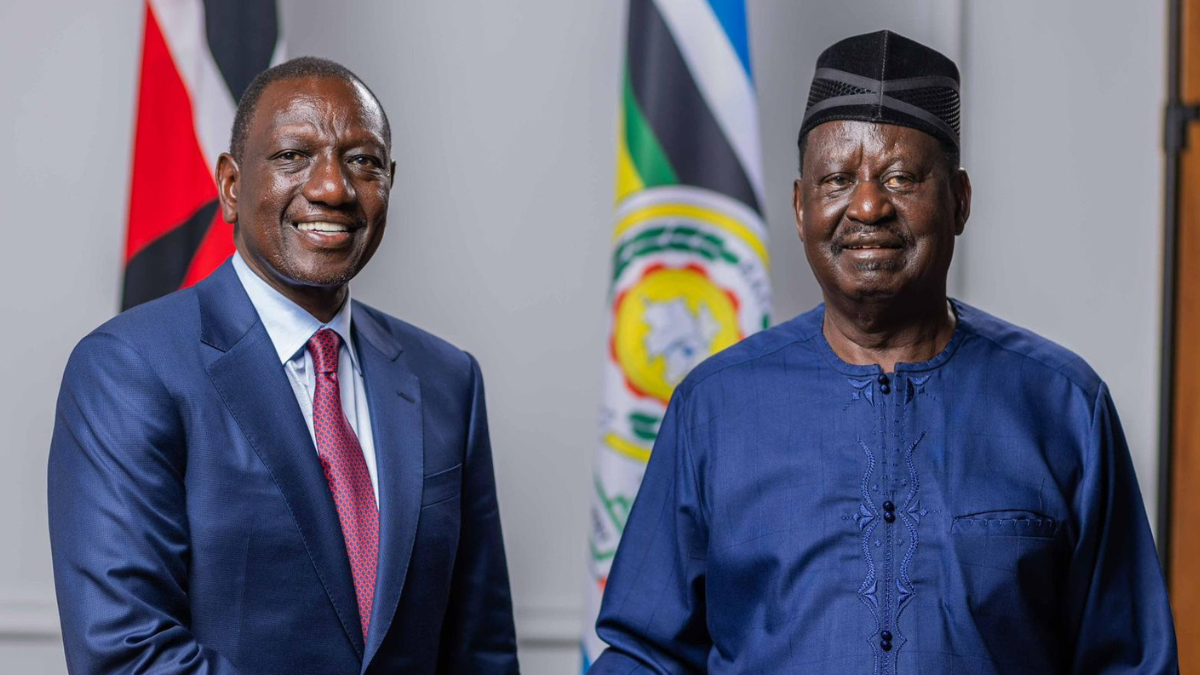
President Ruto and Raila at the launch of Raila’s AUC bid at State House – Nairobi

Fast forward to the present, and the political dynamics in Kenya have taken an unexpected turn, revealing the cyclical nature of political allegiances. Raila Odinga, who has long been a mainstay in Kenyan politics, is now setting his sights on the international stage with his bid for the African Union Commission (AUC) chairmanship. What is perhaps most surprising is the support he has garnered from President William Ruto, his long-time political adversary. This alliance, which would have been unthinkable just a few years ago, underscores the strategic calculations at play in Kenya’s political arena. For Raila, Ruto’s backing is crucial as it not only bolsters his candidacy but also provides a sense of national unity that could strengthen his position on the continental stage. For Ruto, supporting Raila may serve to consolidate his own power by easing domestic tensions and sidelining a potential competitor in the next general election. This pragmatic alliance highlights the fluidity of Kenyan politics, where today’s adversaries can quickly become tomorrow’s allies if the circumstances are right.

The implications of this alliance are far-reaching and could significantly reshape Kenya’s political landscape. Raila’s pursuit of the AUC chairmanship has left a potential power vacuum within ODM, a party that has been synonymous with his leadership for nearly two decades. This could lead to a reorganization within the party, with emerging leaders vying to fill the void, or it could trigger the formation of new alliances as political players reposition themselves for the future. Meanwhile, the Kenyan electorate is left to grapple with the ramifications of this newfound camaraderie between two of the country’s most influential leaders. On one hand, the alliance could bring a period of political stability, reducing the polarization that has characterized recent elections. On the other hand, there is a risk that voters, particularly those who have been loyal to Raila or Ruto based on their opposition to the other, may feel disillusioned or betrayed. This evolving narrative is a testament to the ever-changing nature of Kenyan politics, where alliances are as much about survival as they are about ideology, and where the next chapter is always just one unexpected alliance away.

References:

Capital News Ruto Hosts Historic Launch of Raila’s AU Commission Chairmanship Candidacy

The EastAfrican Raila Odinga: ‘My heart is ready, my hands are steady’ for AUC top job

The Star Raila arrives at State House ahead of his AUC bid launch

Nation Show of might as Ruto unveils Raila AUC bid

The Star Raila launches website to promote his AUC job bid

The Star [PHOTOS] Ruto officially launches Raila’s AUC bid at State House

The Nairobi Law Monthly Raila’s handshakes with opponents greatly cost his supporters

Nation United stand in vote against 2005 constitution gave birth to Orange

The Standard How referendum campaigns gave birth to ODM


Infinix CogLabs: Revolutionizing Africa with AI Education

Infinix Mobility isn’t just a tech brand; it’s an agent of change, striving to empower Africa through the transformative power of artificial intelligence (AI). Their ambitious CogLabs initiative, born from a partnership with Google and UNESCO, transcends traditional education models. CogLabs blends hands-on workshops integrating 3D printing, robotics, and basic programming with a revolutionary mobile application that democratizes access to machine learning and coding concepts. This digital platform, accessible on any smartphone, breaks down geographical barriers and economic disparities, ensuring every child has the opportunity to unlock their potential in the AI-powered future.

Infinix Partners with UNESCO for STEM Program CogLabs Workshops

Infinix’s commitment to Africa runs deeper than simply providing technological tools. They understand the continent’s rich linguistic diversity and are actively addressing it. Specialized R&D centers across seven African nations employ over 120 linguists dedicated to developing localized AI language models that cater to minor and regional languages. This proactive approach ensures inclusivity, guaranteeing that every voice can participate in the AI revolution regardless of their native tongue. CogLabs is already making waves in Kenya, where workshops are engaging primary, secondary, and tertiary students, igniting their imaginations and fostering a generation of innovators.

But CogLabs isn’t confined to Kenyan borders; it’s poised to become a continental movement. Plans are underway to expand workshops across Africa, reaching even more young minds and nurturing their potential. Infinix’s vision extends beyond just equipping individuals with skills; they aim to shape the future of Africa through technology education, empowering its youth to become agents of innovation and progress. Their story resonates globally as a powerful example of how technology can be wielded to create a more equitable and prosperous future for all.

References:

Xinhua Chinese smartphone firm, UNESCO partner to launch AI robot project in Kenya

The Star New deal to hand Kenyan youths skills to build own robots

PR Newswire Infinix Teams Up with UNESCO and Google to Inspire Today’s Youth with AI and Robotics Education through the Largest CogLabs Workshop Ever

Kenyan Executive Under Fire: Petition Filed for President and Deputy’s Removal

A legal petition has been submitted to the Kenyan courts seeking the removal of President William Ruto and Deputy President Rigathi Gachagua, citing constitutional violations and a breach of public trust. The petition, filed by Migeria Lempaa & Kariuki Advocates, accuses the leaders of incompetence and mismanagement, particularly highlighting the mishandling of economic policies and the discontinuation of vital social programs. The petitioners argue that these actions have resulted in socio-economic instability, undermining the constitutional responsibilities of the executive office.

Milimani Law Courts

The allegations hinge on Article 145 of the Kenyan Constitution, which provides grounds for impeachment, including gross misconduct and violation of the Constitution. The petitioners claim that the actions of Ruto and Gachagua meet these criteria, noting their failure to uphold public welfare and constitutional duties. They stress that the administration’s conduct could lead to further unrest and instability, drawing parallels with economic crises in other countries. The call for judicial intervention is seen as a necessary step to uphold governance and prevent further constitutional breaches.

Given the escalating public discontent, it would be prudent for President Ruto to consider reordering his government’s priorities to better align with the needs of the Kenyan populace. This could involve revisiting controversial economic policies and strengthening social support systems. By taking proactive steps to address the concerns raised in the petition, Ruto could mitigate potential political fallout and restore confidence in his administration. A focus on transparency, accountability, and responsiveness to public needs may offer a constructive path forward, potentially averting the need for drastic measures like impeachment or a public referendum.

References:

The Standard Petitioners move to court seeking to oust Ruto, Gachagua

Nairobi Wire Petition Filed to Remove Ruto and Gachagua from Office

Impeaching the Kenyan President is Not Treason, It’s Constitutional Ruth Nashipae Muigai, LLB(Hons). LLM

KLRC Constitution of Kenya: Article 145. Removal of President by impeachment


Kenya’s Political Landscape: Ruto’s Surprising Move and Good Governance Challenges

Kenya’s President Ruto has taken a surprising step by nominating four Cabinet Secretaries from the opposition party, sparking concerns about the legitimacy of his administration. The move comes as the country grapples with economic challenges and political tensions.

Left: Raila Odinga; Right: President Ruto

Sources close to the ruling party have revealed that the nominations were made without the formal approval of the opposition leader, Raila Odinga, who had previously issued demands for specific issues to be addressed before engaging in dialogue with the government. This development has left many wondering whether the opposition is quietly aligning itself with the government, potentially compromising its independence.

As the situation unfolds, analysts are cautioning that a broad-based government of national unity could have far-reaching implications for Kenya’s democracy. In light of this, it is crucial to examine the concept of good governance and its intersection with human rights. Good governance refers to the process by which public institutions conduct public affairs, manage public resources, and guarantee the realization of human rights in a manner free from abuse and corruption. This requires respecting human rights, ensuring transparency, accountability, responsibility, participatory decision-making, responsiveness to people’s needs, and freedom from corruption.

According to experts, good governance is closely linked to human rights, as human rights standards and principles provide a set of values to guide government actions and a framework for accountability. In turn, good governance is essential for respecting and protecting human rights in a sustainable manner.

The four key areas where good governance and human rights intersect are:

  1. Democratic Institutions: The establishment of strong democratic institutions is critical for ensuring that power is exercised transparently and in accordance with the rule of law.
  2. Public Service Delivery: Good governance requires effective public service delivery, which involves providing essential services to citizens in a fair, equitable, and efficient manner.
  3. The Rule of Law: The rule of law is essential for upholding human rights, as it provides a framework for ensuring that laws are respected and enforced fairly and without discrimination.
  4. Anti-Corruption Efforts: Anti-corruption efforts are vital for preventing the abuse of power and ensuring that public resources are used for the benefit of all citizens.

As Kenya’s government navigates this complex landscape, it is essential to prioritize good governance and ensure that institutions are accountable, transparent, and responsive to the needs of the people. This requires a commitment to upholding human rights, protecting fundamental freedoms, and promoting sustainable development.

References:

The Standard Mixed reactions as Ruto unveils new Cabinet

AllAfrica Kenya: Sifuna Insists ODM Not in Govt Despite Ruto’s Cabinet Picks

AllAfrica Kenya: Ruto Co-Opts ODM Into Govt Naming Joho, Oparanya, Mbadi In Cabinet

Associated Press Kenyan president appoints opposition ministers to his Cabinet amid political unrest

United Nations Human Rights About good governance

United Nations Human Rights OHCHR and good governance

Navigating Change: The Path Ahead for Kenya’s Acting Inspector General of Police

The Kenyan Police Service stands at a crossroads, facing both challenges and opportunities as it enters a new chapter under Acting Inspector General Douglas Kanja. Kanja’s appointment follows the resignation of Japhet Koome, whose tenure was marked by controversy, particularly surrounding the handling of recent anti-government protests.

Former Inspector General of Police – Japhet Koome

Koome took office in November 2022, bringing with him 31 years of experience within the force. He had previously served as Nairobi County Police Commander and Commandant of the National Police Service College in Kiganjo. His appointment was meant to bring stability and reform after a period of political turbulence and public distrust in law enforcement. However, his time in office was overshadowed by escalating tensions between citizens and authorities, fueled by President Ruto’s administration’s introduction of controversial tax hikes.

The protests that erupted in response were met with a heavy-handed police response, resulting in at least 39 deaths according to Kenya’s national rights watchdog. This sparked widespread condemnation both domestically and internationally, with accusations of excessive force and human rights violations leveled against the police. Public outcry intensified, leading to calls for Koome’s resignation and an overhaul of the police force. While President Ruto initially dismissed the protesters, mounting pressure forced him to concede, ultimately accepting Koome’s resignation on July 12th, 2024 and appointing Kanja as Acting Inspector General.

The situation highlights several deeply rooted issues within Kenya: the ever-present struggle for economic justice, concerns over government transparency and accountability, and a history of police brutality that continues to erode public trust. Kanja now faces the daunting task of restoring faith in the police service while addressing these fundamental challenges. His success will depend on his ability to implement meaningful reforms, promote human rights, and build bridges between law enforcement and the communities they serve.

Acting Inspector General of Police – Douglas Kanja

Looking ahead, Kanja’s leadership presents an opportunity for positive change within the Kenyan Police Service. He can prioritize de-escalation tactics during protests, strengthen internal oversight mechanisms to ensure accountability, and invest in community policing initiatives that foster trust and collaboration. It is crucial for him to engage with civil society organizations, human rights groups, and ordinary citizens to understand their concerns and work together towards a more just and equitable society. The road ahead will undoubtedly be challenging, but with commitment, transparency, and a genuine desire to serve the people, Kanja can pave the way for a more effective and ethical police force in Kenya.

References:

Citizen Digital Japhet Koome Sworn In As New Inspector General Of Police

The Star 8 police bosses shortlisted for Deputy Inspector General position

Aljazeera Kenya police chief resigns after criticism over protest crackdown

The Star Police boss IG Japhet Koome resigns