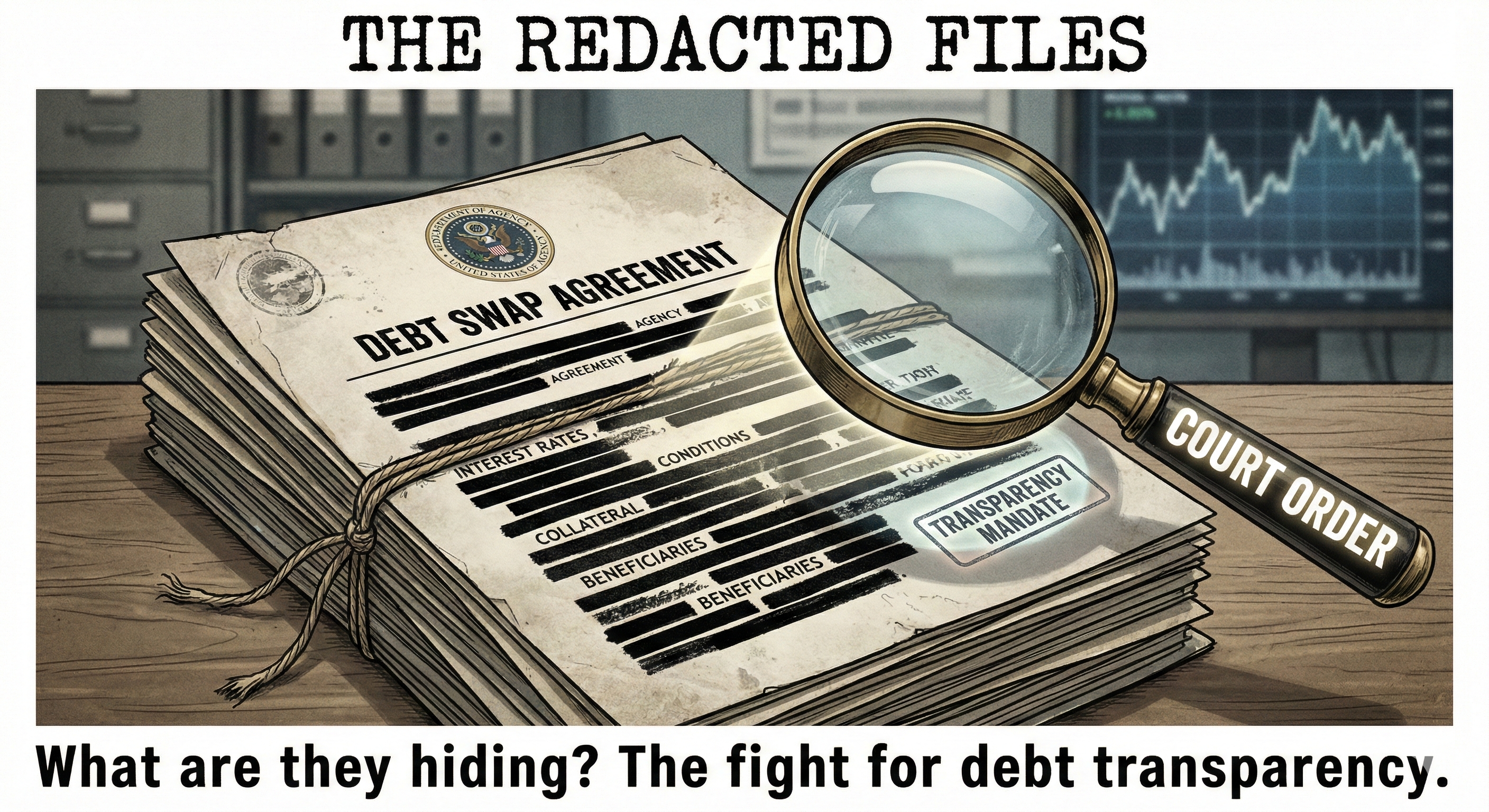
Despite the high stakes, the specific terms of the debt-for-food swap remain shrouded in secrecy, sparking legal battles and civil society alarm. A case filed at the East African Court of Justice, Wanjiru Gikonyo v The Attorney General, challenges the government’s refusal to disclose the full details of sovereign debt agreements. Litigants argue that committing future tax revenues and “savings” to long-term projects without public participation is unconstitutional. The lack of a public dashboard detailing exactly how the Sh129 billion will be spent creates a “transparency deficit” that invites mismanagement.
This opacity exacerbates the “sovereignty paradox.” By allowing the US-DFC and WFP to dictate the terms of expenditure, Kenya is effectively admitting that its own institutions cannot be trusted. While external conditionality acts as a safeguard against local corruption, the public remains in the dark about what exactly has been signed away. Are there hidden fees? What are the penalties for non-compliance? Without full disclosure, the Kenyan taxpayer is a passenger in a vehicle being driven by foreign creditors.
Transparency is not just a legal formality; it is the only disinfectant strong enough to prevent the “bureaucratic consignment” of funds. Civil society is demanding that the Treasury publish every shilling of the “savings” and every project beneficiary. Until then, the debt swap remains a “black box”—a deal negotiated in boardrooms in Washington and Nairobi, with the bill sent to the citizen who has no say in the menu.
References:
Afronomics Law Sovereign Debt News Update No. 147: The Promises and Transparency Pitfalls of Kenya’s $1 Billion Debt-for-Food Swap
The Institute for Social Accountability The High Court has ordered the National Treasury to disclose critical information on Kenya’s bilateral loans and sovereign bonds.
Beyond the Guarded Gates: My Stealth Trek to the Edge of Menengai Crater
Standing at an altitude of 2,278 meters above sea level, the Menengai Crater remains one of Nakuru’s most formidable natural landmarks, but for this “Jijuze Eco-Tour,” the approach was anything but standard. Choosing a “guerrilla-style” entry to bypass the guarded main gates, I disembarked 2 kilometers early, navigating a bush-trek through the local scrubland. This off-road detour offered a raw, unshielded perspective of the terrain before merging back onto the main road, where the typical buzz of school buses and eco-tourists from across Kenya signaled our arrival at the primary viewpoint.
Menengai Crater – Jijuze Eco-Tour | Full video
The sheer scale of the caldera is a geographic marvel, boasting a staggering vertical drop of 485 meters into the floor below. It is a classroom without walls, where the silence of the heights is frequently punctuated by the excitement of visiting students witnessing the raw power of the Rift Valley. However, the beauty of the rim carries a physical warning: the ground is a treacherous mix of loose volcanic gravel and uneven soil. During the tour, a near-slip served as a visceral reminder that at these heights, the line between a breathtaking view and a dangerous situation is as thin as the mountain air.
As the tour concluded, the journey ended exactly as it began—retracing the “bypass” route through the bushes to return to the vehicle. This trek was less about the manicured tourism of the main entrance and more about the investigative spirit that defines the Jijuze platform. From the dizzying depths of the 485-meter abyss to the stealthy 2-kilometer bushwalk, this expedition highlighted that the Menengai Crater is not just a destination to be seen, but a landscape to be navigated with caution, curiosity, and a touch of defiance.
When a private company’s neural nets began to unmask the hidden flows inside M-Pesa, the discovery jolted more than the fintech sector — it forced Kenya to confront a systemic question: who watches the watchers, and on what rules? The rollout of AI-driven compliance tools at Safaricom was never merely a tech upgrade; it arrived as part of a national emergency — a response to international pressure, spiralling fraud, and regulatory failure. The Financial Action Task Force’s increased-monitoring designation and months of global scrutiny had already pushed lawmakers and regulators into a sprint of reforms; industry actors answered with models that could learn patterns humans could not. But those same models required data — vast, granular, and often personal — and the legal scaffolding for such access was changing in real time. Kenya’s recent cyber-law overhaul and parliamentary amendments to the Computer Misuse and Cybercrime Act expanded state powers over online infrastructure, tightened penalties for SIM-swap and phishing offences, and gave the National Computer and Cybercrimes Coordination Committee sweeping directive authority over platforms and applications. Those moves addressed real harms — SIM swap fraud, phishing, and mass laundering — but they also recalibrated the balance between surveillance and rights.
Video Courtesy: The Kenyan Wall Street Youtube Channel
That recalibration is tested in the day-to-day rub of enforcement. Regulators and the ODPC have begun to draw lines: the Data Protection Commissioner’s recent ruling against a major betting operator for excessive data demands underscores the point that AML objectives cannot be a carte blanche for limitless intrusion. In the Betika case the ODPC found the company’s demand for three months of a user’s M-Pesa statements at account-closure to be disproportionate and ordered compensation, signalling that data-minimisation and privacy remain legally enforceable even amid AML pressures. At the same time, FATF’s 2025 monitoring guidance — and independent analysis from ISS Africa — make plain that Kenya must also show measurable results in prosecutions, beneficial-ownership transparency, and risk-based supervision of non-financial entities (including gambling and virtual assets) if it is to repair global confidence. The practical implication is blunt: Kenya cannot satisfy international partners by papering laws alone; enforcement and proportionate procedural safeguards must accompany technical surveillance. Otherwise the country risks swapping one reputational problem (grey-listing) for another — a domestic legitimacy crisis born of heavy-handed data practices.
So where does Kenya go from here? The answer lies in design choices — legal, technical, and institutional — that make accountability a feature, not an afterthought. We recommend three urgent, interlocking reforms that turn the AI question into a governance opportunity: (1) Purpose-bound, time-limited data access. AML or security queries should be scoped narrowly and logged; full transaction histories must not be a default feed into private models. (2) Explainability + redress. Any automated decision that materially affects a person (account freezes, cash-outs blocked, KYC escalations) must carry a succinct, non-technical rationale and a fast appeals channel routed through an independent body. (3) Joint independent oversight. Operationalize a statutory ODPC–FRC technical review board with public reporting obligations, the power to audit both models and data requests, and a mandate to publish redaction and retention metrics. These are not frictionless reforms — they will slow some processes and impose costs — but that trade-off is precisely the point: legitimacy costs less than lost trust. If Kenya stitches these protections into law and practice — and couples them with meaningful prosecution of financial crimes and improved beneficial-ownership registers — it can convert the awkward moment of global scrutiny into a first-mover advantage: an African model of rights-based, explainable AI governance for financial systems. The choices made now will decide whether Kenya’s algorithms become instruments of accountability or mechanisms that hollow out public trust.
References:
Business Daily Security or surveillance? How amended cyber law could reshape Kenya’s online space
Daily Nation How AI can close trust gaps in Africa’s financial systems
The Kenyan Wall Street How Safaricom is Leveraging AI to Bolster M-Pesa Security and Efficiency
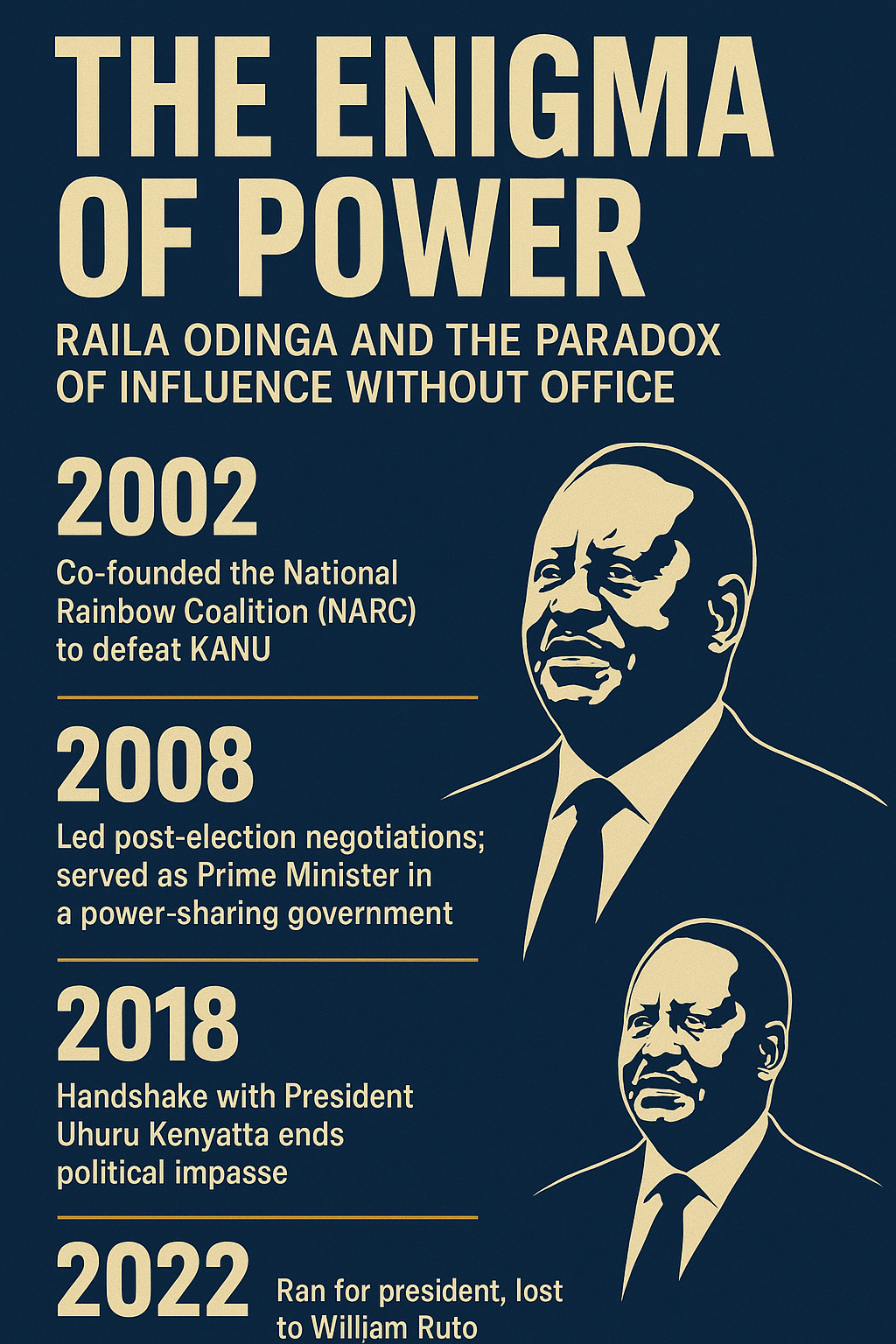
History rarely rewards those who come close — but in Raila Odinga’s case, proximity itself became the point of power. For more than four decades, Raila lived at the edge of power yet shaped every regime from within the shadows of opposition. He was, as The Africa Report aptly put it, “the man who lost every election but won Kenya’s democracy.” From the twilight of Daniel arap Moi’s rule to the dawn of Kenya’s multiparty renaissance, Raila’s defiance never waned — earning him both fear and reverence in equal measure. In 2002, when KANU’s dominance finally cracked, it was his dramatic declaration of “Kibaki Tosha” that propelled Mwai Kibaki to State House and ushered in the first peaceful transfer of power in Kenya’s history. Yet even in victory, Raila remained the outsider: betrayed by broken coalition promises, sidelined by those he helped elect. Still, he never relinquished the moral authority of the people’s voice. In 2005, his “Orange” movement defeated Kibaki’s draft constitution — a rare case of an opposition leader reshaping national destiny without holding office. And when the 2007 elections collapsed into violence, it was again Raila’s resilience that forced Kenya back from the brink, transforming a disputed vote into a dialogue for survival. Through pain, loss, and endurance, he became less a politician and more a barometer of Kenya’s democratic conscience — the man who could lose and still lead.
Raila’s power was never institutional; it was cultural, narrative, and profoundly human. He understood Kenya’s pulse — and weaponised symbolism like few before him. His aliases — Agwambo, Tinga, Baba — transcended politics, morphing into collective identities of resistance, belonging, and hope. His supporters saw in him their own unfulfilled promise; his rivals, a reminder that legitimacy cannot be decreed. Each administration that followed — from Kibaki to Kenyatta to Ruto — has been shaped, challenged, or legitimised by Raila’s political presence. As Prime Minister in the 2008 Grand Coalition, he co-supervised the nation’s reconstruction after post-election chaos and championed reforms that birthed the 2010 Constitution — arguably his greatest institutional legacy. That charter redefined Kenyan governance, devolving power to the counties and embedding civil rights into law, echoing the principles for which he had once been jailed. Later, his controversial 2018 “Handshake” with President Uhuru Kenyatta ended months of unrest following the disputed 2017 polls and restored political calm — though it also fractured his traditional support base. Yet, even that act reinforced his lifelong philosophy: that peace, not position, defines statesmanship. His later appointment as the African Union’s High Representative for Infrastructure confirmed his continental stature — a statesman recognised beyond Kenya’s borders for blending political endurance with technocratic vision.
In the end, Raila Odinga’s paradox was not that he failed to capture the presidency, but that he redefined what power itself means in a fragile democracy. His defeats never diminished his influence; they amplified it. Every president who took office did so under the long shadow of his moral authority. He forced institutions to evolve, compelled courts to assert independence, and transformed the vocabulary of opposition into the grammar of governance. In his twilight years, even adversaries acknowledged that Kenya’s political story could not be told without him — that every victory or reform bore his fingerprints somewhere beneath the surface. He was both architect and agitator, healer and heretic, rebel and reformer. Raila Odinga never occupied State House, but he changed what it stood for — from a fortress of fear to a house answerable to its citizens. And as the nation continues to wrestle with the legacy of leadership and legitimacy, his life offers a sobering truth: that true power is not seized, but earned — and sometimes, it lives longest in the hands of those who never hold the crown.
References:
The Africa Report Raila Odinga: The man who lost every election but won Kenya’s democracy
The Star Raila Odinga: The man who changed Kenya without ever ruling it
The Star Most consequential politician in history of Kenya bows out
All Africa Kenya Mourns Raila Odinga ‘The President’ It Never Had
TRT World Raila Odinga: Kenya’s political enigma never left the stage
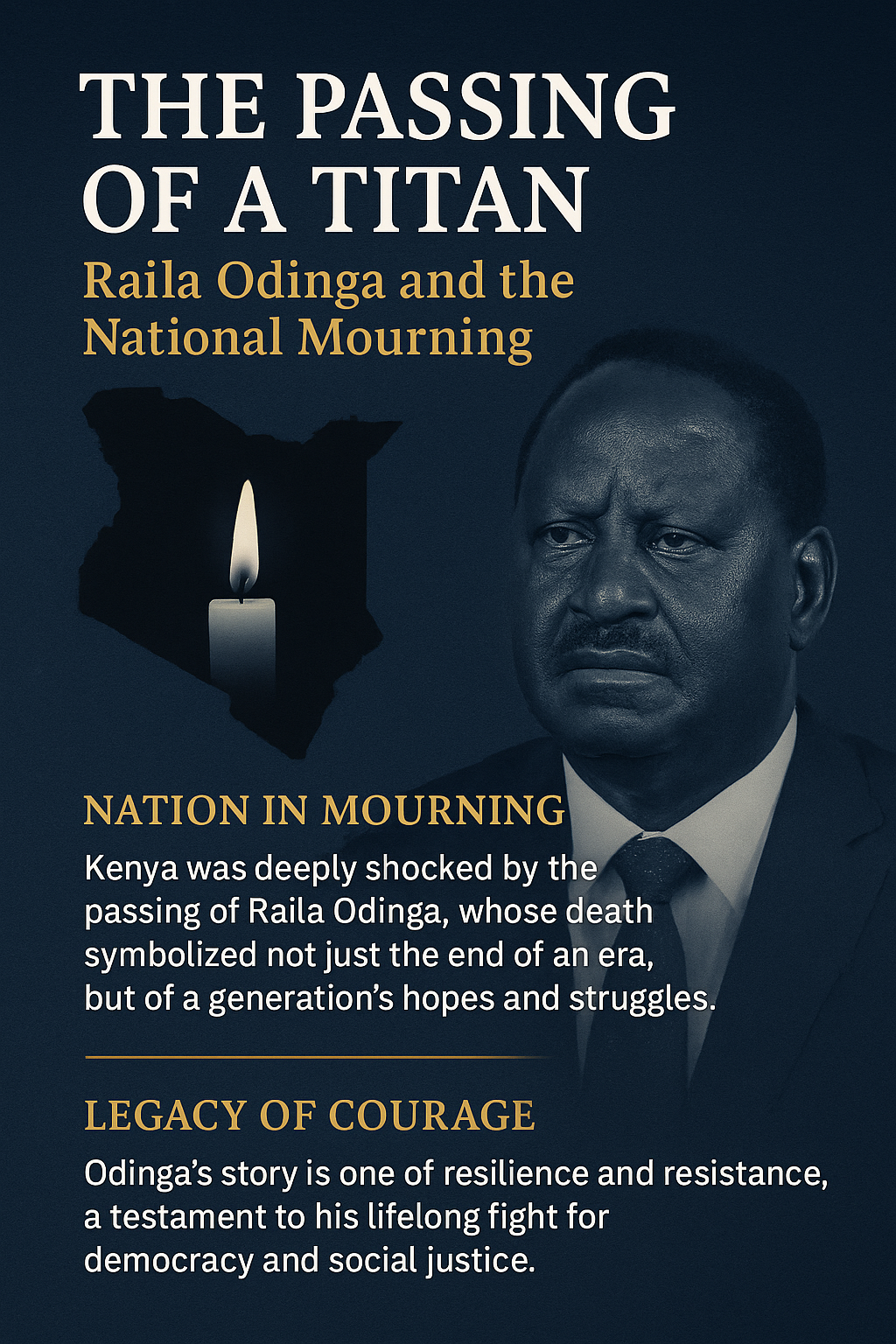
When the news broke that Raila Amolo Odinga had breathed his last, Kenya did not just lose a leader — it lost a paradox made flesh. He was the man who never won the presidency, yet arguably won the soul of Kenya’s democracy — the one who lost every major election but gained the moral authority few in power ever matched. Across towns and villages, in markets and offices, a shared stillness settled like evening dew — part disbelief, part reverence. Television stations turned monochrome; social feeds filled with memories of rallies, reform, and resilience. From Kibera to Kisumu, from Nairobi to Namanga, Raila’s name echoed in chants of grief and gratitude. He was more than a politician; he was the pulse of a people who found in him the courage to speak, to dissent, and to dream. To many, Raila Odinga was Kenya’s moral compass — the man who, even in loss, made millions believe in the promise of justice.
As the state prepared to honour him, the weight of history pressed against the walls of memory. Here was a man who had been imprisoned for ideals, tortured for his convictions, yet emerged each time more resolute than before. The tributes flowing in from across Africa captured this paradox of pain and purpose — Tanzania’s President calling him “the conscience of East Africa,” Nigeria’s Senate hailing him as “a reformer who saw power as duty, not privilege.” In Nairobi, the national flag flew at half-mast, while Parliament prepared to host what may be the most emotionally charged state funeral in decades. But behind the ceremonies lay a deeper reckoning — the realization that Kenya’s democratic soul was, in many ways, shaped by one man’s endurance. To chronicle Raila’s life is to trace the country’s long struggle between oppression and reform, silence and voice, fear and freedom.
And now, in death, his story returns to the people who carried him for half a century — the voters who called him “Baba,” the youth who painted his slogans, the rivals who feared yet respected him. His passing is not just a political event; it is a national rite of reflection — a chance for Kenya to measure how far it has come, and how far it still must go to realize the ideals he fought for. In the coming posts of this legacy series, we will explore those ideals — from his days in detention to his time as Prime Minister, from his Pan-African mission to his unfinished democratic dream. Raila Odinga’s journey did not end with his last breath; it endures in the conscience of a nation still learning to live up to the ideals he refused to abandon. Stay with us as we begin this national remembrance — a chronicle of courage, conviction, and continuity.
References:
BBC ‘Father of our democracy’: Kenya’s Raila Odinga dies in India aged 80
The Standard Raila Odinga’s death: What the world is saying
France 24 Kenya opposition leader Raila Odinga dies, sparking emotion, uncertainty
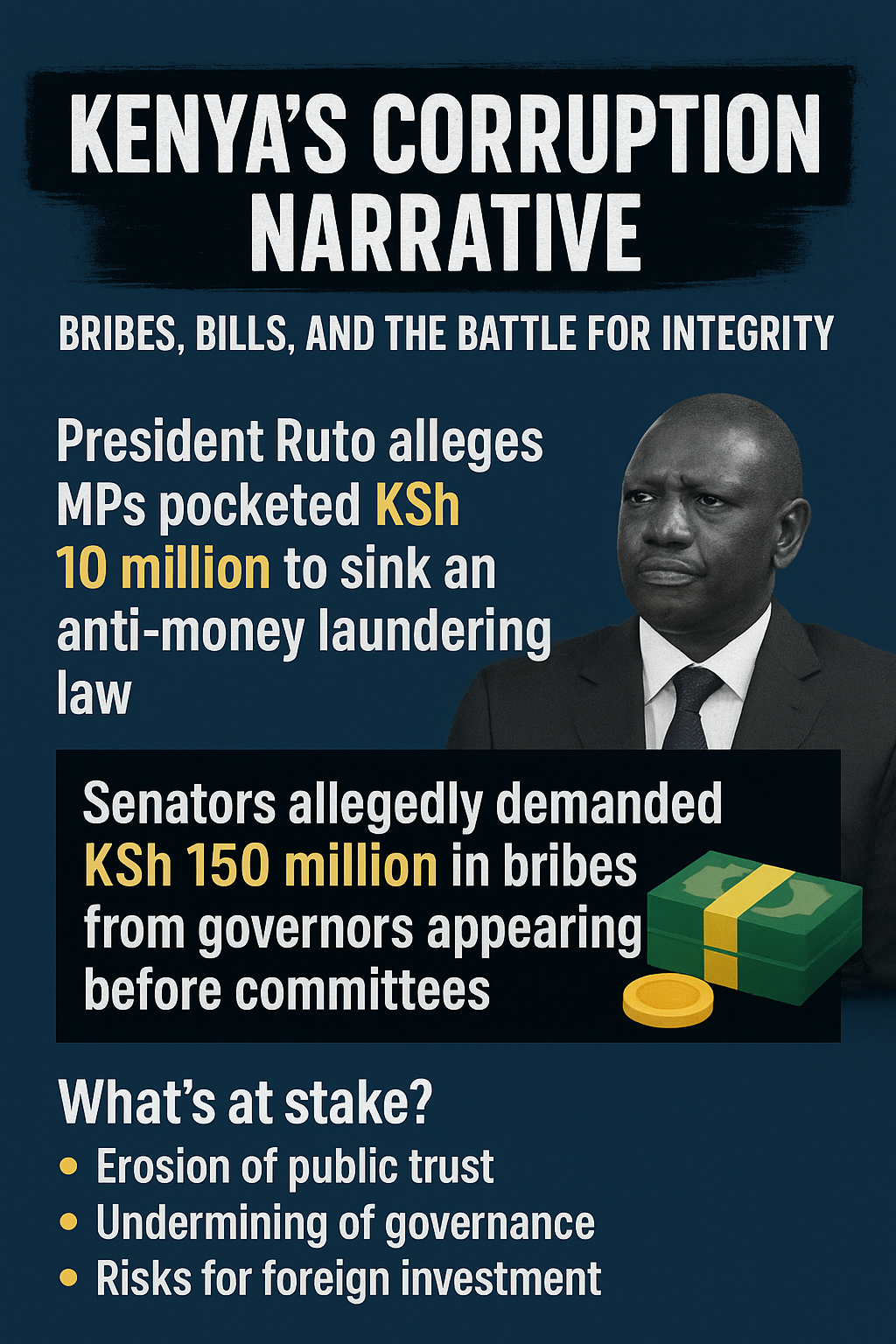
When President William Ruto stood before UDA and ODM legislators on August 18, 2025, and declared that MPs had pocketed KSh 10 million to sink an anti-money laundering bill, while senators allegedly demanded up to KSh 150 million from governors under probe, it marked a seismic moment in Kenya’s corruption narrative. Unlike broad platitudes, these allegations were laced with precision—figures, targets, and the President’s insistence that he was a “consumer of raw intelligence” with knowledge of what was happening behind closed doors. For a country where the shadow of graft often hovers without names or numbers, Ruto’s bluntness pulled corruption out of abstraction and into the raw theatre of governance. The fallout is immense. It not only raises fundamental questions about the integrity of Kenya’s legislative processes but also highlights how deep-rooted corruption risks sabotaging reforms critical to stabilizing the economy, securing donor confidence, and reinforcing Kenya’s democratic fabric.
Such high profile claims cannot be dismissed as political theatre. They expose systemic vulnerabilities where the very guardians of accountability—parliamentary watchdog committees—become gatekeepers of extortion. By placing a price tag on oversight, lawmakers distort the balance of power, weaken enforcement of financial transparency laws, and compromise Kenya’s commitments to international anti-money laundering standards. In practical terms, this jeopardizes more than just the passage of bills: it risks the credibility of Kenya’s financial system, threatening remittance flows, investor trust, and even compliance with IMF and FATF benchmarks. The long-term stakes are enormous. If parliamentarians are perceived as auctioneers of governance, global institutions will tighten their scrutiny, and Kenya’s economy—already weighed down by debt and unemployment—will carry the burden of political impunity.
The President’s vow to arrest both givers and takers of bribes presents a moment of reckoning. Rhetoric without enforcement risks deepening public cynicism rather than rebuilding confidence. What hangs in the balance is Kenya’s ability to demonstrate that governance is not negotiable, and that the fight against corruption is not a selective weapon but a consistent national ethic. Civil society and international observers are watching closely, and the diaspora too remains alert to how corruption narratives shape Kenya’s global reputation. At stake is not just legislative credibility, but the country’s standing as a functional democracy and competitive economy. If Kenya cannot confront and dismantle these entrenched practices, the corruption narrative will continue to define—not just distort—its future.
References:
The Star Some MPs received Sh10 million to sink anti-money laundering law – Ruto
The Star MP Makilap wants Ruto to publicly name corrupt lawmakers
Transparency International Kenya 2024 CORRUPTION PERCEPTIONS INDEX REVEALS HOW WEAK ANTI-CORRUPTION MEASURES UNDERMINE CLIMATE ACTION AND CONTRIBUTE TO THE VIOLATION OF HUMAN RIGHTS
Econfin Agency Kenya Creates Multi-Agency Task Force to Fight Corruption
Citizen Digital East Africa’s investment potential: Why leaders need to tackle corruption
Jijuze Combatting Fraud in Kenya’s Tourism: A Growing Threat
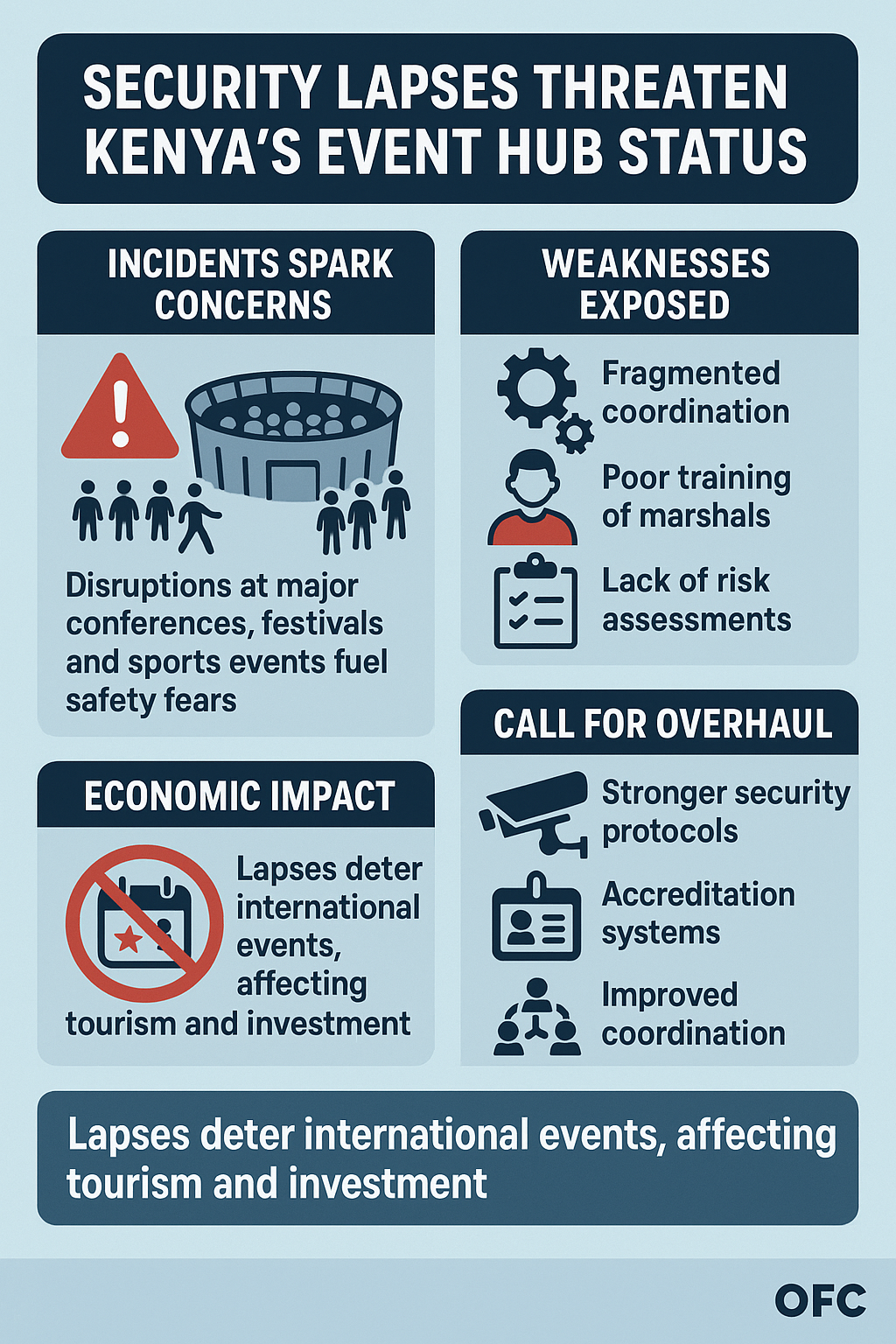
Kenya’s growing profile as a hub for international conferences, cultural festivals, and major sporting events hangs in the balance, threatened by a persistent and damaging weakness—event security lapses. The recent spate of high-profile disruptions, from chaotic crowd control failures to delayed emergency responses, has reignited fears that the country’s infrastructure and management systems are not keeping pace with its ambitions. While Kenya has successfully hosted large-scale gatherings in the past, these successes are increasingly overshadowed by incidents that put both safety and the nation’s reputation at risk. For a tourism and investment-driven economy, where marquee events serve as global shop windows, the stakes could not be higher. Any perception that Kenya cannot guarantee the safety of participants and spectators risks deterring international organizers, sponsors, and attendees, redirecting both revenue and influence to competing destinations.
At the core of the problem lies a combination of fragmented coordination among security agencies, inadequate training for event marshals, and a lack of robust, preemptive risk assessments. Large-scale events—from global athletics meets to high-profile music festivals—often depend on ad hoc arrangements, with security strategies being reactive rather than proactive. This has led to avoidable breaches, where unruly crowd surges, unauthorized access, and even petty crime have disrupted otherwise well-planned programs. For international guests, especially those attending for the first time, such lapses create a lasting negative impression, overshadowing the event’s core purpose and undermining Kenya’s pitch as a safe, reliable host. Stakeholders in the hospitality, transport, and retail sectors warn that the ripple effects of diminished confidence could translate into real economic losses, especially in cities like Nairobi and Mombasa where event-linked tourism forms a major income stream.
The solution requires more than isolated fixes—it demands a systemic overhaul anchored in professionalism, technology, and accountability. Kenya must invest in event-specific security protocols that integrate crowd science, digital surveillance, and emergency response drills into every planning phase. Clear chains of command, mandatory accreditation systems, and cross-agency coordination hubs should be standard practice, not aspirational goals. Without this, the “Africa’s Meeting Place” narrative risks collapsing under the weight of recurring security failures. The opportunity cost is immense: from losing bids to host continental championships, to deterring corporate conventions, to stalling the growth of cultural tourism. Kenya’s position as an event destination of choice is not guaranteed; it must be earned and safeguarded through consistent, visible competence. If the country cannot put its house in order, it may soon find the world taking its events—and its investment—elsewhere.
References:
Jijuze How CHAN 2024 is Boosting Tourism and Infrastructure in East Africa
The Kenyan Wall Street Legacy or Liability? Putting Kenya’s CHAN 2024 Moment Under the Lens
GhanaWeb Crowd disorder at CHAN raises concerns in Kenya
Pulse Sports Protect the Game: How CHAN 2024 Fans Can Keep Big Tournaments Coming to Kenya
FlashScore 2024 CHAN: Kenya fined by CAF again over multiple safety and security breaches
The Standard CHAN 2024: Why Kenya could lose quarterfinal hosting rights
As the African Nations Championship (CHAN) 2024 shifts its focus to East Africa, the co-hosting of the tournament by Kenya, Tanzania, and Uganda represents a significant shift in leveraging sports for economic transformation. For Kenya, this is a vital opportunity to recover its sporting integrity after a disappointing bid in 2018, underscored by considerable investments in stadium infrastructure, notably in Nairobi’s Nyayo Stadium and Eldoret’s Kipchoge Keino facility. These venues serve not just as football fields but as epicenters for urban redevelopment, spurring enhancements in transportation, hospitality, and small business interactions. The rising bookings in Nairobi’s hospitality sector indicate that CHAN is influencing broader economic dynamics, while also acting as a political lever to expedite long-delayed public works, showcasing the power of football in aligning with national development agendas.
Tanzania’s strategy for CHAN 2024 is meticulously crafted around intentional, brand-driven national development, where the Benjamin Mkapa Stadium in Dar es Salaam is being promoted as a pivotal regional hub for intertwining sports, tourism, and diplomacy. The government is tying the tournament to a larger tourism revival initiative, highlighting not only Dar es Salaam but also related destinations such as Arusha, Zanzibar, and Kilimanjaro to attract visitors. With a projected TSh 85 billion anticipated to flow into the economy as a direct result of the events, Tanzania seeks to boost its visibility as a potential future AFCON bidder. This emphasis on long-term tourism sustainability and attractive international offerings is designed to craft a narrative of lasting impact that transcends the tournament.
As Uganda joins its neighbors in this collaborative effort, it is focusing on a community-centered approach despite logistical challenges concerning stadium upgrades. The government is investing in public-private partnerships that engage local artisans, vendors, and cultural showcases to ensure wider community involvement in the festivities. Investments in essential infrastructure, including public transport and sanitation, aim to position CHAN as a catalyst for enduring urban renewal. By pairing match experiences with unique local attractions like gorilla trekking and cultural tours, the Ugandan Tourism Board is working to transition CHAN visitors into long-term tourists. Overall, while the three nations unite to present East Africa as a cohesive travel destination, the urgent challenge lies in translating the tournament’s temporary excitement into lasting benefits for the region, effectively establishing their collective identity as a forward-thinking economic bloc.
References:
Citizen Digital Why CHAN 2024 is not just a tournament, but a catalyst for East Africa integration
The Standard CHAN 2024, Kenya’s opportunity to boost economy, tourism
Nile Post Uganda Co-Hosting CHAN 2024 is a Landmark Achievement in the Country’s Sports
EAC EAC to promote the region as a unified tourism destination at ITB Berlin 2025
IPP Media Zanzibar hotels overflow with tourists ahead of CHAN match
Lake Nakuru, once Kenya’s unrivaled icon of flamingo tourism and a UNESCO World Heritage Site, is undergoing an environmental transformation that is quietly redefining its future. The dramatic shift from a shallow, alkaline soda lake to a swelling freshwater body—driven by climate change, deforestation, urban runoff, and persistent pollution—has reshaped not just the lake’s ecology, but also its economic and cultural purpose. Once celebrated as the “Lake of a Million Flamingos,” the site now faces a tourism identity crisis as its signature attraction—the vibrant flocks of Lesser Flamingos—has largely vanished due to the disappearance of Spirulina platensis, the algae they feed on. This ecological transition is not a fleeting anomaly; it signals a long-term reset, potentially stripping Kenya of one of its most iconic natural tourism assets.
The implications for Kenya’s tourism economy are profound. Flamingo migration has dealt a blow to the local hospitality industry, with ripple effects felt from Nakuru to Elementaita and Naivasha. The park’s submerged infrastructure—gates, roads, and buildings—has necessitated a KSh 38 million investment in repairs and relocation, eating into Kenya Wildlife Service’s already stretched budget. Yet amid this disruption, opportunity glimmers. Kenya has a chance to reframe Lake Nakuru not as a site of lost heritage, but as a blueprint for adaptive, resilient tourism in the age of climate change. KWS has already introduced new water-compatible experiences, including adjusted game-viewing routes and potential boating attractions. With careful investment, storytelling, and conservation marketing, this shift can usher in a new kind of eco-tourism centered on freshwater biodiversity, migratory birds, and climate adaptation success stories.
But realizing this vision demands urgency, strategy, and inclusivity. Conservation and tourism authorities must actively engage displaced communities, whose turn to illegal fishing underscores a deeper social fragility tied to the lake’s changes. Tourism policy must evolve to support heritage resilience—protecting UNESCO designation through scientific reinterpretation of the site’s ecological value, not just nostalgia for what it once was. Lake Nakuru stands at the frontline of global climate impact on natural heritage. If Kenya can lead the world in repurposing this park’s brand while safeguarding its ecosystems and communities, it won’t just save a destination—it will create a model for climate-smart tourism across Africa and beyond.
References:
Scientific Research Assessment of Spatial Expansion of Rift Valley Lakes Using Satellite Data
The Standard State of three Rift Valley Lakes worry experts
Talk Africa Lake Nakuru’s Water levels Expected to Cause More Havoc During The Rainy Season, Experts Say
Jijuze Is Lake Nakuru’s Ecosystem at Risk Due to Pollution and Illegal Fishing?
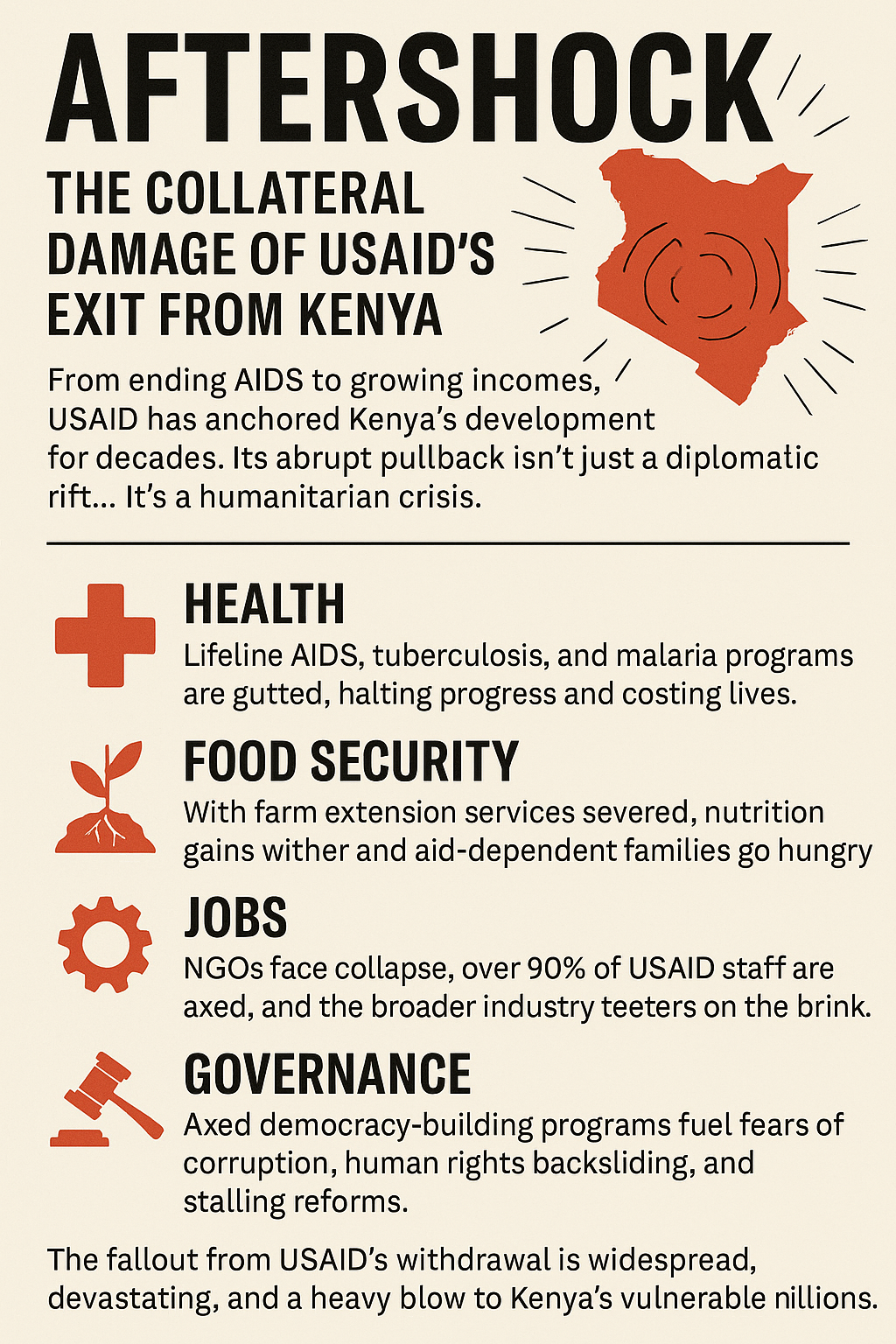
The abrupt dissolution of USAID, catalyzed by the U.S. government’s sweeping “America First” foreign aid policy pivot, has left Kenya reeling from a vacuum of support once critical to its public health, agriculture, and economic systems. With over $2.5 billion in planned investments between 2020 and 2025, the agency was more than just a donor—it was woven into the fabric of Kenyan service delivery. The termination of 83% of USAID’s programs and the layoff of 94% of its staff effectively ended over six decades of robust U.S. development engagement. For Kenya, this rupture came without a viable transitional plan. Clinics shuttered, medicines vanished, and 40,000 jobs tied to health services evaporated. Programs such as PEPFAR, which had sustained over a million Kenyans on antiretroviral treatment, have been gutted, with HIV/AIDS funding slashed from $846M in 2023 to just $66M in 2025. Maternal health, malaria prevention, and reproductive health services now teeter at the edge of collapse, with service cuts exceeding 90% in some areas. Kenya’s health infrastructure, already strained, is now buckling under a loss that is not merely financial—but fatal.
The economic blowback extends far beyond healthcare. USAID had supported Kenya’s agriculture sector through subsidies, training, and innovation, all now dismantled. Smallholder farmers are especially vulnerable. With the termination of the Famine Early Warning Systems Network (FEWS NET) after four decades of operation, Kenya has lost its primary mechanism for forecasting and responding to food insecurity. Meanwhile, tax reforms in the proposed 2025 Finance Bill—removing VAT exemptions on farm inputs and raising fuel duties—compound the crisis, inflating production costs and shrinking rural margins. The convergence of aid withdrawal, policy shocks, and climate threats is deepening food insecurity and threatening to reverse years of agricultural gains. Simultaneously, the Kenyan startup ecosystem and governance reform sectors face a projected $100 million funding shortfall. Civil society actors, often powered by USAID support, now risk losing their watchdog capacity. In areas such as conflict prevention and refugee education, where USAID once acted as a stabilizing force, the vacuum could be exploited by extremist recruiters, echoing conflict patterns seen in past aid shock cases in West Africa.
Kenya’s response has been urgent but encumbered. The government has committed to repatriating its health data from U.S.-hosted systems and shifting toward local infrastructure, yet faces severe capacity shortfalls. The fiscal strain is formidable: a KSh 52 billion health budget hole and a broader KSh 66.9 billion gap across affected sectors. While the Bottom-Up Economic Transformation Agenda (BETA) reflects ambition for self-reliance through tax reforms and private investment, execution remains constrained by weak systems and widespread corruption. Still, civil society and policymakers are beginning to reframe the crisis as a wake-up call for domestic revenue mobilization and governance renewal. If there is a path forward, it lies in converting dependency into resilience—not just by replacing funding streams, but by rethinking national priorities, protecting human capital, and investing in sovereign, accountable systems that can withstand future geopolitical shocks.
References:
Citizen Digital Over 40,000 Kenyans jobless after USAID-funded health facilities shut down
The Voice of Africa USAID Shuts Down After 63 Years, Leaving Africa in Crisis
The Star Civil society calls for self-reliance as foreign aid dwindles
Africa.com Kenya to Reclaim Health Data After Trump Administration’s USAID Cuts
Jijuze Kenya Faces Crisis After USAID Funding Withdrawal
Capital Business USAID funding halt to hit Kenya’s economy, social sectors – report


 Jijuze