Understanding Kenya’s Labor Unrest: Beyond Government Missteps

Kenya’s labor unrest cannot be fully explained by the Kenya Kwanza administration’s missteps alone. The deeper roots of today’s incessant strikes lie in structural shifts unleashed by the 2010 Constitution. By embedding strong labor rights—including the freedom to unionize, collectively bargain, and strike—while simultaneously devolving key government functions, the Constitution created both an empowered workforce and a fragmented system of accountability. These changes reshaped labor relations across education and health, planting the seeds for recurrent clashes between workers, unions, and the state.

Nowhere is this clearer than in the health sector. When the 2010 Constitution devolved primary and secondary health services to 47 county governments, it fractured the once-unified employer-employee relationship between health unions and the state. Doctors, nurses, and other medical professionals suddenly faced a dual negotiation front: the national Ministry of Health and individual county governors. This decentralization introduced ambiguity about who should fund or enforce collective bargaining agreements (CBAs), fueling a wave of prolonged nationwide strikes. The infamous 2016–2017 standoff—where doctors and nurses collectively downed tools for nearly a year, resulting in 250 lost strike days—exemplified how devolution multiplied points of conflict rather than streamlining accountability.

By contrast, the education sector retained a centralized structure under the Teachers Service Commission (TSC). While this avoided the maze of devolved negotiations, it meant that disputes often escalated into high-stakes, nationwide confrontations. Teachers’ unions, dealing with a single employer, have consistently locked horns with the TSC over promotions, career progression, and salary schemes. Despite this centralization, the state has still failed to fund signed CBAs adequately, proving that the conflict is not just about institutional design but also about political will. Ultimately, the post-2010 constitutional settlement entrenched a dual dilemma: fragmentation in devolved sectors like health, and high-stakes concentration in centralized sectors like education—both of which ensure that labor unrest remains baked into Kenya’s governance model.

References:

KMPDU Promise Made, Promise Kept As Doctors Receive Full 2017–2024 CBA Arrears

BMJ Global Health Tackling health professionals’ strikes: an essential part of health system strengthening in Kenya

Health Business Ministry of Health signs agreement with KMPDU in new deal

Finn Partners The Evolution of Healthcare in Kenya Amidst Doctor’s Strike and the Rise of Digital Health Innovations

Trust Deficit: Kenya’s Labor Crisis Explained

Kenya’s recurring waves of labor strikes reveal a crisis far deeper than wage disputes or delayed allowances—they point to a fundamental trust deficit between workers, their unions, and the state. From teachers to doctors, nearly every major sector has, at some point, downed tools in protest. Each time, negotiations end with government signing collective bargaining agreements (CBAs) it struggles—or refuses outright—to honor. The result is a vicious cycle: unions mobilize, the government promises, arrears pile up, and new strikes erupt. This perpetual conflict has eroded the credibility of institutions meant to safeguard industrial harmony, leaving both service delivery and economic stability hostage to distrust.

Trust deficit as Kenya's Undoing

At the heart of the matter is governance failure. Ministries, parastatals, and the National Treasury routinely blame one another for delayed payments or stalled promotions, creating an accountability vacuum. The Salaries and Remuneration Commission (SRC), meant to be the fiscal referee, is shackled by lack of enforcement powers, reducing it to a “recommendations desk” with little bite. This gap between policy pronouncements and actual execution has not only fueled suspicion among workers but also entrenched cynicism among citizens. When doctors or teachers take to the streets, the public sees not just disgruntled professionals but a state apparatus incapable of keeping its word. In such an environment, even genuine calls for fiscal restraint sound hollow, because credibility has already been squandered.

The trust deficit is not an abstract concept; it’s Kenya’s undoing. A nation cannot build a resilient education system if teachers constantly fear stalled promotions, nor can it deliver universal healthcare when doctors are unsure if their salaries will come through. Investors, too, read these signals—constant strikes flag an unstable labor environment, making Kenya a costlier and riskier place to do business. To restore confidence, government must urgently bridge the gap between rhetoric and reality: fund agreements it signs, empower regulatory bodies to enforce compliance, and practice transparency in fiscal commitments. Until then, Kenya’s labor landscape will remain a theatre of promises made and promises broken, with the trust deficit at its core.

References:

KMPDU Promise Made, Promise Kept As Doctors Receive Full 2017–2024 CBA Arrears

BMJ Global Health Tackling health professionals’ strikes: an essential part of health system strengthening in Kenya

TV47 Kenya “Trust deficit is Kenya Kwanza’s greatest undoing” – MP Makali Mulu


Corruption Shockwaves: Ruto’s Bold Claims on Kenya’s Legislative Integrity

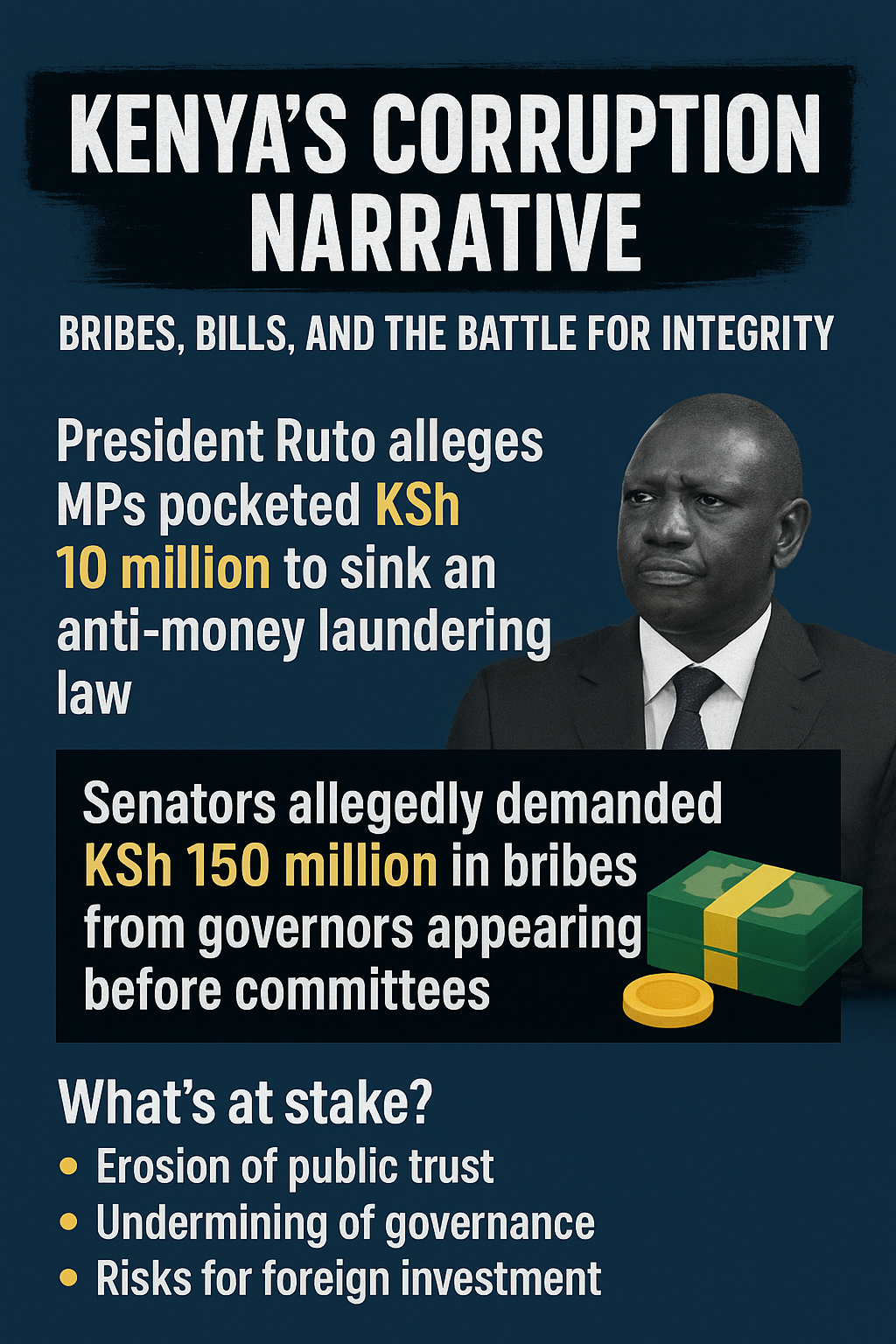
When President William Ruto stood before UDA and ODM legislators on August 18, 2025, and declared that MPs had pocketed KSh 10 million to sink an anti-money laundering bill, while senators allegedly demanded up to KSh 150 million from governors under probe, it marked a seismic moment in Kenya’s corruption narrative. Unlike broad platitudes, these allegations were laced with precision—figures, targets, and the President’s insistence that he was a “consumer of raw intelligence” with knowledge of what was happening behind closed doors. For a country where the shadow of graft often hovers without names or numbers, Ruto’s bluntness pulled corruption out of abstraction and into the raw theatre of governance. The fallout is immense. It not only raises fundamental questions about the integrity of Kenya’s legislative processes but also highlights how deep-rooted corruption risks sabotaging reforms critical to stabilizing the economy, securing donor confidence, and reinforcing Kenya’s democratic fabric.

Such high profile claims cannot be dismissed as political theatre. They expose systemic vulnerabilities where the very guardians of accountability—parliamentary watchdog committees—become gatekeepers of extortion. By placing a price tag on oversight, lawmakers distort the balance of power, weaken enforcement of financial transparency laws, and compromise Kenya’s commitments to international anti-money laundering standards. In practical terms, this jeopardizes more than just the passage of bills: it risks the credibility of Kenya’s financial system, threatening remittance flows, investor trust, and even compliance with IMF and FATF benchmarks. The long-term stakes are enormous. If parliamentarians are perceived as auctioneers of governance, global institutions will tighten their scrutiny, and Kenya’s economy—already weighed down by debt and unemployment—will carry the burden of political impunity.

The President’s vow to arrest both givers and takers of bribes presents a moment of reckoning. Rhetoric without enforcement risks deepening public cynicism rather than rebuilding confidence. What hangs in the balance is Kenya’s ability to demonstrate that governance is not negotiable, and that the fight against corruption is not a selective weapon but a consistent national ethic. Civil society and international observers are watching closely, and the diaspora too remains alert to how corruption narratives shape Kenya’s global reputation. At stake is not just legislative credibility, but the country’s standing as a functional democracy and competitive economy. If Kenya cannot confront and dismantle these entrenched practices, the corruption narrative will continue to define—not just distort—its future.

References:

The Star Some MPs received Sh10 million to sink anti-money laundering law – Ruto

The Star MP Makilap wants Ruto to publicly name corrupt lawmakers

Transparency International Kenya 2024 CORRUPTION PERCEPTIONS INDEX REVEALS HOW WEAK ANTI-CORRUPTION MEASURES UNDERMINE CLIMATE ACTION AND CONTRIBUTE TO THE VIOLATION OF HUMAN RIGHTS

Econfin Agency Kenya Creates Multi-Agency Task Force to Fight Corruption

Citizen Digital East Africa’s investment potential: Why leaders need to tackle corruption

Jijuze Combatting Fraud in Kenya’s Tourism: A Growing Threat


Understanding Kenya’s eTA Troubles: What Travelers Need to Know

Kenya’s ambitious shift to a universal Electronic Travel Authorization (eTA) system on January 1, 2024, was meant to be a game-changer for tourism, projecting an image of digital efficiency and openness. The vision—replacing traditional visas with an online pre-authorization—was sold as “visa-free” travel for the world, echoing President William Ruto’s promise of easier entry and smoother travel. Yet, what travelers encountered was a reality at odds with the marketing: mandatory paid applications, detailed documentation requirements, and unpredictable processing times. For visitors from over 40 countries that once enjoyed genuine visa-free access, the change felt less like liberation and more like an unexpected hurdle. Industry insiders describe the rollout as a “bait and switch” that has not only dented Kenya’s reputation but also triggered fears of retaliatory entry restrictions abroad. This mismatch between promise and practice was compounded in March 2025 when the government quietly replaced a stable Swiss-developed system with a locally built platform plagued by downtimes, payment failures, and technical glitches—sparking a multi-million dollar lawsuit and months of operational chaos.

A Report by iVisa

The fallout has been costly. Tour operators, hotels, and airlines have all reported significant losses as delays, application failures, and the absence of a functional support framework have disrupted itineraries and led to cancellations. Airlines face fines of KES 1 million per passenger without valid eTA documentation, a policy that has left many travelers stranded at departure gates. While Kenya recorded a record-breaking Sh 452 billion in tourism revenue in 2024—driven largely by post-pandemic recovery and aggressive marketing—the eTA crisis has cast a long shadow. The country’s visa openness ranking plunged from 29th to 46th in Africa, eroding hard-earned goodwill and weakening its competitive edge against rivals like Ghana and Rwanda, which have fully opened their borders. Industry leaders, including the Kenya Association of Travel Agents (KATA) and the Kenya Tourism Federation (KTF), warn that unless systemic fixes are made, Kenya’s target of five million annual visitors by 2027 could be jeopardized. Their calls range from establishing an emergency “crisis desk” for stranded travelers to temporarily reinstating visas on arrival while the digital system is repaired.

In response to mounting pressure, the government has introduced notable policy reversals, exempting most African and Caribbean nationals from eTA requirements and promising faster approvals for others. At the same time, industry stakeholders and the Tourism Ministry are working to embed risk management into the process—introducing contingency measures such as backup server capacity, offline verification protocols at airports, and dedicated “rapid response” teams to assist travelers facing last-minute clearance issues. While KATA’s August 2025 meeting with Tourism CS Rebecca Miano confirmed that some operational bottlenecks remain for non-exempt travelers, these interventions are designed to ensure that no visitor’s trip is derailed by system errors or delays. The emphasis now is on creating a safety net that preserves the integrity of Kenya’s digital entry framework while protecting the traveler’s experience. In an era where seamless digital access is part of a destination’s brand, these safeguards—paired with transparent communication—are key to restoring confidence and reinforcing Kenya’s identity as a warm, accessible, and world-class destination.

References:

The Permanent Mission of the Republic of Kenya to the United Nations Implementation of Electronic Travel Authorization (eTA) in Kenya

Kenya Association of Travel Agents Tourism industry raises concerns over ETA system delays

eVisa How Foreigners Will Apply For Kenya ETA Before Visiting (Visa-Free Kenya)

Aljazeera ‘Bait and switch’: Why Kenya’s no-visa policy is drawing pushback

Kenya Association of Travel Agents KATA Meets Tourism CS Rebecca Miano to Address Sector Challenges and Strengthen Collaboration


Tourism Fees Under Fire: Should Kenya Charge More to Protect Its Parks?

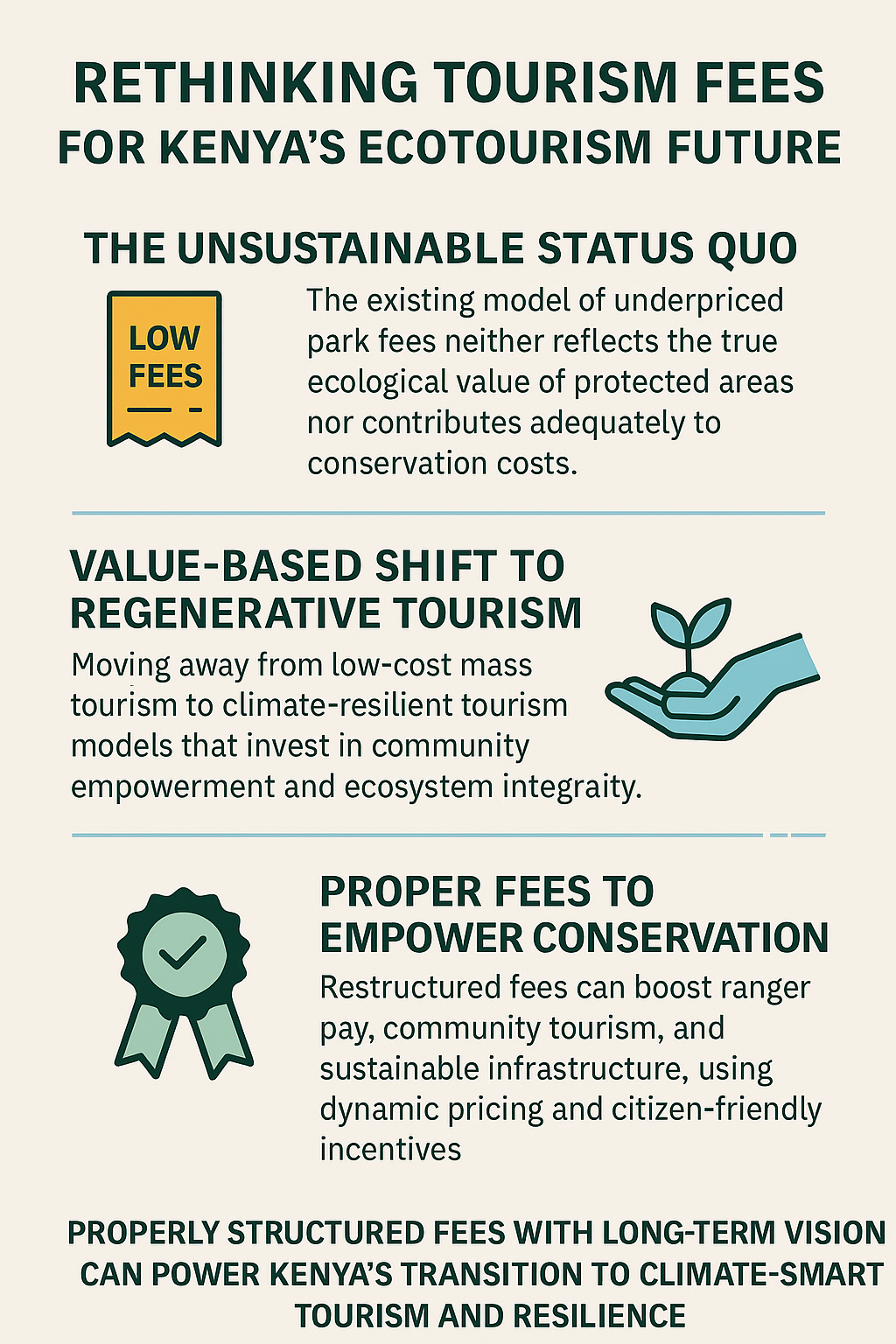
Kenya’s tourism sector is embroiled in a polarizing debate over the proposed increase in park entry fees by the Kenya Wildlife Service (KWS)—a move that has triggered pushback from parts of the tourism industry. Critics argue that the price hike could drive tourists away and stall the sector’s fragile post-COVID recovery. But that narrative, while convenient, masks a more urgent reality: our current tourism pricing model is fundamentally unsustainable. Kenya’s parks remain globally underpriced, with outdated fee structures that neither reflect the ecological value of protected areas nor contribute meaningfully to the conservation costs borne by the country. The research-backed push for value-based pricing is not just about economics—it’s about survival. A model dependent on cheap mass tourism ultimately risks collapsing under the weight of its own footprint, undercutting the very landscapes and wildlife it profits from.

Behind this pricing debate is a much bigger question: what kind of tourism future does Kenya want? Thought leaders like Prof. Bitange Ndemo have laid out a compelling vision for a shift away from extractive tourism that prioritizes volume, to regenerative tourism anchored in climate resilience, community empowerment, and ecosystem integrity. That means investing in tourism models that diversify products—like cultural tourism, eco-lodges, digital nomad experiences, and heritage circuits—that share value beyond the traditional safari elite. It also means linking fees directly to visible benefits: better ranger pay, stronger community tourism projects, and infrastructure that supports conservation rather than compromises it. The government’s failure to transparently communicate how increased revenue would be reinvested only feeds public skepticism, but that shouldn’t be used to stall reform altogether. If anything, it’s a call for better governance—not retreat.

The real danger isn’t raising fees—it’s failing to raise the bar. Kenya sits on the cusp of becoming a global model for climate-smart tourism, but that future will not be built on subsidized access and status quo politics. Properly structured fees—coupled with dynamic pricing, seasonal packages, and citizen-friendly incentives—can empower conservation without excluding access. The goal is not to gatekeep Kenya’s beauty, but to protect it with intention and long-term vision. Every tourist who visits our parks should not just be a guest but a contributor to a shared legacy of resilience. That’s the story Kenya should be telling the world—and charging fairly for.

References:

MDPI Re-Imagining Heritage Tourism in Post-COVID Sub-Saharan Africa: Local Stakeholders’ Perspectives and Future Directions

Travel Weekly Weighing the pros and cons of Kenya’s proposed safari park fee increase

The Journal of African Policy Studies Sustainable Tourism in Kenya: An Analysis of Tourism Policy Currently Under Consideration

EAC Tourism and Wildlife Management


Conservation Challenges in Kenya’s Maasai Mara Region

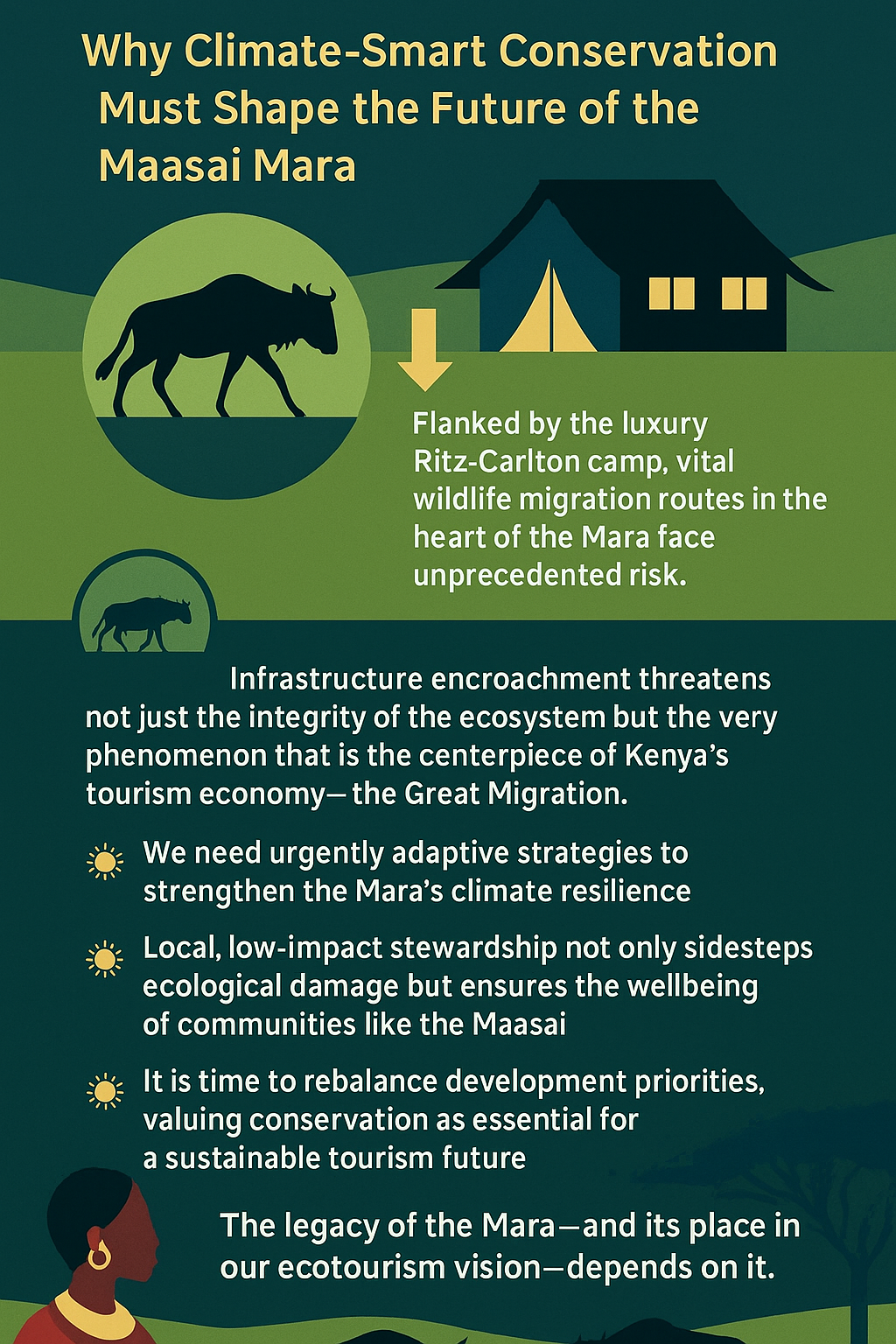
The Maasai Mara, one of the last remaining wild frontiers of Africa’s Great Migration and a cornerstone of Kenya’s ecotourism economy, now faces one of the gravest threats in its recent history—not from drought, poaching, or climate change alone, but from unchecked commercial expansion. A controversial plan to construct a high-end hotel complex and convention centre within the fragile Pardamat Conservation Area has triggered fierce opposition from environmental experts, conservancy leaders, tourism stakeholders, and sections of the local Maasai community. The development, backed by county government actors and private investors, was initially celebrated as a boost to job creation and conference tourism. But critics warn it could irreversibly damage the very ecosystem that draws visitors—and revenue—to the region.

At the heart of the concern is the ecological fragility of the Pardamat area, a critical corridor for wildebeest, elephants, and other migratory species. The proposed construction site borders sensitive wildlife routes and overlaps with communal land managed under an innovative conservation model that merges livestock grazing with wildlife protection. Experts argue that the scale and permanence of such infrastructure threaten to fragment habitat, displace species, and compromise the authenticity of the Mara’s wilderness appeal. Already, irregular land sales, fencing, and proliferation of unregulated camps have altered key migratory paths—choking the ecosystem and undermining decades of community-led conservation gains.

What the Mara needs is not another luxury venue, but a decisive pivot toward climate-smart, community-anchored ecotourism. This means planning developments in harmony with nature, prioritizing low-impact, mobile tourism models, and bolstering scientific land-use policies that preserve migratory corridors and biodiversity integrity. Kenya’s international tourism reputation—and its ability to withstand climate volatility—depends on how well we defend and innovate around natural heritage sites like the Mara. The future must be shaped not by profit margins alone, but by policies rooted in ecological wisdom, community ownership, and a long-term vision for a resilient, inclusive conservation economy.

References:

Spa Opportunities Marriott to open luxury safari camps in Kenya under JW Marriott and Ritz-Carlton brands, with architecture by LW Design

The Star Narok county defends Ritz-Carlton Safari Camp amid conservation criticism

The Standard County contests claims that new safari camp is obstructing wildlife

The Ritz Carlton The Ritz-Carlton, Masai Mara Safari Camp

Aftershock: The Collateral Damage of USAID’s Exit from Kenya

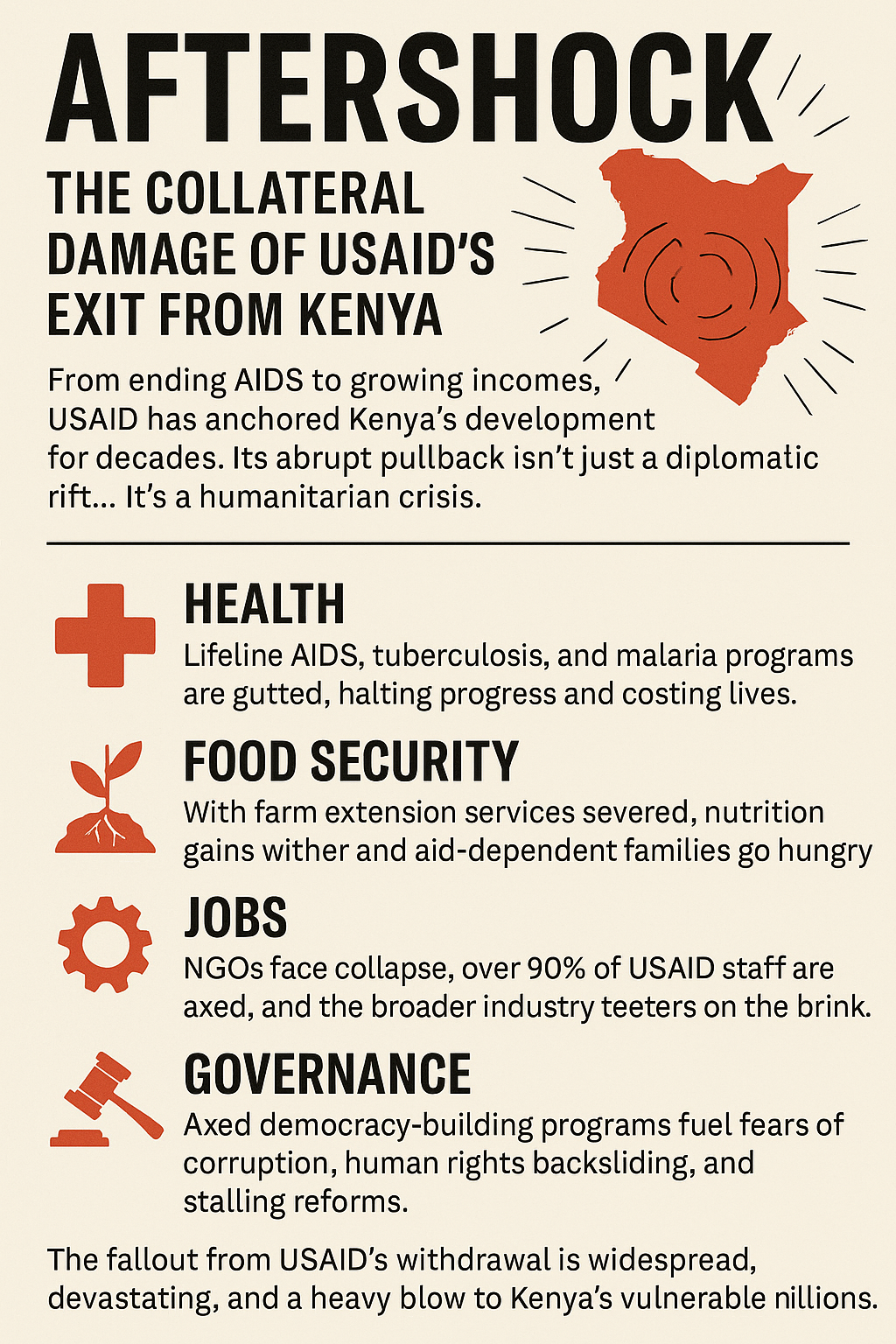
The abrupt dissolution of USAID, catalyzed by the U.S. government’s sweeping “America First” foreign aid policy pivot, has left Kenya reeling from a vacuum of support once critical to its public health, agriculture, and economic systems. With over $2.5 billion in planned investments between 2020 and 2025, the agency was more than just a donor—it was woven into the fabric of Kenyan service delivery. The termination of 83% of USAID’s programs and the layoff of 94% of its staff effectively ended over six decades of robust U.S. development engagement. For Kenya, this rupture came without a viable transitional plan. Clinics shuttered, medicines vanished, and 40,000 jobs tied to health services evaporated. Programs such as PEPFAR, which had sustained over a million Kenyans on antiretroviral treatment, have been gutted, with HIV/AIDS funding slashed from $846M in 2023 to just $66M in 2025. Maternal health, malaria prevention, and reproductive health services now teeter at the edge of collapse, with service cuts exceeding 90% in some areas. Kenya’s health infrastructure, already strained, is now buckling under a loss that is not merely financial—but fatal.

The economic blowback extends far beyond healthcare. USAID had supported Kenya’s agriculture sector through subsidies, training, and innovation, all now dismantled. Smallholder farmers are especially vulnerable. With the termination of the Famine Early Warning Systems Network (FEWS NET) after four decades of operation, Kenya has lost its primary mechanism for forecasting and responding to food insecurity. Meanwhile, tax reforms in the proposed 2025 Finance Bill—removing VAT exemptions on farm inputs and raising fuel duties—compound the crisis, inflating production costs and shrinking rural margins. The convergence of aid withdrawal, policy shocks, and climate threats is deepening food insecurity and threatening to reverse years of agricultural gains. Simultaneously, the Kenyan startup ecosystem and governance reform sectors face a projected $100 million funding shortfall. Civil society actors, often powered by USAID support, now risk losing their watchdog capacity. In areas such as conflict prevention and refugee education, where USAID once acted as a stabilizing force, the vacuum could be exploited by extremist recruiters, echoing conflict patterns seen in past aid shock cases in West Africa.

Kenya’s response has been urgent but encumbered. The government has committed to repatriating its health data from U.S.-hosted systems and shifting toward local infrastructure, yet faces severe capacity shortfalls. The fiscal strain is formidable: a KSh 52 billion health budget hole and a broader KSh 66.9 billion gap across affected sectors. While the Bottom-Up Economic Transformation Agenda (BETA) reflects ambition for self-reliance through tax reforms and private investment, execution remains constrained by weak systems and widespread corruption. Still, civil society and policymakers are beginning to reframe the crisis as a wake-up call for domestic revenue mobilization and governance renewal. If there is a path forward, it lies in converting dependency into resilience—not just by replacing funding streams, but by rethinking national priorities, protecting human capital, and investing in sovereign, accountable systems that can withstand future geopolitical shocks.

References:

Citizen Digital Over 40,000 Kenyans jobless after USAID-funded health facilities shut down

The Voice of Africa USAID Shuts Down After 63 Years, Leaving Africa in Crisis

The Star Civil society calls for self-reliance as foreign aid dwindles

Africa.com Kenya to Reclaim Health Data After Trump Administration’s USAID Cuts

Jijuze Kenya Faces Crisis After USAID Funding Withdrawal

Capital Business USAID funding halt to hit Kenya’s economy, social sectors – report

Audit vs. Austerity: The IMF’s Role in Kenya’s Recovery

Kenya is on the edge of a pivotal financial reckoning. In the wake of the 2024 Finance Bill’s withdrawal and amid a battered economy, the International Monetary Fund (IMF) has demanded a sweeping corruption audit before any further disbursement of financial aid. At stake is more than KSh 100 billion in support tied to Kenya’s Extended Fund Facility, Extended Credit Facility, and Resilience and Sustainability Facility—aid that could help stabilize an economy reeling from debt, inflation, and political distractions. The collapse of the 2024 Finance Bill, triggered by nationwide protests over tax hikes, left a gaping fiscal hole. Now, the IMF wants answers before money moves. Between June 16 and 30, a Governance Diagnostic mission wrapped up in Nairobi. While Treasury insists the audit is not a precondition for funding, international observers say its findings will heavily influence future negotiations. The IMF has drawn a clear line: no serious anti-corruption reforms, no fresh credit.

IMF Demands corruption audit on Kenya

The Kenyan public feels the consequences every day. For ordinary wananchi, the stalled billions aren’t just digits on a spreadsheet—they represent hospital beds without medicine, classrooms without books, roads that end in dust, and a tax burden growing heavier on already strained shoulders. Years of unchecked corruption have gutted public institutions, forcing citizens to pay more for less while a well-connected elite evades accountability. The protests of June 2024 were not merely about a finance bill—they were about a social contract broken. Corruption doesn’t just steal money; it steals opportunity, trust, and dignity. It pushes more families below the poverty line and leaves critical sectors like education and healthcare in permanent crisis. Every act of embezzlement is a tax on hope. And now, Kenya must confront that cost head-on.

Yet as this economic standoff unfolds, the political class seems to be campaigning rather than governing. With two years until the 2027 general elections, the air is already thick with premature rallies and succession battles. This relentless politicking is not just tone-deaf—it undermines policy coherence and economic recovery. Critics argue that Kenya risks squandering a historic opportunity to reset its governance priorities. The IMF’s demand for a corruption audit is not just a bureaucratic checkbox; it is a test of political will. Whether the government embraces or evades the findings of the Governance Diagnostic will speak volumes. Kenya is at a crossroads. What lies ahead will depend on whether its leaders prioritize reform over rhetoric, the public over politics, and accountability over access to short-term cash. The world is watching. But more importantly, Kenyans are waiting.

References:

Mariblock Kenya fails IMF review, forfeits $850M disbursement

International Monetary Fund IMF Staff Completes Governance Diagnostic Mission to Kenya

Transparency International – Kenya Debate on Kenya’s economy must include a cure to the endemic corruption

The Standard Bitter IMF austerity pill return overshadows budget unveiling

The Standard Why IMF is demanding corruption audit on Kenya


Impact of Kenya’s Toxic Chemical Policy on Farmers and Exports

Kenya’s 2025 pesticide ban is more than a policy shift—it’s an overdue confrontation with dangerous agrochemical practices that have long gone unchecked. At the heart of the crackdown is Mancozeb, a fungicide so entrenched in Kenyan agriculture that it’s sprayed like water on tomatoes, potatoes, and maize. Yet this widely used chemical breaks down into ethylene thiourea (ETU)—a probable human carcinogen linked to thyroid harm and reproductive toxicity. Mancozeb has already been banned across the European Union and flagged by multiple global health authorities, but until now, it continued to flow into Kenyan markets with barely a check. Now, alongside Mancozeb, Kenya has also moved to restrict or suspend other hazardous products including chlorpyrifos, acephate, glyphosate, and dimethoate—compounds associated with cancer risks, neurotoxicity, endocrine disruption, and acute poisoning in both humans and animals. In withdrawing 77 toxic products and tightening rules on 202 more, the government is finally rejecting the toxic trade imbalance that treats African countries as chemical dumping grounds. The new policy aligns Kenyan regulation with international best practice: no pesticide can be registered here unless it’s also legal in its country of origin and in developed economies like the EU, USA, Canada, or Australia. It’s a turning point—but not without blowback.

A Report by K24TV

For years, Mancozeb symbolized Kenya’s regulatory inertia: cheap, accessible, and unchallenged despite the mounting science against it. Farmers, often unaware of its dangers, sprayed it without masks or gloves, storing the residues in their homes, their soil, and their food. Chlorpyrifos, a widely used insecticide linked to developmental harm in children, and glyphosate, a herbicide under global scrutiny for carcinogenicity, have followed similar trajectories—popular with farmers but flagged by scientists and health agencies. Now, the state faces a high-stakes transition. Smallholders reliant on these chemicals are being urged toward Integrated Pest Management (IPM) and agroecological alternatives. Yet less than 10% of Kenyan farmers use biopesticides, and most lack training, equipment, or trust in new inputs. The Pest Control Products Board, emboldened by fresh legislation, is finally flexing its oversight powers. But enforcement remains patchy, and counterfeit products exploit the regulatory vacuum. Mancozeb isn’t just a pesticide—it’s a case study in how economic expediency once overrode health and environmental responsibility. That era, Kenya now claims, is ending.

Timing is crucial. The EU is cracking down on residue limits. Kenya’s vegetable exports—once worth KSh 100 billion—have already taken a hit. If the country wants to stay competitive and credible, aligning with global safety standards is not optional. Mancozeb’s fall is both symbolic and strategic: it’s a warning to other harmful substances still in circulation—like profenofos, carbendazim, and triazophos—and a test of whether Kenya can enforce its own reform. This is where political will must hold—beyond press briefings and regulatory memos. Farmers need practical support. Consumers need transparency. And regulators must resist the pressure of well-funded pesticide lobbies looking to reverse course. Kenya has declared its direction. Now the country must walk it—with clarity, speed, and resolve—before the next generation pays the price in poisoned soil, sickened bodies, and lost trade.

References:

Trade World News Kenya Bans Import of 50 Pesticide Brands for Safer Farming

The Standard State cracks down on harmful pesticides, bans 77 products

The Star Civil society demand full disclosure of banned pesticides, calls for safer agricultural reforms

The Star 77 pesticides banned in Kenya as 202 others restricted – CS Kagwe

Kenya News Agency State urged to make to make public list of banned pesticides

Kenyans.co.ke Kenya Bans Use of Pesticides Not Approved in Europe, USA, Canada & Australia

Beyond Tear Gas: Kenya’s Protests and the Deeper Economic Fault Lines

Kenya stands on the edge of a breaking point, as nationwide protests planned for June 25, 2025, threaten to ignite a powder keg of grievances that have simmered for far too long. The recent killings of Albert Ojwang and Boniface Kariuki during demonstrations are not isolated incidents—they are flashpoints in a larger pattern of state overreach and institutional deafness. While headlines focus on police brutality and protest management, a more insidious reality demands attention: the sustained economic suffocation of the Kenyan populace. The cost of living continues to soar. Public debt has swollen to KSh 11 trillion. Education remains underfunded, and youth unemployment festers like an untreated wound. Amid this, the government’s focus on force and optics, rather than reform and relief, appears increasingly deliberate. It is no longer simply a failure to act—it is a strategy of distraction, where brute security responses replace dialogue, and public anger is met with tear gas instead of tangible solutions.

A Report by Citizen TV Kenya

This redirection is clearest in the shift from last year’s finance protests to this year’s rhetoric on law and order. After being forced to walk back the 2024 Finance Bill amid massive pushback, the state seems determined to recast the youth-led movement as a public threat rather than a national awakening. But this strategy grossly underestimates the intelligence and resolve of a digitally savvy, politically alert generation. What the state has failed to internalize is that the fuel behind these protests is not a single tax line or budget clause—it is the lived experience of economic abandonment. From unpaid interns to underfunded school programs, from shuttered clinics to inflated basic goods, Kenyans are not protesting a moment—they are protesting a system. When young people march, they are not just asking for change; they are demanding to be seen, to be heard, and to be respected as stakeholders in a country that often treats them as collateral.

That is why June 25 holds more than just symbolic significance—it is a moral crossroads for the nation. One year after the storming of Parliament by a disillusioned youth bloc, the same issues remain unresolved, and in many cases, have worsened. Kenya cannot police its way out of a political and economic crisis. The louder the government beats the drums of security, the more transparent its silence becomes on job creation, education reform, healthcare access, and corruption crackdowns. If this government fails to acknowledge the root causes of unrest, it will find itself chasing symptoms while the disease spreads. True national stability will not come from the barrel of a gun or the lens of a surveillance drone—it will come from confronting the truth with courage. The youth are not the enemy. They are the warning light on the dashboard of a republic veering off course. And unless Kenya listens—and acts—history may remember this moment not as a turning point, but as a missed opportunity written in smoke and silence.

References:

All Africa Kenya Drops Tax Hikes in New Budget, Focuses on Reforms

The Star Factors affecting retail prices in Kenya

The Kenyan Wall Street Kenya’s Public Debt Interest Payments On Pace to Cross KSh 1 Trillion in 2025

Kenya News Agency Kenya launches the 2025 Economic Survey

Citizen Digital A depressed economy? Employment opportunities in Kenya shrink as wages go down

Aljazeera Kenyan police shoot bystander at close range during latest protests