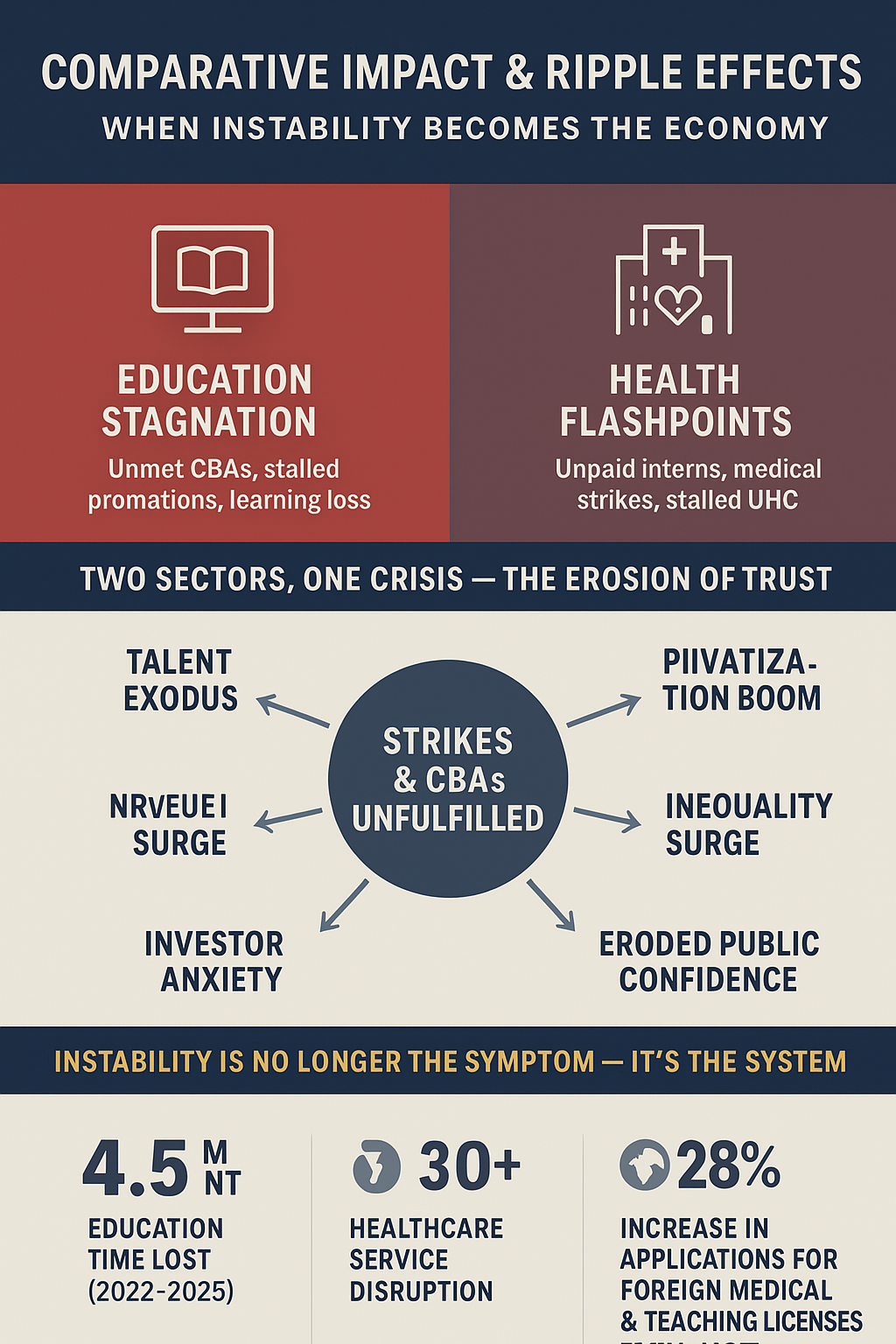
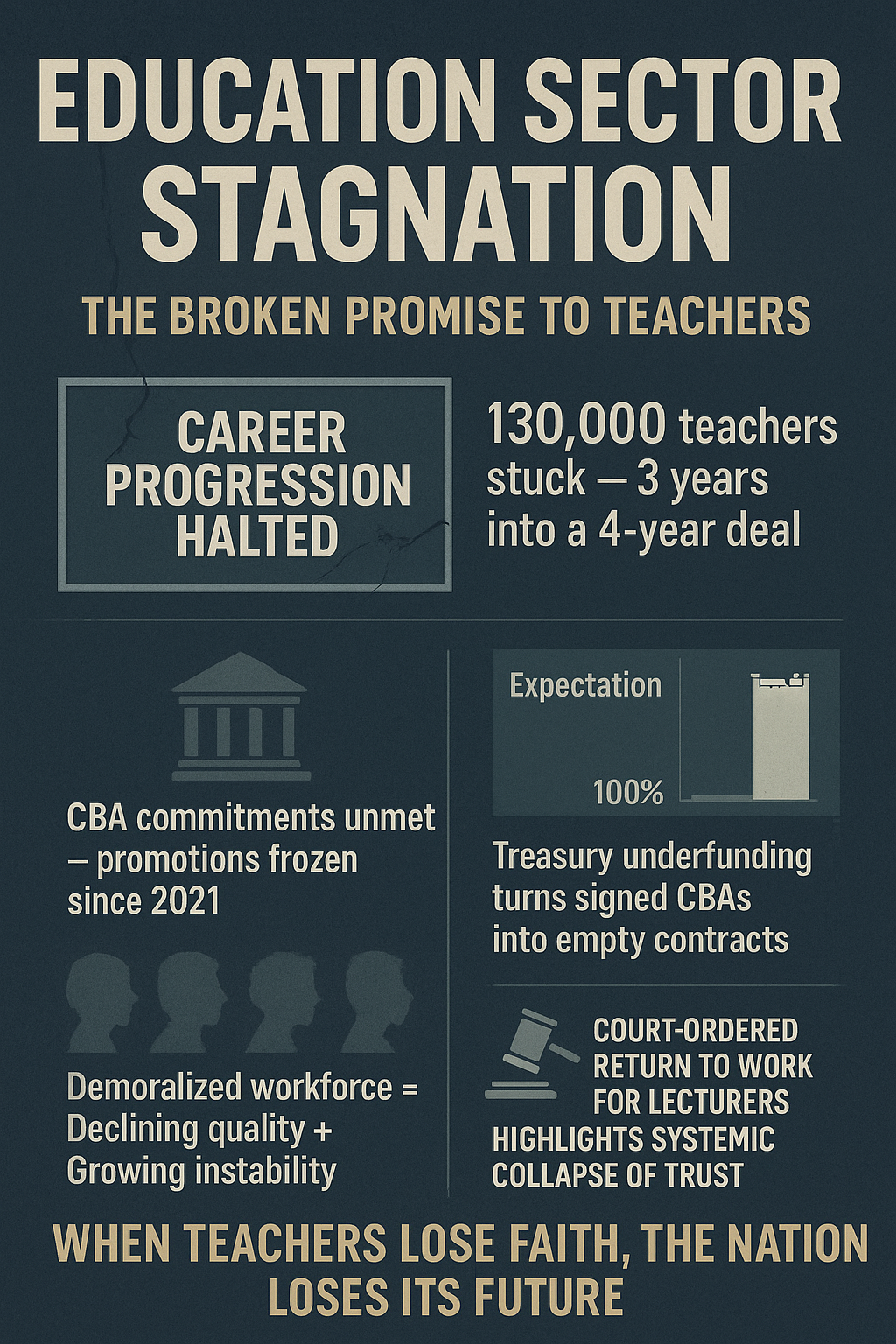
The crisis speaks to something more profound than missed promotions; it exposes a deliberate governance failure that prioritizes fiscal optics over human capital. The TSC’s inability to execute the agreed promotions has become emblematic of Kenya’s “paper promises” — deals inked and celebrated, then quietly buried when budgets tighten. Treasury allocations to the Commission repeatedly fall short of covering the wage and progression costs enshrined in signed CBAs. This chronic underfunding transforms legal agreements into empty gestures, leaving teachers to bear the brunt of political short-termism. The result is an education system running on disillusionment: educators forced to do more with less, students learning from underpaid, overworked instructors, and parents watching as quality erodes year after year.
Recent developments in higher education reveal that this dysfunction is not confined to basic learning. As of October 2025, the University of Nairobi (UoN) directed lecturers to resume work following a prolonged strike, acting on a court order that temporarily suspended the industrial action and mandated conciliation. The strike, spearheaded by academic unions including UASU, KUSU, and KUDHEIHA, centered on the government’s alleged failure to pay KSh 7.9 billion owed under the 2021–2025 Collective Bargaining Agreement — a claim contested by the Ministry of Education, which maintains that several payment tranches have already been released. The unions, however, insist that discrepancies persist and have demanded documentary proof such as payslips and audited records. This confrontation underscores a grim pattern: collective agreements, even when legally binding, are routinely undermined by bureaucratic opacity and political deflection. From teachers denied promotions to lecturers forced back to class under court order, the system thrives on compulsion rather than collaboration. When dialogue collapses into litigation and contractual rights depend on judicial enforcement rather than institutional integrity, it becomes clear that Kenya’s education crisis is no longer about money — it’s about the state’s eroding credibility. The country’s future is being taught by a workforce losing faith not just in their employer, but in the very promise of public service.
References:
Citizen Digital UoN directs lecturers to resume work on Monday amid ongoing strike
The Standard The Sh7.9 billion stalling university lecturers strike talks
Daily Nation Lecturers accuse SRC, universities of delay tactics over pay arrears
KTN News Kenya KUPPET demands promotion of over 130,000 teachers working under same job groups for many years.
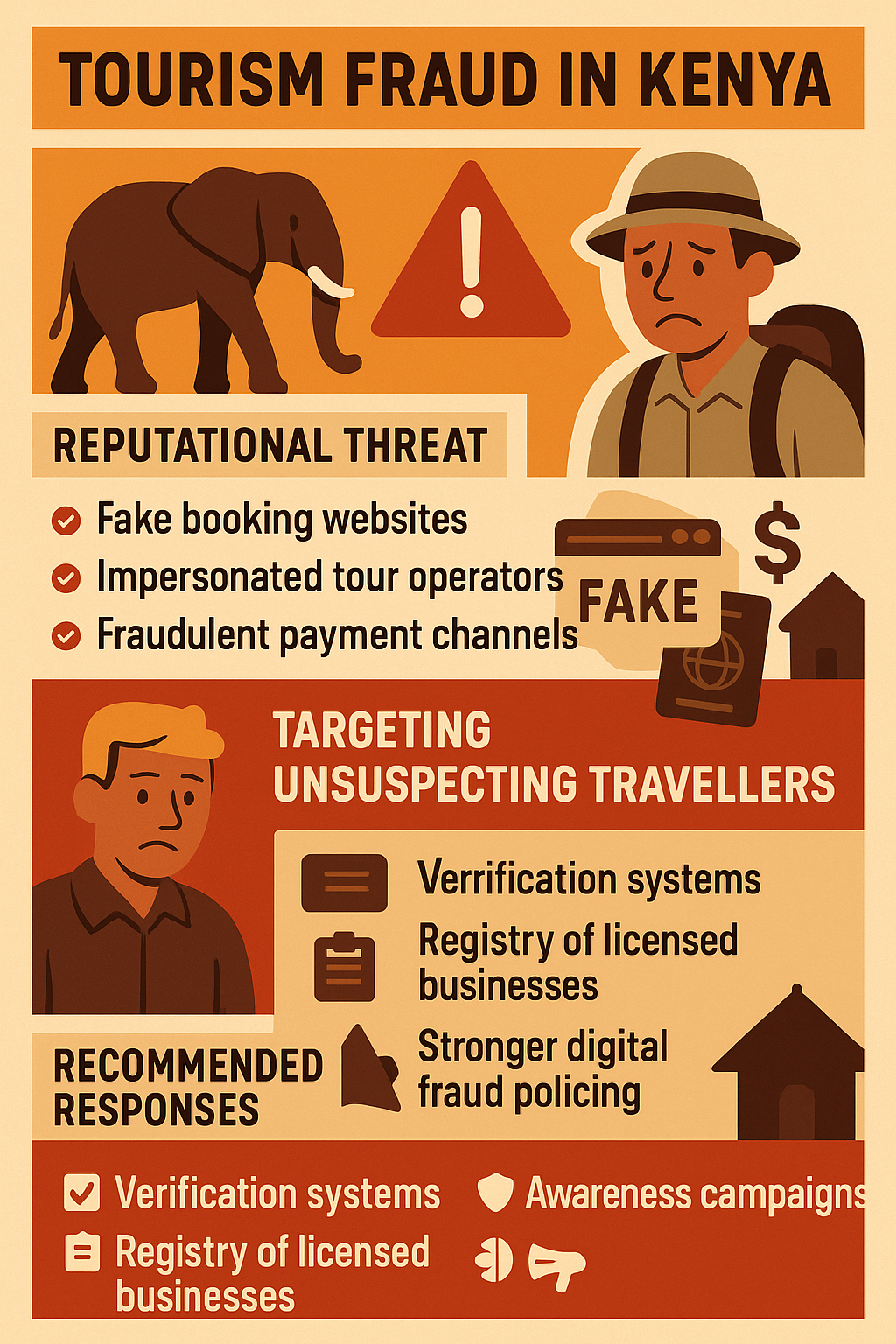
Kenya’s tourism industry, a vital pillar of the economy and a top foreign exchange earner, is now battling a growing reputational threat: sophisticated fraud targeting unsuspecting travelers. According to the latest sector review, a surge in fake booking websites, impersonated tour operators, and fraudulent payment channels is eroding visitor trust and undermining the gains made in post-pandemic recovery. Many of these scams operate with alarming polish—using stolen branding, cloned websites, and even counterfeit licenses to lure victims into paying for non-existent safaris, hotel stays, or cultural tours. Victims, often diaspora Kenyans and international tourists planning high-value itineraries, only discover the deceit upon arrival, when their bookings prove fake and their funds unrecoverable. The Kenya Tourism Board (KTB) and sector associations have flagged these schemes as a systemic risk that, if unchecked, could tarnish Kenya’s image as a safe, reliable destination.
Industry stakeholders stress that the challenge is compounded by gaps in regulatory oversight, slow cross-border law enforcement cooperation, and limited consumer awareness in key source markets. Fraudsters exploit these vulnerabilities, targeting peak travel seasons and leveraging digital marketing channels to reach large audiences with minimal traceability. Tour operators report that such scams not only cause financial loss but also drive potential travelers toward competing destinations perceived as safer or better regulated. Its important to note that while Kenya’s tourism marketing campaigns have successfully reignited global interest, this momentum risks being reversed if fraud-related horror stories dominate travel forums and social media. Experts recommend a multi-pronged response: real-time verification systems for operators, a central registry of licensed tourism businesses accessible to the public, stronger digital fraud policing, and targeted awareness campaigns in both domestic and foreign markets.
To its credit, the government has begun aligning with these recommendations, with the Ministry of Tourism working alongside the Communications Authority, cybercrime units, and private-sector stakeholders to roll out verification platforms and consumer education drives. Pilots for an online “Tourism Trust Mark” are already underway, enabling travelers to authenticate operators before making payments. Additionally, diplomatic missions are being engaged to circulate fraud alerts in high-risk markets, while tourism associations are exploring partnerships with payment processors to flag suspicious transactions. These initiatives, if scaled and sustained, could restore confidence and reinforce Kenya’s brand as a secure, trustworthy destination. In an increasingly competitive global tourism landscape, safeguarding the integrity of the travel experience is no longer optional—it’s a prerequisite for growth. Kenya’s long-term competitiveness will hinge not just on the beauty of its landscapes, but on the trustworthiness of the path visitors take to reach them.
References:
Kenyans.co.ke DCI Arrest Suspect After Greek Tourist Loses Ksh3.6 Million in Maasai Mara Scam
Behind the lesson plans, classroom chalkboards, and national curriculum reforms lies a worsening crisis no one wants to confront: the mental health of Kenyan teachers. While policymakers debate school infrastructure and CBC reforms, teachers — especially those deployed to remote hardship areas — are quietly slipping into psychological distress. Long hours, poor housing, insecurity, and administrative pressure are converging into what experts describe as a “mental health time bomb.” According to recent findings, over 25% of teachers in hardship zones exhibit symptoms of burnout, anxiety, or depression. This figure is likely underreported, given the stigma that still surrounds mental health discussions in the education sector. The harsh irony is that those tasked with nurturing the mental and emotional well-being of children are themselves emotionally depleted, working under punishing conditions with minimal support. For teachers posted to far-flung regions — from Turkana to Taita Taveta — the challenges aren’t just professional; they’re deeply personal. They’re living in fear of conflict, cut off from families, often without access to clean water or stable power — and still expected to deliver top academic outcomes.
A Report by K24TV
This psychological pressure has come to a head following a proposal by the Teachers Service Commission (TSC) to revise the hardship allowance structure. The proposal suggests reviewing and potentially reducing hardship allowances in counties where conditions are deemed to have “improved” — including several historically marginalized regions like Marsabit, Mandera, Isiolo, and Kilifi. This has sparked instant backlash from the Kenya Union of Post Primary Education Teachers (KUPPET) and the Kenya National Union of Teachers (KNUT), who argue that the proposed changes are tone-deaf and dangerous. Union leaders insist that the so-called improved areas still suffer from chronic insecurity, food scarcity, poor health services, and deplorable living conditions. Cutting allowances under these conditions, they argue, will only deepen teacher shortages, worsen morale, and push more educators into psychological breakdown. Already, high turnover and transfer requests plague hardship regions — not because teachers don’t care, but because they are exhausted, isolated, and unsupported. The allowance, for many, is the only remaining incentive tethering them to these underserved regions. Removing or reducing it, without real infrastructure or support investment, is like cutting the safety net and hoping no one falls.
But the issue isn’t just about allowances — it’s about the invisible costs of neglecting teacher welfare. As mental health deteriorates and professional burnout spikes, teaching quality suffers, student outcomes drop, and entire communities are affected. What’s urgently needed is not just an economic rethink of allowances, but a national teacher wellness policy. Mental health support must be built into education sector planning, especially for those in high-stress deployments. That means professional counseling access, more humane deployment cycles, structured leave, and peer support programs. The government must stop treating teachers as expendable cogs in the machinery of curriculum delivery — and start seeing them as human beings, whose mental strength is foundational to national development. Education reform can’t succeed on exhausted minds and broken morale. Kenya cannot afford to ignore this crisis in its classrooms any longer.
References:
The Standard Teachers fume over plan to slash their hardship allowance
Kenyans.co.ke Teachers Threaten to Strike as Push and Pull On Hardship Allowance Intensifies
The Eastleigh Voice Teachers unions reject govt plan to reclassify hardship areas without consultation
In April 2025, the Kenyan government did what governments often do when the heat rises — it rebranded. Out went the Competency-Based Curriculum (CBC), in came Competency-Based Education (CBE), now dubbed Elimu Thabiti — “Stable Education.” On the surface, it looked like a smart communications reset: streamline the curriculum, simplify delivery, calm public fears, and signal that Kenya’s education reform is finally maturing. But under the hood, the same unresolved problems are festering — and threatening to derail the system again. A new name hasn’t solved the deep cracks in Kenya’s education foundation: from underfunded schools and frustrated teachers, to digital inequalities and mismanaged infrastructure. The education sector is being reshaped with bold promises — but very few of the tools needed to make those promises real.
A Report by TV47 Kenya
Let’s talk numbers. While the Teachers Service Commission boasts about retooling 291,000 educators, independent research in 2025 shows two-thirds of teachers say they haven’t been adequately trained for CBE. Many still rely on the old 8-4-4 methods. Worse, over 343,000 trained teachers remain jobless while schools face a 72,000-strong staff shortage in Junior Secondary School alone. Promotion pathways are clogged, hardship allowances may be cut, and morale is low. Now layer that on top of infrastructure demands: the new “pathway model” for senior schools, launching fully in 2026, demands schools be categorized as “Triple Pathway” or “Double Pathway” — meaning massive upgrades to labs, sports halls, art studios, and digital infrastructure. And while the government talks about progress, the Auditor-General is flagging KSh 6 billion in irregular spending from previous education projects. What’s the point of planning a digital classroom if half the schools don’t even have functioning toilets?
And here’s the financial kicker: schools are still owed over KSh 64 billion in capitation arrears. As of May 2025, the promised Sh21 billion had yet to arrive. Headteachers are being fined Sh500 per project for late CBC/KJSEA submissions — even though many schools have no internet access or computers to begin with. Meanwhile, a flashy new KEAC Bill proposes AI exam grading and electronic assessment. Great on paper, but in classrooms across ASAL regions, basic digital literacy is still below 50%. While Finland’s President arrives with hope and MoUs to support Kenyan education, the shadow of the Uasin Gishu scholarship scandal still looms large. Education reform can’t run on optics alone. Kenya doesn’t need another slogan. It needs teachers who are paid and trained, capitation that arrives on time, classrooms that work — and honesty about just how deep the overhaul must go. If Elimu Thabiti is going to be more than a PR stunt, it has to fix the pipes — not just polish the tap.
References:
The Star MPs Raise Concern Over Zero Budget Allocation for KCSE, JSS Exams
The Eastleigh Voice Budget cuts jeopardise education for millions as key programmes struggle with shortfalls
The Eastleigh Voice CS Mbadi: KCSE funds frozen over misuse, but parents won’t pay
KBC Kenya, Finland sign deals to boost ties in peace, education
The Standard Kenya and Finland forge strategic partnership
In March 2025, we examined the rising concerns over Kenya’s Competency-Based Curriculum (CBC) rollout, where critics warned that critical academic foundations were being neglected in the rush toward specialization as discussed here. Chief among these concerns was the controversial proposal to make mathematics optional for students in the Arts & Sports Science and Social Sciences pathways at the senior secondary school level. Many stakeholders — including professional bodies, educators, and parent associations — argued that removing compulsory mathematics risked undermining students’ critical thinking, problem-solving ability, and future career flexibility. The fears were compounded by Kenya’s broader ambitions to remain competitive in a global economy increasingly shaped by STEM skills and data-driven professions. As the CBC pathways were being finalized for the Grade 10 transition starting in 2026, it became clear that significant gaps remained between the curriculum’s vision and its practical implications. It is against this backdrop that, in April 2025, the Ministry of Education announced a major policy reversal: mathematics would once again be mandatory across all senior secondary school pathways, not just for STEM students. This reinstatement signals an important shift toward reinforcing core competencies while still pursuing specialization — a recognition that a solid academic base is essential for building adaptable, future-ready graduates.
A Report by KTN News Kenya
The decision to reverse course on mathematics came after intense, organized advocacy by various stakeholder groups who viewed the optionalization of math as a dangerous policy misstep. Organizations such as the Institution of Engineers of Kenya (IEK), the Kenya Union of Post-Primary Education Teachers (KUPPET), and the Architectural Association of Kenya (AAK) were among the most vocal opponents. They collectively warned that sidelining mathematics would erode essential competencies needed across all fields, not just technical ones. Their arguments framed mathematics as the “language” underpinning modern engineering, architecture, finance, digital technology, and even the creative industries — emphasizing that basic numeracy is now a universal life skill, not a niche technical ability. During the national dialogues on CBC reforms, a strong consensus emerged that foundational subjects like mathematics cannot be optional in a 21st-century education system. CS Julius Ogamba acknowledged the impact of this feedback during the announcement, positioning the Ministry’s U-turn as evidence of a responsive government willing to adjust policy based on real-world insights. However, this shift, while welcome, also highlights earlier weaknesses in CBC policy design — suggesting that insufficient consultation with key professional sectors had left the initial plans vulnerable to critical gaps. It also underlines a broader tension within the CBC framework: the challenge of balancing meaningful specialization with maintaining a strong, common academic foundation across diverse student pathways.
To operationalize the reinstated mathematics requirement, the Ministry of Education — in collaboration with the Kenya Institute of Curriculum Development (KICD) — has adopted a differentiated model. Students following the STEM pathway will study “pure mathematics,” covering advanced concepts necessary for science and technology careers. Meanwhile, those pursuing Arts & Sports Science and Social Sciences will engage with a “simplified” or “foundational” version of mathematics aimed at building essential problem-solving and numeracy skills relevant to their fields. While this solution addresses stakeholder demands for universal mathematical literacy, it simultaneously introduces a new layer of complexity into an already strained CBC implementation process. The development of two distinct mathematics curricula will require extensive work by KICD to ensure each pathway remains rigorous and coherent. Additionally, the Teachers Service Commission (TSC) must ensure that sufficient numbers of teachers are trained and deployed to deliver differentiated mathematics instruction effectively — a tall order given existing shortages and capacity constraints highlighted in previous CBC evaluations. Schools will also need updated materials, tailored assessments from KNEC, and sufficient infrastructure to handle new teaching demands. In short, while reinstating compulsory mathematics is a vital corrective step, it magnifies the resource, training, and logistical challenges already dogging CBC’s transition. It also reinforces a broader lesson for education reform: that protecting foundational skills must remain central, even as systems innovate and specialize for a changing world.
References:
All Africa Kenya: Mathematics to Remain Compulsory in Primary and Secondary Schools
The Eastleigh Voice State makes Math mandatory for all CBC senior school learners after public outcry
The Standard Maths no longer compulsory as CBC pioneers set to pick careers
The Standard Stakeholders raise concerns over Math specialisation at Senior Schools
Capital News Mathematics to remain compulsory in primary and Secondary Schools
Jijuze Concerns Over Kenya’s Competency-Based Curriculum Implementation
The Ministry of Education has announced the release of 2024 KCSE certificates, kicking off the week of April 27, 2025, a deadline that couldn’t come at a more critical time. Education CS Julius Ogamba has pressed students and guardians to pick up certificates urgently, warning that the Kenya Universities and Colleges Central Placement Service (KUCCPS) portal closes on April 30. With over 962,000 candidates having sat the exams and only 246,391 securing the minimum C+ grade needed for university admission, timely collection is non-negotiable for those hoping to lock in their higher education spots. Yet, this milestone is clouded by a stubborn and illegal practice: the continued withholding of certificates by school principals chasing unpaid fees, despite the Kenya National Examinations Council (KNEC) Act of 2012 outlawing the behavior. Top education leaders, including PS Julius Bitok and Government Spokesperson Isaac Mwaura, have slammed the practice as a violation of students’ rights, but many principals remain defiant. PS Bitok has now issued a blunt circular demanding immediate certificate release and compliance reporting within 14 days, reflecting the Ministry’s boiling frustration with rogue school heads who continue to treat legal orders as suggestions.
A Report by Kisii TV
Fed up with defiance, the Ministry is now raising the stakes, moving from warnings to hard action. CS Ogamba has made it plain: starting the week after certificates are released, principals who still withhold them will face disciplinary and legal consequences. This marks a sharp turn — no more polite memos, no more ignored directives. But even more critical is a deeper systemic fix in the works: plans are advancing to pull certificate collection entirely out of schools’ hands. Under the new model, students will pick up their documents directly from Sub-County Directors of Education (SCDE) offices, a shift that aims to kill the problem at its root. It’s a bold move, built on the successful pilot earlier this year when KCSE result slips were sent through SCDE offices. Stripping principals of the power to hold certificates hostage cuts out the middleman and restores certificates to their rightful owners — the students. Beyond logistics, this strategy is about restoring trust in the education system itself: showing that once a student earns a certificate, no one — not even a principal — should stand between them and their future.
The next few weeks will be the true test of whether this shake-up delivers real change. For the 2024 KCSE candidates, quick access to certificates is the key that unlocks university admission, job applications, and life plans that can’t wait. For principals who defy orders, this time the consequences are meant to be real — legal action, career-ending sanctions, public accountability. And for the education system as a whole, the shift to SCDE offices could become a model for breaking down entrenched administrative abuses that have long crippled student mobility. But this won’t happen automatically: it’ll require tight coordination across counties, clear instructions to SCDEs, public communication campaigns, and a Ministry willing to enforce its own rules without flinching. If it works, it will not just be a victory for this year’s candidates — it will set a new standard for fairness and efficiency in how Kenyan education treats its students. Either way, the clock is ticking, and the Ministry’s next moves will show if it’s serious about turning bold words into bold action.
References:
The Standard KCSE Certificates to be collected from government offices, not schools
Daily Nation KCSE 2024: Highest university qualifiers recorded in eight years
Kenyans.co.ke KNEC to Release 2024 KCSE Certificates This Week As KUCCPS Portal Closes
Kenyans.co.ke KCSE Certificates to Be Collected from Govt Offices Instead of Schools
The 2025 censorship of Echoes of War, a play by Butere Girls High School, marks a flashpoint in Kenya’s long-standing tensions between youthful artistic expression and state authority. Despite winning top honors at the Western Region level of the Kenya National Schools and Colleges Drama Festival, the play was abruptly barred from proceeding to the national stage. Written by former senator and seasoned dramatist Cleophas Malala—who also penned the previously banned Shackles of Doom—Echoes of War was a bold allegory set in a fictional kingdom grappling with generational tensions and authoritarian rule. Its protagonist, Mustafa, a university student and tech innovator, challenges the regime’s rigidity with digital solutions like telemedicine, while his ally Anifa Imana mobilizes public opinion through social media. The play’s futuristic and radical tone, its incorporation of AI characters, and its critique of entrenched leadership struck a nerve with education officials. Events took a darker turn when police forcibly disrupted the school’s participation in Nakuru, deploying tear gas, arresting journalists, and detaining Malala despite a valid High Court order authorizing the play’s staging. The students’ response—singing the national anthem and then walking out—symbolized a defiant act of resistance that reverberated far beyond the festival venue, turning a school play into a national spectacle and sparking widespread outrage over the apparent state-sanctioned suppression of minors.
A Report by Nation
To understand the gravity of this moment, one must view it through the historical lens of Kenyan theatre, where censorship has long been wielded to curtail dissenting voices, especially those emanating from younger, politically aware generations. The Kenya Schools and Colleges Drama Festival, established in 1959, was originally a colonial import modeled on British educational theatre, excluding African voices until the early 1970s. It became a crucible of radical expression in the post-independence years, especially after the historic 1971 victory of Olkirkenyi, the first indigenous play to win at the national level. Throughout the late 20th century, plays became a subtle yet powerful means for students and teachers to comment on societal issues—ranging from tribalism to corruption and inequality—often using metaphor, allegory, and traditional performance styles. However, successive regimes, particularly under the KANU government and President Moi, treated such works as subversive. Prominent playwrights like Ngugi wa Thiong’o were jailed or exiled for dramatizing the suffering of the poor and critiquing the status quo. Plays like Makwekwe and Shackles of Doom were famously banned, with their writers and adjudicators fleeing or facing arrest. The state’s fear of theatre has historically stemmed from its ability to unify, mobilize, and awaken young minds—an effect amplified when performed by students within national platforms.
What happened in Nakuru in 2025 is a modern echo of this legacy, but it also highlights new dynamics in the ongoing struggle for creative freedom. Unlike past generations, today’s students are more connected, more media-literate, and more aware of their rights, particularly through digital platforms that allow them to share their voices widely and instantly. This context raises the stakes of state censorship. It is no longer just a question of restricting a school play but of suppressing a broader youth movement grounded in performance, protest, and political consciousness. The state’s justification for the ban—Malala’s role as a non-teacher and allegations of script alteration—rings hollow when contrasted with the overwhelming legal, civic, and public support for the students. The High Court’s intervention and the public’s reaction, including condemnation from Chief Justice Martha Koome, human rights organizations, and political leaders across the spectrum, reflect a society that is increasingly unwilling to tolerate authoritarian overreach in education and the arts. If anything, the incident has catalyzed a reexamination of the role of drama in education, with calls growing louder for student-centered authorship, institutional accountability, and a reformed regulatory framework that nurtures, rather than punishes, expressive courage. In this light, Echoes of War is not just a play—it is a clarion call, and how the nation responds will shape the cultural and civic landscape of Kenya’s future.
References:
Nation Echoes of War: The script of the play government doesn’t want you to watch
BBC Kenya police fire tear gas during school drama competition
Capital News Tension in Nakuru as Journalists, public barred from viewing ‘Echoes of War’ play
Citizen Digital Echoes of war: No photos or videos of Drama Festivals as Butere girls set to perform
Kenya’s mental health sector presents a striking paradox: despite the growing recognition of mental health challenges and an increasing demand for psychological services, psychology graduates continue to face significant unemployment and underemployment. This contradiction is rooted in deep-seated structural issues that systematically undermine the profession, making it difficult for trained psychologists to secure stable, well-paying jobs. One of the primary factors contributing to this crisis is the severe lack of job opportunities within both the public and private sectors. Many organizations, including hospitals, rehabilitation centers, and educational institutions, employ only a minimal number of psychologists, often restricting these roles to one or two individuals per institution. This results in a highly competitive job market where only the most experienced professionals stand a chance of securing employment, leaving recent graduates with limited options. Additionally, the financial sustainability of private practice is severely threatened by the prevalence of free or low-cost counseling services offered by religious institutions, non-governmental organizations, and community-based groups. While these services play a crucial role in expanding access to mental healthcare, they inadvertently undermine the ability of qualified psychologists to establish viable independent practices. Consequently, many graduates are unable to leverage their expertise in the field, often resorting to working in unrelated sectors, taking on temporary and poorly remunerated jobs, or abandoning the profession altogether despite their years of specialized training.
A Citizen Digital Report on Mental Health Awareness
A major challenge compounding this issue is the lack of a structured and regulated career pathway for psychology graduates, which creates uncertainty for both practitioners and potential employers. Unlike other fields such as medicine, law, or engineering, where licensing and professional development are clearly defined, psychology remains a largely unstructured profession in Kenya. The absence of standardized guidelines for internships, supervised practice, and professional accreditation means that many graduates complete their studies without the practical experience necessary to meet employer expectations. This situation is further exacerbated by the commercialization of mental health services, where some institutions prioritize financial gain over the provision of quality care. This business-oriented approach has led to exploitative employment conditions, where psychologists are often hired on short-term contracts with little job security, minimal benefits, and unrealistic workloads. Furthermore, some rehabilitation centers and private institutions reportedly prefer hiring new graduates on temporary terms rather than renewing contracts with existing employees, ostensibly as a cost-cutting measure to avoid higher salary commitments. These systemic challenges not only create instability within the profession but also discourage qualified individuals from remaining in the field, ultimately reducing the availability of experienced professionals in the country’s mental health workforce. As a result, Kenya continues to experience a significant gap between the increasing need for psychological services and the limited number of trained professionals who can afford to remain in practice under these conditions.
Addressing these issues requires comprehensive structural reforms aimed at professionalizing the psychology field and integrating it more effectively into Kenya’s healthcare and social support systems. First, policymakers must acknowledge the critical role of psychology in national development and mental well-being by increasing investment in mental health services, expanding employment opportunities within public institutions, and ensuring that psychologists are recognized as essential healthcare providers. Universities should also play a more active role in bridging the gap between academic training and practical application by incorporating robust internship programs, mentorship opportunities, and entrepreneurial training to equip graduates with the necessary skills to navigate the job market. Additionally, regulatory bodies should establish a standardized licensing framework to ensure that all psychology professionals meet clear competency standards while also receiving fair remuneration and workplace protections. By implementing these reforms, Kenya can begin to address the persistent challenges facing psychology graduates, ensuring that their skills and expertise are fully utilized to meet the country’s growing mental health needs. Failure to take action will not only continue to render psychology graduates underemployed but will also undermine the long-term development of the mental health sector, leaving thousands of Kenyans without access to qualified psychological care at a time when it is needed more than ever.
References:
Nation Psychology graduates struggle to get jobs in Kenya
Nation THE SILENT SCREAM OF KENYA’S PSYCHOLOGY GRADUATES
The Star Tales of despair for Kenyan graduates seeking jobs
Johnson & Johnson Building health worker capacity to close the mental healthcare gap across Kenya
The Court of Appeal’s recent intervention in the ongoing university funding dispute in Kenya has further complicated an already volatile situation. On March 26, 2025, the appellate court suspended the High Court’s ruling that had previously declared the Variable Scholarship Loan Funding (VSLF) model unconstitutional. This decision temporarily reinstated the controversial funding framework, allowing the government to resume its implementation while the appeal is heard. The suspension was granted based on arguments from the Higher Education Loans Board (HELB) and the Universities Fund (UF), both of which warned that halting the VSLF model would cripple their ability to allocate funds, potentially leading to financial instability and even the closure of multiple institutions. Former HELB Acting CEO Mary Muchoki emphasized in an affidavit that the High Court’s ruling could result in the indefinite closure of universities, underscoring the gravity of the situation. Similarly, former Universities Fund CEO Geoffrey Monari defended the VSLF model as a more equitable and cost-effective funding mechanism, cautioning that the previous decision could trigger a crisis in university financing. By suspending the High Court’s ruling, the Court of Appeal sought to balance the urgent need to sustain university funding with the concerns raised regarding the legality and fairness of the model. However, this move introduces another layer of uncertainty, as universities, students, and policymakers must now navigate an unpredictable legal landscape while awaiting a final resolution.
A Report by KTN News Kenya
To mitigate the immediate fallout and provide transparency, the Court of Appeal issued several directives aimed at ensuring that students, universities, and other stakeholders remain informed about the potential implications of the ongoing legal battle. The court instructed the Attorney General, HELB, and the Kenya Universities and Colleges Central Placement Service (KUCCPS) to disseminate detailed information about the VSLF model to all relevant parties within 14 days. This included clear communication to current beneficiaries and prospective applicants that the funding framework could still be subject to further changes. Additionally, the appellate court mandated the establishment of an appeals mechanism within the same timeframe, allowing students dissatisfied with their funding allocations or categorization to seek redress. These directives were an attempt to address the concerns raised by the High Court regarding the lack of transparency and due process in the implementation of the VSLF model. Nonetheless, the broader financial challenges facing Kenyan universities persist, as public institutions continue to struggle with substantial funding deficits while private universities remain burdened by unpaid government sponsorship funds. Although the temporary reinstatement of the VSLF model might alleviate some immediate financial pressures, the long-term sustainability of higher education funding in Kenya remains a pressing issue that requires a more comprehensive and permanent solution. The shift towards increased household contributions under the VSLF model raises additional concerns about affordability, particularly for students from low-income backgrounds, who now face the prospect of significant debt accumulation through student loans.
The current funding controversy is part of a broader historical shift in Kenya’s higher education financing strategy, transitioning from the Differentiated Unit Cost (DUC) model, which had been in place since 1995, to a more individualized, means-tested approach. Under the DUC model, public universities received block funding based on student enrollment and the costs associated with different academic programs, with the government initially expected to cover 80% of the unit cost. However, persistent underfunding led to financial distress for universities, necessitating alternative approaches. In May 2023, the government introduced the VSLF model, which sought to provide direct funding to students through a combination of scholarships, loans, and household contributions, assessed via a Means Testing Instrument (MTI). While this shift was designed to target financial aid to the most economically vulnerable students and encourage universities to diversify their revenue sources, it has sparked concerns about access and equity. The ongoing legal uncertainties surrounding the VSLF model have further exacerbated these concerns, as students remain unsure about their financial obligations, and universities continue to grapple with inconsistent funding. Moving forward, Kenya must establish a stable, transparent, and equitable university financing system that balances institutional sustainability with student accessibility. This requires strengthening legal frameworks, improving the MTI to ensure fairness, enhancing government investment, and exploring diversified funding sources such as public-private partnerships and alumni contributions. Without such reforms, the country risks entrenching financial instability in its higher education sector, limiting opportunities for students, and undermining national development objectives.
References:
Jijuze Impact of Kenya’s Court Decision on University Funding
The Standard Court of Appeal suspends ruling on university funding model
Kenya News Agency Govt reaffirms commitment to new varsity funding model
All Africa Kenya: COA Temporarily Allows Impementation of New University Funding Model
Kenya’s ambitious new university funding model, intended to revolutionize higher education financing, remains in a state of uncertainty following a decisive blow from the High Court, which declared it unconstitutional in December 2024. Justice Chacha Mwita cited a lack of legal framework, discriminatory elements based on financial ability, school type, age, and ambiguous criteria like “household income,” and insufficient public participation as key reasons for the ruling, a decision hailed as a victory by students and civil society groups who had long protested the model’s perceived unfairness. The National Student Caucus celebrated the ruling as an opportunity for national reflection on tertiary education funding, echoing the sentiments of thousands of students who had earlier taken to the streets in September 2024, decrying the increased financial burden placed on them and their families, with over 10,000 students even appealing their assigned funding allocations. Parents, too, voiced relief, having expressed fears that the new model would lock out deserving students due to unaffordable costs and flawed categorization through the Means Testing Instrument (MTI). The Kenya Human Rights Commission (KHRC), a key petitioner in the case alongside the Elimu Bora Working Group and a Students’ Caucus, framed the model as a manifestation of “neoliberal” policies that commodify education, emphasizing the need for a funding approach that prioritizes accessibility and equity for all Kenyans, as education is considered a fundamental public good.
A Report by Citizen Digital
Despite the High Court’s firm stance, the government has swiftly appealed the decision, with Education Cabinet Secretary (CS) Julius Ogamba reaffirming the commitment to the model’s core principles of ensuring no needy student is left behind and highlighting that the government had doubled funding to universities in the past two years. While acknowledging the initial challenges and inaccuracies in the Means Testing Instrument (MTI), the government is actively working on revisions, with a special committee appointed by President William Ruto submitting a preliminary report proposing changes and aiming for a re-introduction by September to coincide with the admission of new first-year students. However, this legal tug-of-war has created a significant impasse, leaving universities in a precarious financial situation. Professor Daniel Mugendi, chair of the Public Universities Vice Chancellors’ Committee, warned of an impending crisis if the matter is not resolved promptly, highlighting the difficulties in running institutions with delayed fund disbursements, especially for first and second-year students who cannot access government support as the allocated funds are held by the Higher Education Loans Board (HELB) and the Universities Fund (UF) awaiting court direction. The Universities Fund (UF) Chief Executive Officer (CEO), Geoffrey Monari, also voiced concerns that the suspension could exacerbate the already mounting public debt for universities, emphasizing the intended benefits of the new model in alleviating financial strain and granting universities independence to commercialize research. Currently, universities are navigating the uncertainty by agreeing not to demand fees from first and second-year students until the issue is resolved through the courts, while relying on the older Differentiated Unit Cost (DUC) model for continuing students.
As the legal battle continues, stakeholders are actively proposing alternative solutions and voicing their concerns about the long-term implications. Private universities, through the National Association of Private Universities in Kenya (NAPUK), have seized this moment to advocate for a fundamental shift towards a loan-based funding model, suggesting the establishment of a unified National Students Financial Aid Corporation (NSFAC) to streamline financial assistance across both public and private institutions and move away from a “social-welfare orientation.” This proposal reflects a broader debate about the sustainability and equity of higher education financing in Kenya, especially considering historical funding disparities where private universities received significantly less government support under the DUC model. The ongoing uncertainty has left many first and second-year students in limbo, unsure of the fees they will ultimately be required to pay, with some even facing difficulties in enrolling or sitting for exams due to the funding crisis, as universities demand outstanding fees based on the now-unconstitutional band system. Furthermore, an audit report revealed significant operational challenges and management flaws in the initial implementation of the new funding model, including a lack of coordination between key agencies like the UF, HELB, and the Kenya Universities and Colleges Central Placement Service (KUCCPS), raising concerns about the efficiency and fairness of fund allocation and the long-term sustainability of the fund given low loan repayment rates. The path forward remains unclear, but the need for a resolution that addresses both the financial sustainability of universities and the accessibility of higher education for all qualified Kenyan students is more pressing than ever.
References:
People’s Dispatch Kenya’s High Court delivers blow to neoliberal university funding model
Business Daily Hundreds of students locked out of varsities as finance woes persist
KBC Private Universities offer middle ground proposals on funding model
Nation Ogamba: Improved draft for new varsity funding model ready
Capital News High Court declines to lift orders quashing new University Funding Model
Nation Hundreds fail to report to universities over funding crisis