How CHAN 2024 is Boosting Tourism and Infrastructure in East Africa

As the African Nations Championship (CHAN) 2024 shifts its focus to East Africa, the co-hosting of the tournament by Kenya, Tanzania, and Uganda represents a significant shift in leveraging sports for economic transformation. For Kenya, this is a vital opportunity to recover its sporting integrity after a disappointing bid in 2018, underscored by considerable investments in stadium infrastructure, notably in Nairobi’s Nyayo Stadium and Eldoret’s Kipchoge Keino facility. These venues serve not just as football fields but as epicenters for urban redevelopment, spurring enhancements in transportation, hospitality, and small business interactions. The rising bookings in Nairobi’s hospitality sector indicate that CHAN is influencing broader economic dynamics, while also acting as a political lever to expedite long-delayed public works, showcasing the power of football in aligning with national development agendas.

Tanzania’s strategy for CHAN 2024 is meticulously crafted around intentional, brand-driven national development, where the Benjamin Mkapa Stadium in Dar es Salaam is being promoted as a pivotal regional hub for intertwining sports, tourism, and diplomacy. The government is tying the tournament to a larger tourism revival initiative, highlighting not only Dar es Salaam but also related destinations such as Arusha, Zanzibar, and Kilimanjaro to attract visitors. With a projected TSh 85 billion anticipated to flow into the economy as a direct result of the events, Tanzania seeks to boost its visibility as a potential future AFCON bidder. This emphasis on long-term tourism sustainability and attractive international offerings is designed to craft a narrative of lasting impact that transcends the tournament.

As Uganda joins its neighbors in this collaborative effort, it is focusing on a community-centered approach despite logistical challenges concerning stadium upgrades. The government is investing in public-private partnerships that engage local artisans, vendors, and cultural showcases to ensure wider community involvement in the festivities. Investments in essential infrastructure, including public transport and sanitation, aim to position CHAN as a catalyst for enduring urban renewal. By pairing match experiences with unique local attractions like gorilla trekking and cultural tours, the Ugandan Tourism Board is working to transition CHAN visitors into long-term tourists. Overall, while the three nations unite to present East Africa as a cohesive travel destination, the urgent challenge lies in translating the tournament’s temporary excitement into lasting benefits for the region, effectively establishing their collective identity as a forward-thinking economic bloc.

References:

Citizen Digital Why CHAN 2024 is not just a tournament, but a catalyst for East Africa integration

The Standard CHAN 2024, Kenya’s opportunity to boost economy, tourism

Nile Post Uganda Co-Hosting CHAN 2024 is a Landmark Achievement in the Country’s Sports

EAC EAC to promote the region as a unified tourism destination at ITB Berlin 2025

IPP Media Zanzibar hotels overflow with tourists ahead of CHAN match
Tourism Fees Under Fire: Should Kenya Charge More to Protect Its Parks?

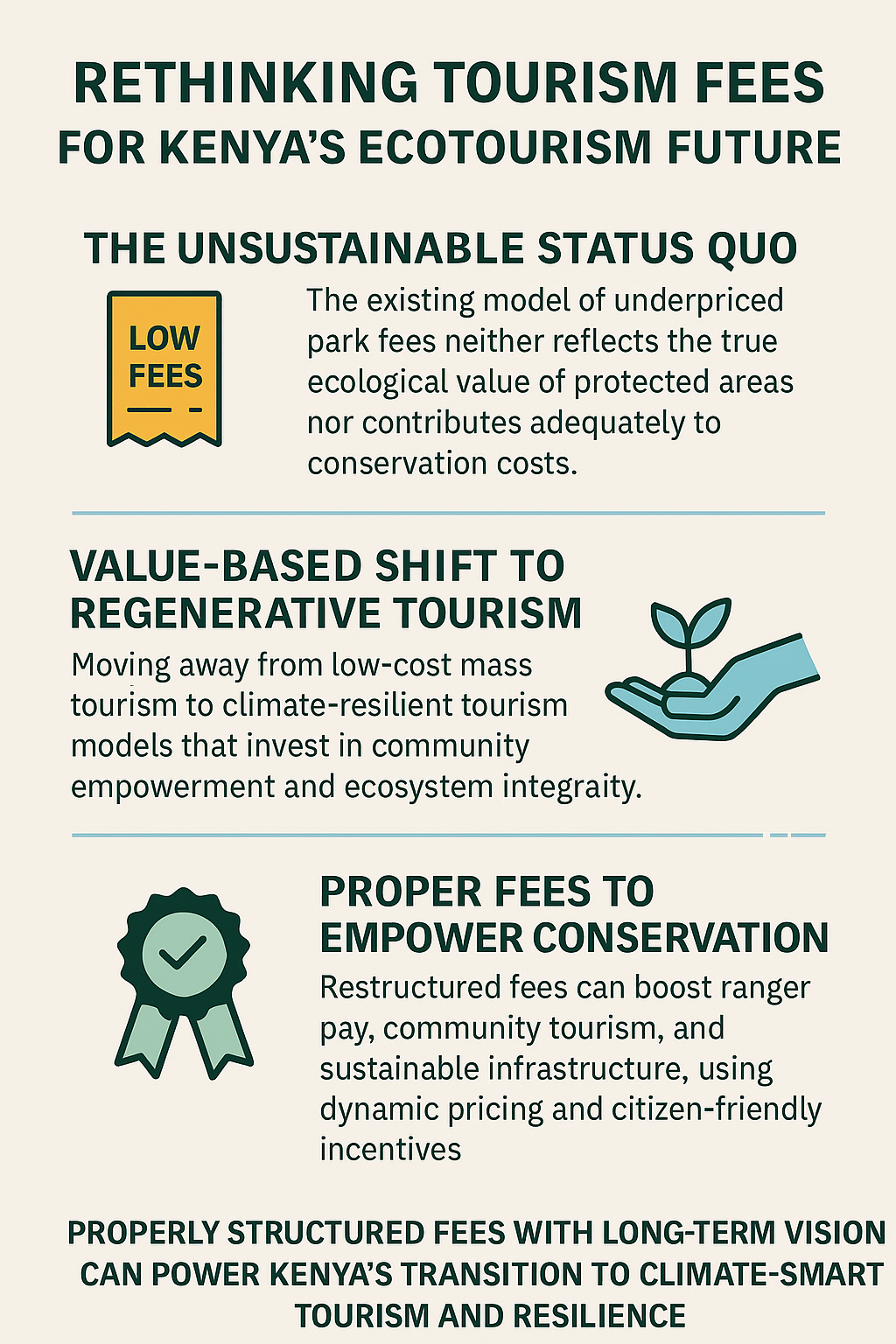
Kenya’s tourism sector is embroiled in a polarizing debate over the proposed increase in park entry fees by the Kenya Wildlife Service (KWS)—a move that has triggered pushback from parts of the tourism industry. Critics argue that the price hike could drive tourists away and stall the sector’s fragile post-COVID recovery. But that narrative, while convenient, masks a more urgent reality: our current tourism pricing model is fundamentally unsustainable. Kenya’s parks remain globally underpriced, with outdated fee structures that neither reflect the ecological value of protected areas nor contribute meaningfully to the conservation costs borne by the country. The research-backed push for value-based pricing is not just about economics—it’s about survival. A model dependent on cheap mass tourism ultimately risks collapsing under the weight of its own footprint, undercutting the very landscapes and wildlife it profits from.

Behind this pricing debate is a much bigger question: what kind of tourism future does Kenya want? Thought leaders like Prof. Bitange Ndemo have laid out a compelling vision for a shift away from extractive tourism that prioritizes volume, to regenerative tourism anchored in climate resilience, community empowerment, and ecosystem integrity. That means investing in tourism models that diversify products—like cultural tourism, eco-lodges, digital nomad experiences, and heritage circuits—that share value beyond the traditional safari elite. It also means linking fees directly to visible benefits: better ranger pay, stronger community tourism projects, and infrastructure that supports conservation rather than compromises it. The government’s failure to transparently communicate how increased revenue would be reinvested only feeds public skepticism, but that shouldn’t be used to stall reform altogether. If anything, it’s a call for better governance—not retreat.

The real danger isn’t raising fees—it’s failing to raise the bar. Kenya sits on the cusp of becoming a global model for climate-smart tourism, but that future will not be built on subsidized access and status quo politics. Properly structured fees—coupled with dynamic pricing, seasonal packages, and citizen-friendly incentives—can empower conservation without excluding access. The goal is not to gatekeep Kenya’s beauty, but to protect it with intention and long-term vision. Every tourist who visits our parks should not just be a guest but a contributor to a shared legacy of resilience. That’s the story Kenya should be telling the world—and charging fairly for.

References:

MDPI Re-Imagining Heritage Tourism in Post-COVID Sub-Saharan Africa: Local Stakeholders’ Perspectives and Future Directions

Travel Weekly Weighing the pros and cons of Kenya’s proposed safari park fee increase

The Journal of African Policy Studies Sustainable Tourism in Kenya: An Analysis of Tourism Policy Currently Under Consideration

EAC Tourism and Wildlife Management


Conservation Challenges in Kenya’s Maasai Mara Region

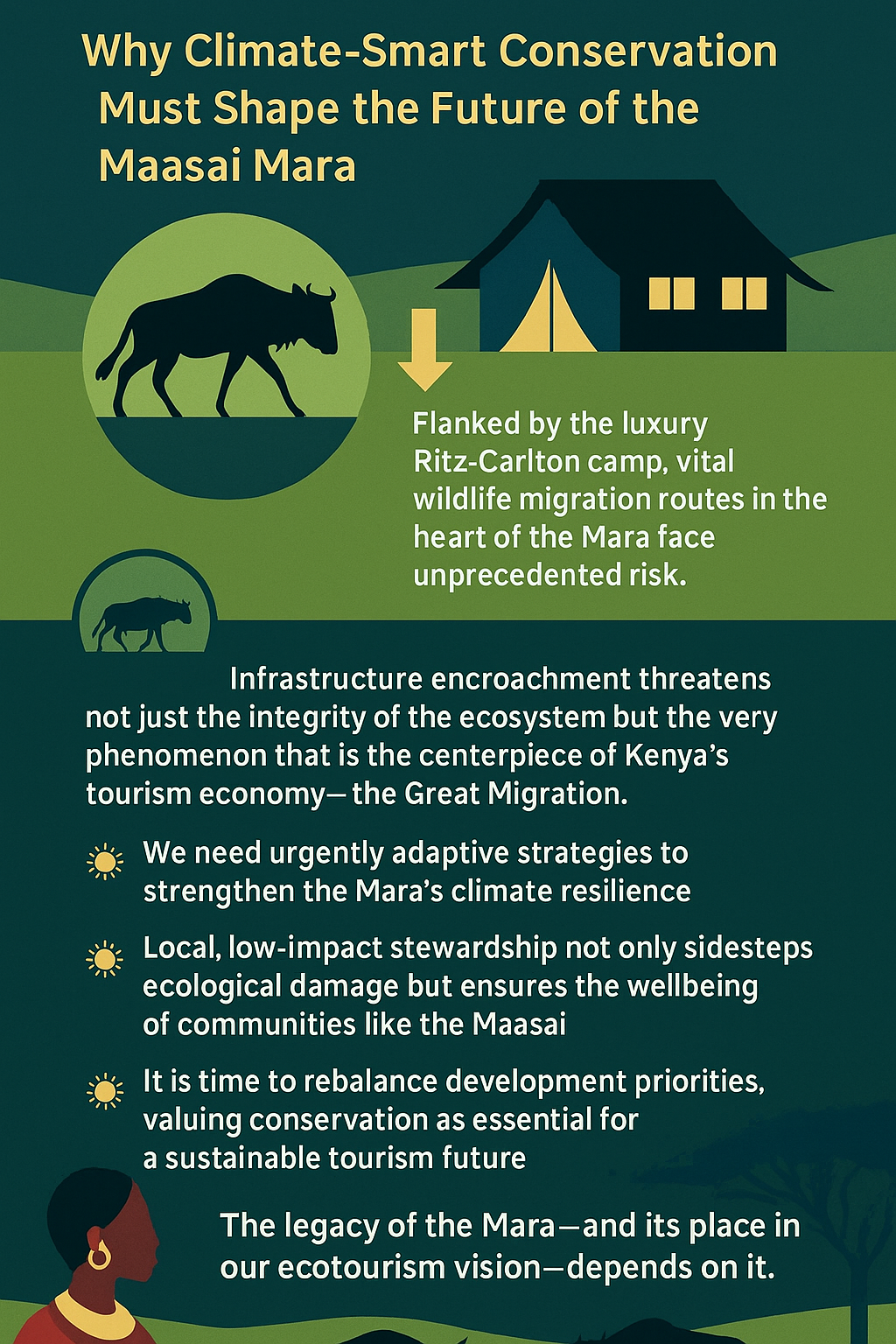
The Maasai Mara, one of the last remaining wild frontiers of Africa’s Great Migration and a cornerstone of Kenya’s ecotourism economy, now faces one of the gravest threats in its recent history—not from drought, poaching, or climate change alone, but from unchecked commercial expansion. A controversial plan to construct a high-end hotel complex and convention centre within the fragile Pardamat Conservation Area has triggered fierce opposition from environmental experts, conservancy leaders, tourism stakeholders, and sections of the local Maasai community. The development, backed by county government actors and private investors, was initially celebrated as a boost to job creation and conference tourism. But critics warn it could irreversibly damage the very ecosystem that draws visitors—and revenue—to the region.

At the heart of the concern is the ecological fragility of the Pardamat area, a critical corridor for wildebeest, elephants, and other migratory species. The proposed construction site borders sensitive wildlife routes and overlaps with communal land managed under an innovative conservation model that merges livestock grazing with wildlife protection. Experts argue that the scale and permanence of such infrastructure threaten to fragment habitat, displace species, and compromise the authenticity of the Mara’s wilderness appeal. Already, irregular land sales, fencing, and proliferation of unregulated camps have altered key migratory paths—choking the ecosystem and undermining decades of community-led conservation gains.

What the Mara needs is not another luxury venue, but a decisive pivot toward climate-smart, community-anchored ecotourism. This means planning developments in harmony with nature, prioritizing low-impact, mobile tourism models, and bolstering scientific land-use policies that preserve migratory corridors and biodiversity integrity. Kenya’s international tourism reputation—and its ability to withstand climate volatility—depends on how well we defend and innovate around natural heritage sites like the Mara. The future must be shaped not by profit margins alone, but by policies rooted in ecological wisdom, community ownership, and a long-term vision for a resilient, inclusive conservation economy.

References:

Spa Opportunities Marriott to open luxury safari camps in Kenya under JW Marriott and Ritz-Carlton brands, with architecture by LW Design

The Star Narok county defends Ritz-Carlton Safari Camp amid conservation criticism

The Standard County contests claims that new safari camp is obstructing wildlife

The Ritz Carlton The Ritz-Carlton, Masai Mara Safari Camp

Lake Nakuru’s New Waters: From Flamingo Spectacle to Tourism Uncertainty

Lake Nakuru, once Kenya’s unrivaled icon of flamingo tourism and a UNESCO World Heritage Site, is undergoing an environmental transformation that is quietly redefining its future. The dramatic shift from a shallow, alkaline soda lake to a swelling freshwater body—driven by climate change, deforestation, urban runoff, and persistent pollution—has reshaped not just the lake’s ecology, but also its economic and cultural purpose. Once celebrated as the “Lake of a Million Flamingos,” the site now faces a tourism identity crisis as its signature attraction—the vibrant flocks of Lesser Flamingos—has largely vanished due to the disappearance of Spirulina platensis, the algae they feed on. This ecological transition is not a fleeting anomaly; it signals a long-term reset, potentially stripping Kenya of one of its most iconic natural tourism assets.

The implications for Kenya’s tourism economy are profound. Flamingo migration has dealt a blow to the local hospitality industry, with ripple effects felt from Nakuru to Elementaita and Naivasha. The park’s submerged infrastructure—gates, roads, and buildings—has necessitated a KSh 38 million investment in repairs and relocation, eating into Kenya Wildlife Service’s already stretched budget. Yet amid this disruption, opportunity glimmers. Kenya has a chance to reframe Lake Nakuru not as a site of lost heritage, but as a blueprint for adaptive, resilient tourism in the age of climate change. KWS has already introduced new water-compatible experiences, including adjusted game-viewing routes and potential boating attractions. With careful investment, storytelling, and conservation marketing, this shift can usher in a new kind of eco-tourism centered on freshwater biodiversity, migratory birds, and climate adaptation success stories.

But realizing this vision demands urgency, strategy, and inclusivity. Conservation and tourism authorities must actively engage displaced communities, whose turn to illegal fishing underscores a deeper social fragility tied to the lake’s changes. Tourism policy must evolve to support heritage resilience—protecting UNESCO designation through scientific reinterpretation of the site’s ecological value, not just nostalgia for what it once was. Lake Nakuru stands at the frontline of global climate impact on natural heritage. If Kenya can lead the world in repurposing this park’s brand while safeguarding its ecosystems and communities, it won’t just save a destination—it will create a model for climate-smart tourism across Africa and beyond.

References:

Scientific Research Assessment of Spatial Expansion of Rift Valley Lakes Using Satellite Data

The Standard State of three Rift Valley Lakes worry experts

Talk Africa Lake Nakuru’s Water levels Expected to Cause More Havoc During The Rainy Season, Experts Say  

Jijuze Is Lake Nakuru’s Ecosystem at Risk Due to Pollution and Illegal Fishing?

Aftershock: The Collateral Damage of USAID’s Exit from Kenya

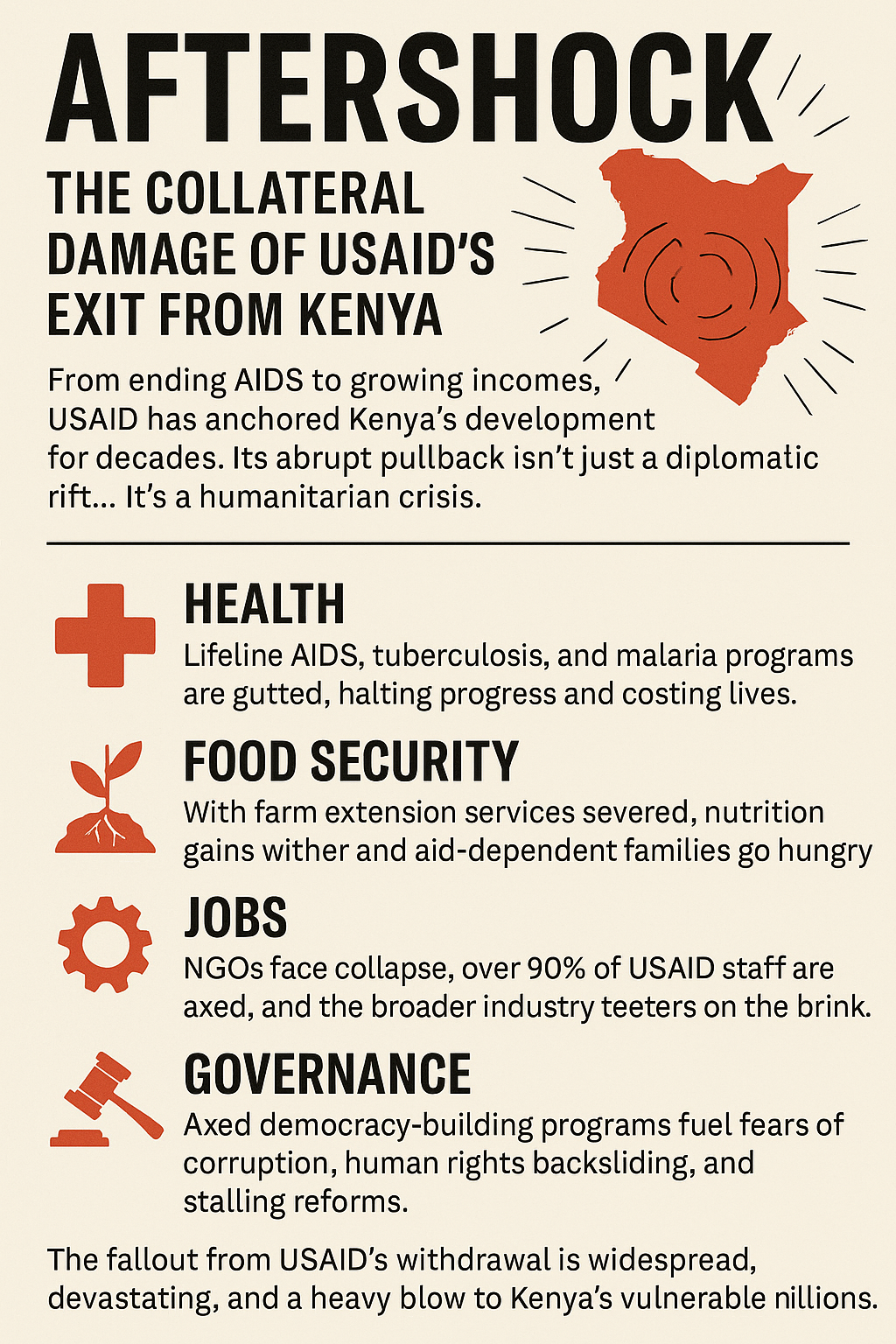
The abrupt dissolution of USAID, catalyzed by the U.S. government’s sweeping “America First” foreign aid policy pivot, has left Kenya reeling from a vacuum of support once critical to its public health, agriculture, and economic systems. With over $2.5 billion in planned investments between 2020 and 2025, the agency was more than just a donor—it was woven into the fabric of Kenyan service delivery. The termination of 83% of USAID’s programs and the layoff of 94% of its staff effectively ended over six decades of robust U.S. development engagement. For Kenya, this rupture came without a viable transitional plan. Clinics shuttered, medicines vanished, and 40,000 jobs tied to health services evaporated. Programs such as PEPFAR, which had sustained over a million Kenyans on antiretroviral treatment, have been gutted, with HIV/AIDS funding slashed from $846M in 2023 to just $66M in 2025. Maternal health, malaria prevention, and reproductive health services now teeter at the edge of collapse, with service cuts exceeding 90% in some areas. Kenya’s health infrastructure, already strained, is now buckling under a loss that is not merely financial—but fatal.

The economic blowback extends far beyond healthcare. USAID had supported Kenya’s agriculture sector through subsidies, training, and innovation, all now dismantled. Smallholder farmers are especially vulnerable. With the termination of the Famine Early Warning Systems Network (FEWS NET) after four decades of operation, Kenya has lost its primary mechanism for forecasting and responding to food insecurity. Meanwhile, tax reforms in the proposed 2025 Finance Bill—removing VAT exemptions on farm inputs and raising fuel duties—compound the crisis, inflating production costs and shrinking rural margins. The convergence of aid withdrawal, policy shocks, and climate threats is deepening food insecurity and threatening to reverse years of agricultural gains. Simultaneously, the Kenyan startup ecosystem and governance reform sectors face a projected $100 million funding shortfall. Civil society actors, often powered by USAID support, now risk losing their watchdog capacity. In areas such as conflict prevention and refugee education, where USAID once acted as a stabilizing force, the vacuum could be exploited by extremist recruiters, echoing conflict patterns seen in past aid shock cases in West Africa.

Kenya’s response has been urgent but encumbered. The government has committed to repatriating its health data from U.S.-hosted systems and shifting toward local infrastructure, yet faces severe capacity shortfalls. The fiscal strain is formidable: a KSh 52 billion health budget hole and a broader KSh 66.9 billion gap across affected sectors. While the Bottom-Up Economic Transformation Agenda (BETA) reflects ambition for self-reliance through tax reforms and private investment, execution remains constrained by weak systems and widespread corruption. Still, civil society and policymakers are beginning to reframe the crisis as a wake-up call for domestic revenue mobilization and governance renewal. If there is a path forward, it lies in converting dependency into resilience—not just by replacing funding streams, but by rethinking national priorities, protecting human capital, and investing in sovereign, accountable systems that can withstand future geopolitical shocks.

References:

Citizen Digital Over 40,000 Kenyans jobless after USAID-funded health facilities shut down

The Voice of Africa USAID Shuts Down After 63 Years, Leaving Africa in Crisis

The Star Civil society calls for self-reliance as foreign aid dwindles

Africa.com Kenya to Reclaim Health Data After Trump Administration’s USAID Cuts

Jijuze Kenya Faces Crisis After USAID Funding Withdrawal

Capital Business USAID funding halt to hit Kenya’s economy, social sectors – report

Audit vs. Austerity: The IMF’s Role in Kenya’s Recovery

Kenya is on the edge of a pivotal financial reckoning. In the wake of the 2024 Finance Bill’s withdrawal and amid a battered economy, the International Monetary Fund (IMF) has demanded a sweeping corruption audit before any further disbursement of financial aid. At stake is more than KSh 100 billion in support tied to Kenya’s Extended Fund Facility, Extended Credit Facility, and Resilience and Sustainability Facility—aid that could help stabilize an economy reeling from debt, inflation, and political distractions. The collapse of the 2024 Finance Bill, triggered by nationwide protests over tax hikes, left a gaping fiscal hole. Now, the IMF wants answers before money moves. Between June 16 and 30, a Governance Diagnostic mission wrapped up in Nairobi. While Treasury insists the audit is not a precondition for funding, international observers say its findings will heavily influence future negotiations. The IMF has drawn a clear line: no serious anti-corruption reforms, no fresh credit.

IMF Demands corruption audit on Kenya

The Kenyan public feels the consequences every day. For ordinary wananchi, the stalled billions aren’t just digits on a spreadsheet—they represent hospital beds without medicine, classrooms without books, roads that end in dust, and a tax burden growing heavier on already strained shoulders. Years of unchecked corruption have gutted public institutions, forcing citizens to pay more for less while a well-connected elite evades accountability. The protests of June 2024 were not merely about a finance bill—they were about a social contract broken. Corruption doesn’t just steal money; it steals opportunity, trust, and dignity. It pushes more families below the poverty line and leaves critical sectors like education and healthcare in permanent crisis. Every act of embezzlement is a tax on hope. And now, Kenya must confront that cost head-on.

Yet as this economic standoff unfolds, the political class seems to be campaigning rather than governing. With two years until the 2027 general elections, the air is already thick with premature rallies and succession battles. This relentless politicking is not just tone-deaf—it undermines policy coherence and economic recovery. Critics argue that Kenya risks squandering a historic opportunity to reset its governance priorities. The IMF’s demand for a corruption audit is not just a bureaucratic checkbox; it is a test of political will. Whether the government embraces or evades the findings of the Governance Diagnostic will speak volumes. Kenya is at a crossroads. What lies ahead will depend on whether its leaders prioritize reform over rhetoric, the public over politics, and accountability over access to short-term cash. The world is watching. But more importantly, Kenyans are waiting.

References:

Mariblock Kenya fails IMF review, forfeits $850M disbursement

International Monetary Fund IMF Staff Completes Governance Diagnostic Mission to Kenya

Transparency International – Kenya Debate on Kenya’s economy must include a cure to the endemic corruption

The Standard Bitter IMF austerity pill return overshadows budget unveiling

The Standard Why IMF is demanding corruption audit on Kenya


Impact of Kenya’s Toxic Chemical Policy on Farmers and Exports

Kenya’s 2025 pesticide ban is more than a policy shift—it’s an overdue confrontation with dangerous agrochemical practices that have long gone unchecked. At the heart of the crackdown is Mancozeb, a fungicide so entrenched in Kenyan agriculture that it’s sprayed like water on tomatoes, potatoes, and maize. Yet this widely used chemical breaks down into ethylene thiourea (ETU)—a probable human carcinogen linked to thyroid harm and reproductive toxicity. Mancozeb has already been banned across the European Union and flagged by multiple global health authorities, but until now, it continued to flow into Kenyan markets with barely a check. Now, alongside Mancozeb, Kenya has also moved to restrict or suspend other hazardous products including chlorpyrifos, acephate, glyphosate, and dimethoate—compounds associated with cancer risks, neurotoxicity, endocrine disruption, and acute poisoning in both humans and animals. In withdrawing 77 toxic products and tightening rules on 202 more, the government is finally rejecting the toxic trade imbalance that treats African countries as chemical dumping grounds. The new policy aligns Kenyan regulation with international best practice: no pesticide can be registered here unless it’s also legal in its country of origin and in developed economies like the EU, USA, Canada, or Australia. It’s a turning point—but not without blowback.

A Report by K24TV

For years, Mancozeb symbolized Kenya’s regulatory inertia: cheap, accessible, and unchallenged despite the mounting science against it. Farmers, often unaware of its dangers, sprayed it without masks or gloves, storing the residues in their homes, their soil, and their food. Chlorpyrifos, a widely used insecticide linked to developmental harm in children, and glyphosate, a herbicide under global scrutiny for carcinogenicity, have followed similar trajectories—popular with farmers but flagged by scientists and health agencies. Now, the state faces a high-stakes transition. Smallholders reliant on these chemicals are being urged toward Integrated Pest Management (IPM) and agroecological alternatives. Yet less than 10% of Kenyan farmers use biopesticides, and most lack training, equipment, or trust in new inputs. The Pest Control Products Board, emboldened by fresh legislation, is finally flexing its oversight powers. But enforcement remains patchy, and counterfeit products exploit the regulatory vacuum. Mancozeb isn’t just a pesticide—it’s a case study in how economic expediency once overrode health and environmental responsibility. That era, Kenya now claims, is ending.

Timing is crucial. The EU is cracking down on residue limits. Kenya’s vegetable exports—once worth KSh 100 billion—have already taken a hit. If the country wants to stay competitive and credible, aligning with global safety standards is not optional. Mancozeb’s fall is both symbolic and strategic: it’s a warning to other harmful substances still in circulation—like profenofos, carbendazim, and triazophos—and a test of whether Kenya can enforce its own reform. This is where political will must hold—beyond press briefings and regulatory memos. Farmers need practical support. Consumers need transparency. And regulators must resist the pressure of well-funded pesticide lobbies looking to reverse course. Kenya has declared its direction. Now the country must walk it—with clarity, speed, and resolve—before the next generation pays the price in poisoned soil, sickened bodies, and lost trade.

References:

Trade World News Kenya Bans Import of 50 Pesticide Brands for Safer Farming

The Standard State cracks down on harmful pesticides, bans 77 products

The Star Civil society demand full disclosure of banned pesticides, calls for safer agricultural reforms

The Star 77 pesticides banned in Kenya as 202 others restricted – CS Kagwe

Kenya News Agency State urged to make to make public list of banned pesticides

Kenyans.co.ke Kenya Bans Use of Pesticides Not Approved in Europe, USA, Canada & Australia

A Dose Too Late: Kenya’s Vaccine Shortage Risks a Generational Health Collapse

As of mid-2025, Kenya is teetering on the brink of a devastating public health collapse driven by severe vaccine shortages. With 12 counties having completely run out of critical vaccines such as BCG, polio, and rotavirus, the government’s assurance that “no child will miss a dose” stands at odds with harsh ground realities. This is not just a failure of procurement; it is a breakdown of the entire immunization ecosystem—from poor cold chain infrastructure and inadequate forecasting to chronic delays in budget disbursement and transportation shortfalls. Border regions and refugee camps like Dadaab and Kakuma are hardest hit, with near-zero stock levels and rising numbers of zero-dose children. The threat of disease resurgence is no longer hypothetical: polio cases have already been confirmed in Garissa, and a major measles outbreak is underway in Turkana. These are not just statistics. They are warnings of a long-term developmental regression that, if ignored, will haunt the nation for decades.

A Report by NTV Kenya

The implications of this vaccine crisis stretch far beyond public health clinics. Vaccines are a cornerstone of Kenya’s investment in its human capital. Every child who misses their immunization schedule increases the nation’s future healthcare burden and diminishes productivity potential. When children fall ill or die from preventable diseases, families spiral into poverty, and entire communities are destabilized. The social contract that underpins Kenya’s National Safety Net Program—which aims to protect the most vulnerable—is severely undermined when children, citizens or not, cannot access lifesaving interventions. Refugees, nomadic populations, and residents of arid and semi-arid lands are disproportionately affected, exacerbating inequality and fostering mistrust in state institutions. In practical terms, this also undermines peace-building efforts in volatile regions. Failing to vaccinate every child—regardless of their citizenship status—is not just a moral failure; it is a strategic one.

This crisis must jolt the government and its international partners into urgent, coordinated action. Kenya has outlined promising frameworks, including the Kenya Health Emergency Preparedness, Response and Resilience Project (KHEPRR) and plans for a Strategic Vaccine Reserve. But ambition alone is not enough. These initiatives must be fully financed, properly managed, and transparently implemented. The Shirika Plan, which aims to integrate refugee populations and reduce aid dependency, must also prioritize health equity—not just infrastructure. Kenya’s development goals under Vision 2030, including universal health coverage, depend on this. International precedent shows that nations that fail to maintain routine immunization lose decades of progress in mere months during outbreaks. Kenya must act now to secure its population’s health and uphold its moral and constitutional duty to protect every child. This is no longer just about doses and syringes. It’s about defending the right to survive—and thrive—for generations to come.

References:

ReliefWeb Kenya: Vaccine Shortages Endanger Children’s Lives in Remote and Humanitarian Settings

Kenyans.co.ke Ministry of Health Announces Arrival of Polio and BCG Vaccines Amid Shortage

The Star MoH admits vaccine shortage amid global supply bottlenecks

Refugees International Aid cuts in Kenya will jeopardize years of progress for refugees.

Evaluating Kenya’s Affordable Housing Program: Benefits and Risks

Kenya’s Affordable Housing Programme (AHP) has been framed by the government as a historic solution to the nation’s urban housing deficit — a bold, transformative plan to put 250,000 new housing units into the hands of low- and middle-income earners each year. It’s the crown jewel of the Kenya Kwanza administration’s economic agenda, wrapped in promises of job creation, urban renewal, and dignity for the working class. But behind the polished press briefings and televised groundbreakings, the cracks are showing. Critics argue the housing levy — a mandatory deduction from all salaried workers — amounts to taxation without representation, especially when access to the houses is uncertain and the projected costs remain largely unaffordable for the very people funding them. Worse still, the rollout has sparked deep anxiety over forced evictions, unclear beneficiary selection processes, and the growing fear that without proper planning, these “affordable” units may become vertical slums stacked over broken infrastructure. For many Kenyans, the project feels less like a social contract and more like a speculative bet — one where the house always wins, and it’s not the public holding the keys.

A Report by Citizen Digital

The legal and structural questions around the housing project are mounting. In 2023, the High Court ruled parts of the Affordable Housing Act unconstitutional — particularly the centralized levy collection through the Kenya Revenue Authority, which bypassed public participation and legislative oversight. While the government quickly responded with legislative tweaks, the shadow of that ruling lingers. Public trust in housing delivery remains fragile, especially given Kenya’s history with failed or stalled housing programs and ghost estates like the infamous Nyayo House projects. Though the state touts the initiative as “inclusive,” it is heavily reliant on public-private partnerships where the private sector bears little risk, while taxpayers shoulder both the capital and the consequences. Key policy watchdogs argue that the financing model lacks transparency, and that the absence of social safeguards could lead to gentrification and displacement, particularly in areas like Mukuru, Kibera, and Mathare where informal settlements sit on prime land now targeted for redevelopment. The big risk? That homes built in the name of the poor end up benefiting civil servants, politicians, and private investors — not the mama mboga or jua kali artisan.

If Kenya’s affordable housing dream is to succeed, it must move beyond brick-and-mortar targets and confront the human realities of affordability, transparency, and equity. The price tags on many units still outpace the average urban worker’s income. The so-called “affordable” category often starts at KSh 1.5M — a figure out of reach for most informal sector workers who make up over 80% of Kenya’s labor force. Meanwhile, the digitized application and allocation model, while meant to enhance fairness, risks excluding those without access to mobile money, smartphones, or stable identification — particularly the urban poor it claims to prioritize. Additionally, new housing developments are outpacing investments in transport, sewerage, schools, and hospitals, raising fears that these estates will quickly deteriorate into overpopulated, under-serviced high-rises. The government must urgently clarify allocation policies, invest in supporting infrastructure, and put people — not politics — at the center of the housing agenda. Because if “affordable housing” becomes just another ambitious slogan without delivery, it won’t just fail to fix the housing crisis — it will deepen Kenya’s already fractured urban future.

References:

KBC Completed number of affordable housing units down by half

The Eastleigh Voice Govt raises affordable housing research budget to Sh2.8bn amid credibility concerns

Capital News Ruto says handing over Housing units the most consequential day of his political career.

NTV Who got Ruto Mukuru houses? Not us, residents now claim

Citizen Digital Vertical slums: How new crop of apartments in Kilimani, Kileleshwa is affecting Nairobi’s infrastructure

Fake Medicines Threaten Public Health in Kenya

Kenya’s pharmaceutical supply chain is facing a creeping, deadly crisis — one that’s quietly poisoning public trust in healthcare. In 2024 alone, over 30 different drug products were recalled in Kenya, more than doubling the previous year’s figure. This disturbing surge included contaminated pediatric syrups, mislabeled antibiotics, and packaging mix-ups between life-saving cancer drugs and common generics. Some of these were produced by global manufacturers with once-reputable names. The growing scale and severity of these incidents have exposed glaring weaknesses in regulatory enforcement, border control, and supply chain oversight. But beyond the headlines lies a darker story — fake and substandard medicines are no longer rare exceptions; they are becoming routine features in pharmacies, clinics, and even households. As treatment failures rise and drug resistance intensifies, trust in medicine itself is breaking down. Patients increasingly worry: if I walk into a pharmacy, how can I know what I’m buying won’t kill me?

A K24 Report from 2024

The regulator, the Pharmacy and Poisons Board (PPB), is overwhelmed. With just 16 inspectors tasked with overseeing a vast and evolving market — spanning over 10,000 retail outlets, mobile vendors, and now, an unregulated e-pharmacy explosion — enforcement efforts are falling behind. In 2024, the PPB shut down 117 illegal pharmacies, an important but ultimately symbolic move in the face of thousands more operating without licenses or pharmacist supervision. Online drug sales are the new front line. A study found that over 60% of Kenyan e-pharmacies sell restricted drugs like antibiotics and sedatives without prescriptions, bypassing safeguards entirely. These platforms, often disguised as Instagram shops, WhatsApp-based vendors, or websites with fake credentials, target desperate buyers looking for cheap, fast relief. With little digital verification, no pharmacist involvement, and no legal framework to manage or penalize them, the risk of mass harm is escalating. Meanwhile, legitimate pharmacies face the fallout: eroded consumer confidence, a rise in self-medication, and unfair competition from black-market sellers. At the center of it all is a poorly resourced regulator trapped in a battle it cannot win with its current tools.

Fixing this won’t come from a few more closures or stern warnings. What’s needed is a total overhaul of pharmaceutical regulation and public health literacy. The PPB needs financial and legal independence, an expanded workforce, and modern tools — including barcode authentication, blockchain-backed tracking systems, and real-time reporting dashboards for drug recalls and falsifications. E-pharmacies must be brought under legal oversight immediately, with criminal penalties for non-compliant platforms. Consumer protection should no longer be passive; the government must launch aggressive national awareness campaigns to teach people how to identify fake drugs, report suspicious sources, and verify prescriptions. Crucially, Kenya must repair public trust — not just in the pills on pharmacy shelves, but in the very systems meant to safeguard their health. Because when faith in medicine collapses, people don’t stop getting sick — they just stop getting help. This is more than a regulatory failure. It’s a national health emergency — and one that cannot be ignored.

References:

The Eastleigh Voice Inside Kenya’s battle against fake and unsafe medicines

Eurek Alert Curbing harmful medicines: the promise of a unified African health products regulatory system

OECD Dangerous Fakes