💰 KSh 2,500 Fertilizer: How to Bypass the Queues and Get Your Share
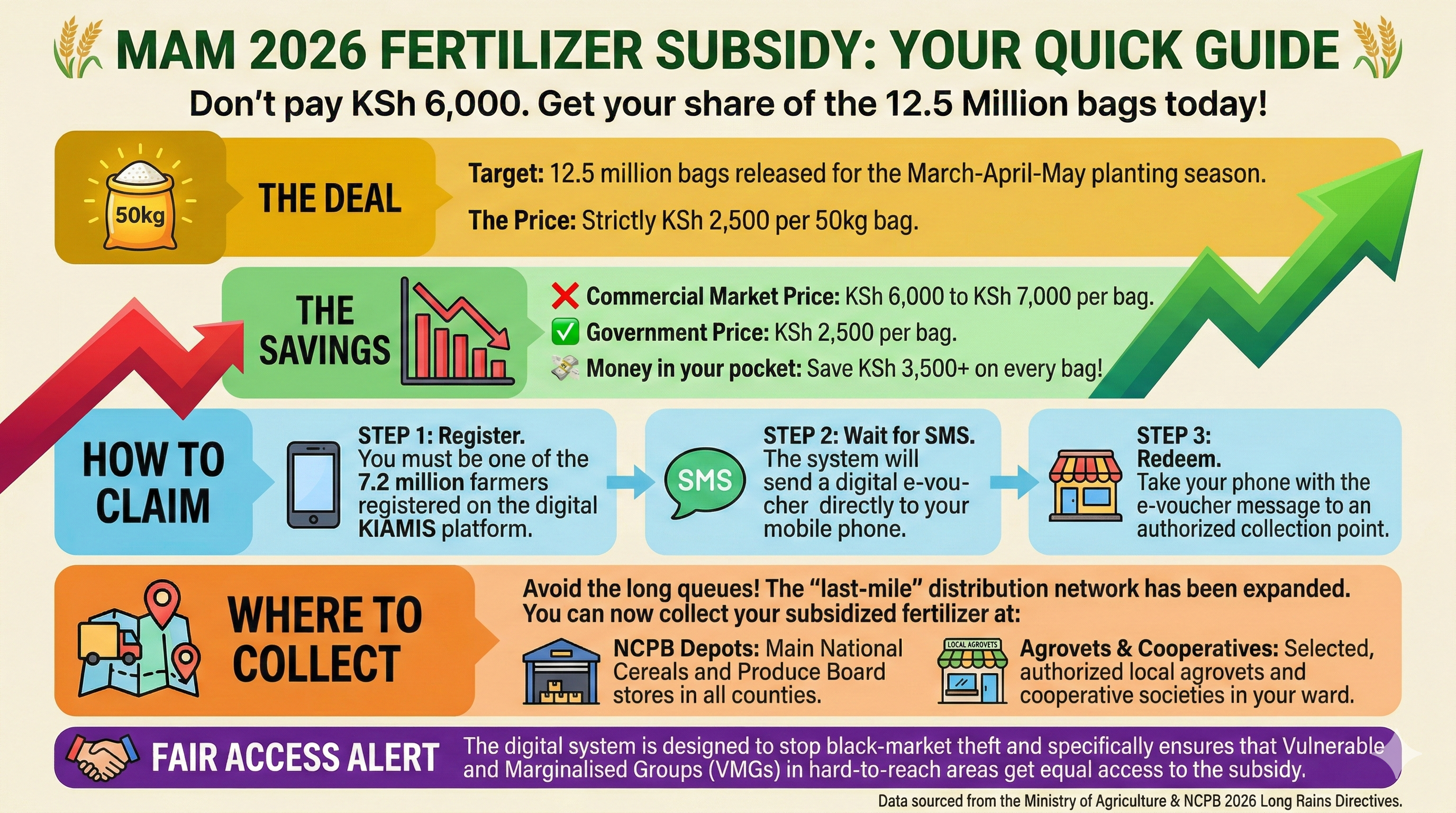
The government has released 12.5 million bags of subsidized fertilizer for the 2026 Long Rains, capping the price at KSh 2,500 per bag (down from market rates of KSh 6,000+).
The Catch? You Must Be Digital. Gone are the days of just showing up at the NCPB.
Register: Ensure you are listed on the KIAMIS (Kenya Integrated Agricultural Management Information System) platform.
Wait for the SMS: You will receive an e-voucher on your phone.
Collect: Go to your nearest NCPB depot or registered agro-vet agent.
References:
Streamline Operation Long Rains: State Floods Market with 12.5 Million Bags of Subsidized Fertilizer
Ratin Agriculture Ministry Flags Off Major Fertiliser Distribution to Strengthen Food Security
In the quiet, fog-drenched highlands of Nyamira County lies Kenyamware, a place where the morning air is so sharp it feels like a physical presence. As the sun struggles to pierce through the thick white veil of the “Nyamira cold,” the day begins with the rhythmic sound of the Gucha River—the county’s longest waterway, stretching nearly 150km before eventually feeding the vast basin of Lake Victoria. Standing here, you realize that this river isn’t just a scenic backdrop; it is the primary lifeblood of the Gusii highlands, carving a path through the heart of a community that has mastered the art of survival along its winding banks.
A Jijuze Eco-Tour in Kenyamware, Nyamira County, Kenya.
Along these very banks, the Gucha’s water fuels a bustling corridor of small-scale, artisanal industries that represent the backbone of the region’s manual economy. Kenyamware serves as a micro-industrial hub where the scent of fresh sawdust from local lumbering sites mingles with the earthy aroma of wet clay from the nearby brick-making kilns. Rather than massive factories, this is an economy of the hands—a decentralized network of producers transforming the river’s silt and the highland timber into the literal building blocks for the ongoing construction boom in Nyamira and beyond.
As the fog finally retreats to reveal a landscape painted in hues of gold and amber, it becomes clear that Kenyamware holds a profound, untapped beauty. It is a moment of stillness that captures the essence of the Jijuze spirit: finding the extraordinary in the everyday. However, for these hidden gems to truly thrive, we must bridge the gap between this rural charm and the global traveler through a stronger uptake of local and international tourism on modern e-platforms. By putting places like Kenyamware on the digital map, we ensure that Nyamira’s quiet power isn’t just witnessed by the few, but celebrated by the many.
🌱 Stop! Don’t Bury Your Money: The Seeds That Will Survive the 2026 “Insignificant Rains”
Farmers in Arid and Semi-Arid Lands (ASALs) are walking a tightrope. With the Met Department warning of “intermittent dry spells” and poor distribution, planting standard 6-month maize is a gamble you will likely lose.
The “Smart Farm” Swap:
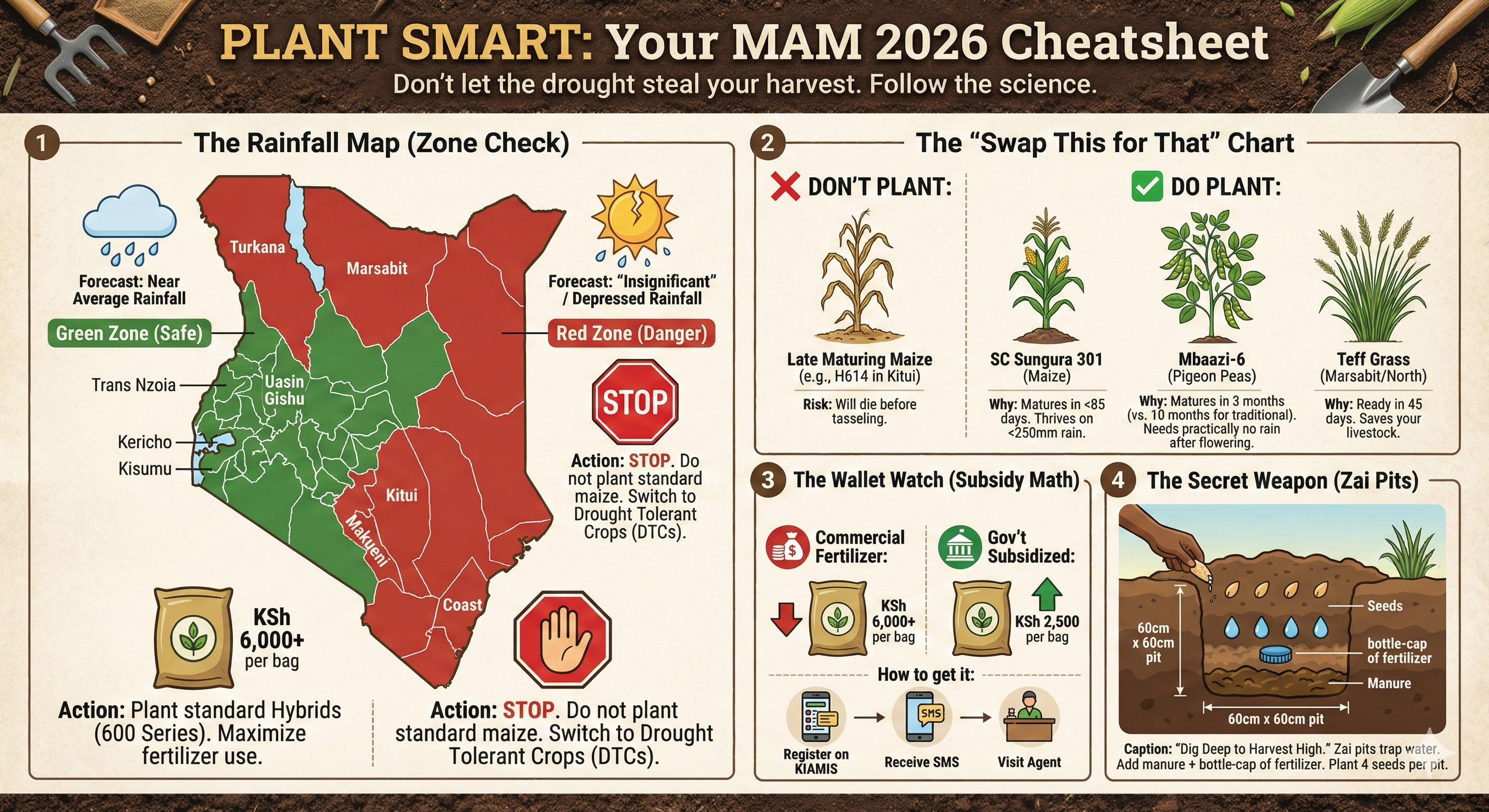
Swap H614 for SC Sungura 301: If you must plant maize, use ultra-early varieties. SC Sungura 301 matures in just 75-85 days and thrives on less than 250mm of rain.
Swap Beans for Mbaazi-6: Traditional pigeon peas take 10 months. The new Mbaazi-6 variety from KALRO is ready in under 3 months. It needs rain only during flowering; after that, it uses deep roots to survive the heat.
Check Dryland Varieties: Look for the DH Series (DH04, DH08) which are specifically bred for these conditions.
References:
Farm Biz Africa Crops that can reach harvest in 2024’s dry short rains
KALRO Climate Smart Agricultural Technologies,Innovations and Management Practices for Green Gram Value Chain
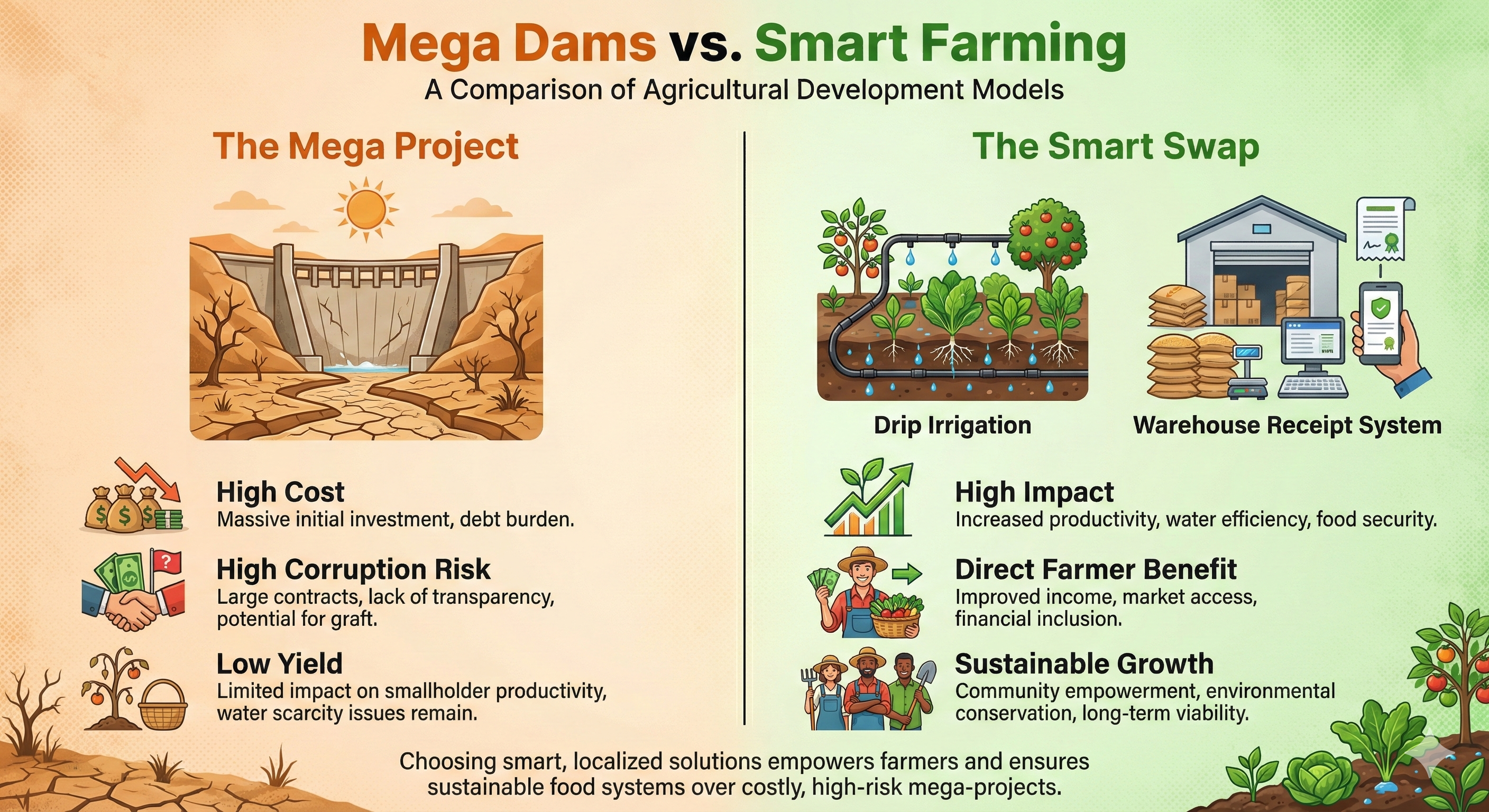
As the government targets 2 million acres for irrigation under the new debt swap initiative, the ghost of the Galana Kulalu project looms large. Just days ago, on January 26, 2026, the government announced plans for six new mega dams, signaling a return to the large-scale infrastructure strategy that failed so spectacularly in 2014. The original Galana Kulalu pilot consumed Sh7 billion to produce maize at costs higher than market price, collapsing under poor planning and corruption. Critics argue that repeating this “big dam” strategy ignores the hard-learned lessons of the past.
The disconnect is palpable. While the state plans mega-projects in arid lands, small-scale farmers—who produce the bulk of Kenya’s food—are struggling with basic input costs and lack of market access. The “savings” from the debt swap would likely yield higher returns if invested in decentralized solutions: household water pans, small-scale drip irrigation kits, and the Warehouse Receipt System (WRS) to help farmers store grain and avoid price exploitation by middlemen.
If the Sh129 billion is poured into another series of mega-dams, the funds risk being absorbed by contractors and consultants, leaving the country with more debt and no food. The success of this swap depends on shifting focus from concrete structures to the actual economics of farming—lowering production costs and ensuring profitability. Without this shift, we are merely “mixing oil and water” again, hoping that high-finance infrastructure will somehow trickle down to the grassroots.
References:
Capital Business Govt plans six mega dams, targets 2mn acres in irrigation push
The Star Government plans six mega dams, targets 2 million acres for irrigation push
🌦️ Wet West, Dry East: Why One Strategy Won’t Work for All in MAM 2026
The Kenya Meteorological Department (KMD) has dropped its forecast for the March-April-May (MAM) long rains, and it paints a picture of two very different planting seasons.
The Good News: If you are in the Highlands West of the Rift (Trans Nzoia, Uasin Gishu, Kericho) or the Lake Victoria Basin, get your tractors ready. The forecast predicts near-average to above-average rainfall. This is the green light for high-yield maize farming.
The Warning: For farmers in the Southeastern Lowlands (Kitui, Makueni), Northeastern, and the Coast, the forecast is tough. You are facing “near-average to below-average” rainfall, with a high chance of insignificant rains—meaning showers that wet the dust but don’t sustain a crop.
The Takeaway: Don’t copy your neighbor in Eldoret if you live in Machakos. The government is urging everyone to plant, but what you plant matters more than ever.
West: Go for maximum yield (600 series maize).
East/North: Go for survival (fast-maturing crops).
References:
Nairobi Leo Kenya Met Issues March-May 2026 Long Rains Forecast
Daily Nation End of drought in sight, but coming rains will be insignificant for arid regions
All Africa Above-Average Rains Expected in Key Regions, Weatherman Warns of Dry Spells Elsewhere
 Jijuze