Harvesting the ROI—The Macroeconomic Impact of the Subsidy

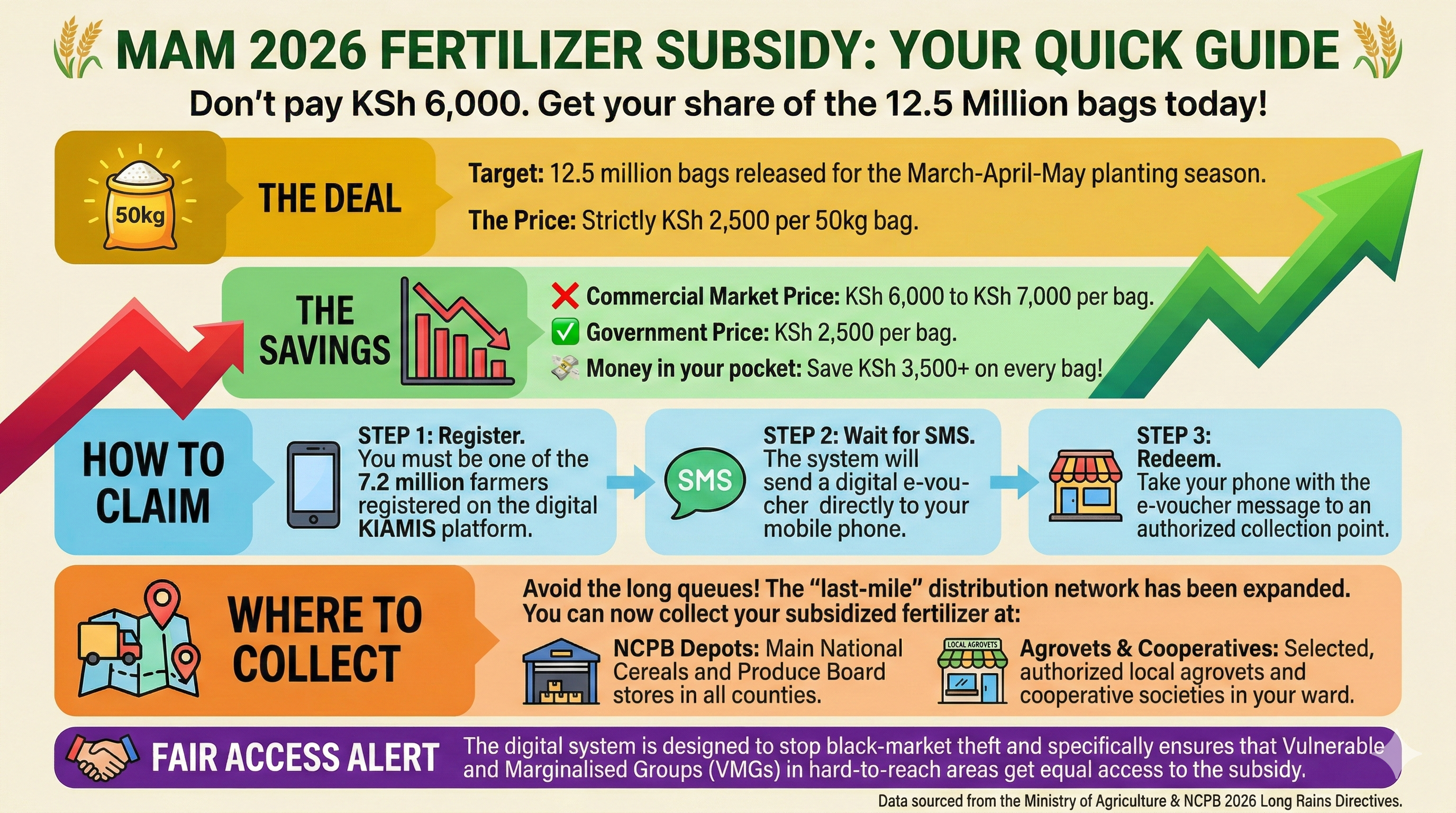
The economic ripple effects of the 2025 fertilizer subsidy program are beginning to manifest in Kenya’s national food security metrics with startling clarity. According to the June 2025 Treasury budget highlights, the government has allocated Ksh 8 billion specifically for the Fertilizer Subsidy Programme for the 2025/2026 financial year. This is part of a broader Ksh 47.6 billion agricultural transformation budget aimed at moving Kenya from a “food deficit” nation to a “food surplus” economy. By slashing the cost of a 50kg bag by approximately 60% compared to market rates, the program has successfully triggered a 38.9% increase in maize production in high-potential regions, directly contributing to the stabilization of mealie-meal prices in urban centers like Nakuru and Nairobi.

Kenya is set to harvest 70 million bags of maize in 2025 | NTV Kenya

However, the 2025 policy is no longer just about quantity; it is increasingly about soil health and long-term sustainability. New directives from the Ministry of Agriculture emphasize the use of NPK 23:23:0 and other non-acidic blends to correct soil degradation caused by years of over-relying on DAP. This scientific approach ensures that the “bumper harvests” seen this year are not a one-time fluke but the beginning of a sustained increase in yield per hectare. For the Kenyan farmer, this shift represents a move toward “Precision Agriculture,” where the digital data collected during KIAMIS registration helps the government determine which specific nutrient blends are needed for which regions, potentially saving billions in wasted inputs.

The final piece of this economic puzzle lies in the integration of “De-Risking” strategies. For the first time, the 2025 digital registration automatically links farmers to climate-risk insurance and credit facilities. This means that a farmer who buys subsidized fertilizer is also protected against the devastating losses of drought or floods, making the entire agricultural sector more attractive to young “agri-preneurs.” As Jijuze continues to monitor these developments, it is clear that the fertilizer subsidy is the anchor of a much larger economic engine. By empowering smallholders with affordable inputs and digital tools, Kenya is slowly rebuilding its agricultural backbone, turning the “kabambe” phone into a powerful tool for national prosperity.

References:

Capital Business Maize harvest to hit 70mn bags in 2025, up from 67mn last year

The Kenyan Wall Street The Hidden Costs of Kenya’s Fertiliser Subsidy Model

Jijuze How to Access Subsidized Fertilizer in Kenya


The “Iron Circuit”—Solving the Last Mile Bottleneck

The logistical machinery behind the 2025 fertilizer subsidy has undergone a radical shift to solve the “depot bottleneck” that plagued previous seasons. In late March 2025, the Ministry of Agriculture, led by CS Mutahi Kagwe, confirmed a massive surge in distribution, moving over one million bags of fertilizer in a single week to meet the high demand of the long rain season. The strategic change this year involves a heavy reliance on the “Iron Circuit”—using the Standard Gauge Railway (SGR) freight wagons to bypass the congested Port of Mombasa and deliver directly to the Naivasha Inland Container Depot. This shift has significantly reduced the turnaround time for stocks, ensuring that once a farmer receives their e-voucher via the KIAMIS system, the physical bags are already staged at regional hubs rather than being stuck in highway transit.

The iron circuit

Despite these macro-logistical wins, the “Last Mile” remains the most significant challenge for the average Kenyan smallholder. Current research indicates that while private agro-dealers are usually within 6km of a farm, centralized NCPB depots are often an average of 18km away. To bridge this gap in 2025, the government has entered into critical Memorandums of Understanding (MoUs) with county governments like Uasin Gishu and Nakuru. These partnerships allow for the transfer of fertilizer from main regional hubs to smaller, county-run satellite depots. This decentralization strategy is designed to lower the “hidden costs” of the subsidy—specifically the high transport fees farmers previously paid to move 50kg bags across long distances, which often eroded the savings provided by the government-capped price of Ksh 2,500.

At the depot level, the 2025 experience is becoming increasingly automated, yet it requires farmer vigilance. The Ministry has introduced “Consignment-Based Framework Agreements,” allowing for a more diverse mix of fertilizers, including crop-specific blends for coffee and tea sectors, moving away from a “one-size-fits-all” approach. However, with high demand comes the risk of exploitation. Farmers are urged to verify their e-vouchers through the upgraded KIAMIS interface before making the journey to the depot to avoid “system-down” frustrations. Furthermore, officials have issued stern warnings against counterfeiters attempting to sell substandard mixtures in look-alike government packaging, reinforcing that legitimate subsidized stock is only available at registered NCPB or county-authorized sites.

References:

Citizen Digital Gov’t to issue over 1 million bags of subsidized fertilizer amid high demand

Kenyans.co.ke Govt to Distribute 1 Million Bags of Fertilizer to NCPB Depots Next Week After Shortage

Daily Nation Kagwe orders destruction of 25,518 bags of expired fertiliser

Jijuze How to Access Subsidized Fertilizer in Kenya

The Digital Gatekeeper—Decoding Kenya’s New Era of Fertilizer Distribution

The transition from traditional, manual fertilizer distribution to the Kenya Integrated Agriculture Management Information System (KIAMIS) represents one of the most significant shifts in the nation’s agricultural history. As of late 2025, the Ministry of Agriculture has officially taken full ownership of this digital registry, which now hosts data for over 7.1 million smallholder farmers. This digital “handshake” is no longer a mere pilot program but the mandatory gateway for anyone seeking to purchase subsidized DAP, NPK, or CAN fertilizer at the government-capped price of Ksh 2,500. For the Kenyan farmer, this means the end of “analog” vouchers and the birth of a data-driven system where eligibility is determined not by a physical queue, but by a biometric profile and a verified USSD record. However, as Jijuze has discovered, the sheer scale of this migration has created a new set of digital hurdles that many are struggling to navigate.

The digital gateway for fertilizer subsidy

At the heart of this system lies the *616*3# USSD code, a simple string of digits that serves as the farmer’s primary interface with the KIAMIS cloud. When a farmer dials this code, they are not just checking a balance; they are interacting with a complex backend that validates their land acreage, crop type, and regional location. The 2025 updates to the platform have introduced even more granular requirements, including the integration of climate-shock insurance directly into the registration process. This means that for a farmer to receive an e-voucher via SMS, their data must be fully validated by both the local Assistant Chief and the Sub-County Agricultural Officer. We have received reports that thousands of farmers who believed they were “registered” are being turned away at National Cereals and Produce Board (NCPB) depots because their profiles lack these critical secondary validations, highlighting a gap between initial data entry and final system approval.

Government targeting 500,000 farmers in KIAMIS registration drive | KBC Business

For the modern Kenyan smallholder, understanding the “Digital Gatekeeper” is now as essential as understanding the soil itself. The government’s 2025 policy emphasizes that the e-voucher system is designed to eliminate the “middleman” and “ghost farmers” who previously diverted subsidized stocks to the black market. By tying every bag of fertilizer to a specific ID number and a geo-tagged farm, the KIAMIS platform ensures that resources reach the intended hands. Yet, this digital-first approach demands a higher level of technical literacy. Farmers must ensure their mobile numbers are correctly linked to their ID and that they have not exceeded the allocated bags per acre—a limit strictly enforced by the algorithm. As the planting season approaches, the message from the Ministry is clear: the era of walking into a depot with just cash is over; if you are not in the cloud, you are not on the farm.

References:

Jijuze How to Access Subsidized Fertilizer in Kenya

Sacco Review Gov’t rolls out pioneering insurance-integrated fertilizer subsidy to safeguard smallholder farmers

The Kenya Times How Kenyans Can Apply for Govt Fertilizer Subsidy Program

Eagmark Agri-Hub Kenya Takes Ownership of National Digital Farmer Registry

The Hero’s Exit: Why David Munyua’s 3-0 Loss is Still a Win for Kenya

The dream run at Alexandra Palace may have hit a clinical Dutch roadblock in the form of Kevin Doets, but to focus on David Munyua’s 3-0 defeat is to miss the point entirely. While the scoreboard at Ally Pally showed a straight-sets exit, the digital scoreboard across Kenya and the UK was lighting up with a different narrative: the birth of a legend. Munyua walked onto that stage not just as a darts player, but as a veterinary surgeon from Murang’a who forced a global audience to take Kenyan sports diversity seriously. He didn’t just play the game; he advocated for it with every dart thrown, proving that Kenyan excellence isn’t confined to the track—it’s alive and well on the Oche, even when the “home” government is slow to notice.


Ally Pally HERO David Munyua’s walk-on! | Sky Sports Darts

Despite the loss, Munyua’s advocacy for the sport reached a fever pitch. In the post-match atmosphere, the conversation wasn’t about his average or his double-top misses; it was about the sheer audacity of a man who fought his way from Kabati to London with a foreign sponsor’s logo on his chest and a nation’s hope on his back. He has single-handedly elevated Darts from a “pub sport” to a national priority. He showed the world a Kenyan who was resilient, articulate, and capable of commanding the rowdiest crowd in sports. If the Ministry of Sports was looking for a masterclass in “Sporting Diplomacy,” Munyua just gave it to them for free, while exiting the stage with the kind of grace that only true champions possess.

David Munyua INSTANT REACTION to Doets World Championship loss: ‘PDC, BRING DARTS TO AFRICA!’ | TungstenTales
Kevin Doets reacts to his 3-0 win over David Munyua at the PDC World Championships | talkSPORT Darts

The question now shifts from the dartboard to the boardroom. As Munyua packs his flights and stems to head back home, the “Magical Kenya” stakeholders are left holding a mirror to their own missed opportunities. Will they let this momentum vanish like a missed double, or will they finally invest in the infrastructure that Munyua’s success has proven is vital? He has done the hard work of opening the door; he has provided the global platform and the viral interest. The ball—or rather, the dart—is now in the government’s court to ensure that the next David Munyua doesn’t have to rely on a UK betting tipster to fly the Kenyan flag at the highest level of global competition.

References:

PDC Munyua vows to inspire new generation of Kenyan dart players

Mirror David Munyua’s huge prize money so far, job outside of darts, ‘choo choo’ meaning on his shirt

Insider Sport PDC world championship welcomes first Kenyan as betting ties shine

Daily Nation Invest in talent early, not after success

The Most Expensive Shirt in London: How Brand Kenya Lost Millions to a Betting Club

As David Munyua stood on the oche at Alexandra Palace, broadcast to millions of households via Sky Sports, his chest should have been a billboard for “Magical Kenya.” Instead, viewers around the world saw the logo of Andy’s Betting Club. This visual represents one of the most significant marketing fumbles of the year for the Kenya Tourism Board (KTB). The advertising value equivalent (AVE) of a prime-time slot during the World Darts Championship is estimated in the millions of shillings—far exceeding the cost of the flight ticket the government refused to pay. By failing to sponsor Munyua for a nominal sum (approx. Ksh 200,000), Brand Kenya forfeited a global advertising asset that a Scottish betting tipster was savvy enough to seize for pennies on the dollar.

David Munyua 'Whynot'

This missed opportunity highlights a rigid, outdated approach to tourism advocacy that fails to capitalize on organic viral moments. While the KTB recently appointed a taskforce to refresh the “Magical Kenya” brand with a focus on youth, their strategy seems fixated on traditional avenues. They appoint established stars like Faith Kipyegon or pageant winners like Michelle Otieno, who are safe, predictable choices. Meanwhile, they overlook the “everyman” appeal of a figure like Munyua—a veterinarian who plays darts in a local bar. Munyua’s story resonates perfectly with the UK working-class demographic, a key source market for Kenyan tourism. A “Darts & Safari” campaign built around him could have opened a new, lucrative niche, but the agility to execute such a pivot in real-time appears absent from the current bureaucratic structure.

The implications extend to Truphena Muthoni’s case as well. Her intended protest in the Amazon was a ready-made global PR campaign for Kenya’s climate leadership. By failing to facilitate her travel, the Ministry of Environment lost a powerful visual symbol of Kenya’s commitment to the Global South’s conservation dialogue. Instead of a Kenyan girl hugging a tree in the Amazon alongside indigenous Brazilian tribes—a photo op that would have gone viral globally—we got a localized protest in Nyeri. The lesson for Brand Kenya is stark: in the digital age, the most valuable ambassadors are often the ones you didn’t create. The state must shift from merely congratulating viral stars to actively incubating them, or continue losing its most authentic marketing assets to private entities and foreign sponsors.

References:

The Kenya Times Rebecca Miano Appoints Taskforce to Rebrand ‘Magical Kenya’, Create Youth Jobs

Kenya Tourism Board MAGICAL KENYA TO WORK WITH THE 2025 MISS TOURISM GLOBAL TO SHOWCASE THE DESTINATION

Yahoo Sport Darts vet David Munyua pockets win to change lives and also the Ally Pally wasp

Kenya News Agency Munyua makes history at World Darts Championship

From Rejected Emails to State House Awards: The Crisis of “Clout Chasing” in Government

The government’s jubilant reaction to the successes of David Munyua and Truphena Muthoni has exposed a jarring disconnect between state advocacy and the reality of Kenyan talent. President Ruto’s tweet urging Munyua to “bring the trophy home” and the subsequent awarding of the Head of State Commendation (HSC) to Muthoni have been widely criticized by netizens as “clout chasing”—the act of celebrating a harvest one did not plant. The irony is particularly bitter in Munyua’s case; reports indicate he sought sponsorship from the Ministry of Sports for his travel to London but was met with silence or rejection, allegedly because darts is viewed as a “pub sport.” He eventually made it to the World Championship not through the “Talanta Hela” initiative, but thanks to Andy Robson, a Scottish betting tipster who recognized the marketing goldmine Kenyan officials ignored.

KTN News Kenya

A similar narrative of neglect precedes Truphena Muthoni’s viral fame. Her grueling 72-hour tree-hugging feat in Nyeri was born from a diplomatic snub. Muthoni had originally planned to perform this record-breaking act in the Brazilian Amazon during COP30 to highlight the link between Kenyan and Amazonian conservation. However, she was denied accreditation and support by the Ministry of Environment, with specific blame directed at bureaucratic hurdles that favored government officials over activists. It was only after she risked her health with a 72-hour fast in Nyeri—a feat currently under review by Guinness World Records due to the strict “no breaks” claim—that the state machinery pivoted. She was invited to State House, named an ambassador for the 15 Billion Tree Planting Campaign, and promised a government-funded trip to Brazil—a trip that, had it happened sooner, could have been a powerful diplomatic statement rather than a retrospective reward.

This pattern of “reactive appropriation” suggests a systemic failure in identifying high-potential ambassadors before they hit the global news cycle. By waiting for international validation—Sky Sports for Munyua and Guinness World Records for Muthoni—the government effectively outsources its talent scouting to foreign entities. The cost of this hesitation is trust. When officials line up to congratulate heroes they previously ignored, the applause rings hollow to a youth demographic acutely aware of the struggle (“hustle”) required to bypass state inertia. True support would mean funding the flight ticket, not just tweeting about the trophy; it would mean accrediting the activist for the summit, not just awarding a medal after the protest is over.

References:

Nairobi Leo Ministry of Environment on the Spot as Truphena Muthoni Alleges Lack of Support

The Kenyan Daily Post TRUPHENA MUTHONI reveals how RUTO’s Government failed her before her 72-hour tree-hugging feat – “I did not get any support”

People Daily Truphena Muthoni appointed ambassador for Ruto’s 15B tree campaign

The Standard Munyua secures historic victory at PDC World Championships

The 169 Million Shilling Myth: What David Munyua is Actually Playing For Today

As the country rallies behind David Munyua for his second-round clash against Dutchman Kevin Doets today, it is crucial to separate the viral hype from the financial reality. A persistent rumor has suggested that Munyua pocketed a staggering Ksh 169 million (£1 million) simply by winning his opening match, but the math tells a different, albeit still impressive, story. The £1 million prize is reserved exclusively for the ultimate winner of the entire tournament—a feat requiring six more consecutive victories against the world’s best. By defeating Mike De Decker last week, Munyua guaranteed himself £25,000 (approx. Ksh 4.3 million). While this is a life-changing sum for the full-time veterinarian from Murang’a, the real financial escalation begins this afternoon. A victory today against Doets would lift his guaranteed earnings to £35,000 (approx. Ksh 6 million), keeping the dream of the jackpot alive, but more importantly, cementing his status as a serious professional in a sport often dismissed locally as a leisure activity.

Sky Sports

The action kicks off today, Monday, December 22, during the afternoon session at Alexandra Palace. The broadcast begins at 3:30 PM EAT (12:30 PM UTC) on SuperSport and Sky Sports, with Munyua scheduled as the third match on the card. This places his estimated walk-on time between 5:00 PM and 5:40 PM EAT, depending on the duration of the preceding matches (Beveridge vs. Razma and Nijman vs. Clemens). His opponent, Kevin Doets, ranked 41st in the world, has publicly called this a “dream draw,” implying he sees the Kenyan underdog as an easy path to the next round. This underestimation could be Munyua’s greatest weapon. Just as De Decker crumbled under the pressure of the “Ally Pally” crowd—which has adopted Munyua and his “Why Not?” persona—Doets faces the psychological burden of being the heavy favorite against a player who has nothing to lose and a continent behind him.

Tactically, today’s match will require Munyua to find his rhythm faster than he did in the first round. While his 135-bullseye checkout and the viral “wasp incident” dominated the headlines, his three-dart average hovered in the mid-70s, a figure he must improve to trouble the technically sound Dutchman. However, the “Ally Pally” is rarely about pure statistics; it is a theatre of atmosphere. Munyua’s ability to engage the crowd, laugh off distractions (like the wasp he joked he wanted to keep as a pet), and hit high checkouts under pressure makes him a dangerous “wildcard.” For Kenyan fans, the instruction is clear: tune in from 3:30 PM, ignore the fake news about the millions already won, and focus on the Ksh 6 million check that is actually on the line today.

References:

PDC Munyua vows to inspire new generation of Kenyan dart players

Daily Nation Kenyans fault govt for failing to support history-making darts player Munyua

Andy’s Bet Club Andy Robson Sponsors David Munyua – The First Kenyan to Play at the World Darts Championship

Talk Sport Kenya sensation David Munyua stages all-time comeback with budget darts and denies killing Ally Pally wasp

Kenya’s Circular Economy Moment — A 10-Year Blueprint for What Comes Next

Kenya has now reached the point in its circular economy journey where ambition is no longer the constraint — execution is. Over the course of this series, we have traced the full arc of the challenge: from the structural realities of plastic waste, to the centrality of informal workers, to the promise and limits of advanced recycling technologies, to financing, regional positioning, and the risks of institutional failure. What emerges is not a story of inevitability, but one of choice. Kenya has assembled most of the components required for a functional circular system. What remains unresolved is whether those components will be integrated into a coherent, enforceable, and durable whole. The next decade will not be defined by new strategies or declarations, but by the quality of implementation that follows the ones already on the table.

A credible 10-year circular blueprint for Kenya rests on a small number of non-negotiables. First, enforcement must be normalized. Extended Producer Responsibility cannot remain a negotiated obligation; it must become a predictable cost of doing business, applied evenly and transparently. Second, infrastructure must be scaled deliberately, favoring modular, resilient systems over politically attractive megaprojects that fail under operational stress. Third, data must move to the center of governance — from digital EPR reporting and material traceability to public performance dashboards that make compliance visible and verifiable. And finally, the informal waste workforce must be formally integrated, not rhetorically acknowledged. Stable pricing, standardized contracts, access to health and safety protections, and financial inclusion are not social add-ons; they are system stabilizers.

If Kenya can align these pillars, the payoff extends well beyond waste management. A disciplined circular economy strengthens industrial policy, attracts long-term capital, stabilizes supply chains, and positions the country as a regional materials hub at a moment when global markets are actively reshuffling. Failure, by contrast, will not be dramatic — it will be quiet, gradual, and familiar: underperforming facilities, investor fatigue, informal workers absorbing systemic risk, and opportunities migrating elsewhere. Kenya’s circular economy moment is not a single policy decision or flagship project. It is a sustained, cumulative choice to govern complexity with consistency. The window is still open. What will determine the outcome is whether the next ten years are spent managing appearances — or building systems that endure.

References:

Kenya Plastics Pact Kenya Plastics Pact & WWF-Kenya Drive Plastic Recycling Efforts Amid EPR Implementation

Sustainable Packaging Middle East & Africa Kenya’s Extended Producer Responsibility (EPR) regulations to take effect on May 5, 2025

The Standard Counties blamed for failure to adopt waste management plants

The Exchange Africa’s SMEs: How Policymakers Can Speed Up Growth and Innovation

The Innovations That Will Separate Circular Leaders from Laggards

The next phase of the circular economy will not reward enthusiasm — it will reward precision. Across Africa, the coming divide will not be between countries that “care” about sustainability and those that do not, but between systems that can deploy advanced technologies with discipline and those that remain trapped in manual, under-capitalized models. The age of blanket recycling narratives is ending. What is emerging instead is a highly technical, data-driven materials economy where feedstock quality, traceability, emissions accounting, and digital enforcement determine who attracts capital and who is bypassed. Kenya’s challenge is no longer whether it can adopt innovation, but whether it can do so fast enough — and with enough governance — to remain competitive as global standards tighten.

At the center of this separation are four innovation frontiers already reshaping advanced circular systems worldwide. First is AI-enabled sorting, which uses machine vision and spectroscopy to achieve purity levels manual systems cannot sustain, unlocking higher-value rPET and polyolefin streams. Second is digital EPR infrastructure — real-time producer reporting, automated compliance scoring, and public dashboards that eliminate regulatory opacity. Third is modular recycling architecture, where decentralized, scalable MRFs replace monolithic plants that collapse under feedstock volatility. And fourth is advanced chemical recycling, including depolymerization and enzymatic processes that reclaim value from materials mechanical systems cannot process. None of these technologies are experimental. What remains experimental in Africa is the institutional capacity to deploy them without distortion.

The danger for Kenya is not technological exclusion — it is selective adoption without system reform. AI sorting without feedstock discipline fails. Chemical recycling without emissions oversight invites backlash. Digital platforms without enforcement authority become cosmetic. Innovation only works when it is embedded inside a governed system that punishes non-compliance and rewards performance. Countries that master this integration will dominate future recycled-material markets, attract patient capital, and shape regional standards. Those that do not will watch value leak outward — exporting waste, importing virgin plastics, and subsidizing inefficiency with public funds. Going forward, its not about what Kenya could adopt someday. It is about what it must deploy now — deliberately, decisively, and without illusions — if it intends to remain relevant in the circular economy that is already taking shape.

References:

Sustainability Magazine AI and robotics are transforming recycling with EPR laws

Tomra Recycling News

UOCS Revolutionizing Recycling: Smart Technologies for Plastic Waste

Wikipedia CleanHub

Kenya Plastics Pact Kenya Plastics Pact & WWF-Kenya Drive Plastic Recycling Efforts Amid EPR Implementation

Wikipedia Recykal

Why Circular Economy Projects in Africa Fail — And Why Kenya Is Still at Risk

Africa’s circular economy graveyard is already full — littered with donor-funded pilots, ribbon-cut recycling plants, and policy frameworks that never made it past the launch event. The continent does not lack ideas, technologies, or goodwill. It lacks execution discipline. Circular projects fail not because the science is flawed, but because governance is weak, incentives are misaligned, and accountability dissolves the moment external funding expires. Kenya is not immune. Despite progress on EPR, private-sector engagement, and innovation, the country remains structurally exposed to the same failure patterns that have derailed circular initiatives across the continent: regulatory softness, political interference, underpriced waste, unreliable data, and a dangerous tolerance for “pilot culture” that rewards announcements more than outcomes.

The most common failure point is institutional fragility. Waste systems collapse when counties are underfunded, when regulators lack enforcement capacity, and when standards exist on paper but not in practice. Facilities designed to process thousands of tonnes operate at a fraction of capacity because feedstock flows are unstable, contaminated, or diverted through informal channels. Producers default to virgin materials because enforcement is weak. Investors retreat because market signals shift without warning. And in the background, the informal waste workforce absorbs the shock — losing income, facing unsafe conditions, and subsidizing system failure with their bodies. This is the brutal reality: without strong institutions, circularity becomes extractive, not regenerative.

Kenya now stands at a narrow threshold between replication and rupture. It can repeat the familiar African cycle — ambitious strategies undermined by weak enforcement and politicized implementation — or it can confront the uncomfortable truth that circular economies only work when failure is punished and compliance is unavoidable. That means independent regulators with teeth, public dashboards that expose non-compliance, hard penalties for EPR defaulters, standardized contracts that protect waste pickers, and zero tolerance for underperforming infrastructure. There are no shortcuts left. As the global plastics transition accelerates, Kenya will either prove it can govern complexity — or it will join the long list of countries that mistook intention for capacity. This is the moment where rhetoric must end, and consequences must begin.

References:

OECD Extended producer responsibility and economic instruments

GreenPeace New documentary exposes recycling fallacy and health impacts of plastic pollution on Kenya’s waste workers

MarcoPolis Silafrica Kenya’s Akshay Shah on Sustainable Packaging and the Future of the Circular Economy in Africa

The Exchange Africa Africa’s SMEs: How Policymakers Can Speed Up Growth and Innovation

Frontiers in Sustainability Transitioning circular economy from policy to practice in Kenya

The Standard Counties blamed for failure to adopt waste management plants

Envaco The Role of Circular Economy in Kenya’s Waste Management Future

EnvyNature Waste Management in Africa: What’s Working and What’s Next