The Molecular Mutiny—Inside the Parasite’s New Defenses

While Kenya has celebrated a drop in national malaria prevalence from 8% to 6%, a silent mutiny is occurring at the genetic level. Investigative surveillance in eight Western Kenyan counties has confirmed the emergence of k13 gene mutations—specifically A675V, C469Y, and R561H—which confer partial resistance by delaying how fast the parasite is cleared from the blood. Siaya County currently stands as a unique hotspot, harboring all three validated mutations simultaneously, a signal that the parasite is successfully adapting to our primary defense: Artemisinin-based Combination Therapy (ACT).

Research shows evidence of drug-resistant malaria | CGTN Africa

The prevalence of these mutations is shifting regionally, with the A675V mutation rising from 1% in 2022 to approximately 5% in 2023. This specific mutation is predominant in Uganda, suggesting a trans-border biological migration that mirrors the movement of communities across the Lake Victoria region. History warns us that the collapse of a first-line drug, much like chloroquine in the late 20th century, typically leads to a catastrophic spike in mortality across the continent.

Experts describe this as an “evolutionary certainty,” meaning that even our most effective tools will eventually face failure. To counter this, scientists are racing to authorize next-generation, non-artemisinin therapies like ganaplacide-lumefantrine, which achieved positive Phase 3 results in late 2025. For now, the focus remains on scaling up molecular surveillance to catch these “drug-defying” genes before they spread to the rest of the country.

References:

The Scientist The Malaria Fight Evolves: How to Outsmart the World’s Deadliest Parasite

KEMRI | Wellcome Trust Rising K13 validated artemisinin resistance mutations in Western Kenya
The Billion-Dollar Gamble: Inside Kenya’s “Food-for-Eurobond” Swap

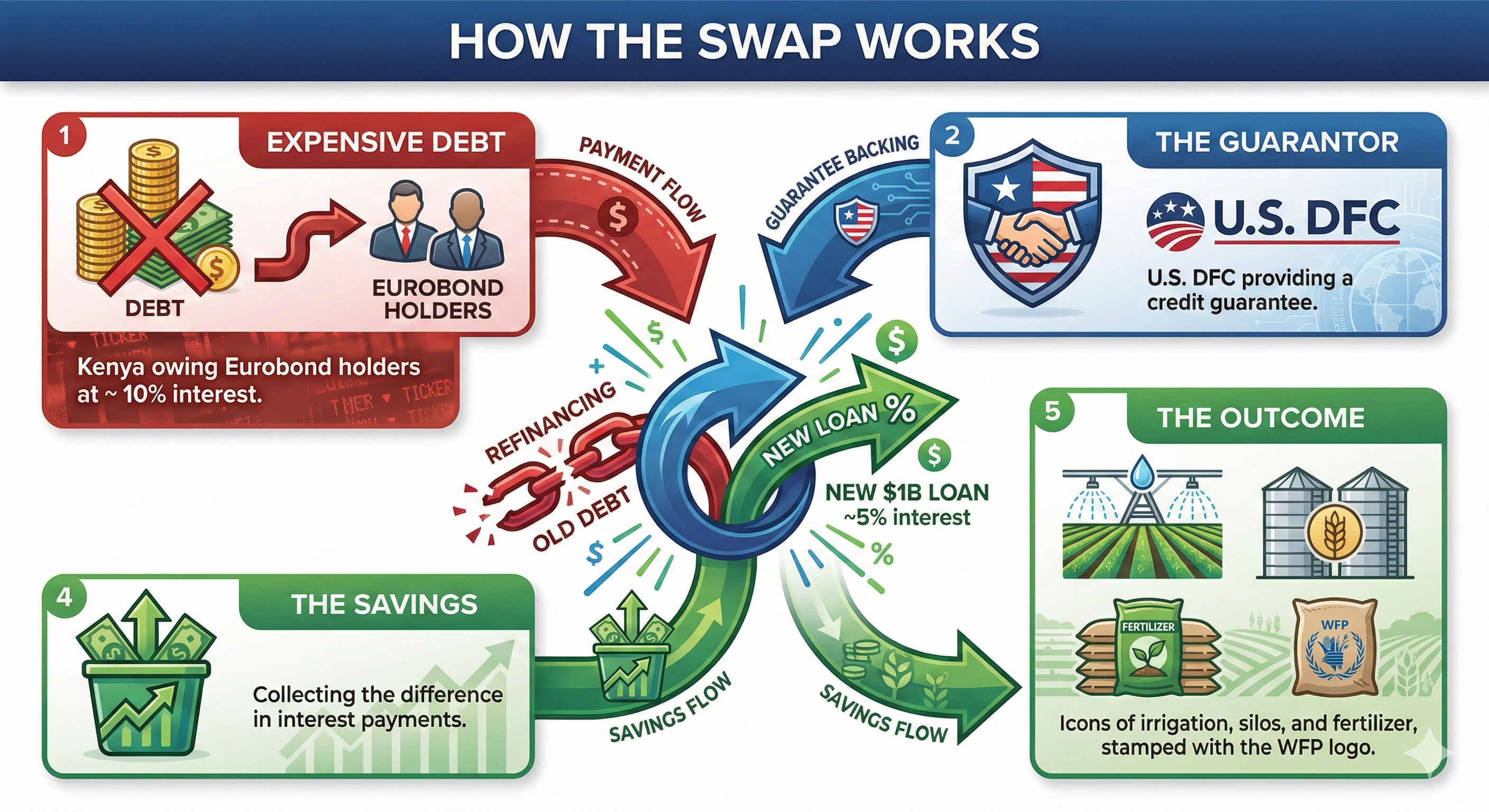
Kenya is on the verge of finalizing a landmark $1 billion (Sh129 billion) debt-for-food security swap, a sophisticated financial maneuver designed to rescue the country from a suffocating liquidity crunch. By leveraging a guarantee from the U.S. International Development Finance Corporation (DFC), the Treasury intends to refinance expensive Eurobond debt with cheaper, concessional loans. The plan is financially astute: it swaps high-interest commercial debt for lower-interest obligations, a move that prompted Moody’s to upgrade Kenya’s credit rating to B3 and stabilize the outlook on the nation’s sovereign debt.

However, the deal comes with a catch that transforms it from a simple refinancing operation into a complex development experiment. The interest “savings” generated from this swap must be ring-fenced and funneled directly into food security projects, managed in partnership with the World Food Programme (WFP). This arrangement effectively outsources a portion of national planning to an international body, admitting that the state needs external discipline to ensure funds aren’t diverted. While this stabilizes the shilling and pleases bondholders, it raises a fundamental question: is this a genuine strategy to feed the nation, or simply financial engineering to avoid default?

The stakes could not be higher. With 3.4 million Kenyans facing acute food insecurity and public debt service consuming over two-thirds of tax revenue, the government is betting that this “financial oil” can mix with the “water” of local agriculture without separating. If successful, it provides fiscal breathing room and lowers input costs for farmers; if it fails, Kenya will be left with the same debt burden and no improvement in the cost of living for the average wananchi.

References:

Business Insider Africa Kenya plans to borrow $1 billion using debt for food swap

CNBC Africa Kenya, US agency to proceed with $1 billion debt-for-food swap