The next phase of the circular economy will not reward enthusiasm — it will reward precision. Across Africa, the coming divide will not be between countries that “care” about sustainability and those that do not, but between systems that can deploy advanced technologies with discipline and those that remain trapped in manual, under-capitalized models. The age of blanket recycling narratives is ending. What is emerging instead is a highly technical, data-driven materials economy where feedstock quality, traceability, emissions accounting, and digital enforcement determine who attracts capital and who is bypassed. Kenya’s challenge is no longer whether it can adopt innovation, but whether it can do so fast enough — and with enough governance — to remain competitive as global standards tighten.
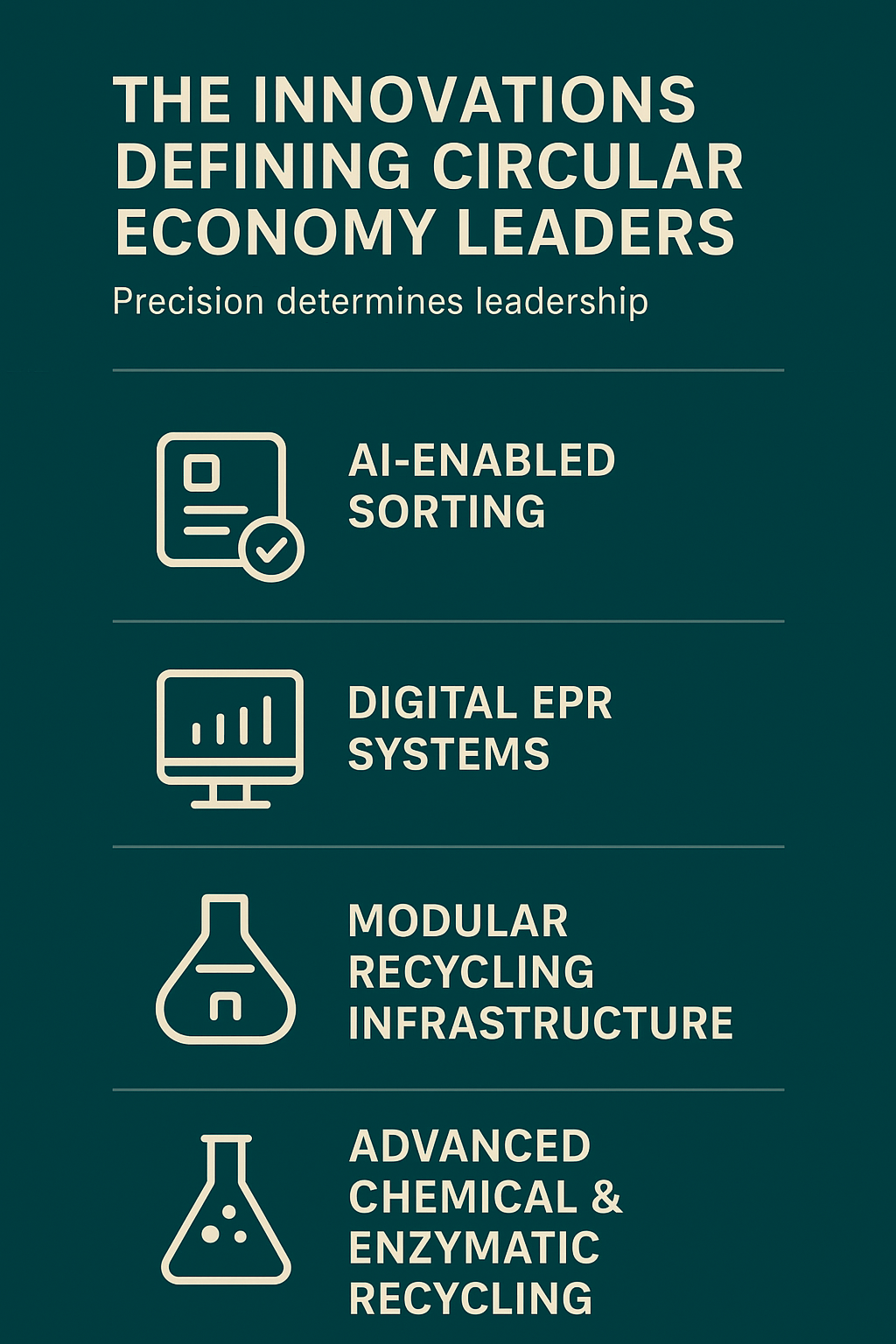
At the center of this separation are four innovation frontiers already reshaping advanced circular systems worldwide. First is AI-enabled sorting, which uses machine vision and spectroscopy to achieve purity levels manual systems cannot sustain, unlocking higher-value rPET and polyolefin streams. Second is digital EPR infrastructure — real-time producer reporting, automated compliance scoring, and public dashboards that eliminate regulatory opacity. Third is modular recycling architecture, where decentralized, scalable MRFs replace monolithic plants that collapse under feedstock volatility. And fourth is advanced chemical recycling, including depolymerization and enzymatic processes that reclaim value from materials mechanical systems cannot process. None of these technologies are experimental. What remains experimental in Africa is the institutional capacity to deploy them without distortion.
The danger for Kenya is not technological exclusion — it is selective adoption without system reform. AI sorting without feedstock discipline fails. Chemical recycling without emissions oversight invites backlash. Digital platforms without enforcement authority become cosmetic. Innovation only works when it is embedded inside a governed system that punishes non-compliance and rewards performance. Countries that master this integration will dominate future recycled-material markets, attract patient capital, and shape regional standards. Those that do not will watch value leak outward — exporting waste, importing virgin plastics, and subsidizing inefficiency with public funds. Going forward, its not about what Kenya could adopt someday. It is about what it must deploy now — deliberately, decisively, and without illusions — if it intends to remain relevant in the circular economy that is already taking shape.
References:
Sustainability Magazine AI and robotics are transforming recycling with EPR laws
Tomra Recycling News
UOCS Revolutionizing Recycling: Smart Technologies for Plastic Waste
Wikipedia CleanHub
Kenya Plastics Pact Kenya Plastics Pact & WWF-Kenya Drive Plastic Recycling Efforts Amid EPR Implementation
Wikipedia Recykal
 Jijuze