Kenya has now reached the point in its circular economy journey where ambition is no longer the constraint — execution is. Over the course of this series, we have traced the full arc of the challenge: from the structural realities of plastic waste, to the centrality of informal workers, to the promise and limits of advanced recycling technologies, to financing, regional positioning, and the risks of institutional failure. What emerges is not a story of inevitability, but one of choice. Kenya has assembled most of the components required for a functional circular system. What remains unresolved is whether those components will be integrated into a coherent, enforceable, and durable whole. The next decade will not be defined by new strategies or declarations, but by the quality of implementation that follows the ones already on the table.
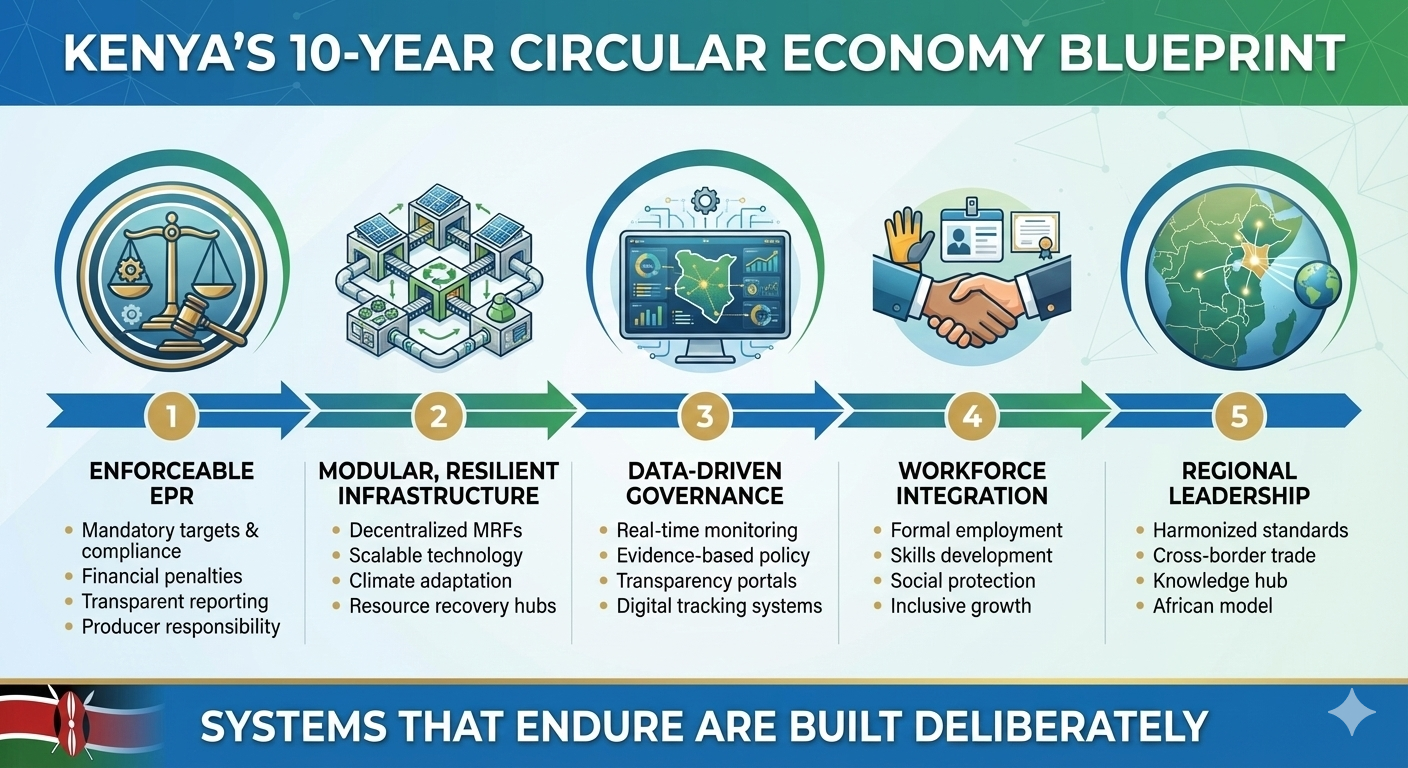
A credible 10-year circular blueprint for Kenya rests on a small number of non-negotiables. First, enforcement must be normalized. Extended Producer Responsibility cannot remain a negotiated obligation; it must become a predictable cost of doing business, applied evenly and transparently. Second, infrastructure must be scaled deliberately, favoring modular, resilient systems over politically attractive megaprojects that fail under operational stress. Third, data must move to the center of governance — from digital EPR reporting and material traceability to public performance dashboards that make compliance visible and verifiable. And finally, the informal waste workforce must be formally integrated, not rhetorically acknowledged. Stable pricing, standardized contracts, access to health and safety protections, and financial inclusion are not social add-ons; they are system stabilizers.
If Kenya can align these pillars, the payoff extends well beyond waste management. A disciplined circular economy strengthens industrial policy, attracts long-term capital, stabilizes supply chains, and positions the country as a regional materials hub at a moment when global markets are actively reshuffling. Failure, by contrast, will not be dramatic — it will be quiet, gradual, and familiar: underperforming facilities, investor fatigue, informal workers absorbing systemic risk, and opportunities migrating elsewhere. Kenya’s circular economy moment is not a single policy decision or flagship project. It is a sustained, cumulative choice to govern complexity with consistency. The window is still open. What will determine the outcome is whether the next ten years are spent managing appearances — or building systems that endure.
References:
Kenya Plastics Pact Kenya Plastics Pact & WWF-Kenya Drive Plastic Recycling Efforts Amid EPR Implementation
Sustainable Packaging Middle East & Africa Kenya’s Extended Producer Responsibility (EPR) regulations to take effect on May 5, 2025
The Standard Counties blamed for failure to adopt waste management plants
The Exchange Africa’s SMEs: How Policymakers Can Speed Up Growth and Innovation
 Jijuze