Kenya’s uneasy relationship with digital freedom deepened on October 15, 2025, when President William Ruto assented to the Computer Misuse and Cybercrimes (Amendment) Act 2024—a move that instantly ignited outrage across the country’s vibrant online community. The signing coincided with the death of former Prime Minister Raila Odinga, and critics accused the administration of using a moment of national grief to push through controversial legislation. Ruto rejected that charge, saying that the Bill had already cleared Parliament and that “governance cannot be suspended, even in sadness.” Still, the optics proved volatile: by nightfall, hashtags such as #RejectCyberCrimeLaw trended across X, while activists, journalists, and lawyers decried what they called an assault on free expression in the digital space.
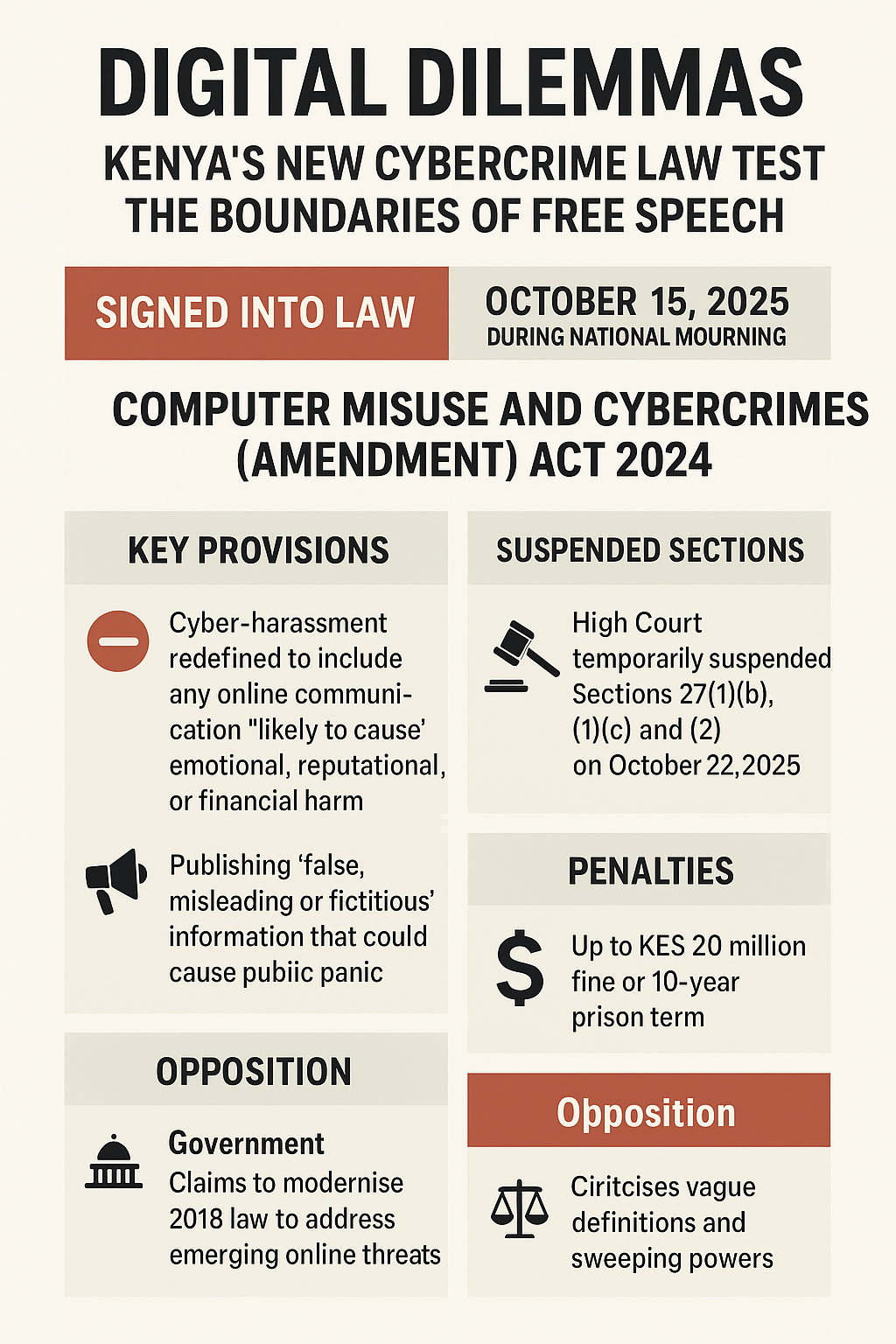
At issue are vague definitions and sweeping powers that critics fear will criminalize dissent. The law expands the offense of cyber-harassment to cover any online communication “likely to cause” emotional, reputational, or financial harm—a threshold that the Kenya Human Rights Commission (KHRC) calls “unconstitutionally broad and prone to abuse.” It also criminalizes the publication of “false, misleading, or fictitious” information deemed capable of causing public panic and grants the National Computer and Cybercrimes Coordination Committee (NC4)—a body dominated by security officials—the power to block or remove content without prior court approval. Penalties are steep: up to KES 20 million in fines or ten years in prison. Civil-society groups, led by the KHRC and activist-musician Reuben Kigame, swiftly challenged the law in the High Court, arguing it violated constitutional rights to free expression and fair trial. On October 22, Justice E. Mabeya temporarily suspended sections 27(1)(b), 27(1)(c), and 27(2)—the core clauses on cyber-harassment and “false” information—pending a full hearing, acknowledging “serious questions on proportionality and vagueness.”
Government officials have defended the legislation as an overdue modernization of Kenya’s 2018 cybercrime law. Spokesperson Isaac Mwaura said it targets “emerging online threats like financial fraud, child exploitation, and cyber-terrorism,” while State House’s Dennis Itumbi maintained the amendments merely “tighten enforcement loopholes.” Yet digital-rights advocates see a wider pattern of algorithmic governance and shrinking civic space—from biometric identity systems like Maisha Namba to Kenya’s cloud-first data partnerships with Big Tech. To them, the new Act represents not reform but regression: a consolidation of executive control over cyberspace. As the High Court prepares to hear the substantive case, Kenya faces a pivotal test. Whether the Cybercrimes (Amendment) Act becomes a legitimate shield against digital abuse or a weapon against dissent will determine how the nation defines liberty in its fast-evolving algorithmic state.
References:
Techcabal Court suspends parts of Kenya’s new cyber law over free speech concerns
Kenya News Agency President Ruto clarifies cyber crime law amid public debate
The Star High Court suspends key provisions of Ruto’s newly assented cybercrime law
Citizen Digital Court suspends cyber harassment section in new Computer Misuse law
Tech Africa News Kenya Begins Drafting National Data Governance Policy
Jijuze Privacy vs. Security — Kenya’s New Surveillance Dilemma
 Jijuze