When the news broke that Raila Amolo Odinga had breathed his last, Kenya did not just lose a leader — it lost a paradox made flesh. He was the man who never won the presidency, yet arguably won the soul of Kenya’s democracy — the one who lost every major election but gained the moral authority few in power ever matched. Across towns and villages, in markets and offices, a shared stillness settled like evening dew — part disbelief, part reverence. Television stations turned monochrome; social feeds filled with memories of rallies, reform, and resilience. From Kibera to Kisumu, from Nairobi to Namanga, Raila’s name echoed in chants of grief and gratitude. He was more than a politician; he was the pulse of a people who found in him the courage to speak, to dissent, and to dream. To many, Raila Odinga was Kenya’s moral compass — the man who, even in loss, made millions believe in the promise of justice.
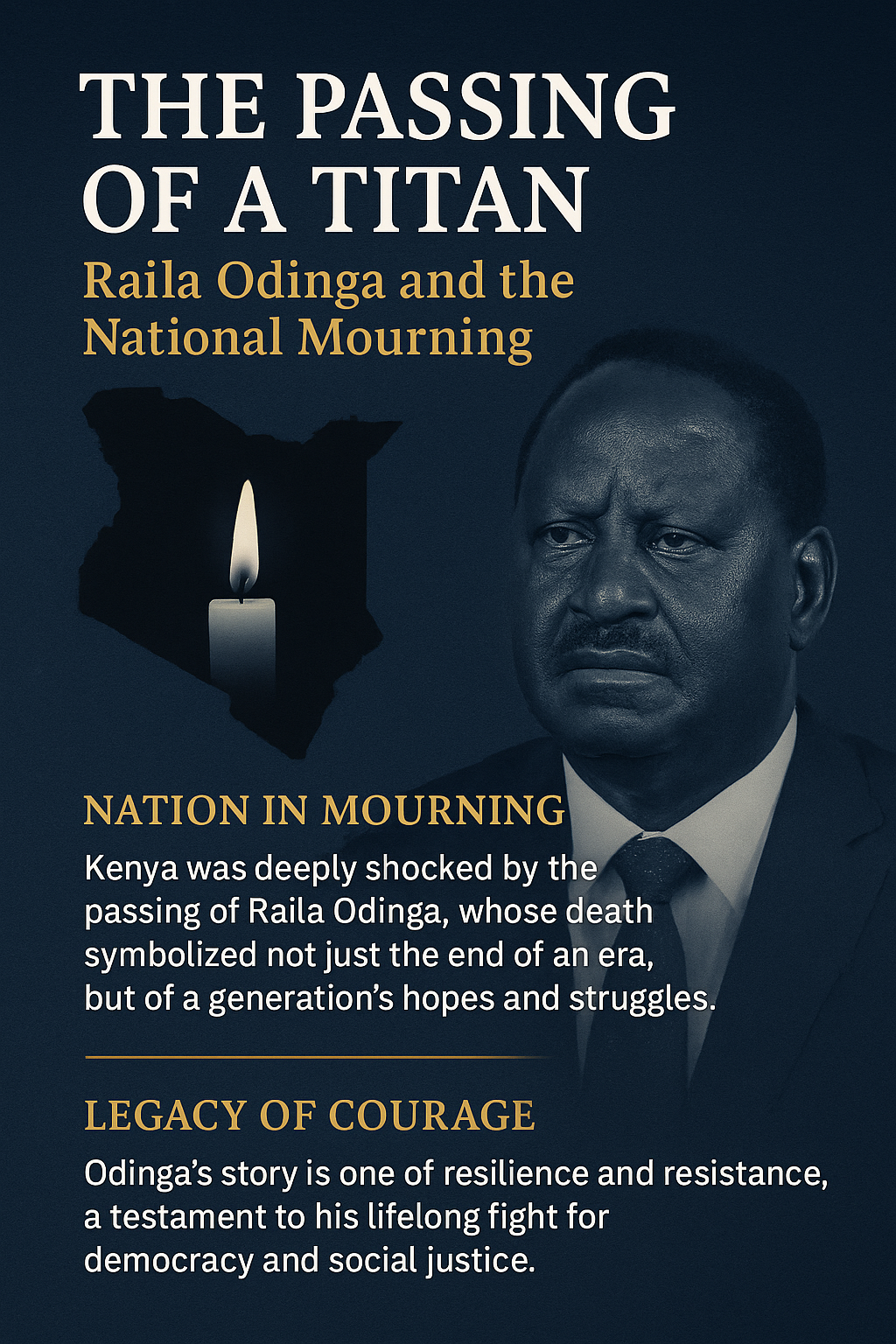
As the state prepared to honour him, the weight of history pressed against the walls of memory. Here was a man who had been imprisoned for ideals, tortured for his convictions, yet emerged each time more resolute than before. The tributes flowing in from across Africa captured this paradox of pain and purpose — Tanzania’s President calling him “the conscience of East Africa,” Nigeria’s Senate hailing him as “a reformer who saw power as duty, not privilege.” In Nairobi, the national flag flew at half-mast, while Parliament prepared to host what may be the most emotionally charged state funeral in decades. But behind the ceremonies lay a deeper reckoning — the realization that Kenya’s democratic soul was, in many ways, shaped by one man’s endurance. To chronicle Raila’s life is to trace the country’s long struggle between oppression and reform, silence and voice, fear and freedom.
And now, in death, his story returns to the people who carried him for half a century — the voters who called him “Baba,” the youth who painted his slogans, the rivals who feared yet respected him. His passing is not just a political event; it is a national rite of reflection — a chance for Kenya to measure how far it has come, and how far it still must go to realize the ideals he fought for. In the coming posts of this legacy series, we will explore those ideals — from his days in detention to his time as Prime Minister, from his Pan-African mission to his unfinished democratic dream. Raila Odinga’s journey did not end with his last breath; it endures in the conscience of a nation still learning to live up to the ideals he refused to abandon. Stay with us as we begin this national remembrance — a chronicle of courage, conviction, and continuity.
References:
BBC ‘Father of our democracy’: Kenya’s Raila Odinga dies in India aged 80
The Standard Raila Odinga’s death: What the world is saying
France 24 Kenya opposition leader Raila Odinga dies, sparking emotion, uncertainty
Daily Nation Raila Odinga dies at age 80 in India
 Jijuze