Kenya’s twin crises in education and health now mirror each other so perfectly that they read like two halves of the same systemic failure. In both sectors, the story begins with noble ideals and ends in bureaucratic betrayal. Teachers denied promotions for years and doctors left unpaid for months are not victims of isolated lapses — they are casualties of a governance structure that treats agreements as aspirational and accountability as negotiable. What began as labor unrest has evolved into a chronic condition, one that corrodes morale, erodes professional standards, and undermines the country’s developmental spine. When classrooms and hospitals — the two pillars of human capital — falter simultaneously, the result is not just administrative paralysis; it is a national identity crisis. These strikes expose Kenya’s deepest institutional flaw: a state that signs social contracts it refuses to honor, and in doing so, normalizes dysfunction as policy.
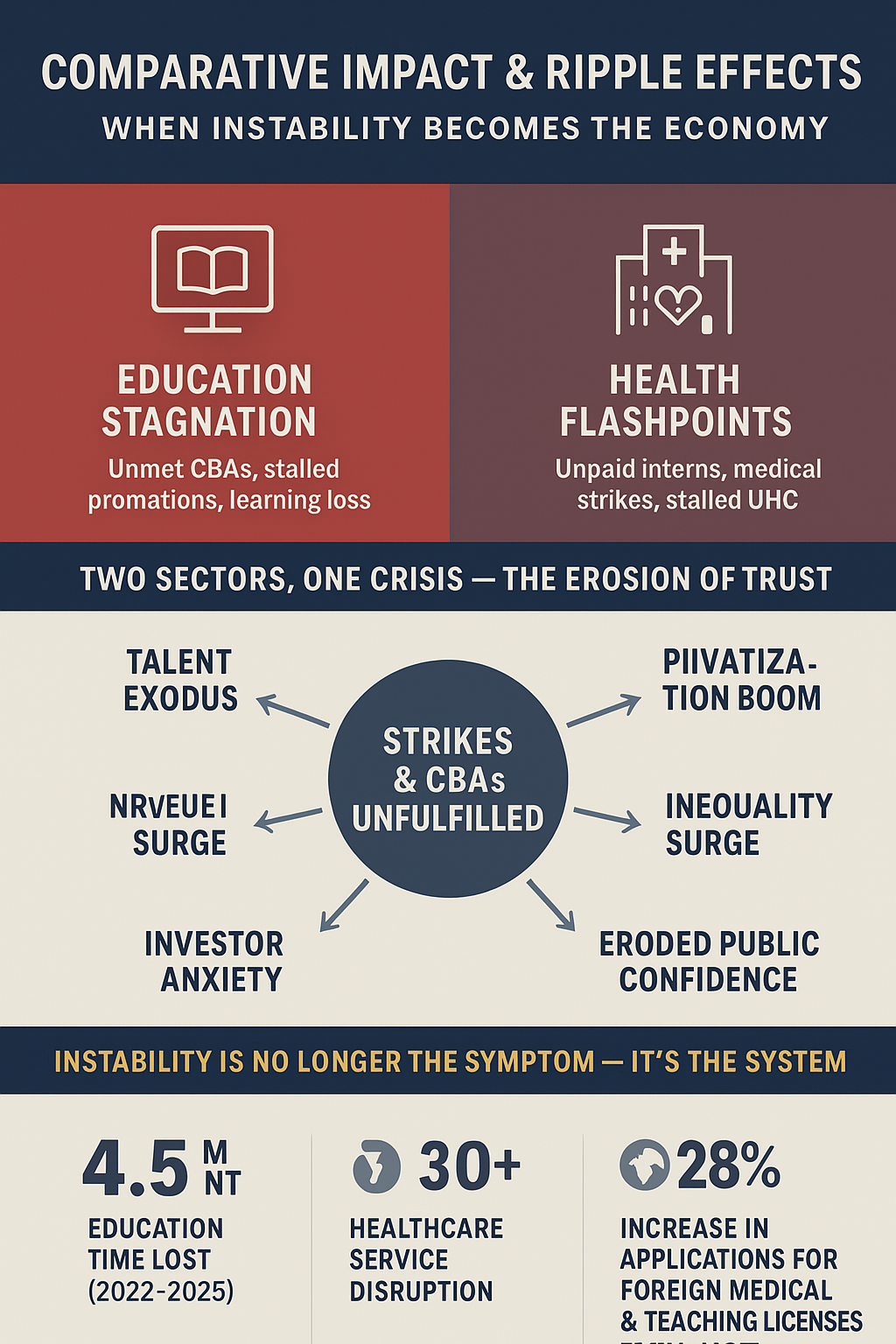
The ripple effects stretch far beyond picket lines. Every unfulfilled CBA or stalled negotiation accelerates a quiet exodus — of talent, trust, and taxpayers — toward private alternatives. Parents turning to private schools and clinics are not exercising choice; they are fleeing collapse. What was once a temporary workaround has become a permanent migration, where education and healthcare are increasingly determined not by citizenship but by income. The rise of digital substitutes — telemedicine, e-learning platforms, private tutoring, and subscription-based health services — signals a privatized survival economy emerging in the vacuum of public failure. While the elite can insulate themselves, the poor are trapped in decaying facilities where teachers are demoralized, and doctors are on strike. Devolution, meant to democratize access, has inadvertently decentralized neglect. As the public system withers, inequality becomes Kenya’s most stable institution.
The economic and social toll of this instability is staggering yet deliberately undercounted. Prolonged strikes shave months off learning calendars, deepen skills gaps, and delay the entry of professionals into the workforce. Health disruptions spike morbidity, drain productivity, and inflate private health costs. Each wave of unrest injects uncertainty into the investment climate, with labor volatility now ranking among Kenya’s top deterrents for both local and foreign investors. The human cost is equally severe: young teachers and medics — once the backbone of Kenya’s social mobility — are migrating en masse to stable economies like Germany, Canada, and Australia, seeking the professional dignity their homeland denied them. What remains is a hollow state: one where service delivery depends on judicial orders, governance runs on press statements, and citizens learn to survive outside the system meant to protect them. Unless Kenya rebuilds credibility at the intersection of policy, trust, and labor justice, instability will cease to be a crisis — it will become the economy itself.
References:
NTV Kenya What factors drive Kenya’s brain drain, and how can it be reversed? | Unpacked
The Conversation Kenyan doctors’ strike: the government keeps failing to hold up its end of the bargain
The Standard Strikes make life expensive, scare investors, experts tell Kenyans
 Jijuze