The Long Road to the White House: How Decades of Defeat Paved the Way for Obama’s Triumph

What historical event fascinates you the most?

The story of Barack Obama’s rise to the presidency is not a solitary tale of brilliance or destiny—it is the culmination of a decades-long relay of political courage that redefined the limits of the possible in American democracy. His 2008 victory stands as the visible peak of an arduous climb shaped by the endurance of pioneers who came before him. Figures like Congresswoman Shirley Chisholm, who shattered racial and gender ceilings in 1972, and Reverend Jesse Jackson, whose “Rainbow Coalition” candidacies in 1984 and 1988 forced America to confront its biases, laid the early foundations of a movement that would outlive them. Their “failures” were not in vain—they were experiments in expanding the nation’s democratic DNA. From a Kenyan perspective, this lineage carries deep emotional weight, embodying the spirit of relentless persistence familiar to anyone who understands the slow, generational battle for inclusion and recognition.

The genius of this political evolution lies in its incremental engineering. Chisholm’s courage and Jackson’s campaigns did not just inspire—they changed the machinery of American politics itself. Through sustained pressure, they compelled the Democratic Party to modernize, reforming delegate rules that amplified the voices of minorities and younger voters. By the 1990s, candidates like Alan Keyes and Al Sharpton ensured the continuity of representation, keeping racial equality firmly in the national conversation. Each successive run normalized the image of a serious Black contender in presidential politics. What emerged over time was not a series of symbolic gestures, but a cumulative transformation—a slow and deliberate reshaping of the public imagination that made Obama’s candidacy viable. His triumph, therefore, was not born of luck, but of a carefully built architecture of hope laid down by generations of pioneers who refused to yield to cynicism.

From a global vantage point, this political journey is an extraordinary testament to democracy’s capacity for self-correction and redemption. The election of Barack Obama—a man with direct African heritage—to lead the world’s most powerful democracy represented the closing of a historical circle. It was the moment when the symbolic finally became substantive, when decades of struggle, protest, and faith converged into a living affirmation that even the most entrenched systems can evolve. For the world, and particularly for Africa, it was proof that history bends not by miracle but by momentum—by the unyielding will of those who run, fall, and rise again until the summit is reached. The path to Obama’s presidency, then, is not just an American story. It is a universal parable about the patience, pain, and persistence required to turn political impossibility into historical inevitability.

The First Law of Politico-Dynamics: Power Is Never Lost, Only Transformed

What’s something you believe everyone should know.

One of the greatest truths in both physics and politics is this: power never disappears—it merely changes form. Just as energy can neither be created nor destroyed, political power, too, is a conserved force that shifts, mutates, and re-emerges. Tanzania’s recent history is a masterclass in this invisible law. Under the late President John Magufuli, the country witnessed a deliberate compression of democratic energy. Opposition rallies were banned, media voices silenced, and civil liberties choked under an increasingly authoritarian grip. The 2020 general elections—tainted by accusations of fraud and intimidation—did not destroy dissent; they simply converted it into dormant potential energy, locked within the state’s total control. What appeared as political dominance was, in essence, the gathering of immense pressure beneath the surface of the republic.

When Magufuli passed away in 2021 and Vice President Samia Suluhu Hassan took over, that compressed energy found a new expression. For a moment, Tanzania seemed to exhale. Political dialogue resumed, exiled opposition leaders like Tundu Lissu returned, and the media regained a measure of freedom. Yet this was not the dismantling of power but its phase shift—a transformation from brute coercion to soft diplomacy. The ruling party, CCM, maintained its institutional grip, only trading kinetic repression for the subtler currency of legitimacy and international goodwill. Tanzania’s newfound openness was real, but it was carefully managed; the core quantum of control remained untouched. The machinery of power, having changed its form, retained its full magnitude, calibrated now for persuasion instead of fear.

By 2023, the cycle completed itself. The language of reform gave way once more to the mechanics of control. Opposition figures were again entangled in legal webs, critics silenced through procedural precision, and the state’s energy of dominance reappeared cloaked in legality. The lesson is universal: no political power is ever destroyed—it only transforms. What matters is not whether power exists, but how it is expressed, shared, and held accountable. Citizens must therefore act as the catalysts of transformation, ensuring that this energy—inevitable, immense, and perpetual—remains a force for justice rather than repression. The equation, always, must balance.

The Adult Filter Is Overrated: Reclaiming the Small Wonders of Life

What does it mean to be a kid at heart?


In the frantic, non-stop race of modern life, we often chase the “big things”—the promotion, the huge vacation, the major milestone. Yet, some of the wisest people I know aren’t those with the biggest bank accounts or titles; they’re the ones who’ve mastered the art of being a kid at heart.
This doesn’t mean avoiding responsibility or acting immature. It means possessing a superpower we tend to lose with age: the ability to find pure, uncomplicated joy in the smallest moments.
Think about a child. Hand them a piece of candy, or watch the sheer concentration and triumph on their face when they successfully blow a huge bubble. Their reaction isn’t measured or conditional; it’s a burst of unfiltered gratitude and delight. A simple act of kindness, a silly joke, or even just mastering a small skill is met with a sincere, radiant smile. They express the purest impression of thankfulness, even for the minutest act they can comprehend.
That is the essence of being a kid at heart: The capacity to appreciate the little things that warm the soul and make the world brighter.
It’s about ditching the adult filter of cynicism and comparison, and allowing yourself to be truly present for the moment. It’s about feeling the sunshine on your face, laughing until your stomach hurts over something ridiculous, or getting genuinely excited about your favorite snack.
It’s an open invitation to a happier life. So, today, let’s all try to be a little less “grown-up” and a lot more like the kids who know that the best things in life aren’t things at all—they are tiny moments of wonder, waiting to be appreciated.

Three Genie Wishes for Kenyans

You have three magic genie wishes, what are you asking for?

🧠 Wish One: The Wisdom to Code with Conscience

May Kenya’s AI rise not as a ruler, but as a reflection of our better selves.
May we build algorithms that see citizens — not profiles, not probabilities.
Let data serve dignity, not dominate it.
For in the age of automation, the greatest innovation will still be empathy.

🔐 Wish Two: The Courage to Guard Our Digital Soul

May every Kenyan know that privacy is not paranoia — it is power.
May our laws protect not just servers and systems, but stories and selves.
Let data ownership become a national value — like land, language, or liberty.
And when convenience tempts us to trade our freedoms for ease, may we remember: once data is lost, democracy follows.

🌍 Wish Three: The Unity to Humanize the Machine

May Kenya’s digital tomorrow be built by all, not a few.
May innovators, regulators, and citizens speak one ethical language — accountability.
Let no algorithm decide without explanation, and no system evolve without oversight.
For the republic’s next constitution may not be written in law — but in code.
May we write it with care, courage, and conscience.

The Machine Has Taken the Wheel — and the Citizen Is the Passenger

Kenya has crossed a line that few noticed but everyone will soon feel. Power is no longer only exercised through parliaments or police — it now flows invisibly through algorithms. From biometric verification at Huduma Centres to risk-scoring systems in the Kenya Revenue Authority (KRA), decisions about who is served, who is flagged, and who is ignored are increasingly being made by code. The Maisha Namba digital identity system — hailed as the backbone of Kenya’s digital transformation — has already shown how easily automation can exclude citizens. Court petitions warn that technical errors and biased design could lock thousands out of essential services without explanation. Meanwhile, police are piloting predictive analytics to map “high-risk” zones, and cybercrime units use social-media scraping tools to monitor dissent. What looks like modernization is fast becoming mechanized control. The machine is now a policymaker — and citizens are its subjects.

Kenya’s legal firewall is alarmingly thin. The National Artificial Intelligence Strategy (2025–2030) — launched to much applause — offers lofty ethics and fairness goals but zero enforcement. The Data Protection Act (2019) was never built to confront opaque AI systems or demand algorithmic audits. Oversight bodies like the Office of the Data Protection Commissioner (ODPC) and ICT Authority lack both the technical muscle and legal mandate to compel transparency from state vendors. Contracts with tech giants such as Huawei, Microsoft, and Oracle remain classified, their algorithms shielded from public scrutiny even as they shape how millions are governed. Experts warn this marks the rise of algorithmic colonialism — where the decision-making tools of foreign corporations become the digital architecture of domestic governance. Kenya may soon discover that it doesn’t just lack ownership of its data — it has surrendered control over the very logic that interprets it.

The stakes could not be higher. As the world races to regulate artificial intelligence — with Europe’s AI Act and new Algorithmic Accountability Bills in the U.S. — Kenya stands at a crossroads between leadership and loss of agency. If it fails to legislate now, automation will outpace democracy itself. Algorithms trained on biased data will entrench inequality faster than any law can undo it. Citizens will be profiled, scored, and excluded — not by government decree, but by silent lines of code. The next phase of Kenya’s reform journey must be radical: transparency must be mandatory, algorithmic decisions must be appealable, and the public must reclaim the right to know how the state’s machines think. In the end, Kenya’s digital destiny will not be determined by data alone — but by who dares to demand accountability from the algorithm. Because the next struggle for freedom will not be fought in the streets. It will be fought — and either won or lost — in the source code.

References:

Strathmore University Kenya’s Efforts in AI and Implementation Plan of the Kenyan National AI Strategy

Ministry of Information, Communications and the Digital Economy Kenya’s Artificial Intelligence (AI) Strategy 2025-2030 launched at the KICC, Nairobi

Namati Kenyan Citizens Who Struggle to Obtain IDs Still Blocked from Enrolling to Digital ID Maisha Namba, Court Told

ID Tech Legal Challenge Targets Kenya’s New Digital ID System Over Rights Concerns

Daily Nation Exclusive: How Kenyan police use mobile phones to track, capture suspects

East African Journal of Law and Ethics Digital Policing in Kenya: Opportunities and Challenges

The Watchers of the Digital Republic: Kenya’s Quiet March Into a Surveillance State

Kenya is watching itself — pixel by pixel. Over the last five years, the country has built an unseen digital nervous system linking thousands of Huawei-powered Safe City cameras, police databases, and social-media monitoring tools. From downtown Nairobi to Mombasa’s seafront, every movement can be captured and cross-checked within seconds at the National Police Service Command Centre. Officials hail this as “smart security”; critics call it the birth of an algorithmic state. It is now evident that Kenya’s system is among the most extensive in sub-Saharan Africa — facial recognition, automatic number-plate readers, and voice analytics feeding a real-time surveillance web. Civil-rights groups such as Article 19 Eastern Africa warn that the same technologies meant to protect citizens are increasingly used to watch them, often without consent or transparency.

The legal architecture meant to contain this power is full of blind spots. The Cybercrimes (Amendment) Act 2024 widened government interception powers and allowed the Communications Authority to pull down online content on loosely defined “security” grounds. Meanwhile, the National Intelligence Service runs data-fusion platforms that combine SIM registration, mobile-money, and tax records — none of which fall under the Data Protection Act’s civilian oversight. The Office of the Data Protection Commissioner cannot audit national-security operations, leaving surveillance programs completely opaque. As the Kenya Human Rights Commission noted in an April 2024 brief, “privacy protections collapse precisely where the State holds the most data.” In the name of safety, a culture of monitoring has replaced a culture of accountability.

Kenya’s experiment is shaping regional norms. The Huawei model first tested in Nairobi has now appeared in Ethiopia, Uganda, and Tanzania, while Western donors — from the EU to Interpol — fund “cyber-capacity” projects that quietly expand the same infrastructure. Analysts describe this as a surveillance compromise: Eastern hardware, Western money, African data. What began as a modernization effort has become a mirror of global power politics — a democracy borrowing the tools of autocracy to stay secure. Unless Parliament enacts a Surveillance Oversight Law and empowers independent audits, Kenya risks institutionalizing fear as policy. The technology that promised protection now records obedience, and in this new digital republic one truth persists: the cameras no longer blink — they remember.

References:

Article 19 Eastern Africa Surveillance, data protection, and freedom of expression in Kenya and Uganda during COVID-19

The Kenyan Wall Street Kenya Upgrades Cybercrime Law to Hand Gov’t Sweeping Powers to Block Websites

The Star Controversial Cybercrime Act: What they said

Huawei Safaricom:Enhancing Security in Kenya with Huawei’s Converged Command & Control Solution

Africa – China Reporting Project Huawei’s surveillance tech in Kenya: A safe bet?

Coda Story In Africa’s first ‘safe city,’ surveillance reigns

The Conversation State surveillance: Kenyans have a right to privacy – does the government respect it?

BBC Safe cities: Using smart tech for public security


The Future Grid: Where Africa’s Power and Politics Collide.

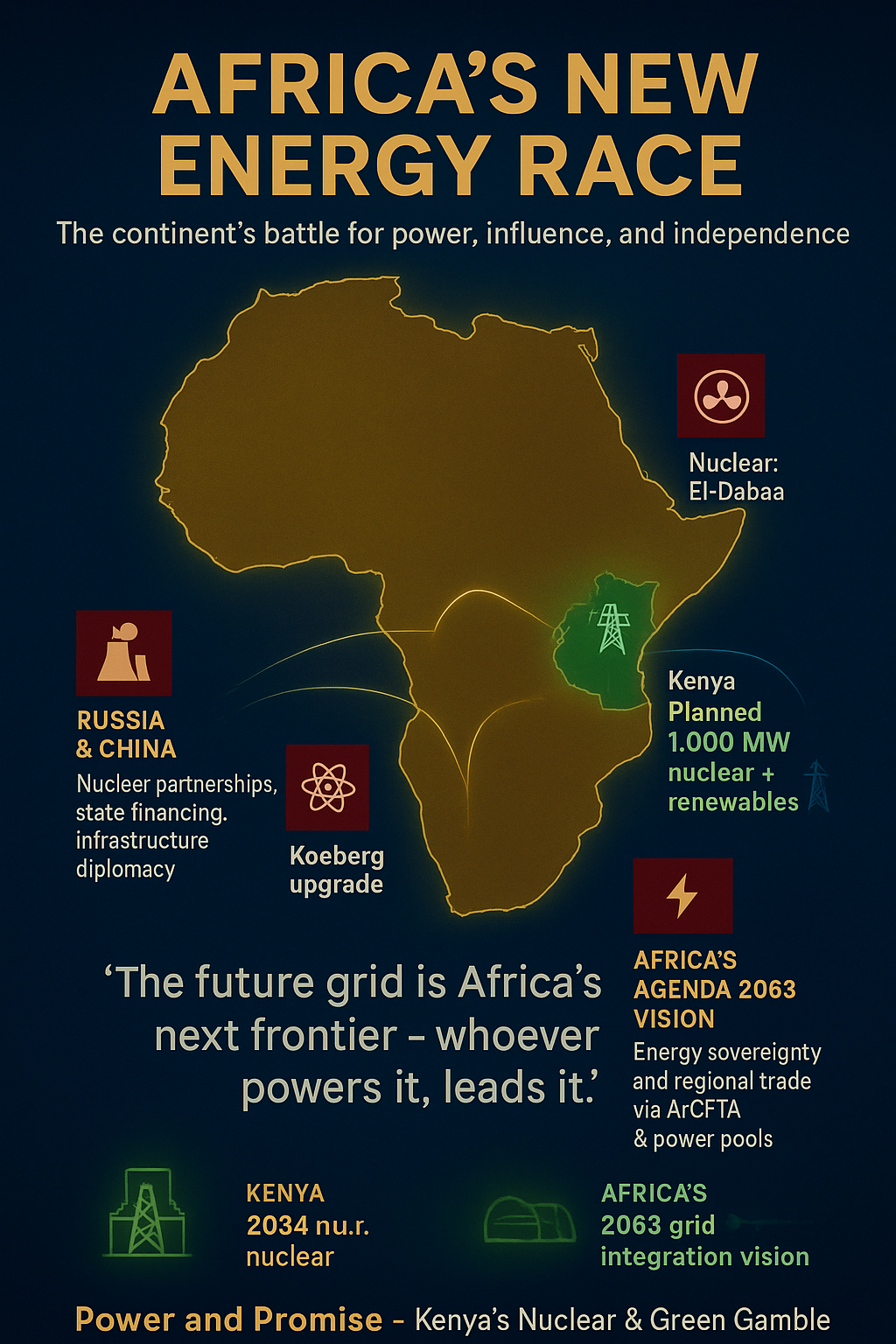
Africa’s energy landscape is shifting faster than at any time in its postcolonial history. From North Africa’s nuclear ventures to Southern Africa’s hydrogen ambitions, the continent is quietly constructing a new map of power — one defined not by oil reserves, but by grid capacity and global alliances. Russia and China are embedding influence through nuclear partnerships; the United States and Europe counter with renewables and clean-tech financing. Across the continent, energy has become the new currency of diplomacy. The story is no longer about light bulbs and power stations — it’s about sovereignty, soft power, and survival. And in this unfolding drama, Kenya stands at the intersection of ambition and caution, armed with geothermal prowess, nuclear dreams, and the burden of fiscal fragility.

Kenya’s choices now echo far beyond its borders. Once hailed as Africa’s renewable beacon, the nation’s dual pursuit of nuclear energy and grid modernization could redefine East Africa’s energy future — or divide it. Egypt’s El-Dabaa reactor is already nearing completion; South Africa is upgrading its Koeberg plant; and Uganda and Ghana are moving from feasibility to formal partnerships. Kenya, strategically perched in the Eastern Africa Power Pool, holds the potential to become a regional energy exporter, a stabilizer in a volatile market. Yet that promise hinges on policy discipline and trust — two currencies Kenya is struggling to sustain. Its fiscal instability, opaque power contracts, and political indecision risk eroding the credibility needed to lead the continental transition. The dream of an integrated African grid may depend less on megawatts and more on governance — and Kenya’s ability to align vision with viability.

The next decade will determine whether Kenya emerges as a powerful nation or merely a powered one. To lead Africa’s energy race, it must balance ambition with accountability, geopolitics with pragmatism. This is not just about building reactors or expanding wind farms — it’s about mastering the grid as an instrument of economic independence and continental diplomacy. The nuclear plant, if realized, will stand not merely as a symbol of technological progress, but as a test of strategic maturity. For Africa, and Kenya especially, the energy race is no longer about who generates power — it’s about who commands it. The atom, the turbine, and the tariff are now the instruments of influence. Kenya’s gamble could define not just its own future, but the direction of Africa’s entire energy destiny.

References:

Sollay Kenyan Foundation Navigating the Challenges of Kenya’s Energy Crisis in 2025

Semafor Africa’s top bank has a fresh chance to bet on nuclear

Observer Research Foundation Advantage China in Africa’s nuclear energy market race

Intellinews More than 20 African countries exploring potential of nuclear energy – IAEA report

IEA Kenya’s energy sector is making strides toward universal electricity access, clean cooking solutions and renewable energy development

Daily Nation Why Kenya is losing its position as regional energy sector leader

When the Lights Cost Too Much: Why Kenya’s Electricity Remains Out of Reach

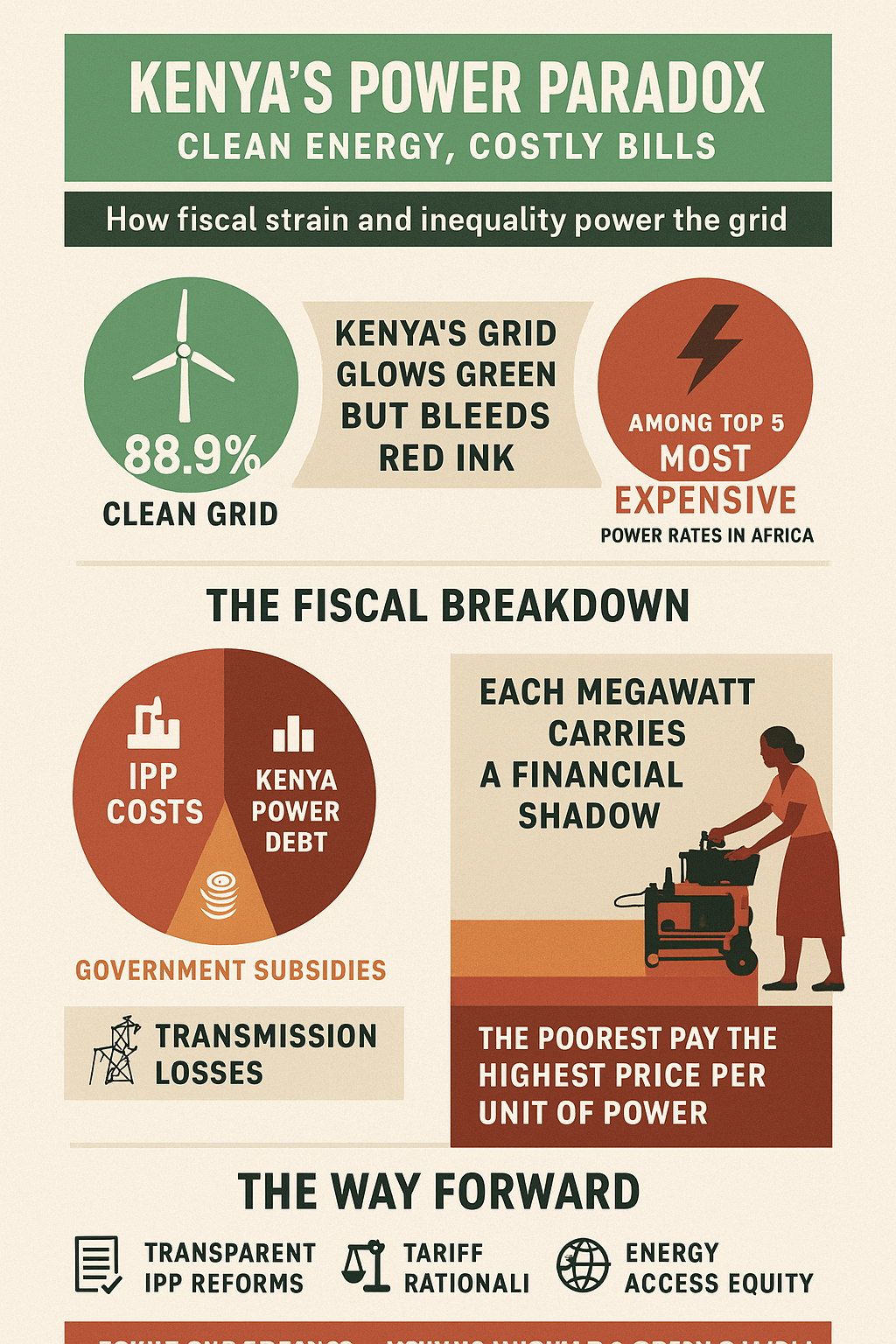
Kenya’s power paradox runs deep: a country rich in renewable generation, yet burdened by some of the highest electricity costs in Africa. On paper, nearly 90% of Kenya’s grid is green — geothermal, hydro, and wind forming a rare climate success story. But for millions of households and industries, that triumph hasn’t translated into affordability. Consumers pay between KSh 25 and 30 per kilowatt-hour, rates that undercut competitiveness and squeeze living standards. In the informal settlements of Nairobi, small shop owners still ration power hours to manage costs, while factories in Athi River and Thika cite electricity tariffs as a primary obstacle to growth. The contradiction is glaring: Kenya has abundant clean power, yet access remains economically exclusionary — an irony that exposes how generation success can mask distributional failure.

At the core of this crisis lies a web of fiscal and contractual distortions. Independent Power Producer (IPP) deals, negotiated during periods of emergency and donor pressure, locked Kenya Power into long-term capacity charges that bleed the utility dry even when consumption dips. The state utility’s balance sheet tells a grim story — mounting arrears, bailout dependencies, and a tariff structure that barely recovers operational costs. Subsidies designed to protect consumers often backfire, distorting market signals and worsening public debt. Populist interventions — from tariff freezes to election-time lifeline promises — have turned energy pricing into political theatre, undermining reform momentum. Meanwhile, Kenya’s push toward big-ticket projects like nuclear power adds new fiscal layers to an already fragile system. It’s a balancing act where every kilowatt carries not just a cost, but a liability.

NTV Kenya Youtube Channel

The human toll of this misalignment is profound. While urban elites and large manufacturers negotiate preferential rates, rural households and informal traders bear the heaviest burden. Many still rely on kerosene lamps and diesel generators — paying more per unit of energy than the grid-connected middle class. The national electrification dream, once buoyed by donor-funded rural projects, has slowed under the weight of poor planning and financial strain. Energy inequality now mirrors broader economic divides, threatening social cohesion and trust in public institutions. The solution lies not in more megawatts, but in smarter management — transparent IPP contracts, realistic tariffs, and equity-centered reform. Kenya’s next decade will determine whether electricity remains a privilege or becomes the universal right it was promised to be. And as the country turns toward nuclear expansion, the cost question will no longer be technical — it will be moral.

References:

Ecofin Agency Kenya Ranks Best in Africa for Power Rules but Prices Keep Rising

Global Petrol Prices Kenya electricity prices

Citizen Digital Cost of electricity: MPs question high amounts paid to independent power producers

The Star Lights on, bills up: Paradox of high electricity costs in Kenya despite abundant renewable sources

Daily Nation Kenya Power MD: Why your electricity bill is so high

Stears Increased electricity tariffs strain Kenyan low and middle-income households

Business Daily Kenyan homes pay highest electricity bills in Eastern, Central Africa


Power Without Progress? Kenya’s Renewable Revolution at Risk

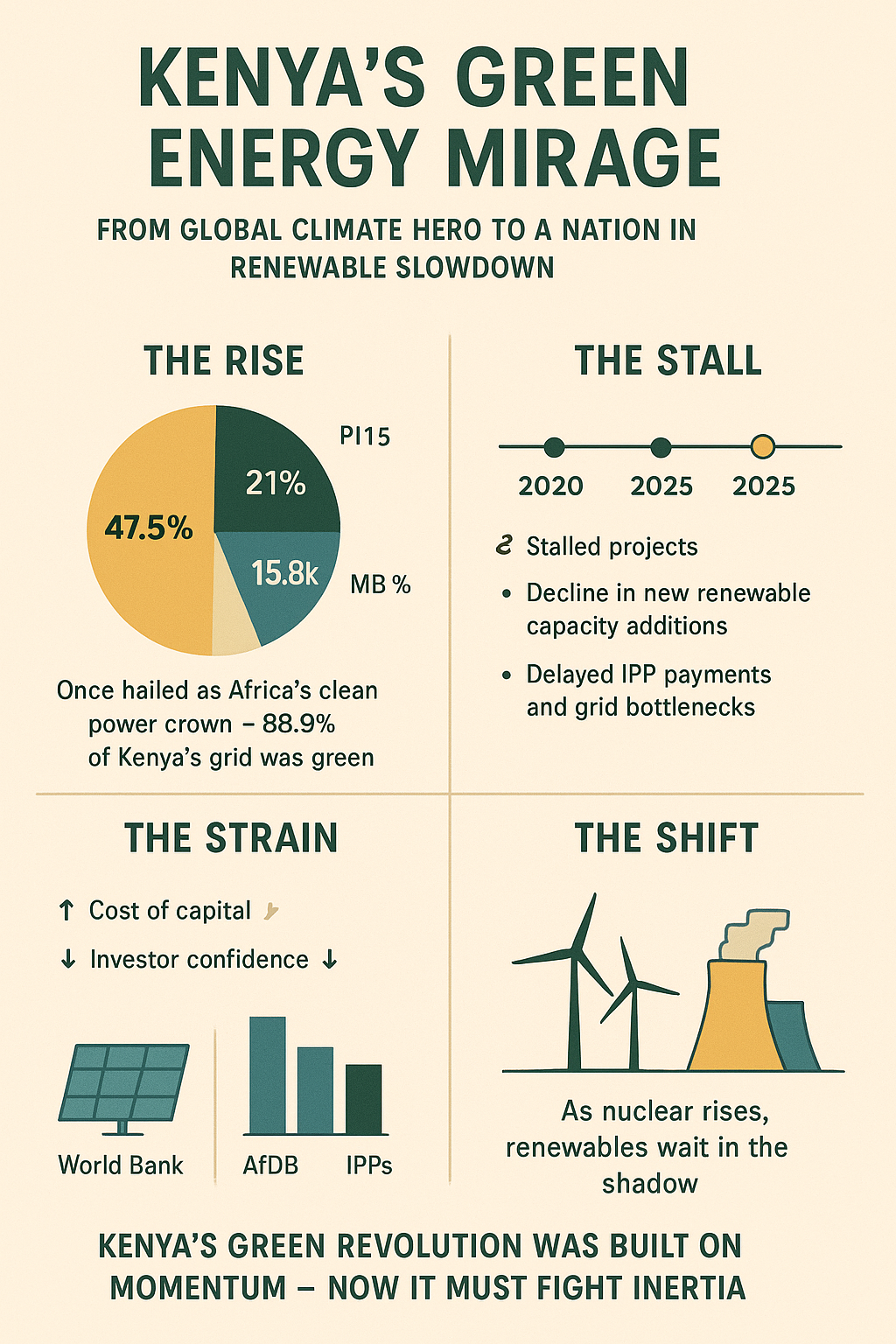
For years, Kenya stood as a global symbol of clean energy success — a nation that proved Africa could power progress without burning its future. With nearly 90% of its electricity drawn from renewables, Kenya’s geothermal fields, hydropower dams, and wind farms once made headlines as the triumph of policy discipline and natural endowment. Yet today, that narrative is faltering. Behind the statistics lies a quiet stagnation. Few major renewable projects have been commissioned since the early 2020s, while others — like Menengai Geothermal and Lake Turkana Wind — have suffered delays, funding gaps, and regulatory setbacks. Grid instability and transmission shortfalls have worsened, creating a paradox: Kenya generates green energy, but struggles to distribute it efficiently or expand access affordably. What was once the continent’s clean energy beacon now risks dimming into complacency.

The chill is most visible in the financing landscape. Kenya’s renewable push was built on concessional lending and development partnerships — a model now straining under fiscal pressure and global credit tightening. According to the World Bank and IEA, the cost of capital for African energy projects has risen sharply, even as debt distress restricts new borrowing. This has slowed project pipelines and rattled investor confidence. Independent Power Producers (IPPs), once seen as catalysts of the renewable surge, now face payment delays and opaque contract reviews that threaten future participation. In solar and mini-grid development — once the pride of Kenya’s rural electrification drive — progress has stalled under mounting bureaucracy and reduced donor enthusiasm. The result is a deep irony: a country rich in green potential but starved of green liquidity. The geothermal wells still steam, but the flow of financing and political focus has cooled.

Kenya’s pivot toward industrial-scale projects — including its ambitious nuclear agenda — risks further diluting the urgency once attached to renewables. Policy attention and investor courting now lean heavily toward centralized megaprojects, sidelining community-level innovation and decentralized energy solutions that had made Kenya’s progress unique. Meanwhile, regional rivals such as Ethiopia and Morocco are racing ahead with diversified, well-financed renewable strategies. Kenya’s hard-won first-mover advantage is eroding, not from technological failure but from strategic drift. Without renewed investment in transparent governance, private-sector trust, and equitable policy incentives, the nation’s celebrated “green crown” could fade into a mirage of past glory — a relic of what once was. And as Kenya’s energy gaze shifts from wind and steam to uranium and reactors, the next big question looms large: why does clean power still cost so much?

References:

IEA Kenya’s energy sector is making strides toward universal electricity access, clean cooking solutions and renewable energy development

IEA How a high cost of capital is holding back energy development in Kenya and Senegal

Daily Nation GDC loses battle with Menengai residents over drilling projects

African Development Bank Group Kenya – 35MW OrPower Menengai Geothermal Power Project – P-KE-FA0-027

The Atom and the Empire: How Global Giants Are Eyeing Kenya’s Energy Future

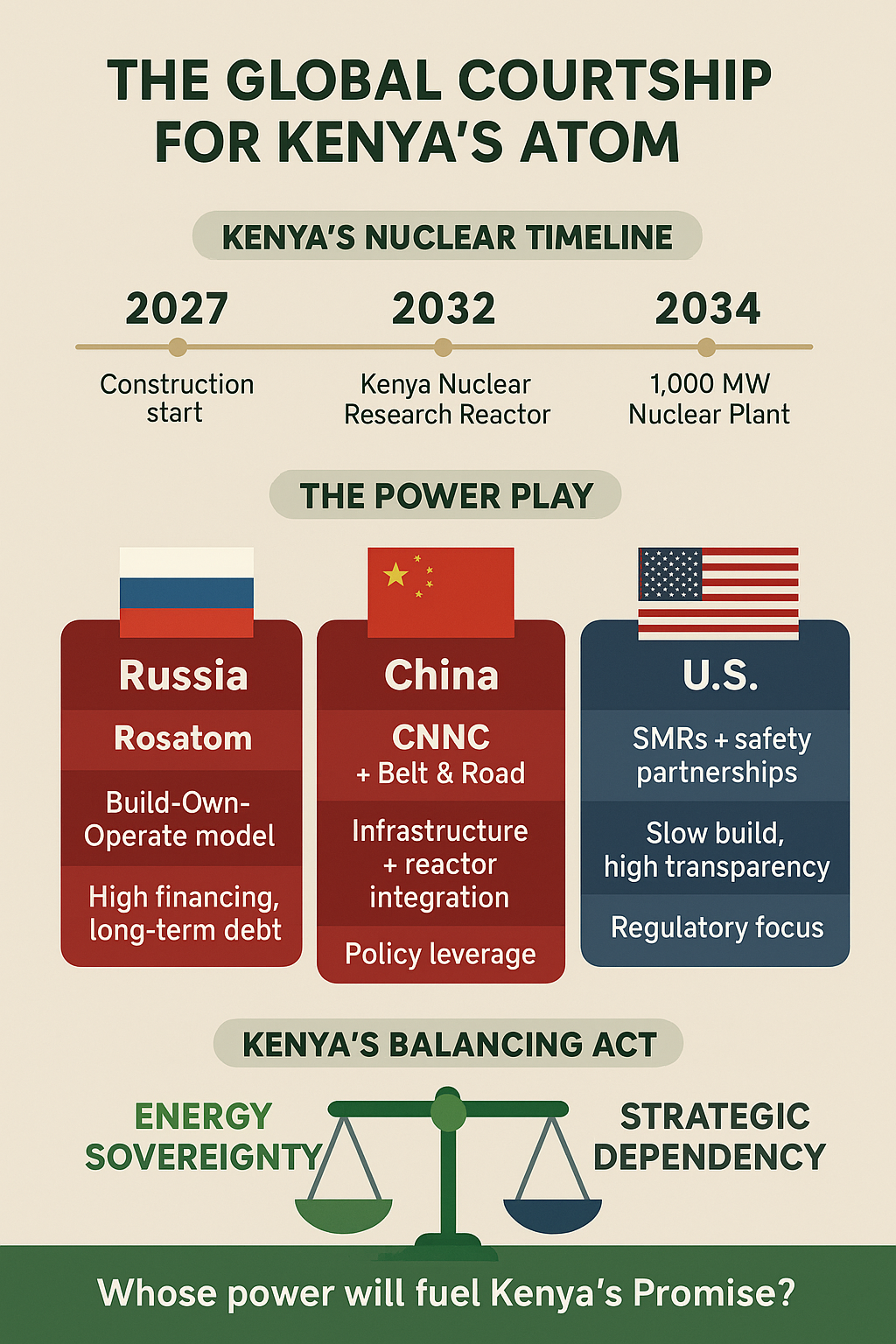
Kenya’s decision to go nuclear has set off more than an energy transition — it has triggered a geopolitical courtship. As the country advances its plan to construct a 1,000-megawatt nuclear power plant by 2034, the world’s top atomic powers are circling. Russia, China, and the United States each see in Kenya more than a client; they see a strategic foothold in East Africa’s next phase of industrialization. Rosatom, Moscow’s state nuclear corporation, has already positioned itself as a leading partner, offering a full-package Build-Own-Operate model similar to the deal it struck in Egypt. China, meanwhile, is extending its Belt and Road footprint to include nuclear cooperation, promising financing, infrastructure, and workforce training. Across the Atlantic, Washington is promoting a more measured engagement — advocating for small modular reactors (SMRs), governance reforms, and safety-first collaboration under IAEA supervision. For Kenya, these competing suitors represent not just technological options, but distinct political and economic futures.

Moscow’s offer is enticing but heavy with precedent. Through Rosatom, Russia promises to finance, construct, and train Kenya’s first generation of nuclear engineers — all while ensuring rapid project delivery. Yet such generosity carries weighty strings. Africa’s only active nuclear project, Egypt’s El-Dabaa, is already testing the sustainability of similar financing terms. The loans are long-term, denominated in hard currency, and backed by state-to-state commitments that can outlast political cycles. For developing economies, such dependency risks trading short-term power security for long-term fiscal vulnerability. China’s playbook differs in form but not in ambition. By bundling nuclear cooperation into its broader Belt and Road matrix, Beijing offers a seamless blend of infrastructure, credit, and control — a model that fuses technology transfer with quiet strategic encroachment. Kenya, already a major recipient of Chinese infrastructure loans, would need to tread carefully to avoid replicating debt traps under a new, atomic banner.

The United States, for its part, sees Kenya as a proving ground for its rebranded nuclear diplomacy in Africa. Washington’s recent “Atoms for Peaceful Growth” initiative seeks to counter Russian and Chinese influence by promoting advanced modular reactors and transparent regulatory partnerships. Its pitch emphasizes capacity-building over construction — slower, perhaps, but anchored in institutional strength and safety culture. For Nairobi, the task is delicate: to navigate between these rival powers without ceding strategic autonomy. Each promise carries peril; each partnership, a price. The nuclear project’s success may depend less on which partner Kenya chooses, and more on whether it can maintain control over the agenda — financing, governance, and public trust alike. For the world’s atomic giants, Kenya is a stage for influence; for Kenya, it is a test of sovereignty. And as this high-stakes energy diplomacy unfolds, the question that follows is equally pressing: can the country’s celebrated green revolution keep pace, or is it being slowly eclipsed by the glow of the atom?

References:

Lida Network Impact of Kenya’s First Nuclear Power Plant Ambitions

IEA How a high cost of capital is holding back energy development in Kenya and Senegal

Nuclear Business Platform Kenya’s Nuclear Energy Sector: A Strategic and Commercial Overview for Investors and Partners

The Africa Report US ramps up nuclear energy for Africa in showdown with Russia, China

IAEA Community at the Heart of Kenya’s Nuclear Energy Debate

The Africa Report Kenya aims to build nuclear power plant by 2034, says minister

Ministry of Energy and Petroleum Kenya signs MOU on Nuclear power collaboration with China

Africa Intelligence Nairobi looks to US rather than Russia for its nuclear programme

Daily Nation Beyond the Cold War: How Russia could help power Kenya’s development agenda

Kenya News Agency Kenya Targets 20,000MW Nuclear Power Plant by 2040

The Star Kenya, China ink major deal to boost nuclear energy development