When President William Ruto stood before UDA and ODM legislators on August 18, 2025, and declared that MPs had pocketed KSh 10 million to sink an anti-money laundering bill, while senators allegedly demanded up to KSh 150 million from governors under probe, it marked a seismic moment in Kenya’s corruption narrative. Unlike broad platitudes, these allegations were laced with precision—figures, targets, and the President’s insistence that he was a “consumer of raw intelligence” with knowledge of what was happening behind closed doors. For a country where the shadow of graft often hovers without names or numbers, Ruto’s bluntness pulled corruption out of abstraction and into the raw theatre of governance. The fallout is immense. It not only raises fundamental questions about the integrity of Kenya’s legislative processes but also highlights how deep-rooted corruption risks sabotaging reforms critical to stabilizing the economy, securing donor confidence, and reinforcing Kenya’s democratic fabric.
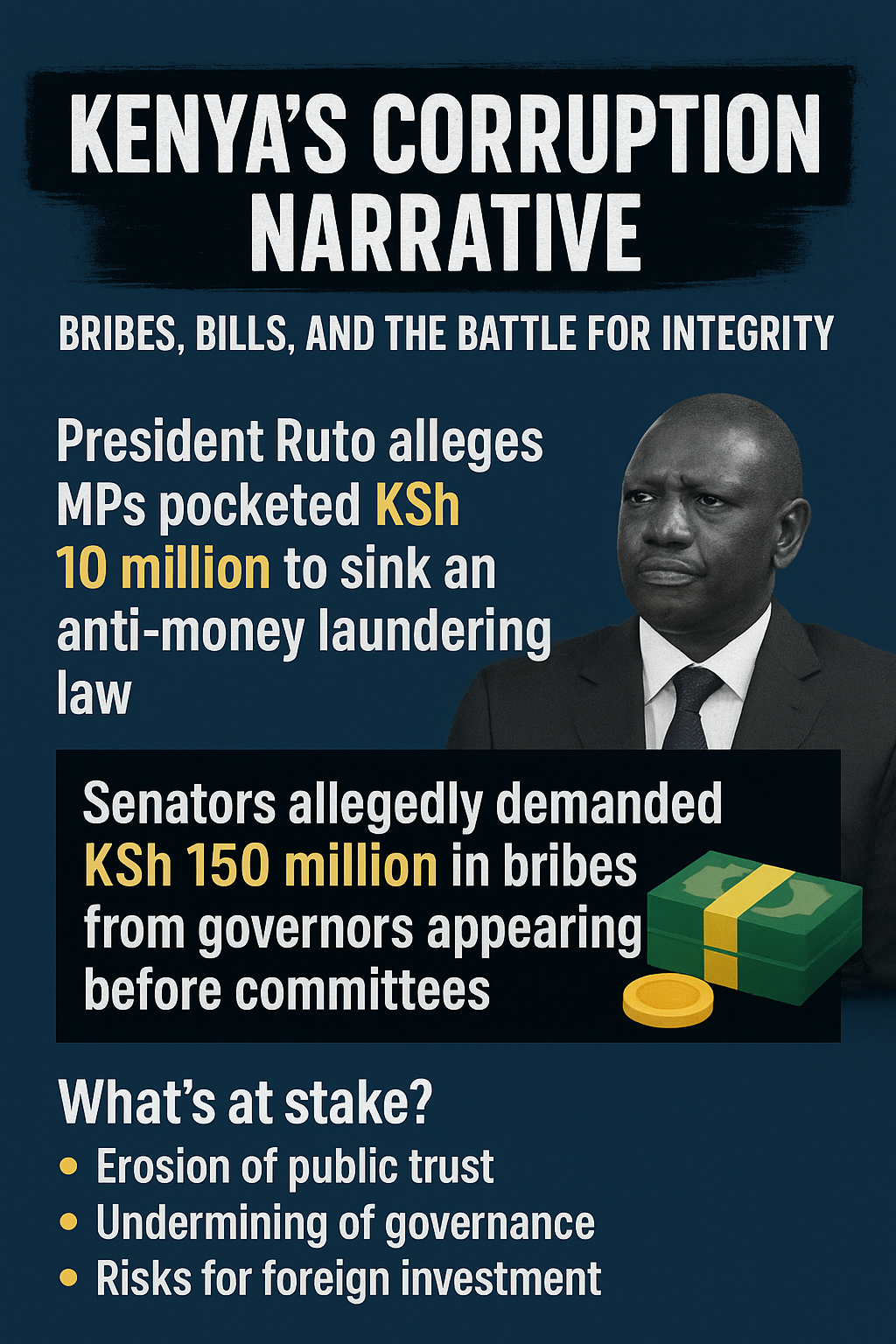
Such high profile claims cannot be dismissed as political theatre. They expose systemic vulnerabilities where the very guardians of accountability—parliamentary watchdog committees—become gatekeepers of extortion. By placing a price tag on oversight, lawmakers distort the balance of power, weaken enforcement of financial transparency laws, and compromise Kenya’s commitments to international anti-money laundering standards. In practical terms, this jeopardizes more than just the passage of bills: it risks the credibility of Kenya’s financial system, threatening remittance flows, investor trust, and even compliance with IMF and FATF benchmarks. The long-term stakes are enormous. If parliamentarians are perceived as auctioneers of governance, global institutions will tighten their scrutiny, and Kenya’s economy—already weighed down by debt and unemployment—will carry the burden of political impunity.
The President’s vow to arrest both givers and takers of bribes presents a moment of reckoning. Rhetoric without enforcement risks deepening public cynicism rather than rebuilding confidence. What hangs in the balance is Kenya’s ability to demonstrate that governance is not negotiable, and that the fight against corruption is not a selective weapon but a consistent national ethic. Civil society and international observers are watching closely, and the diaspora too remains alert to how corruption narratives shape Kenya’s global reputation. At stake is not just legislative credibility, but the country’s standing as a functional democracy and competitive economy. If Kenya cannot confront and dismantle these entrenched practices, the corruption narrative will continue to define—not just distort—its future.
References:
The Star Some MPs received Sh10 million to sink anti-money laundering law – Ruto
The Star MP Makilap wants Ruto to publicly name corrupt lawmakers
Transparency International Kenya 2024 CORRUPTION PERCEPTIONS INDEX REVEALS HOW WEAK ANTI-CORRUPTION MEASURES UNDERMINE CLIMATE ACTION AND CONTRIBUTE TO THE VIOLATION OF HUMAN RIGHTS
Econfin Agency Kenya Creates Multi-Agency Task Force to Fight Corruption
Citizen Digital East Africa’s investment potential: Why leaders need to tackle corruption
Jijuze Combatting Fraud in Kenya’s Tourism: A Growing Threat
 Jijuze