Lake Nakuru’s New Waters: From Flamingo Spectacle to Tourism Uncertainty

Lake Nakuru, once Kenya’s unrivaled icon of flamingo tourism and a UNESCO World Heritage Site, is undergoing an environmental transformation that is quietly redefining its future. The dramatic shift from a shallow, alkaline soda lake to a swelling freshwater body—driven by climate change, deforestation, urban runoff, and persistent pollution—has reshaped not just the lake’s ecology, but also its economic and cultural purpose. Once celebrated as the “Lake of a Million Flamingos,” the site now faces a tourism identity crisis as its signature attraction—the vibrant flocks of Lesser Flamingos—has largely vanished due to the disappearance of Spirulina platensis, the algae they feed on. This ecological transition is not a fleeting anomaly; it signals a long-term reset, potentially stripping Kenya of one of its most iconic natural tourism assets.

The implications for Kenya’s tourism economy are profound. Flamingo migration has dealt a blow to the local hospitality industry, with ripple effects felt from Nakuru to Elementaita and Naivasha. The park’s submerged infrastructure—gates, roads, and buildings—has necessitated a KSh 38 million investment in repairs and relocation, eating into Kenya Wildlife Service’s already stretched budget. Yet amid this disruption, opportunity glimmers. Kenya has a chance to reframe Lake Nakuru not as a site of lost heritage, but as a blueprint for adaptive, resilient tourism in the age of climate change. KWS has already introduced new water-compatible experiences, including adjusted game-viewing routes and potential boating attractions. With careful investment, storytelling, and conservation marketing, this shift can usher in a new kind of eco-tourism centered on freshwater biodiversity, migratory birds, and climate adaptation success stories.

But realizing this vision demands urgency, strategy, and inclusivity. Conservation and tourism authorities must actively engage displaced communities, whose turn to illegal fishing underscores a deeper social fragility tied to the lake’s changes. Tourism policy must evolve to support heritage resilience—protecting UNESCO designation through scientific reinterpretation of the site’s ecological value, not just nostalgia for what it once was. Lake Nakuru stands at the frontline of global climate impact on natural heritage. If Kenya can lead the world in repurposing this park’s brand while safeguarding its ecosystems and communities, it won’t just save a destination—it will create a model for climate-smart tourism across Africa and beyond.

References:

Scientific Research Assessment of Spatial Expansion of Rift Valley Lakes Using Satellite Data

The Standard State of three Rift Valley Lakes worry experts

Talk Africa Lake Nakuru’s Water levels Expected to Cause More Havoc During The Rainy Season, Experts Say  

Jijuze Is Lake Nakuru’s Ecosystem at Risk Due to Pollution and Illegal Fishing?
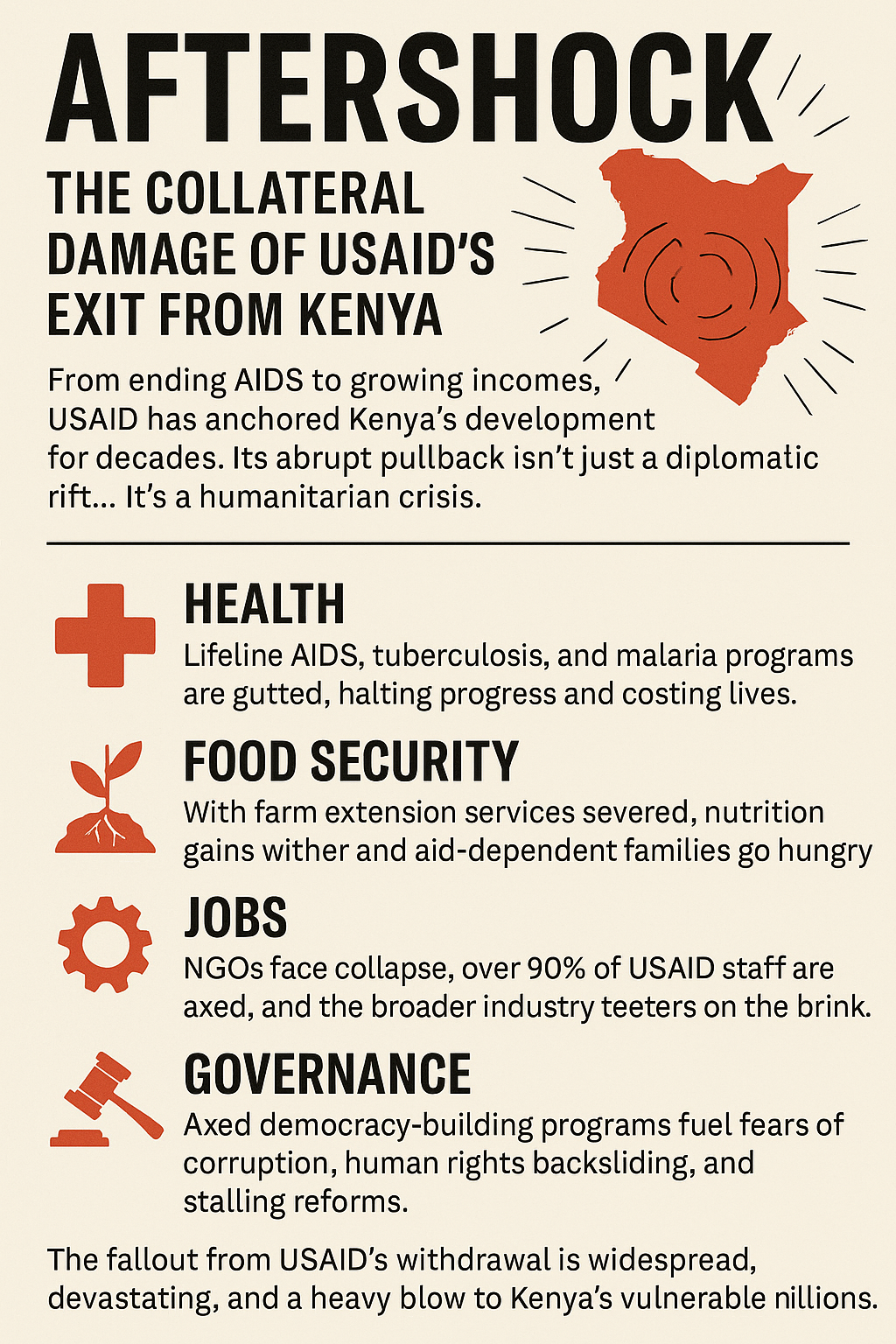
Aftershock: The Collateral Damage of USAID’s Exit from Kenya

The abrupt dissolution of USAID, catalyzed by the U.S. government’s sweeping “America First” foreign aid policy pivot, has left Kenya reeling from a vacuum of support once critical to its public health, agriculture, and economic systems. With over $2.5 billion in planned investments between 2020 and 2025, the agency was more than just a donor—it was woven into the fabric of Kenyan service delivery. The termination of 83% of USAID’s programs and the layoff of 94% of its staff effectively ended over six decades of robust U.S. development engagement. For Kenya, this rupture came without a viable transitional plan. Clinics shuttered, medicines vanished, and 40,000 jobs tied to health services evaporated. Programs such as PEPFAR, which had sustained over a million Kenyans on antiretroviral treatment, have been gutted, with HIV/AIDS funding slashed from $846M in 2023 to just $66M in 2025. Maternal health, malaria prevention, and reproductive health services now teeter at the edge of collapse, with service cuts exceeding 90% in some areas. Kenya’s health infrastructure, already strained, is now buckling under a loss that is not merely financial—but fatal.

The economic blowback extends far beyond healthcare. USAID had supported Kenya’s agriculture sector through subsidies, training, and innovation, all now dismantled. Smallholder farmers are especially vulnerable. With the termination of the Famine Early Warning Systems Network (FEWS NET) after four decades of operation, Kenya has lost its primary mechanism for forecasting and responding to food insecurity. Meanwhile, tax reforms in the proposed 2025 Finance Bill—removing VAT exemptions on farm inputs and raising fuel duties—compound the crisis, inflating production costs and shrinking rural margins. The convergence of aid withdrawal, policy shocks, and climate threats is deepening food insecurity and threatening to reverse years of agricultural gains. Simultaneously, the Kenyan startup ecosystem and governance reform sectors face a projected $100 million funding shortfall. Civil society actors, often powered by USAID support, now risk losing their watchdog capacity. In areas such as conflict prevention and refugee education, where USAID once acted as a stabilizing force, the vacuum could be exploited by extremist recruiters, echoing conflict patterns seen in past aid shock cases in West Africa.

Kenya’s response has been urgent but encumbered. The government has committed to repatriating its health data from U.S.-hosted systems and shifting toward local infrastructure, yet faces severe capacity shortfalls. The fiscal strain is formidable: a KSh 52 billion health budget hole and a broader KSh 66.9 billion gap across affected sectors. While the Bottom-Up Economic Transformation Agenda (BETA) reflects ambition for self-reliance through tax reforms and private investment, execution remains constrained by weak systems and widespread corruption. Still, civil society and policymakers are beginning to reframe the crisis as a wake-up call for domestic revenue mobilization and governance renewal. If there is a path forward, it lies in converting dependency into resilience—not just by replacing funding streams, but by rethinking national priorities, protecting human capital, and investing in sovereign, accountable systems that can withstand future geopolitical shocks.

References:

Citizen Digital Over 40,000 Kenyans jobless after USAID-funded health facilities shut down

The Voice of Africa USAID Shuts Down After 63 Years, Leaving Africa in Crisis

The Star Civil society calls for self-reliance as foreign aid dwindles

Africa.com Kenya to Reclaim Health Data After Trump Administration’s USAID Cuts

Jijuze Kenya Faces Crisis After USAID Funding Withdrawal

Capital Business USAID funding halt to hit Kenya’s economy, social sectors – report

Audit vs. Austerity: The IMF’s Role in Kenya’s Recovery

Kenya is on the edge of a pivotal financial reckoning. In the wake of the 2024 Finance Bill’s withdrawal and amid a battered economy, the International Monetary Fund (IMF) has demanded a sweeping corruption audit before any further disbursement of financial aid. At stake is more than KSh 100 billion in support tied to Kenya’s Extended Fund Facility, Extended Credit Facility, and Resilience and Sustainability Facility—aid that could help stabilize an economy reeling from debt, inflation, and political distractions. The collapse of the 2024 Finance Bill, triggered by nationwide protests over tax hikes, left a gaping fiscal hole. Now, the IMF wants answers before money moves. Between June 16 and 30, a Governance Diagnostic mission wrapped up in Nairobi. While Treasury insists the audit is not a precondition for funding, international observers say its findings will heavily influence future negotiations. The IMF has drawn a clear line: no serious anti-corruption reforms, no fresh credit.

IMF Demands corruption audit on Kenya

The Kenyan public feels the consequences every day. For ordinary wananchi, the stalled billions aren’t just digits on a spreadsheet—they represent hospital beds without medicine, classrooms without books, roads that end in dust, and a tax burden growing heavier on already strained shoulders. Years of unchecked corruption have gutted public institutions, forcing citizens to pay more for less while a well-connected elite evades accountability. The protests of June 2024 were not merely about a finance bill—they were about a social contract broken. Corruption doesn’t just steal money; it steals opportunity, trust, and dignity. It pushes more families below the poverty line and leaves critical sectors like education and healthcare in permanent crisis. Every act of embezzlement is a tax on hope. And now, Kenya must confront that cost head-on.

Yet as this economic standoff unfolds, the political class seems to be campaigning rather than governing. With two years until the 2027 general elections, the air is already thick with premature rallies and succession battles. This relentless politicking is not just tone-deaf—it undermines policy coherence and economic recovery. Critics argue that Kenya risks squandering a historic opportunity to reset its governance priorities. The IMF’s demand for a corruption audit is not just a bureaucratic checkbox; it is a test of political will. Whether the government embraces or evades the findings of the Governance Diagnostic will speak volumes. Kenya is at a crossroads. What lies ahead will depend on whether its leaders prioritize reform over rhetoric, the public over politics, and accountability over access to short-term cash. The world is watching. But more importantly, Kenyans are waiting.

References:

Mariblock Kenya fails IMF review, forfeits $850M disbursement

International Monetary Fund IMF Staff Completes Governance Diagnostic Mission to Kenya

Transparency International – Kenya Debate on Kenya’s economy must include a cure to the endemic corruption

The Standard Bitter IMF austerity pill return overshadows budget unveiling

The Standard Why IMF is demanding corruption audit on Kenya