Betting and Laundering — M-Pesa’s Hidden Battleground

It began as a flicker of digital noise deep within Safaricom’s new artificial intelligence compliance system — a pattern so strange, even the engineers thought it was a software glitch. Betting wallets were trading in micro-loops, small deposits bouncing across networks at impossible speed, masquerading as gaming wins. But when the algorithm slowed the data stream, it exposed the truth: this wasn’t gambling; it was laundering. In days, Safaricom’s AI had flagged dozens of high-traffic betting APIs — among them Betika, Odibets, and MozzartBet — for suspicious activity, their systems pulsing with repeated micro-transactions that defied legitimate gaming behavior. What the model revealed was staggering. Ordinary player wallets had become conduits for billions of shillings, circulating under the guise of lucky streaks. Behind every spin, every small bet, was a meticulously choreographed web of digital cash-washing. The machine had finally confirmed what regulators long suspected but could not prove: Kenya’s fast-rising betting culture had evolved into the perfect laundromat — one hidden in plain sight inside the M-Pesa ecosystem.
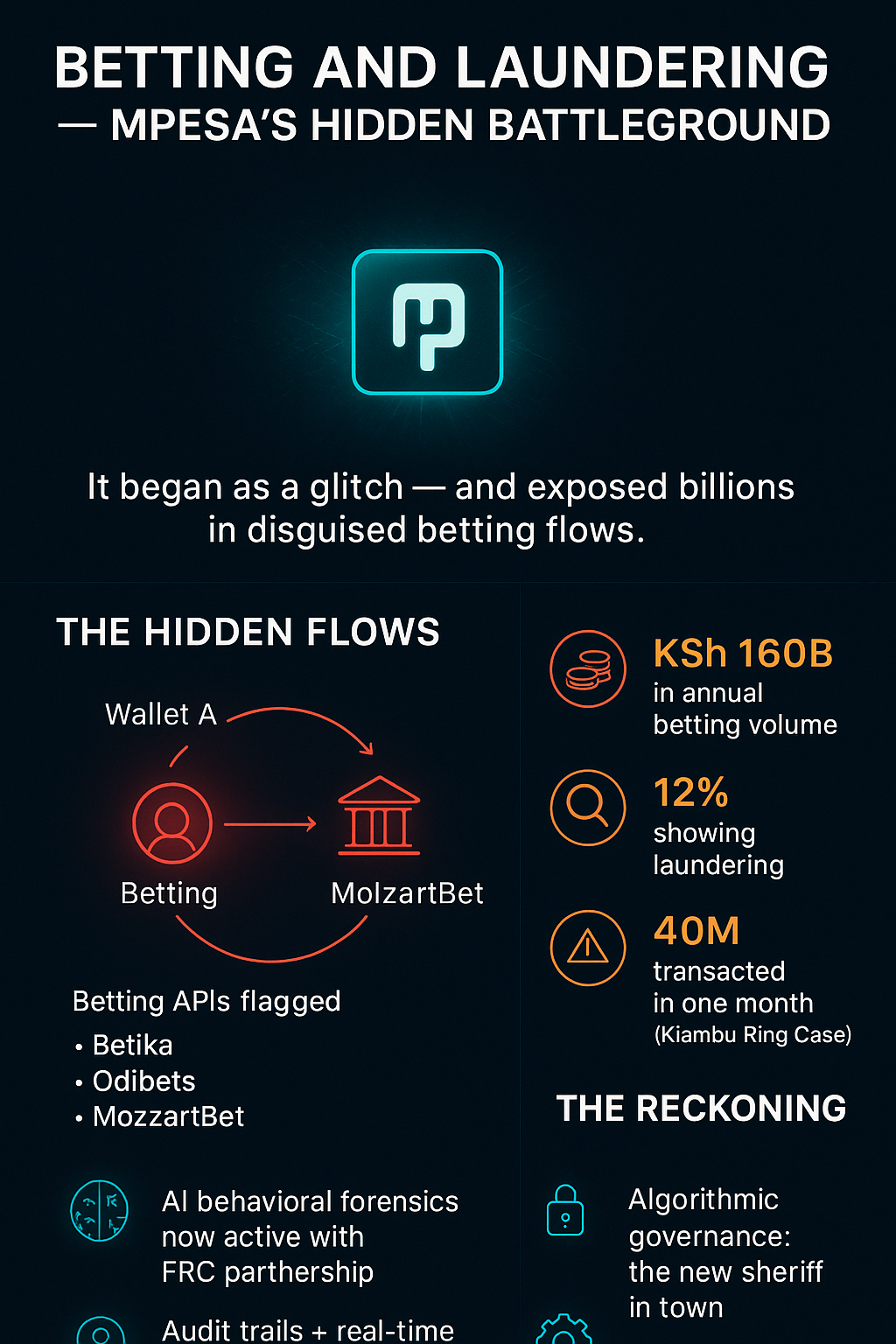
The numbers told their own story. In the Kiambu Betting Ring case, investigators uncovered agents processing over KSh 40 million in just one month, using layered deposits and false payout slips to disguise dirty money as betting gains. Similar patterns appeared in the MozzartBet compliance freeze of mid-2024, where offshore cash-outs linked to unverified wallet owners triggered intervention by the Financial Reporting Centre (FRC) and Central Bank’s AML unit. By then, the data was irrefutable. AI modeling suggested that nearly 12 percent of Kenya’s annual betting volume — roughly KSh 160 billion — showed characteristics of laundering or structured fraud. The algorithms traced wallet behaviors that no manual audit could — bettors who “won” every day without ever placing bets, agents whose transaction volumes exceeded physical limits, and accounts that went dark after a single large payout. These were not random outliers; they were engineered identities, designed to game a system built for speed, not scrutiny. For years, M-Pesa’s success story — its promise of instant, borderless convenience — had inadvertently created the perfect storm: a seamless digital infrastructure exploited by syndicates more agile than the law itself.

Now, that same infrastructure is being weaponized against them. Safaricom’s AI partnership with the FRC has ushered in a new era of behavioral forensics — algorithms that don’t just track money but interpret motion, timing, and correlation. Yet this technological awakening has sparked backlash. Betting firms accuse Safaricom of overreach, freezing legitimate transactions and blurring the line between compliance and surveillance. Regulators, meanwhile, are tightening the screws: audit trails for all gaming wallets, mandatory KYC verification, and real-time data access for AML enforcement. The ripple effects extend far beyond gaming. Kenya’s digital economy now stands at an inflection point, where algorithmic oversight has become both protector and disruptor. In exposing how entertainment masked economic deceit, the AI has done more than flag fraudulent wallets — it has held up a mirror to the fragility of digital trust in a cashless nation. The house may always win, but in this new frontier, so does the machine — and its vision is only getting sharper.

References:

Techcabal Safaricom fires 113 employees over fraud as internal cases rise

KBC Channel 1 Kenya’s gambling industry set for shake-up after President Ruto signs into law Gambling Control Bill (Youtube)

The Kenyan Wall Street How Safaricom is Leveraging AI to Bolster M-Pesa Security and Efficiency

KBC M-pesa outage on Monday as Safaricom adopts AI to tame fraud
The AI Awakening — Safaricom’s New War on Illicit Finance

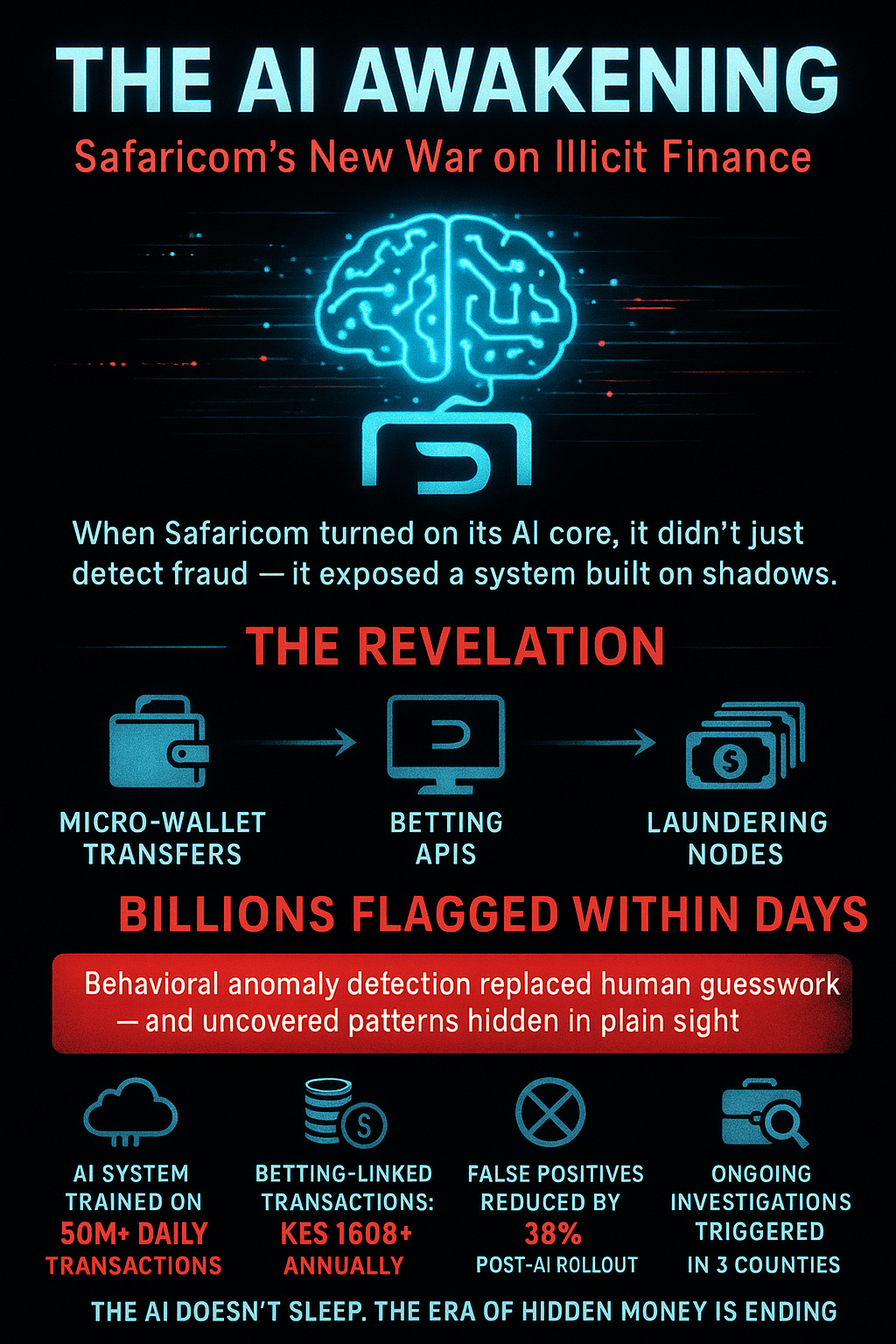
When Safaricom quietly switched on its new artificial intelligence engine earlier this year, no one expected it to rattle the country’s most powerful industry — or expose a side of M-Pesa no one was supposed to see. Within days, the system began lighting up with digital red flags: strange betting transactions looping through ordinary wallets, micro-deposits disguised as gaming payouts, and accounts moving small amounts in patterns too precise to be random. What the algorithms were seeing wasn’t play — it was laundering. Billions of shillings were silently being rinsed through Kenya’s favorite mobile platform, hidden beneath the guise of everyday betting. For weeks, engineers watched in disbelief as the AI’s alerts mapped a web of financial deception so intricate it blurred the line between entertainment and organized crime. The revelation shook Safaricom’s compliance teams — and soon after, the regulators who realized that Kenya’s most celebrated innovation had also become its most sophisticated laundering highway.

Inside Safaricom, a quiet revolution had begun. The company wasn’t just fighting fraud — it was reprogramming its financial DNA. The AI core, built in partnership with advanced compliance auditors and data scientists, doesn’t merely track transactions; it learns human behavior. It detects hesitation, timing anomalies, and wallet relationships that no manual audit could ever spot. What began as a compliance upgrade quickly turned into a forensic awakening — a self-learning system capable of catching what criminals believed was invisible. But the move also triggered backlash. Betting firms, some major ones, protested account freezes and accused Safaricom of overreach. Yet for Safaricom, this was no longer about risk — it was about survival. The same technology that made M-Pesa a lifeline for millions had made it a target for laundering syndicates. Turning AI loose on that frontier was less a choice than an inevitability.

Now, the discovery has thrown Kenya’s digital economy into uncharted territory. Regulators are scrambling to keep up, data privacy watchdogs are asking hard questions, and compliance officers are quietly celebrating the first real glimpse into the scale of illicit flows buried within mobile money. For the first time, artificial intelligence isn’t just assisting Kenya’s war on financial crime — it’s leading it. The system doesn’t sleep, doesn’t flinch, and doesn’t forget. And as it continues to learn, one thing is certain: the era of hidden money on M-Pesa is ending — but the reckoning it has triggered is only beginning. Stay tuned for the next post in this six-part series, where we will delve deeper into the implications of these changes.

References:

Techcabal How Safaricom’s AI exposed money laundering in Kenya’s betting boom

The Kenyan Wall Street How Safaricom is Leveraging AI to Bolster M-Pesa Security and Efficiency

Citizen Digital Father, son arrested for conning M-Pesa operators over Ksh.200K in Nairobi

KBC M-pesa outage on Monday as Safaricom adopts AI to tame fraud

Fraud in the Ministry of Education

More than 100 people, including top civil servants may face graft charges following a new forensic audit by the government revealing fraud involving Sh4.2 billion in the Education Ministry.

The Deputy Prime Minister Uhuru Kenyatta disclosed findings that alleged Sh4.2 billion intended for the Free Primary Education Programme (FPEP) is unaccounted for. Kenyatta, who is also the Finance Minister, handed over the audit report to the Criminal Investigation Department (CID) Director, Ndegwa Muhoro. Daily Nation website reported that, “according to Finance Minister Uhuru Kenyatta, the officials (in the Ministry of Education) not only stole the money, but also manipulated the records to hide the theft.” On one hand, Education Minister Prof. Sam Ongeri has sided with Uhuru Kenyatta in saying, “the focus was not going to be on prosecutions alone, but also on the recovery of the money, with the real possibility that some of the assets of those found guilty may be seized”, Daily Nation reported. On the other hand, Kenya Anti-Corruption Commission (KACC) Director, PLO Lumumba was reported accusing Uhuru Kenyatta of “putting on a show for the World Bank…” The article goes on to read that “Lumumba said Kenya is trying to look good before the world, whereas it is not, adding that the launch and handover of the report to the CID was meant to please the World Bank officials who are in the country to inspect the projects they sponsor.”  Last year, the U.K. Department For International Development (DFID) terminated its financial support to the Ministry of Education in Kenya citing, “It is vital that U.K. aid money is being spent on its intended purpose. We could not be sure this was happening and also we have stopped direct funding to the Ministry of Education in Kenya,” following a statement made by the DFID concerning allegations that some officials in the Ministry misappropriated the fund. Prior to the statement by the DFID, Prime Minister Raila Odinga suspended Ongeri from office for a period of three months following a report by PricewaterhouseCoopers Kenya and  Internal Auditor General, which “laid credible foundations…” African Press International (API) website reported. However, President Kibaki later annulled the suspension.

In 1970, Abba Eban, an Israeli diplomat, said, “history teaches us that men and nations behave wisely once they have exhausted all other alternatives.” Maybe this time the culprits involved in the scam will face the law. ‘Big and small fish’ alike all should be prosecuted, because only then will the government inch closer to recovering the lost billions and more so, toward ending the culture of impunity.

References:

How free education billions were stolen Daily Nation June 16, 2011

Heat over missing billions for schools The Standard June 14, 2011

DFID Halts Funding for Kenyan Education Ministry Devex March 16, 2010

Ministers Ongeri, Ruto suspended by PM Raila over graft: Will his action breed powerful

enemies and destroy his chances to seek presidency come 2012? African Press International February 14, 2010