Tourism Fees Under Fire: Should Kenya Charge More to Protect Its Parks?

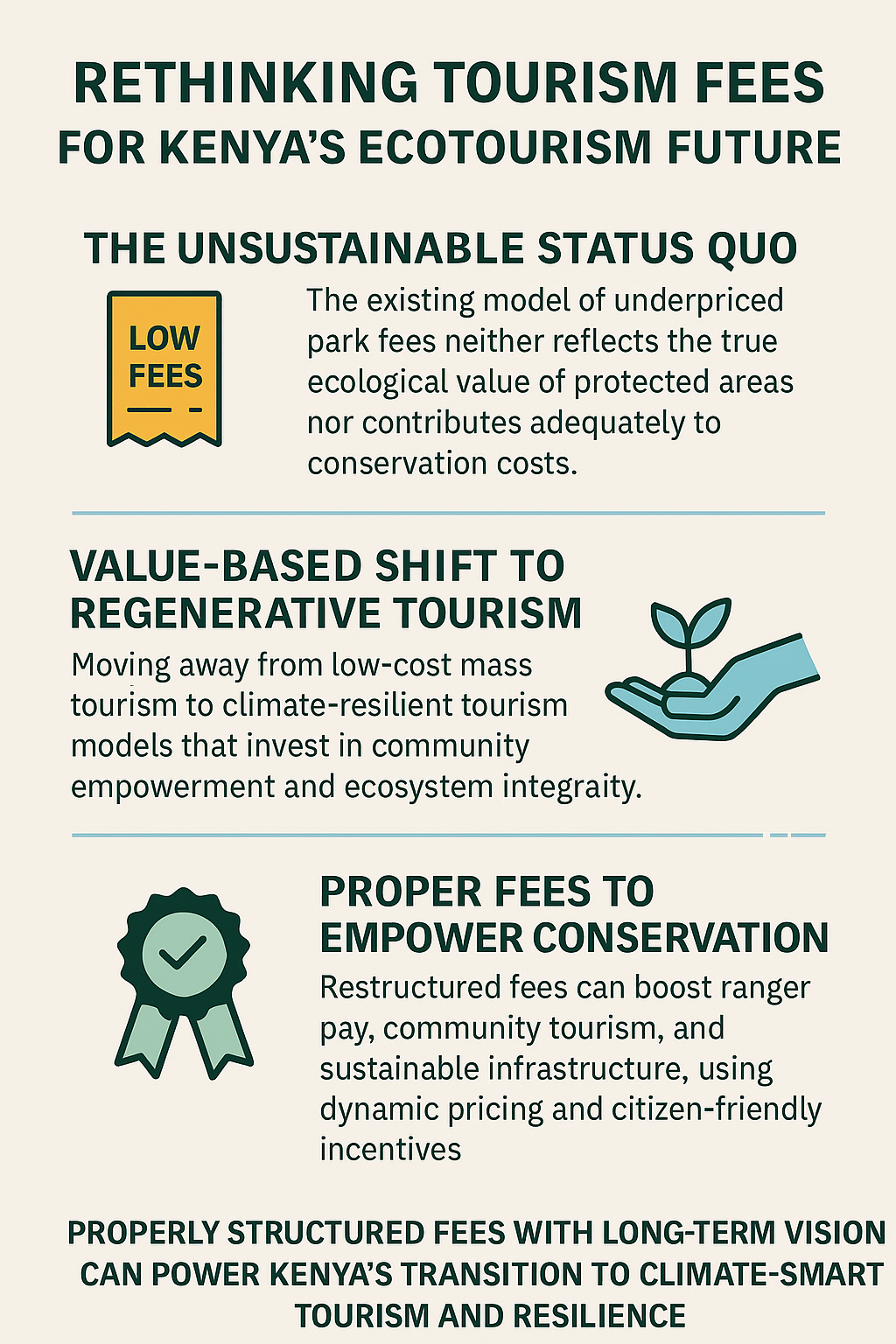
Kenya’s tourism sector is embroiled in a polarizing debate over the proposed increase in park entry fees by the Kenya Wildlife Service (KWS)—a move that has triggered pushback from parts of the tourism industry. Critics argue that the price hike could drive tourists away and stall the sector’s fragile post-COVID recovery. But that narrative, while convenient, masks a more urgent reality: our current tourism pricing model is fundamentally unsustainable. Kenya’s parks remain globally underpriced, with outdated fee structures that neither reflect the ecological value of protected areas nor contribute meaningfully to the conservation costs borne by the country. The research-backed push for value-based pricing is not just about economics—it’s about survival. A model dependent on cheap mass tourism ultimately risks collapsing under the weight of its own footprint, undercutting the very landscapes and wildlife it profits from.

Behind this pricing debate is a much bigger question: what kind of tourism future does Kenya want? Thought leaders like Prof. Bitange Ndemo have laid out a compelling vision for a shift away from extractive tourism that prioritizes volume, to regenerative tourism anchored in climate resilience, community empowerment, and ecosystem integrity. That means investing in tourism models that diversify products—like cultural tourism, eco-lodges, digital nomad experiences, and heritage circuits—that share value beyond the traditional safari elite. It also means linking fees directly to visible benefits: better ranger pay, stronger community tourism projects, and infrastructure that supports conservation rather than compromises it. The government’s failure to transparently communicate how increased revenue would be reinvested only feeds public skepticism, but that shouldn’t be used to stall reform altogether. If anything, it’s a call for better governance—not retreat.

The real danger isn’t raising fees—it’s failing to raise the bar. Kenya sits on the cusp of becoming a global model for climate-smart tourism, but that future will not be built on subsidized access and status quo politics. Properly structured fees—coupled with dynamic pricing, seasonal packages, and citizen-friendly incentives—can empower conservation without excluding access. The goal is not to gatekeep Kenya’s beauty, but to protect it with intention and long-term vision. Every tourist who visits our parks should not just be a guest but a contributor to a shared legacy of resilience. That’s the story Kenya should be telling the world—and charging fairly for.

References:

MDPI Re-Imagining Heritage Tourism in Post-COVID Sub-Saharan Africa: Local Stakeholders’ Perspectives and Future Directions

Travel Weekly Weighing the pros and cons of Kenya’s proposed safari park fee increase

The Journal of African Policy Studies Sustainable Tourism in Kenya: An Analysis of Tourism Policy Currently Under Consideration

EAC Tourism and Wildlife Management


Conservation Challenges in Kenya’s Maasai Mara Region

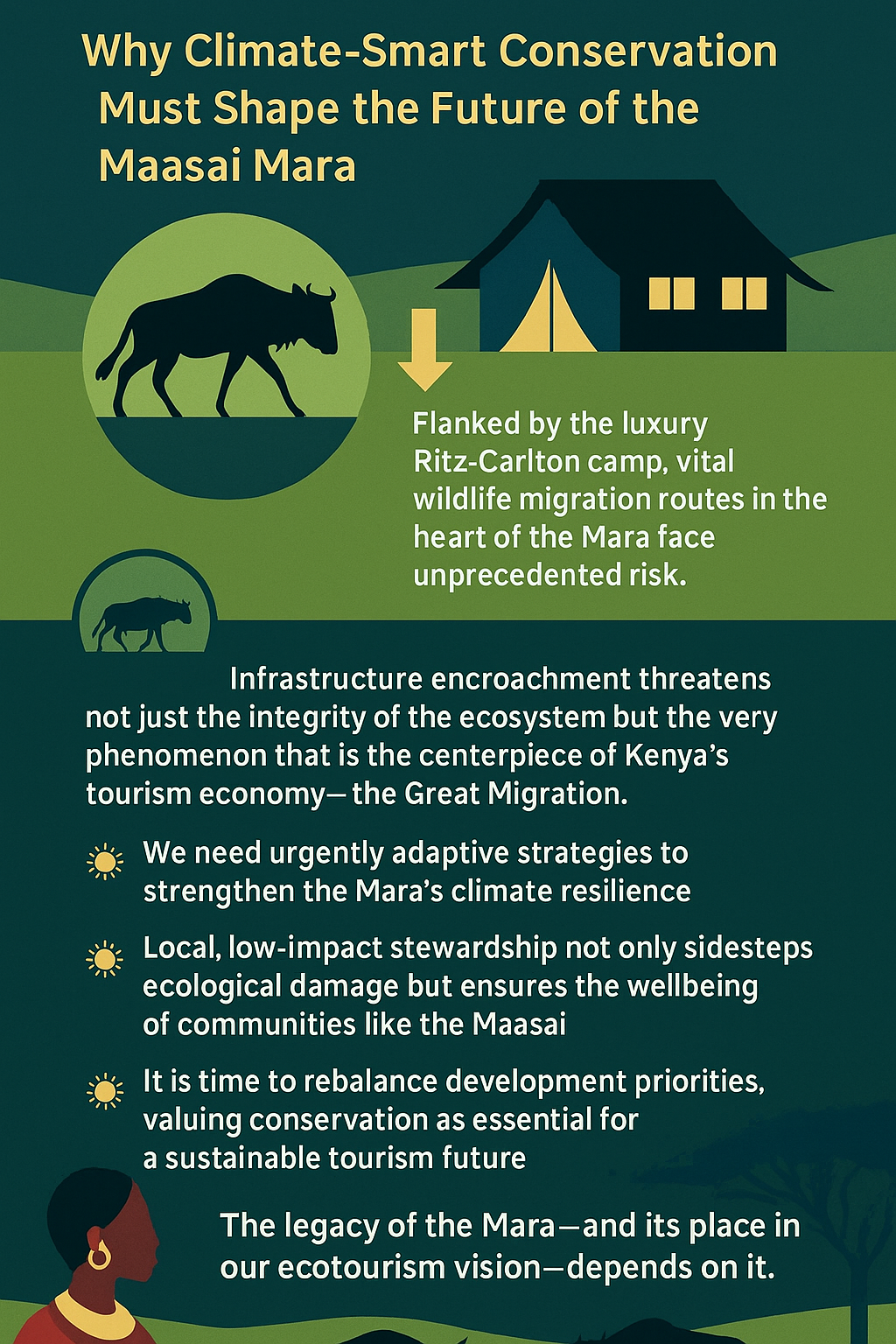
The Maasai Mara, one of the last remaining wild frontiers of Africa’s Great Migration and a cornerstone of Kenya’s ecotourism economy, now faces one of the gravest threats in its recent history—not from drought, poaching, or climate change alone, but from unchecked commercial expansion. A controversial plan to construct a high-end hotel complex and convention centre within the fragile Pardamat Conservation Area has triggered fierce opposition from environmental experts, conservancy leaders, tourism stakeholders, and sections of the local Maasai community. The development, backed by county government actors and private investors, was initially celebrated as a boost to job creation and conference tourism. But critics warn it could irreversibly damage the very ecosystem that draws visitors—and revenue—to the region.

At the heart of the concern is the ecological fragility of the Pardamat area, a critical corridor for wildebeest, elephants, and other migratory species. The proposed construction site borders sensitive wildlife routes and overlaps with communal land managed under an innovative conservation model that merges livestock grazing with wildlife protection. Experts argue that the scale and permanence of such infrastructure threaten to fragment habitat, displace species, and compromise the authenticity of the Mara’s wilderness appeal. Already, irregular land sales, fencing, and proliferation of unregulated camps have altered key migratory paths—choking the ecosystem and undermining decades of community-led conservation gains.

What the Mara needs is not another luxury venue, but a decisive pivot toward climate-smart, community-anchored ecotourism. This means planning developments in harmony with nature, prioritizing low-impact, mobile tourism models, and bolstering scientific land-use policies that preserve migratory corridors and biodiversity integrity. Kenya’s international tourism reputation—and its ability to withstand climate volatility—depends on how well we defend and innovate around natural heritage sites like the Mara. The future must be shaped not by profit margins alone, but by policies rooted in ecological wisdom, community ownership, and a long-term vision for a resilient, inclusive conservation economy.

References:

Spa Opportunities Marriott to open luxury safari camps in Kenya under JW Marriott and Ritz-Carlton brands, with architecture by LW Design

The Star Narok county defends Ritz-Carlton Safari Camp amid conservation criticism

The Standard County contests claims that new safari camp is obstructing wildlife

The Ritz Carlton The Ritz-Carlton, Masai Mara Safari Camp

Lake Nakuru’s New Waters: From Flamingo Spectacle to Tourism Uncertainty

Lake Nakuru, once Kenya’s unrivaled icon of flamingo tourism and a UNESCO World Heritage Site, is undergoing an environmental transformation that is quietly redefining its future. The dramatic shift from a shallow, alkaline soda lake to a swelling freshwater body—driven by climate change, deforestation, urban runoff, and persistent pollution—has reshaped not just the lake’s ecology, but also its economic and cultural purpose. Once celebrated as the “Lake of a Million Flamingos,” the site now faces a tourism identity crisis as its signature attraction—the vibrant flocks of Lesser Flamingos—has largely vanished due to the disappearance of Spirulina platensis, the algae they feed on. This ecological transition is not a fleeting anomaly; it signals a long-term reset, potentially stripping Kenya of one of its most iconic natural tourism assets.

The implications for Kenya’s tourism economy are profound. Flamingo migration has dealt a blow to the local hospitality industry, with ripple effects felt from Nakuru to Elementaita and Naivasha. The park’s submerged infrastructure—gates, roads, and buildings—has necessitated a KSh 38 million investment in repairs and relocation, eating into Kenya Wildlife Service’s already stretched budget. Yet amid this disruption, opportunity glimmers. Kenya has a chance to reframe Lake Nakuru not as a site of lost heritage, but as a blueprint for adaptive, resilient tourism in the age of climate change. KWS has already introduced new water-compatible experiences, including adjusted game-viewing routes and potential boating attractions. With careful investment, storytelling, and conservation marketing, this shift can usher in a new kind of eco-tourism centered on freshwater biodiversity, migratory birds, and climate adaptation success stories.

But realizing this vision demands urgency, strategy, and inclusivity. Conservation and tourism authorities must actively engage displaced communities, whose turn to illegal fishing underscores a deeper social fragility tied to the lake’s changes. Tourism policy must evolve to support heritage resilience—protecting UNESCO designation through scientific reinterpretation of the site’s ecological value, not just nostalgia for what it once was. Lake Nakuru stands at the frontline of global climate impact on natural heritage. If Kenya can lead the world in repurposing this park’s brand while safeguarding its ecosystems and communities, it won’t just save a destination—it will create a model for climate-smart tourism across Africa and beyond.

References:

Scientific Research Assessment of Spatial Expansion of Rift Valley Lakes Using Satellite Data

The Standard State of three Rift Valley Lakes worry experts

Talk Africa Lake Nakuru’s Water levels Expected to Cause More Havoc During The Rainy Season, Experts Say  

Jijuze Is Lake Nakuru’s Ecosystem at Risk Due to Pollution and Illegal Fishing?