Understanding Kosovo’s Quest for Global Acceptance and Territorial Issues

Kosovo’s journey to full international acceptance has been a protracted one since its declaration of independence from Serbia in 2008. While the newly formed nation garnered significant early recognition, the momentum has noticeably slowed in recent years, marked by a near five-year lull in any new countries formally acknowledging its sovereignty. This period of stagnation ended abruptly with Kenya’s announcement on March 26, 2025, making it the latest nation to recognize Kosovo. This diplomatic move, however, has not been without its challenges. Serbia, which continues to view Kosovo as its own territory, reacted with strong condemnation, accusing Kenya of violating international law and United Nations resolutions. This development throws a spotlight on the complex web of international relations surrounding Kosovo and the delicate balance countries must strike when deciding on recognition.

A Report by WawamuStats

The primary reasons for the limited and slowing recognition of Kosovo are deeply rooted in the ongoing opposition from Serbia, which views Kosovo’s independence as a direct assault on its territorial integrity and national sovereignty. This stance is powerfully supported by Serbia’s allies, Russia and China, both of whom hold veto power in the UN Security Council, effectively blocking Kosovo’s membership in the United Nations. This lack of UN membership significantly hinders Kosovo’s full integration into the global community. Furthermore, several European Union member states, including Spain, Slovakia, Cyprus, Romania, and Greece, have also withheld recognition, often citing concerns about territorial integrity and potential precedents for their own domestic issues. This intricate geopolitical landscape, where historical ties, strategic alliances, and concerns about sovereignty intersect, has created a significant hurdle for Kosovo in its pursuit of universal recognition.

Kenya’s decision to break the prolonged silence on Kosovo’s recognition has been met with immediate diplomatic fallout. Serbia has vehemently criticized the move, warning of damage to the long-standing friendly relations between the two nations and vowing to take diplomatic and political measures in response. Domestically, in Kenya, concerns have been raised about potential economic and diplomatic repercussions, with some fearing that this decision could isolate the country on the global stage. While Kenya’s government has defended its recognition by citing the International Court of Justice’s advisory opinion that Kosovo’s declaration of independence did not violate international law, the move underscores the contentious nature of Kosovo’s statehood and the potential diplomatic minefield that nations navigate when choosing to recognize its independence.

References:

Aljazeera Which countries recognise Kosovo’s statehood?

Capital News Serbia vows diplomatic response to Kenya’s recognition of Kosovo

Capital News Foreign Relations Committee member faults Kosovo recognition

Kosovapress Recognition from Kenya brings back criticism of the government: Four years of lobbying failure at the international level
EACOP Insights: Funding Strategies for Kenya’s Oil Sector

In a significant stride for East African energy, Uganda’s ambitious East African Crude Oil Pipeline (EACOP) project has recently secured a crucial funding boost, signaling a move towards the realization of this multi-billion dollar infrastructure. This development offers a wealth of insights for neighboring Kenya, which also harbors considerable aspirations in the oil and gas sector. While Uganda’s EACOP has navigated a complex landscape of financing challenges and environmental concerns to reach this milestone, Kenya’s own oil development plans, particularly in the South Lokichar basin, have faced delays and the withdrawal of key investors. The contrasting progress underscores a valuable opportunity for Kenya to learn from Uganda’s experience, especially in securing the necessary financial backing and managing the intricate environmental and social considerations that come with large-scale energy projects. As Kenya seeks to tap into its hydrocarbon resources for economic growth, the strategies employed and the hurdles overcome by the EACOP project provide a compelling case study in the realities of the regional energy landscape.

A Report by EACOP (March 2025)

Several key lessons emerge for Kenya from Uganda’s journey. Securing funding in an era of increasing climate consciousness requires a diversified approach, potentially looking beyond traditional Western financial institutions to engage with regional banks and explore partnerships with entities that have different investment priorities. Furthermore, proactively addressing environmental and social concerns through transparent impact assessments, robust mitigation plans, and genuine community engagement is paramount to minimize opposition and enhance project bankability. Uganda’s experience highlights the critical need for a strong and consistent government commitment, coupled with a stable and predictable regulatory environment, to build investor confidence. For Kenya, this means streamlining regulatory processes, ensuring policy consistency, and prioritizing the implementation of stringent environmental standards and community-focused initiatives from the outset. Building strong and stable relationships with international oil companies, ensuring transparency in agreements, and investing in essential infrastructure are also crucial takeaways for Kenya as it navigates the complexities of developing its oil and gas sector.

However, Uganda’s EACOP project has not been without its challenges, facing significant environmental opposition and concerns about social displacement. These potential pitfalls offer further learning points for Kenya. Proactive engagement with environmental stakeholders, prioritizing fair compensation and resettlement plans for affected communities, and striving for maximum transparency in all aspects of the oil and gas sector are essential to avoid similar controversies. Kenya must also be mindful of the broader risks associated with resource extraction, such as the “resource curse,” and implement sound economic policies to ensure long-term sustainable development. By carefully analyzing Uganda’s experience – both its successes in securing funding and the controversies it has faced – Kenya can strategically refine its own approach to oil and gas development, aiming for a path that is both economically beneficial and environmentally and socially responsible, ultimately positioning itself as a stable and attractive player in the regional energy market.

References:

Reuters Uganda’s $5 billion EACOP pipeline gets funding boost

Monitor EACOP secures funding as Uganda eyes oil production next year 

Jijuze Kenya’s Oil and Gas Ambitions: Opportunities and Challenges

Pumps Africa Kenya to restart licensing of oil and gas blocks

UN Environment Programme Greasing the wheels of Kenya’s nascent oil and gas sector

Pipeline & Gas Journal EACOP Secures First Tranche of Funding for $5 Billion Uganda-Tanzania Pipeline

Frequent Cabinet Reshuffles in Developing Democracies: Kenya Under Scrutiny

Cabinet reshuffles, a common feature in many developing democracies, often reflect a complex interplay between the need for governmental competence and the pressures of political maneuvering, as evidenced by the recent changes in the Kenyan administration. Defined as alterations in the executive branch’s composition, these reshuffles can be driven by various factors, including the desire to enhance government performance, address corruption, consolidate political power, reward loyalty, respond to public pressure, or signal policy shifts. The Kenyan cabinet reshuffle of March 2025, which saw key figures like Aden Duale moved to the Ministry of Health and Justin Muturi dismissed from his role in Public Service, exemplifies this dynamic. While the stated reasons often revolve around improving service delivery and aligning with the government’s agenda, underlying motivations frequently involve political considerations such as managing internal dissent, rewarding allies, and strategically positioning individuals within the executive. This constant reshuffling raises fundamental questions about the balance between appointing technically skilled individuals and ensuring political loyalty in the pursuit of effective governance.  

A Report by Citizen Digital

The motivations behind frequent cabinet reshuffles in developing democracies are multifaceted, often stemming from a blend of administrative and political imperatives. In the Kenyan context, the reassignment of Aden Duale to the Health Ministry to address challenges within the Social Health Authority suggests an attempt to improve government performance in a critical sector. However, the dismissal of Justin Muturi, following his public criticism of the government and subsequent accusations of incompetence from President Ruto, highlights the significance of political loyalty and the management of dissenting voices within the cabinet. Academic literature supports this observation, noting that leaders in developing democracies often prioritize consolidating political power and rewarding loyalty, sometimes at the expense of technical competence. This “loyalty-competence trade-off” is a recurring dilemma where leaders balance the need for effective governance with the imperative of maintaining political stability and control. The Kenyan reshuffle, with its mix of stated performance objectives and apparent political motivations, underscores this complex dynamic.

The frequent occurrence of cabinet reshuffles can have significant consequences for governance and public perception in developing democracies like Kenya. While intended to inject new impetus or address specific challenges, these changes can also lead to instability within government ministries, disrupting policy continuity and hindering the development of long-term strategic planning. When ministers are frequently moved or replaced, the time required for new appointees to gain expertise and build effective working relationships can impede the overall effectiveness of governance. Furthermore, if the public perceives these reshuffles as being driven primarily by political expediency rather than a genuine commitment to improved governance, it can erode public trust in government institutions and the democratic process. The Kenyan example, with its swift dismissal of a cabinet secretary after public disagreement, risks reinforcing perceptions of a system where loyalty trumps competence, potentially impacting public confidence and the long-term stability of the nation’s governance.

References:

The Star Duale moved to Health ministry in new Cabinet changes

KBC President Ruto drops Muturi in new cabinet changes

National Research University – Higher School of Economics, Moscow, Russia The loyalty-competence tradeoff in dictatorships and outside options for subordinates.

The Constitution Society The Complex Implications of Reshuffles


Kenya’s University Funding Legal Dispute Explained

The Court of Appeal’s recent intervention in the ongoing university funding dispute in Kenya has further complicated an already volatile situation. On March 26, 2025, the appellate court suspended the High Court’s ruling that had previously declared the Variable Scholarship Loan Funding (VSLF) model unconstitutional. This decision temporarily reinstated the controversial funding framework, allowing the government to resume its implementation while the appeal is heard. The suspension was granted based on arguments from the Higher Education Loans Board (HELB) and the Universities Fund (UF), both of which warned that halting the VSLF model would cripple their ability to allocate funds, potentially leading to financial instability and even the closure of multiple institutions. Former HELB Acting CEO Mary Muchoki emphasized in an affidavit that the High Court’s ruling could result in the indefinite closure of universities, underscoring the gravity of the situation. Similarly, former Universities Fund CEO Geoffrey Monari defended the VSLF model as a more equitable and cost-effective funding mechanism, cautioning that the previous decision could trigger a crisis in university financing. By suspending the High Court’s ruling, the Court of Appeal sought to balance the urgent need to sustain university funding with the concerns raised regarding the legality and fairness of the model. However, this move introduces another layer of uncertainty, as universities, students, and policymakers must now navigate an unpredictable legal landscape while awaiting a final resolution.

A Report by KTN News Kenya

To mitigate the immediate fallout and provide transparency, the Court of Appeal issued several directives aimed at ensuring that students, universities, and other stakeholders remain informed about the potential implications of the ongoing legal battle. The court instructed the Attorney General, HELB, and the Kenya Universities and Colleges Central Placement Service (KUCCPS) to disseminate detailed information about the VSLF model to all relevant parties within 14 days. This included clear communication to current beneficiaries and prospective applicants that the funding framework could still be subject to further changes. Additionally, the appellate court mandated the establishment of an appeals mechanism within the same timeframe, allowing students dissatisfied with their funding allocations or categorization to seek redress. These directives were an attempt to address the concerns raised by the High Court regarding the lack of transparency and due process in the implementation of the VSLF model. Nonetheless, the broader financial challenges facing Kenyan universities persist, as public institutions continue to struggle with substantial funding deficits while private universities remain burdened by unpaid government sponsorship funds. Although the temporary reinstatement of the VSLF model might alleviate some immediate financial pressures, the long-term sustainability of higher education funding in Kenya remains a pressing issue that requires a more comprehensive and permanent solution. The shift towards increased household contributions under the VSLF model raises additional concerns about affordability, particularly for students from low-income backgrounds, who now face the prospect of significant debt accumulation through student loans.

The current funding controversy is part of a broader historical shift in Kenya’s higher education financing strategy, transitioning from the Differentiated Unit Cost (DUC) model, which had been in place since 1995, to a more individualized, means-tested approach. Under the DUC model, public universities received block funding based on student enrollment and the costs associated with different academic programs, with the government initially expected to cover 80% of the unit cost. However, persistent underfunding led to financial distress for universities, necessitating alternative approaches. In May 2023, the government introduced the VSLF model, which sought to provide direct funding to students through a combination of scholarships, loans, and household contributions, assessed via a Means Testing Instrument (MTI). While this shift was designed to target financial aid to the most economically vulnerable students and encourage universities to diversify their revenue sources, it has sparked concerns about access and equity. The ongoing legal uncertainties surrounding the VSLF model have further exacerbated these concerns, as students remain unsure about their financial obligations, and universities continue to grapple with inconsistent funding. Moving forward, Kenya must establish a stable, transparent, and equitable university financing system that balances institutional sustainability with student accessibility. This requires strengthening legal frameworks, improving the MTI to ensure fairness, enhancing government investment, and exploring diversified funding sources such as public-private partnerships and alumni contributions. Without such reforms, the country risks entrenching financial instability in its higher education sector, limiting opportunities for students, and undermining national development objectives.

References:

Jijuze Impact of Kenya’s Court Decision on University Funding

The Standard Court of Appeal suspends ruling on university funding model

Kenya News Agency Govt reaffirms commitment to new varsity funding model

All Africa Kenya: COA Temporarily Allows Impementation of New University Funding Model


Kenya’s Oil and Gas Ambitions: Opportunities and Challenges

Kenya is intensifying its efforts to become a significant oil and gas producer, with the government introducing various incentives to attract global investors. This ambition builds on a history of exploration that began in the 1950s and led to the notable discovery of commercially viable oil in the South Lokichar Basin in 2012. Despite this potential, sustained commercial production has remained elusive. The government’s latest strategy involves a licensing round for ten promising oil and gas blocks, scheduled for September 2025. Alongside this, the government is offering tax incentives and flexible terms for Production Sharing Contracts, signaling a strong commitment to developing the sector. Investments in crucial infrastructure, such as the expansion of Lamu Port and the advancement of the Lamu-Lokichar pipeline project, are also underway to support exploration and future production.

A Citizen Digital Report (2022)

However, Kenya’s journey in oil and gas exploration has encountered numerous obstacles. While early efforts identified hydrocarbon presence in basins like Lamu and Anza, they were largely unsuccessful in achieving commercial viability. Logistical challenges, particularly the absence of a reliable pipeline to transport oil from the Turkana region to the coast, have been a major hindrance. Environmental concerns and the critical need for responsible resource management, along with the imperative of fostering positive relationships with local communities, have also posed significant challenges. The substantial oil reserves in the South Lokichar Basin, estimated at 2.85 billion barrels, have yet to be fully exploited due to these infrastructure deficits, coupled with economic uncertainties linked to fluctuating global oil prices and the substantial upfront capital required for development. Regulatory complexities and the evolving global energy landscape, with its increasing emphasis on renewable energy sources, have further complicated the path to commercial production. The recent withdrawal of key partners from the Lokichar project has also added to the existing difficulties.

Experts suggest that while Kenya’s oil and gas sector holds considerable promise, particularly with the untapped potential in various sedimentary basins, realizing this potential depends on effectively addressing the current challenges. Key recommendations for the Kenyan government include accelerating the development of essential infrastructure, most notably the Lokichar-Lamu pipeline, and enhancing the regulatory framework to provide greater clarity and attract sustained investment. Offering competitive fiscal terms, actively pursuing strategic partnerships, and ensuring transparency and good governance within the sector are also deemed crucial. Moreover, prioritizing sustainable and responsible resource management practices, alongside meaningful engagement with local communities and the promotion of local content, are vital for the long-term success and social acceptance of oil and gas development in Kenya. By drawing lessons from international case studies of successful oil and gas development and focusing on these critical areas, Kenya aims to convert its hydrocarbon aspirations into tangible economic progress and development.

References:

The Star Kenya to avail 10 oil and gas blocks to investors

The Standard Kenya to restart licensing of 10 oil and gas blocks in September

AInvest Oil Daily | Kenya Launches Oil Block Bidding, API Reports U.S. Crude Inventory Drop, ONGC Diversifies

Africa Energy Setback for Kenya’s Oil Ambitions as Tullow Oil’s Field Development Plan Faces Rejection

Pumps Africa Oil and Gas Pricing Trends in Africa: Challenges, Opportunities, and Future Outlook

Upstream TotalEnergies and Africa Oil quit Kenya oil project, leaving Tullow without partners

Transforming Nairobi: AI Traffic Management to Combat Congestion

Nairobi is set to revolutionize its traffic management with a Sh7.9 billion investment in an intelligent traffic system (ITS) financed by the Economic Development Cooperation Fund via the Export-Import Bank of Korea. The project will deploy AI-driven technology across 125 intersections—starting with 25 major junctions scheduled for completion by February 2027—in an effort to modernize urban mobility and reduce severe congestion, which currently drains an estimated Sh120 billion from the economy annually. With Kenya’s GDP (PPP) reaching USD 375.36 billion in 2024 and East Africa projected to post 6% regional growth in 2025, this initiative represents a critical step in transforming urban infrastructure. While focusing primarily on general traffic flow management, Nairobi’s plan hints at future phases that could integrate public transport, aligning its long-term vision with regional developments in cities like Addis Ababa and Dar es Salaam, where specialized systems already target bus rapid transit and multimodal transportation networks.

A Report about AI-Powered Smart Traffic Control System by See The Nature

A comparative look at regional systems reveals key differences and opportunities for Nairobi’s ITS. Unlike Dar es Salaam’s ITS, which prioritizes the safety, mobility, and efficiency of its Bus Rapid Transit (BRT) network through real-time data integration for operators and passengers, Nairobi’s initial emphasis remains on managing overall traffic flow. However, adopting elements from Tanzania’s broader national-level ITS strategy could guide future expansions to incorporate public transit more effectively. International best practices underscore Nairobi’s strengths, such as the use of artificial intelligence for real-time traffic control and automated violation detection—tools that could enhance enforcement and reduce the reliance on manual policing. Yet, critical areas need further detailing: adherence to open standards like NTCIP for system interoperability, designing a scalable architecture to support future technological advancements, and outlining clear protocols for data handling and compliance with Kenya’s Data Protection Act 2019. Moreover, the success of this system will hinge on robust internet connectivity (currently at 79%), a reliable fiber optic infrastructure, and comprehensive legal frameworks to govern data security and system operations.

A Report by CGTN Africa

For Nairobi’s ITS to achieve its full potential, a strategic approach incorporating both technical and community-focused recommendations is essential. Authorities should invest heavily in a resilient technological infrastructure—upgrading internet and sensor networks, expanding data processing capabilities, and resolving fiber optic disputes—to ensure that the system can handle the massive data volumes generated. Equally important is the establishment of a strong legal and regulatory framework that not only complies with Kenya’s Data Protection Act but also aligns with national traffic management policies and international standards. Public awareness and training initiatives are crucial; educating citizens on system benefits and new traffic protocols, while training traffic engineers and law enforcement on system management, will foster community acceptance and smooth implementation. In addition, measures to mitigate risks such as power outages, vandalism, and cybersecurity breaches must be integral to the project’s design. By embracing international best practices, encouraging collaboration with cities that have successfully implemented ITS, and focusing on scalability and reliability, Nairobi is poised not only to alleviate congestion but also to emerge as a regional leader in intelligent transportation, paving the way for a smarter, safer, and more sustainable urban future.

References:

The Star Samsung to build Nairobi’s Sh7.9bn intelligent traffic system

Kenyans.co.ke KURA to Begin Construction of AI-Powered Smart Traffic System in Nairobi This April

Business Insider Africa Top 5 largest economies in East Africa ranked

Nairobi Wire Intelligent Transport System Set to Transform Nairobi’s Traffic Flow by 2025

The Citizen DART signs contract to develop intelligent transportation system for BRT

Kenya Faces Crisis After USAID Funding Withdrawal

The abrupt cessation of funding from the United States Agency for International Development (USAID) has sent shockwaves through Kenya, marking a significant turning point in the country’s development trajectory. The decision by the US government to terminate approximately 83% of USAID’s global contracts has had an immediate and profound impact, with Kenya ranking as the seventh most affected nation worldwide, underscoring its heavy reliance on donor funding for crucial sectors. The sheer scale of the withdrawal, encompassing the cancellation of numerous projects across health, education, economic development, and governance, has left a void that will be challenging to fill. Organizations on the ground, such as CFK Africa, have reported widespread panic and uncertainty as essential healthcare services, particularly in the fight against HIV/AIDS and tuberculosis, face severe disruptions . The sudden halt has not only jeopardized the continuation of vital programs but has also resulted in significant job losses, with estimates suggesting that at least 35,000 Kenyans working in USAID-funded initiatives are now facing unemployment . This abrupt departure of a major development partner has ignited discussions about the long-term sustainability of Kenya’s development and the urgent need for alternative strategies.  

A Citizen Digital Report

The health sector in Kenya is bearing the brunt of the USAID funding freeze, with potentially devastating consequences for the progress made over the past two decades, particularly in combating the HIV/AIDS epidemic. While the US has allocated $66 million to HIV/AIDS programs in Kenya for 2025, this represents a significant decrease from the $846 million provided in 2023, signaling a concerning downward trend. The World Health Organization (WHO) had earlier warned that Kenya was among several countries at risk of running out of essential HIV drugs due to the aid pause, potentially undoing years of hard-won gains and leading to a resurgence of the disease. The termination has severely impacted the US President’s Emergency Plan for AIDS Relief (PEPFAR), which relies heavily on USAID’s logistical support, leading to an immediate halt in HIV treatment, testing, and prevention services across more than 50 countries. Reports from organizations like Médecins Sans Frontières (MSF) paint a grim picture of service shutdowns and treatment disruptions, leaving millions of vulnerable individuals without access to life-saving medications and care . The situation is further compounded by existing shortages of some HIV drugs within the country, creating a perfect storm that threatens to overwhelm the healthcare system .  

Beyond the immediate crisis in the health sector, the USAID funding cuts are expected to have far-reaching long-term repercussions across Kenya’s social and economic landscape . Programs supporting maternal and child health, tuberculosis and malaria control, water and sanitation, education, and economic development are all facing significant funding shortfalls . The termination of initiatives aimed at improving primary literacy, supporting smallholder farmers, and promoting trade and investment will hinder progress in these crucial areas . The Kenyan government now faces immense pressure to find alternative funding sources and implement sustainable development strategies to mitigate the impact of this significant withdrawal of aid . This necessitates a concerted effort to strengthen domestic resource mobilization, diversify international partnerships, engage the private sector, and foster local innovation to ensure the continued well-being and progress of the nation .

References:

The Star Kenya 7th most affected by US aid freeze

Aljazeera USAID’s demise raises fears for millions of lives across the Global South

Capital Business USAID funding halt to hit Kenya’s economy, social sectors – report

Nation USAID funding cuts disrupt vulnerable rural livelihoods in Turkana

Think Global Health Life After USAID: Africa’s Development, Education, and Health Care

Reliefweb CFK Africa Witnesses Devastating Effects in Kenya from End of U.S. Agency for International Development Support

Willow Health Media USAID Shut for Good: Millions at risk in Kenya, thousands jobless overnight 


How to Access Subsidized Fertilizer in Kenya

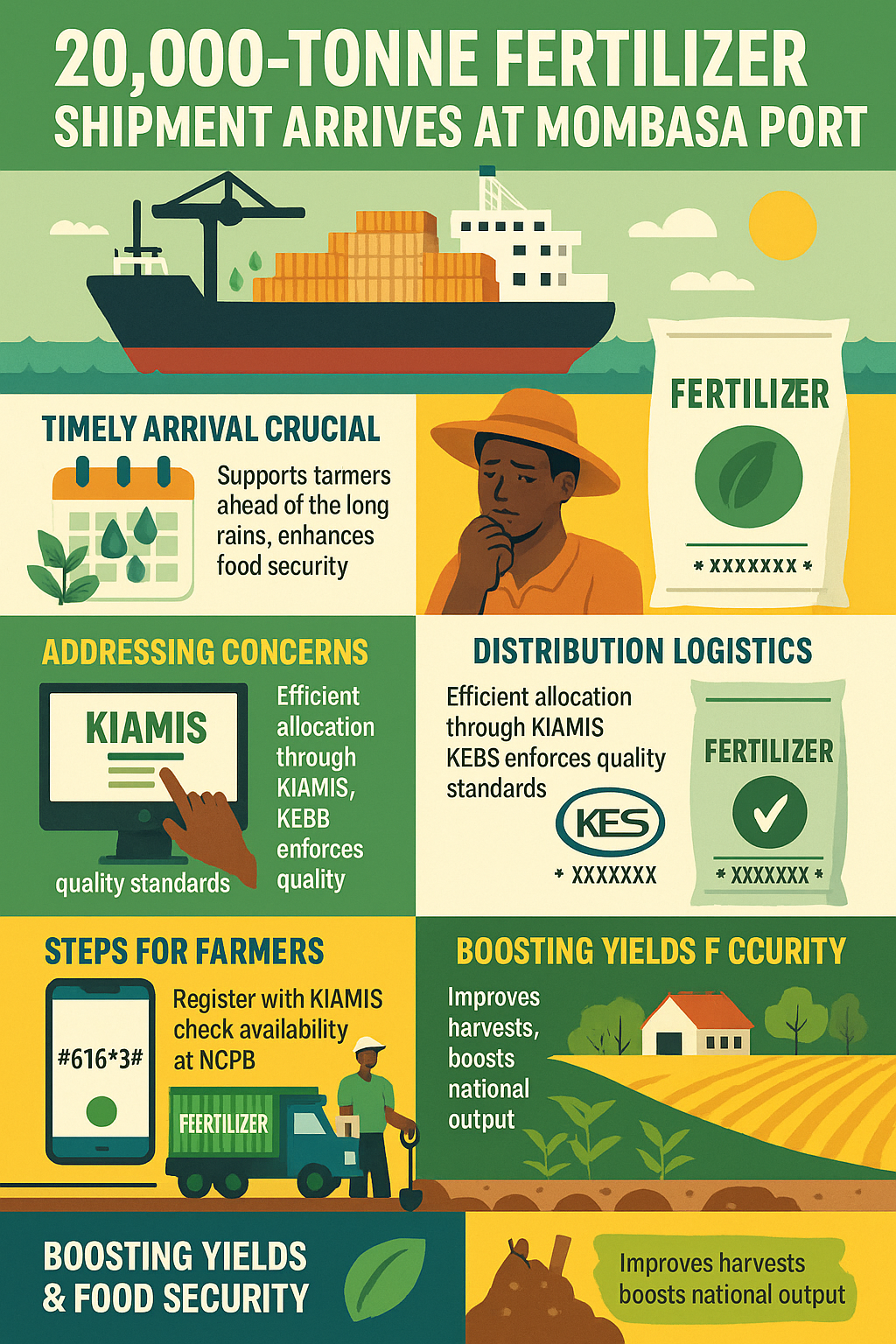
The arrival of a 20,000-tonne fertilizer consignment at Mombasa Port marks a significant milestone in the government’s efforts to support farmers ahead of the long rainy season, a crucial period for agricultural production in Kenya. The timely arrival of this shipment is expected to provide much-needed inputs to enhance food security and boost national yields. An additional 1,300 metric tons of fertilizer is expected soon, further reinforcing the commitment to ensuring farmers have access to essential inputs. However, concerns remain over the lack of transparency regarding the origin and composition of the shipment. The absence of details on the supplier and specific types of fertilizer included in the consignment may limit farmers’ ability to plan effectively, as different soil types and crops require specialized fertilizers for optimal growth. Additionally, past cases of substandard or expired fertilizers in the market have made quality assurance a priority for farmers and stakeholders alike. The government’s approach to addressing these concerns focuses on efficient allocation and swift distribution, primarily managed through the Kenya Integrated Agriculture Management Information System (KIAMIS), ensuring that only registered farmers receive their fair share of subsidized fertilizer.

To guarantee the quality of fertilizer reaching farmers, the Kenya Bureau of Standards (KEBS) plays a critical role in enforcing national quality standards. Farmers are urged to verify the authenticity of their fertilizer by checking for the KEBS Standardization Mark on the packaging and utilizing the SMS verification system by texting the unique code beneath the mark to 20023. This verification step is essential to protect farmers from counterfeit or substandard products that could negatively impact yields. Furthermore, distribution logistics have been carefully structured to ensure that fertilizer reaches key agricultural regions efficiently. The government, in collaboration with the National Cereals and Produce Board (NCPB), is overseeing a multi-modal transportation plan where the fertilizer is first transported from Mombasa to Naivasha by train and then distributed to major farming areas like Uasin Gishu, Bomet, and Nakuru via trucks. This logistical approach is intended to overcome transportation bottlenecks and ensure that farmers across the country receive their fertilizer in time for planting. However, the initial reports do not specify which types of fertilizers—such as Diammonium Phosphate (DAP) or Calcium Ammonium Nitrate (CAN)—are included in the shipment, leaving many farmers uncertain about how best to apply them to different crops. As a result, farmers are encouraged to seek further clarification from NCPB depots or agricultural extension officers before application.

Farmers looking to access the subsidized fertilizer must ensure they are registered with KIAMIS, a digital platform designed to streamline distribution and enhance transparency. Registration can be done through the National Government Administration offices, including local chiefs and village elders, or by dialing *616*3# to confirm or update their details. The use of this system helps prioritize genuine farmers while reducing the risk of fraudulent claims. Once registered, farmers should promptly check with their nearest NCPB depots to inquire about fertilizer availability and collection procedures, as delays in retrieval could affect their planting schedules. Additionally, soil testing is recommended to determine the specific nutrient requirements for different crops, allowing farmers to apply the right type and amount of fertilizer for maximum productivity. Staying informed through official government communication channels, such as the Ministry of Agriculture and NCPB updates, is crucial to keeping track of distribution schedules and additional shipments. With proper planning, timely collection, and strategic application of fertilizer, Kenyan farmers stand to significantly improve yields, contributing to national food security and economic growth.

References:

Kenya News Agency Farmers to receive fertilizer ahead of long rains

The Eastleigh Voice 20,000 tonnes of fertiliser arrive at Mombasa port as planting season starts

KEBS Marks of Quality

All Africa Kenya: Govt Assures Farmers On Subsidy Fertilizer Quality


High Court Strikes Down Government Media Directive

In a significant blow to the government’s media policy, the High Court has resoundingly declared as unconstitutional a directive that sought to channel all public sector advertising exclusively through the state-owned Kenya Broadcasting Corporation (KBC). This landmark ruling, delivered by Justice Lawrence Mugambi, effectively nullifies the order issued by the ICT Principal Secretary, Edward Kisiang’ani, in March 2024, which mandated that all government ministries, agencies, and parastatals place their advertising solely with the national broadcaster. The court’s decisive action underscores the judiciary’s commitment to upholding the tenets of the Kenyan Constitution, particularly those safeguarding media freedom, equality, and the principles of good governance, thereby setting a crucial precedent for the relationship between the state and the media landscape.  

A Report by KTN News Kenya

The High Court’s judgment hinged on the finding that the directive contravened several fundamental articles of the Constitution. Justice Mugambi meticulously detailed how the policy violated Article 10, which enshrines good governance and integrity, Article 27, which guarantees equality and freedom from discrimination, and Article 34, which protects the freedom of the media. The court reasoned that limiting government advertising to a single entity constituted an indirect form of control over the media, potentially stifling dissenting voices and undermining the independence of the press. Furthermore, the judge pointed out a critical procedural flaw, asserting that the ICT Principal Secretary had overstepped his legal authority, as the power to make such a significant policy decision regarding public procurement of advertising services rests solely with the Treasury Cabinet Secretary. This lack of legal mandate rendered the directive void from its inception, highlighting the importance of adherence to established legal frameworks in government operations.

The implications of this ruling extend far beyond a mere legal victory; it serves as a powerful reaffirmation of the critical role of a diverse and independent media in a democratic society. Had the directive been allowed to stand, it would have created an uneven playing field, unfairly disadvantaging private media houses that rely heavily on government advertising revenue for their sustainability. Critics had argued that such a policy would not only threaten the financial viability of independent media outlets, potentially leading to job losses and closures, but also limit the public’s access to a plurality of voices and perspectives. The court’s decision safeguards against the potential for government influence through financial leverage, ensuring that the media can continue to operate as a watchdog, holding power to account and providing the public with the information necessary for informed participation in national discourse.

References:

Citizen Digital High Court declares gov’t advertising monopoly unconstitutional

Nation ‘Non-existent powers’: Court quashes PS Kisiang’ani order restricting State advertising to KBC

Kenyans.co.ke High Court Rules That Kisiang’ani Directive Moving Govt Advertising to KBC is Unconstitutional

The Eastleigh Voice High Court declares ICT PS Kisiang’ani has no powers to decide who gets govt advertising

The Standard State cancels adverts to Standard Media as court set to rule on ad monopoly case


Kenya Ends $3.6 Billion IMF Loan: A Turning Point

Kenya’s decision to mutually end its $3.6 billion loan arrangement with the International Monetary Fund (IMF) marks a significant shift in the nation’s approach to economic management, primarily driven by a confluence of unmet fiscal targets and mounting public discontent . The existing Extended Fund Facility (EFF) and Extended Credit Facility (ECF) arrangement, while having disbursed a substantial $3.12 billion, faced a critical juncture with its ninth review, which ultimately was not pursued . The core issue stemmed from Kenya’s inability to meet specific fiscal obligations stipulated under the program, leading to the cancellation of a significant $850 million payment . This failure to adhere to the agreed-upon spending and revenue collection benchmarks highlighted the challenges President Ruto’s administration encountered in balancing the demands of fiscal discipline with the socio-political realities on the ground . Compounding these difficulties were the widespread public protests against the Finance Bill of 2024, a piece of legislation designed to boost government revenue in line with IMF recommendations but which proposed tax hikes on essential goods, triggering significant public outcry and ultimately its withdrawal . Despite this setback, Kenya has already initiated discussions with the IMF for a new loan agreement, indicating a continued recognition of the necessity for external financial support as the nation grapples with a considerable debt burden.  

A Report by NTV Kenya

The abrupt termination of the IMF program carries significant implications for Kenya’s already strained economic landscape, particularly concerning its high levels of debt and the stability of its financial markets . With a debt-to-GDP ratio exceeding sustainable thresholds and a substantial portion of government revenue already committed to debt servicing, the discontinuation of IMF funding introduces a potential funding gap that could further exacerbate these vulnerabilities . While the government has sought alternative financing through a loan from the UAE and the restructuring of Eurobonds, these measures may come with increased borrowing costs and potential foreign exchange risks . Experts also anticipate that the absence of the IMF program’s oversight could lead to renewed pressure on the Kenyan Shilling and the external sector, potentially impacting inflation and investor confidence . The IMF itself had previously assessed Kenya’s public debt as being at a high risk of distress, and the termination of the program could intensify these concerns, making future access to international capital markets more challenging and potentially increasing the long-term risk of default .  

Looking ahead, Kenya faces a period of economic uncertainty that will require careful navigation and strategic policy decisions . The government will likely need to implement further austerity measures, including budget cuts and enhanced domestic revenue collection, to compensate for the lost IMF funding and maintain fiscal credibility . The success of these measures, coupled with the ongoing negotiations for a new IMF loan agreement targeted for finalization by November 2025, will be crucial in determining Kenya’s economic trajectory . Building public trust and ensuring transparency in the implementation of fiscal reforms will be paramount, especially in light of the recent widespread protests against IMF-backed austerity measures . Ultimately, Kenya’s ability to achieve long-term economic stability and inclusive growth will depend on its commitment to fiscal discipline, equitable revenue mobilization, and sound governance practices in the absence of the previous IMF program.

References:

News Central Kenya Abandons Existing IMF Programme in Pursuit of New Loan Agreement

Further Africa Kenya and IMF Drop Loan Review and Move Toward New Financing Deal

Daba Finance Kenya Faces IMF Setback After $800M Review Falls Through

Aljazeera What do the IMF and foreign debt have to do with Kenya’s current crisis?

The Eastleigh Voice Gen Z anti-tax demos dented Kenya’s GDP growth prospect for 2025 – IMF

African Business IMF exit and eurobonds raise questions over Kenyan debt