Kenya’s Circular Economy Moment — A 10-Year Blueprint for What Comes Next

Kenya has now reached the point in its circular economy journey where ambition is no longer the constraint — execution is. Over the course of this series, we have traced the full arc of the challenge: from the structural realities of plastic waste, to the centrality of informal workers, to the promise and limits of advanced recycling technologies, to financing, regional positioning, and the risks of institutional failure. What emerges is not a story of inevitability, but one of choice. Kenya has assembled most of the components required for a functional circular system. What remains unresolved is whether those components will be integrated into a coherent, enforceable, and durable whole. The next decade will not be defined by new strategies or declarations, but by the quality of implementation that follows the ones already on the table.

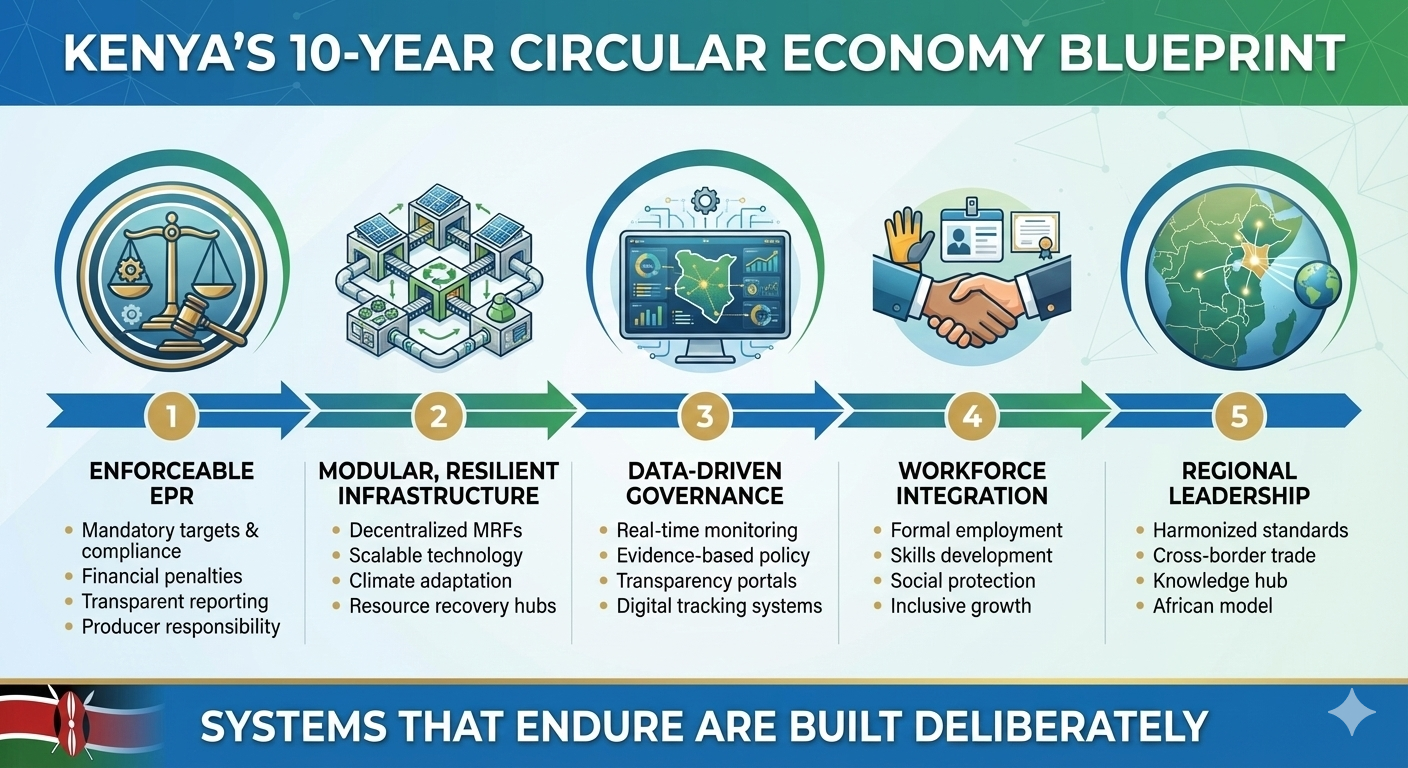
A credible 10-year circular blueprint for Kenya rests on a small number of non-negotiables. First, enforcement must be normalized. Extended Producer Responsibility cannot remain a negotiated obligation; it must become a predictable cost of doing business, applied evenly and transparently. Second, infrastructure must be scaled deliberately, favoring modular, resilient systems over politically attractive megaprojects that fail under operational stress. Third, data must move to the center of governance — from digital EPR reporting and material traceability to public performance dashboards that make compliance visible and verifiable. And finally, the informal waste workforce must be formally integrated, not rhetorically acknowledged. Stable pricing, standardized contracts, access to health and safety protections, and financial inclusion are not social add-ons; they are system stabilizers.

If Kenya can align these pillars, the payoff extends well beyond waste management. A disciplined circular economy strengthens industrial policy, attracts long-term capital, stabilizes supply chains, and positions the country as a regional materials hub at a moment when global markets are actively reshuffling. Failure, by contrast, will not be dramatic — it will be quiet, gradual, and familiar: underperforming facilities, investor fatigue, informal workers absorbing systemic risk, and opportunities migrating elsewhere. Kenya’s circular economy moment is not a single policy decision or flagship project. It is a sustained, cumulative choice to govern complexity with consistency. The window is still open. What will determine the outcome is whether the next ten years are spent managing appearances — or building systems that endure.

References:

Kenya Plastics Pact Kenya Plastics Pact & WWF-Kenya Drive Plastic Recycling Efforts Amid EPR Implementation

Sustainable Packaging Middle East & Africa Kenya’s Extended Producer Responsibility (EPR) regulations to take effect on May 5, 2025

The Standard Counties blamed for failure to adopt waste management plants

The Exchange Africa’s SMEs: How Policymakers Can Speed Up Growth and Innovation

The Innovations That Will Separate Circular Leaders from Laggards

The next phase of the circular economy will not reward enthusiasm — it will reward precision. Across Africa, the coming divide will not be between countries that “care” about sustainability and those that do not, but between systems that can deploy advanced technologies with discipline and those that remain trapped in manual, under-capitalized models. The age of blanket recycling narratives is ending. What is emerging instead is a highly technical, data-driven materials economy where feedstock quality, traceability, emissions accounting, and digital enforcement determine who attracts capital and who is bypassed. Kenya’s challenge is no longer whether it can adopt innovation, but whether it can do so fast enough — and with enough governance — to remain competitive as global standards tighten.

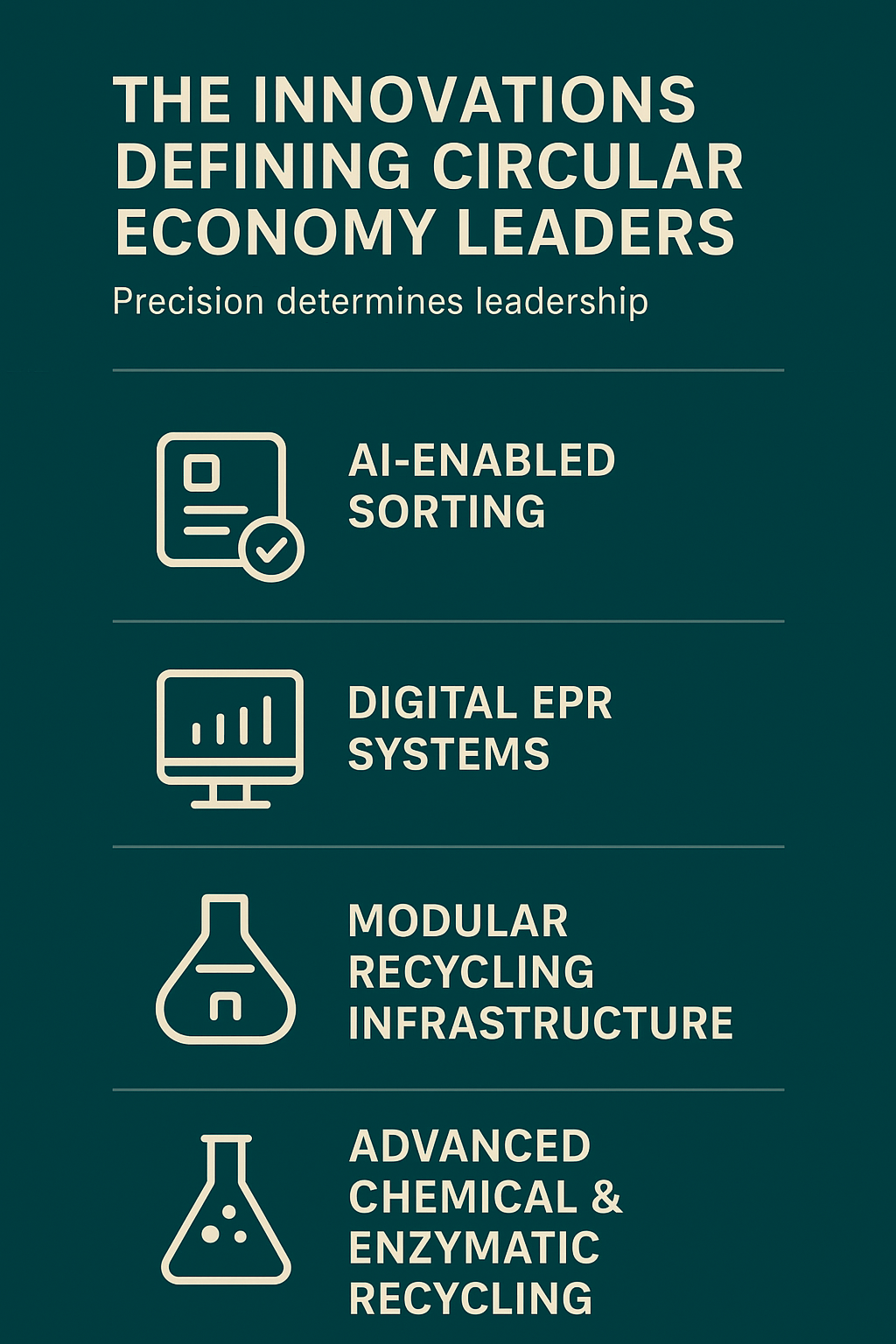
At the center of this separation are four innovation frontiers already reshaping advanced circular systems worldwide. First is AI-enabled sorting, which uses machine vision and spectroscopy to achieve purity levels manual systems cannot sustain, unlocking higher-value rPET and polyolefin streams. Second is digital EPR infrastructure — real-time producer reporting, automated compliance scoring, and public dashboards that eliminate regulatory opacity. Third is modular recycling architecture, where decentralized, scalable MRFs replace monolithic plants that collapse under feedstock volatility. And fourth is advanced chemical recycling, including depolymerization and enzymatic processes that reclaim value from materials mechanical systems cannot process. None of these technologies are experimental. What remains experimental in Africa is the institutional capacity to deploy them without distortion.

The danger for Kenya is not technological exclusion — it is selective adoption without system reform. AI sorting without feedstock discipline fails. Chemical recycling without emissions oversight invites backlash. Digital platforms without enforcement authority become cosmetic. Innovation only works when it is embedded inside a governed system that punishes non-compliance and rewards performance. Countries that master this integration will dominate future recycled-material markets, attract patient capital, and shape regional standards. Those that do not will watch value leak outward — exporting waste, importing virgin plastics, and subsidizing inefficiency with public funds. Going forward, its not about what Kenya could adopt someday. It is about what it must deploy now — deliberately, decisively, and without illusions — if it intends to remain relevant in the circular economy that is already taking shape.

References:

Sustainability Magazine AI and robotics are transforming recycling with EPR laws

Tomra Recycling News

UOCS Revolutionizing Recycling: Smart Technologies for Plastic Waste

Wikipedia CleanHub

Kenya Plastics Pact Kenya Plastics Pact & WWF-Kenya Drive Plastic Recycling Efforts Amid EPR Implementation

Wikipedia Recykal

Why Circular Economy Projects in Africa Fail — And Why Kenya Is Still at Risk

Africa’s circular economy graveyard is already full — littered with donor-funded pilots, ribbon-cut recycling plants, and policy frameworks that never made it past the launch event. The continent does not lack ideas, technologies, or goodwill. It lacks execution discipline. Circular projects fail not because the science is flawed, but because governance is weak, incentives are misaligned, and accountability dissolves the moment external funding expires. Kenya is not immune. Despite progress on EPR, private-sector engagement, and innovation, the country remains structurally exposed to the same failure patterns that have derailed circular initiatives across the continent: regulatory softness, political interference, underpriced waste, unreliable data, and a dangerous tolerance for “pilot culture” that rewards announcements more than outcomes.

The most common failure point is institutional fragility. Waste systems collapse when counties are underfunded, when regulators lack enforcement capacity, and when standards exist on paper but not in practice. Facilities designed to process thousands of tonnes operate at a fraction of capacity because feedstock flows are unstable, contaminated, or diverted through informal channels. Producers default to virgin materials because enforcement is weak. Investors retreat because market signals shift without warning. And in the background, the informal waste workforce absorbs the shock — losing income, facing unsafe conditions, and subsidizing system failure with their bodies. This is the brutal reality: without strong institutions, circularity becomes extractive, not regenerative.

Kenya now stands at a narrow threshold between replication and rupture. It can repeat the familiar African cycle — ambitious strategies undermined by weak enforcement and politicized implementation — or it can confront the uncomfortable truth that circular economies only work when failure is punished and compliance is unavoidable. That means independent regulators with teeth, public dashboards that expose non-compliance, hard penalties for EPR defaulters, standardized contracts that protect waste pickers, and zero tolerance for underperforming infrastructure. There are no shortcuts left. As the global plastics transition accelerates, Kenya will either prove it can govern complexity — or it will join the long list of countries that mistook intention for capacity. This is the moment where rhetoric must end, and consequences must begin.

References:

OECD Extended producer responsibility and economic instruments

GreenPeace New documentary exposes recycling fallacy and health impacts of plastic pollution on Kenya’s waste workers

MarcoPolis Silafrica Kenya’s Akshay Shah on Sustainable Packaging and the Future of the Circular Economy in Africa

The Exchange Africa Africa’s SMEs: How Policymakers Can Speed Up Growth and Innovation

Frontiers in Sustainability Transitioning circular economy from policy to practice in Kenya

The Standard Counties blamed for failure to adopt waste management plants

Envaco The Role of Circular Economy in Kenya’s Waste Management Future

EnvyNature Waste Management in Africa: What’s Working and What’s Next

Kenya’s Regional Advantage — How the Country Can Lead East Africa’s Circular Economy

Kenya is entering a pivotal moment where its internal reforms — if executed with discipline — can position the country as the anchor of East Africa’s circular economy. The region is fractured by uneven policy implementation, weak cross-border standards, and inconsistent producer accountability. Uganda’s plastics bill remains contested; Tanzania’s sector is progressing but largely enforcement-light; Rwanda has strong bans but limited high-capacity recycling infrastructure. Amid this landscape, Kenya is uniquely placed: it has an active plastics pact, defined EPR regulations, a dense private sector ecosystem, and a maturing national conversation on circularity that is more advanced than its neighbours. But leadership is not declared — it is earned. For Kenya to be the region’s circular hub, it must create clear domestic order: stable EPR markets, reliable feedstock flows, predictable investment signals, and systems that can actually scale. Kenya will not lead East Africa by having the best policy documents; it will lead by having the most functional system.

What makes this moment strategically significant is the shifting geopolitics of waste, recycling, and materials value chains. East Africa is rapidly becoming a new battleground in the global plastics transition. Europe is tightening export rules. Asia is closing loopholes. International brands are seeking compliant, reliable supply chains for recycled content, and multinationals are aggressively diversifying their sourcing away from over-saturated Asian markets. Kenya can seize this opportunity — but only if it builds regional interoperability. That means establishing cross-border quality standards for rPET and polyolefins, harmonizing EPR reporting templates within the EAC bloc, and negotiating regional offtake corridors that allow plastic waste and recycled outputs to move as legitimate industrial commodities rather than informal grey-market flows. If Kenya does not define the rules, someone else will — and the region will fall into predictable fragmentation, with each country setting incoherent standards that frustrate investors and undermine the economics of circularity.

Kenya’s next frontier is to turn its emerging domestic system into a regional value proposition. A country with functional MRFs, enforceable EPR, clear emissions oversight, and a formalized waste workforce can anchor regional offtakes, host cross-border recycling partnerships, and operate as the processing hub for high-quality recycled materials. This is not just about environmental leadership; it is about industrial strategy. Recycled PET, high-grade polyolefins, and monomers from enzymatic recycling are already becoming competitive export commodities. A well-structured Kenya can supply the region, attract capital, and negotiate stronger procurement terms with global brands seeking compliant supply chains. The opportunity is enormous — but it depends entirely on Kenya proving, through action rather than rhetoric, that it can run a transparent, disciplined, and investable circular system. If Kenya consolidates its internal framework now, it can shape East Africa’s circular economy for a generation. If it delays, the window closes — and leadership moves elsewhere.

References:

Kenya News Agency Kenya Plastics Pact Commits to Combat Plastic Pollution

Kenya News Agency Kenya launches roadmap for recyclable plastics by 2030

Sustainable Packaging Middle East & Africa Kenya’s Extended Producer Responsibility (EPR) regulations to take effect on May 5, 2025

Sustainable Packaging Middle East & Africa Kenya’s private sector rallies behind new plastics pact to drive circular economy shift

All Africa Kenya Launches Responsible Sourcing Drive to Protect Waste Pickers

The East African Plastic, plastic everywhere but not for African recyclers

Financing Kenya’s Circular Future — The Capital Architecture Required for the Next Decade

Kenya’s circular transition will ultimately depend on finance — not innovation alone, not legislation alone, and not public awareness alone. Finance is the absolute center of gravity. Every global circular success story has been capital-driven: France’s aggressive EPR enforcement, South Korea’s large-scale MRF modernization, South Africa’s PETCO producer-funded model. Kenya, by contrast, continues to rely on fragmented donor pilots, undercapitalized county systems, and private recyclers who operate without predictable feedstock, stable purchase agreements, or affordable credit. The informal workforce — waste pickers who recover the majority of recyclable material — remains excluded from formal banking, insurance, or guaranteed earnings. If Kenya is serious about a true circular transformation, it must design a capital architecture equal to the scale of its ambitions, and it must do so with urgency, discipline, and policy coherence.

The backbone of this architecture must be blended finance: a structured layering of public, private, and philanthropic capital where DFIs absorb first-loss risk, counties provide enabling infrastructure, and private investors supply growth capital for recycling and waste-processing assets. Mechanical recycling plants, enzymatic modules, pyrolysis reactors, digital sorting systems, county-level MRFs — none of these scale through private capital alone because they depend heavily on long-term certainty of feedstock, energy prices, and off-take markets. That certainty can only come from enforceable EPR economics: mandatory recycled-content thresholds, minimum floor prices for PET and polyolefin feedstock, penalties for virgin substitution, and transparent national dashboards that expose producer compliance in real time. Without this market security, investors will hesitate, capital will stall, and Kenya will remain trapped in the expensive improvisation cycle that has defined the past decade.

But perhaps the most critical — and most overlooked — component of circular financing is the treatment of the informal waste workforce. They are the engine of Kenya’s recycling system, yet they absorb the greatest risks for the lowest rewards. Financing Kenya’s circular future means integrating waste pickers into the economic framework: stable purchase guarantees, micro-credit for equipment, digital wallets for secure payments, training stipends, and a national health and safety fund co-financed by government and producers. Social inclusion is not a humanitarian add-on — it is economic infrastructure. A circular economy that excludes the workforce that supplies its feedstock will remain permanently fragile. If Kenya builds a financing system that blends capital intelligently, enforces EPR without compromise, stabilizes feedstock markets, and dignifies the workers who keep the system alive, every innovation in this series becomes scalable. If not, even the most promising breakthroughs will collapse under the weight of familiar structural failure.

References:

Kenya News Agency Kenya launches roadmap for recyclable plastics by 2030

Kenya News Agency Kenya Plastics Pact Commits to Combat Plastic Pollution

Packaging Producer Responsibility Organization PAKPRO launches nationwide EPR awareness campaign in Mombasa, Kenya

Sustainable Packaging Middle East & Africa Kenya’s private sector rallies behind new plastics pact to drive circular economy shift

Sustainable Packaging Middle East & Africa Kenya’s Extended Producer Responsibility (EPR) regulations to take effect on May 5, 2025

All Africa Kenya Launches Responsible Sourcing Drive to Protect Waste Pickers

Climate Change.co.ke A Complete Guide to Kenya’s Green Bond Market for New Investors — Analysis of Kenya’s green bond issuances and investor appetite, relevant to discussions of blended and climate-aligned finance for circular infrastructure.

Kenya’s Circularity Roadmap — Building the Hybrid System That Can Finally Break the Plastic Cycle

Kenya’s plastic crisis will not be solved by a single breakthrough, a single technology, or a single policy decree. If the past four posts have made anything clear, it is that this challenge is multi-layered — social, economic, technological, institutional — and requires a system far more sophisticated than anything the country has attempted so far. Mechanical recycling alone cannot handle the volume or complexity of the waste stream. Enzymatic recycling promises high-value transformation but depends on disciplined feedstock management and purposeful capital. Pyrolysis offers a pathway for Kenya’s dirtiest plastics, but only if environmental oversight becomes a non-negotiable pillar of implementation. And behind all of it stands the human backbone of Kenya’s recycling economy: the informal waste pickers whose labour determines whether any of these systems succeed or fail. The future Kenya wants — clean cities, competitive green industries, dignified work, and reduced dependence on virgin petrochemicals — will require a hybrid circularity model capable of integrating all these components without allowing any one of them to cannibalize the rest.

At the center of this roadmap is a quiet revolution in sorting and digital traceability — the infrastructure Kenya has never fully built. Without accurate sorting, mechanical recycling loses efficiency, enzymatic systems lose purity, and pyrolysis loses economic viability. High-tech optical sorters, digital barcoding, blockchain-driven EPR registries, and AI-enabled materials classification systems are no longer luxuries; they are foundational to a modern circular economy. Countries that have mastered these — from South Korea to France — have done so by centralizing oversight, enforcing producer responsibility, and investing heavily in data-first waste systems. Kenya’s EPR regulations are a promising start, but they require real teeth: mandatory reporting, enforceable purchase obligations for recycled content, non-negotiable penalties for non-compliance, and transparent digital dashboards accessible to the public. Anything less risks turning EPR into another policy with impressive language but weak outcomes.

What Kenya builds over the next five years will determine whether the nation becomes a continental leader in green industrialization or remains trapped in a costly cycle of environmental degradation and lost economic opportunity. The roadmap is clear:
• Mechanical recycling must continue as the backbone for high-volume, easily recoverable plastics.
• Enzymatic recycling should anchor Kenya’s entry into premium circular markets — producing high-grade rPET for export and high-value manufacturing.
• Advanced pyrolysis should be deployed cautiously, strategically, and only under strict regulatory regimes to handle non-recyclable residues.
• Waste pickers must be formalized, protected, and integrated into digital systems that guarantee stable income, health protections, and training.
• Municipalities must build modern MRFs, supervised by independent bodies with zero political interference.
• Financing must be blended — public, private, philanthropic — to derisk innovation and scale responsibly.
If Kenya commits to these pillars, it can escape the linear waste economy and construct a circular system that is clean, fair, profitable, and future-ready.
If it fails, the country will remain stuck in a loop where every new solution dies under the weight of the same old structural weaknesses.

References:

Kenya Plastics Pact Kenya Plastics Pact & WWF-Kenya Drive Plastic Recycling Efforts Amid EPR Implementation

The Star Tackling pollution: How Murang’a engineer is converting plastic waste into clean fuel

Africa News Nairobi-based Company Turns Plastic Waste into Eco-Friendly Bricks

Kenya News Agency Converting Plastic Waste into Building Materials

The National Council for Law Reporting The Sustainable Waste Management (Extended Producer Responsibility) Regulations

Kenya Plastics Pact Kenya Plastics Pact Commits to Combat Plastic Pollution and Support the Implementation of Extended Producer Responsibility in Kenya

Advanced Pyrolysis — Kenya’s High-Risk, High-Reward Gamble in the Battle for Plastic Circularity

After dissecting Kenya’s plastic paradox, amplifying the struggle of waste pickers, and spotlighting the promise of enzymatic recycling, we now turn to one of the most contested technologies in the global waste-to-value conversation: Advanced Pyrolysis. This is the method frequently hailed as the “missing link” for non-recyclable plastics — yet equally criticized for being expensive, energy-hungry, and easily corrupted by weak regulation. And for a country like Kenya, staring at overflowing dumpsites and facing rising global pressure to meet circularity targets, pyrolysis represents both a thrilling opportunity and a dangerous temptation.
The stakes here are far more complex than in enzymatic or mechanical recycling, because pyrolysis operates at the intersection of energy policy, industrial chemistry, geopolitics, and climate governance — a mix Kenya has historically struggled to reconcile coherently.

At its core, advanced pyrolysis breaks down hard-to-recycle plastics — LDPE, HDPE, PP, multi-layer laminates — by heating them in oxygen-free reactors, converting them into fuels, naphtha, waxes, or feedstock oils that can re-enter petrochemical production. In theory, this allows Kenya to tap into the vast volumes of low-value plastic that currently have no market and end up burned, buried, or blown into rivers. It offers a potential pathway to energy diversification at a time when fuel costs continue to shake households and industries. And it carries significant economic upside if Kenya positions itself as a regional hub for circular petrochemicals in East Africa.
But the discipline required to execute pyrolysis safely, profitably, and sustainably is far greater than what Kenya’s current plastic waste governance demonstrates. The technology demands consistent feedstock, stable power, advanced emission control systems, certified output testing, and rigorous oversight — factors that have caused even advanced economies to sabotage their own pyrolysis pilots when shortcuts were taken.

This is why pyrolysis is both a strategic advantage and a national vulnerability. If Kenya rushes into pyrolysis without robust environmental regulation, credible emissions monitoring, and a clear economic model that avoids underpricing waste picker feedstock, the country risks creating a new version of the same inequities we are trying to solve — except now, with industrial smokestacks attached. Yet if Kenya gets the sequencing right — establishing strict standards, blending public financing with private risk capital, creating transparent PET/PO feedstock corridors, and placing waste pickers at the center of value creation — pyrolysis could complement enzymatic recycling and cement Kenya’s position as a regional circular economy powerhouse.
The question, then, is not whether pyrolysis works. The question is whether Kenya can adopt it responsibly — without repeating the extractive, opaque, poorly regulated industrial patterns that have crippled other sectors before.
Because the truth is simple: pyrolysis is not a shortcut. It is a stress test of Kenya’s capacity to govern the future.

References:

The Star Tackling pollution: How Murang’a engineer is converting plastic waste into clean fuel

Kenya News Agency Engineer develops certified diesel from plastic waste

The Star Ambitious Murang’a man invents trailblazing fuel blends from plastic waste

Business Daily ICDC invests Sh420m in firm that converts plastic waste into energy

The Guardian Shell quietly backs away from pledge to increase ‘advanced recycling’ of plastics

Borderless Pyrolysis under fire: Environmental and health concerns cast doubt on “miracle” technology

Africa News The Kenyan entrepreneur turning plastic to fuel

Empowering Kenya’s Informal Waste Pickers for a Sustainable Future

Long before policymakers coined terms like “Extended Producer Responsibility” or “circular economy,” Kenya’s informal waste pickers were already living that reality — only without recognition, protection, or pay equity. Every dawn, thousands of men and women descend upon dumpsites from Dandora to Mombasa, armed with hooks, sacks, and unmatched resilience. They are the invisible workforce behind the country’s fragile recycling system, recovering up to 80 percent of all plastics that ever get recycled. Yet, despite this colossal contribution, their average earnings remain trapped between KSh 30–50 per kilogram, with no health insurance, no stable contracts, and little policy voice. It’s a moral contradiction and an economic inefficiency rolled into one: the very people enabling Kenya’s environmental survival are surviving on its margins. The system is built on their sweat, but not their dignity.

The irony deepens when you follow the plastic’s trail. Once the pickers sell to small middlemen, the material ascends through aggregation points — like Mr. Green Africa’s sorting hubs — and ends up feeding multinational supply chains that boast of “sustainable sourcing.” At every stage, the profit margins grow — except for the people who initiate the cycle. Yet without these workers, Kenya’s plastic waste problem would quadruple overnight. Their local intelligence — knowing which streets yield high-value PET, which neighborhoods mix organics with plastics — is the kind of human data even the best AI sorting systems can’t replicate. In cities like Nairobi, where waste management systems are perpetually underfunded, informal networks fill the void that government institutions have left wide open. The question isn’t whether they matter; it’s whether we’ll ever pay them like they do.

To unlock Kenya’s circular future, policymakers must stop treating informal pickers as peripheral players and start embedding them in the national waste economy. That means formal recognition, access to microfinance, integration into municipal contracts, and training to adapt to upcoming high-tech recycling plants. When hybrid models like enzymatic recycling and pyrolysis eventually take root, the quality of feedstock — clean, segregated plastics — will be the single biggest success factor. And who’s best positioned to ensure that? The same waste pickers who’ve been sorting Kenya’s chaos by hand for decades. Investing in their safety, tools, and professionalization isn’t charity — it’s infrastructure. The day we place their expertise at the center of policy, Kenya’s recycling revolution will finally have the spine it needs.

References:

Africa News Nairobi-based Company Turns Plastic Waste into Eco-Friendly Bricks

The Standard Program to address welfare of Kenyan waste pickers starts

Daily Nation Kenya picked to lead Africa’s plastic waste revolution

WWF Lifetime cost of plastic 10 times higher for low-income countries than rich ones, revealing crippling inequities in plastics value chain

Heinrich Böll Stiftung Garbage collectors who are treated like trash

Daily Nation It is a struggle for recognition and inclusivity

The Long Road to the White House: How Decades of Defeat Paved the Way for Obama’s Triumph

What historical event fascinates you the most?

The story of Barack Obama’s rise to the presidency is not a solitary tale of brilliance or destiny—it is the culmination of a decades-long relay of political courage that redefined the limits of the possible in American democracy. His 2008 victory stands as the visible peak of an arduous climb shaped by the endurance of pioneers who came before him. Figures like Congresswoman Shirley Chisholm, who shattered racial and gender ceilings in 1972, and Reverend Jesse Jackson, whose “Rainbow Coalition” candidacies in 1984 and 1988 forced America to confront its biases, laid the early foundations of a movement that would outlive them. Their “failures” were not in vain—they were experiments in expanding the nation’s democratic DNA. From a Kenyan perspective, this lineage carries deep emotional weight, embodying the spirit of relentless persistence familiar to anyone who understands the slow, generational battle for inclusion and recognition.

The genius of this political evolution lies in its incremental engineering. Chisholm’s courage and Jackson’s campaigns did not just inspire—they changed the machinery of American politics itself. Through sustained pressure, they compelled the Democratic Party to modernize, reforming delegate rules that amplified the voices of minorities and younger voters. By the 1990s, candidates like Alan Keyes and Al Sharpton ensured the continuity of representation, keeping racial equality firmly in the national conversation. Each successive run normalized the image of a serious Black contender in presidential politics. What emerged over time was not a series of symbolic gestures, but a cumulative transformation—a slow and deliberate reshaping of the public imagination that made Obama’s candidacy viable. His triumph, therefore, was not born of luck, but of a carefully built architecture of hope laid down by generations of pioneers who refused to yield to cynicism.

From a global vantage point, this political journey is an extraordinary testament to democracy’s capacity for self-correction and redemption. The election of Barack Obama—a man with direct African heritage—to lead the world’s most powerful democracy represented the closing of a historical circle. It was the moment when the symbolic finally became substantive, when decades of struggle, protest, and faith converged into a living affirmation that even the most entrenched systems can evolve. For the world, and particularly for Africa, it was proof that history bends not by miracle but by momentum—by the unyielding will of those who run, fall, and rise again until the summit is reached. The path to Obama’s presidency, then, is not just an American story. It is a universal parable about the patience, pain, and persistence required to turn political impossibility into historical inevitability.

The First Law of Politico-Dynamics: Power Is Never Lost, Only Transformed

What’s something you believe everyone should know.

One of the greatest truths in both physics and politics is this: power never disappears—it merely changes form. Just as energy can neither be created nor destroyed, political power, too, is a conserved force that shifts, mutates, and re-emerges. Tanzania’s recent history is a masterclass in this invisible law. Under the late President John Magufuli, the country witnessed a deliberate compression of democratic energy. Opposition rallies were banned, media voices silenced, and civil liberties choked under an increasingly authoritarian grip. The 2020 general elections—tainted by accusations of fraud and intimidation—did not destroy dissent; they simply converted it into dormant potential energy, locked within the state’s total control. What appeared as political dominance was, in essence, the gathering of immense pressure beneath the surface of the republic.

When Magufuli passed away in 2021 and Vice President Samia Suluhu Hassan took over, that compressed energy found a new expression. For a moment, Tanzania seemed to exhale. Political dialogue resumed, exiled opposition leaders like Tundu Lissu returned, and the media regained a measure of freedom. Yet this was not the dismantling of power but its phase shift—a transformation from brute coercion to soft diplomacy. The ruling party, CCM, maintained its institutional grip, only trading kinetic repression for the subtler currency of legitimacy and international goodwill. Tanzania’s newfound openness was real, but it was carefully managed; the core quantum of control remained untouched. The machinery of power, having changed its form, retained its full magnitude, calibrated now for persuasion instead of fear.

By 2023, the cycle completed itself. The language of reform gave way once more to the mechanics of control. Opposition figures were again entangled in legal webs, critics silenced through procedural precision, and the state’s energy of dominance reappeared cloaked in legality. The lesson is universal: no political power is ever destroyed—it only transforms. What matters is not whether power exists, but how it is expressed, shared, and held accountable. Citizens must therefore act as the catalysts of transformation, ensuring that this energy—inevitable, immense, and perpetual—remains a force for justice rather than repression. The equation, always, must balance.