Digital Leap or Digital Trap? Kenya’s Governance Gap in the AI Era

Kenya’s digital revolution is unfolding at breakneck speed, promising to propel the nation into the heart of Africa’s AI transformation. Anchored by the Data Protection Act (DPA) 2019 and the National Artificial Intelligence Strategy (2025–2030), the framework looks robust and visionary. It enshrines data privacy as a constitutional right, establishes the Office of the Data Protection Commissioner (ODPC), and commits to algorithmic transparency, fairness, and human oversight. Kenya’s regulatory model has even earned international acclaim — Nairobi is slated to host the Global Privacy Assembly in 2027, a symbolic recognition of its leadership in ethical data governance. Complementing this is the Kenya Bureau of Standards (KEBS) Draft Code of Practice for AI Applications, a soft-law guideline urging developers to uphold explainability, bias detection, and user control. Yet, beneath these commendable milestones lies a troubling contradiction: while Kenya’s digital frameworks project global sophistication, their domestic enforcement remains weak, underfunded, and vulnerable to political interference. The result is a widening gap between the vision of digital accountability and the lived experience of digital vulnerability.

Security & AI Governance: Reducing Risks in AI Systems (IBM Technology)

The cracks are increasingly visible. The Kenya Robotics and Artificial Intelligence Association Bill (2023) offers a striking example: penalties for violations start at just KES 20,000, a figure critics say mocks the idea of deterrence. Meanwhile, the Kenya Information and Communications (Amendment) Bill (2025) threatens to introduce consumption-based internet billing — a policy that could push millions of rural and low-income Kenyans offline, undermining the government’s own pledge of universal digital inclusion. Analysts argue that these contradictions reveal a deeper crisis of coherence: the coexistence of progressive rhetoric and regressive policymaking. Kenya’s digital ecosystem thrives in innovation but falters in accountability. Citizens remain largely unaware of how their personal data — collected through AI-driven platforms in banking, telecommunications, and social services — is analyzed, profiled, or traded. This governance vacuum has turned the promise of the DPA into a largely symbolic safeguard, one that lacks the institutional strength to protect the very citizens it was written for.

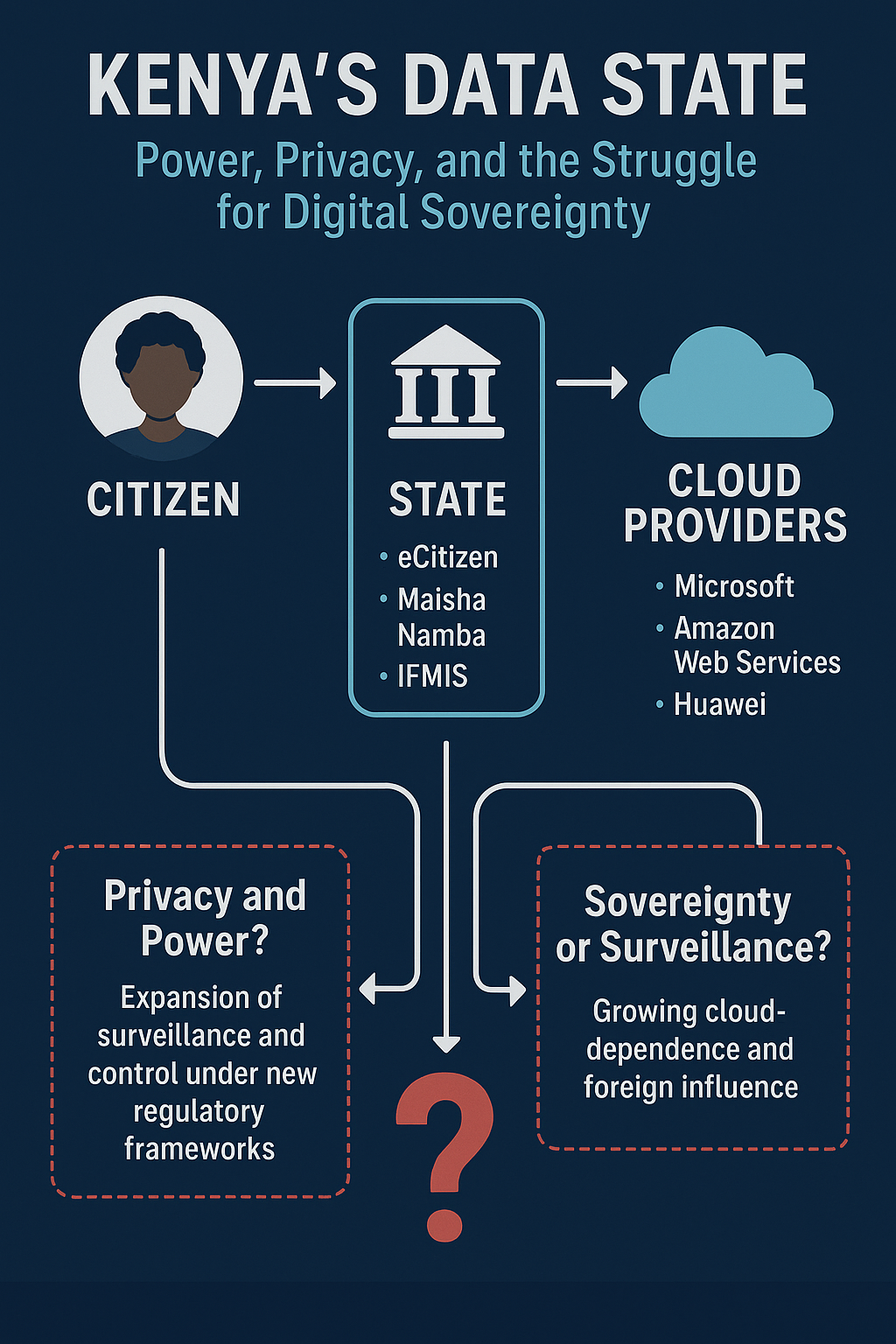
The Maisha Namba digital identity project has become the defining case study in this paradox. Like its predecessor Huduma Namba, it has faced multiple High Court suspensions for failing to meet the DPA’s core requirement — the Data Protection Impact Assessment (DPIA). Civil society watchdogs, led by Haki na Sheria and the Katiba Institute, continue to challenge the government’s persistence in rolling out the system despite clear judicial orders. Experts warn that the project’s centralized biometric database presents a single point of failure — a goldmine for identity theft and a recipe for exclusion should data integrity ever be compromised. The executive’s determination to proceed despite these warnings reflects a governance culture where compliance is optional and constitutional limits are elastic. In the absence of strong regulatory oversight and digital literacy, Kenya risks converting its AI ambition into an algorithmic vulnerability — a digital trap masquerading as a leap forward. The challenge is no longer about drafting new laws; it is about enforcing the ones that already exist with integrity, transparency, and public trust.

References:

The Star Lift order not permit to print Maisha Namba cards, State told

Business Daily Why IT experts want State to reject the new robotics bill

Indepth Research Institute Nairobi To Host The World On Data Privacy in 2027: Big Tech, Big Policy, Big Moment

Biometric Update Advocates pick privacy, inclusion holds in Kenya’s Maisha Namba digital ID system


Digital Dilemmas: Kenya’s New Cybercrime Law Tests the Boundaries of Free Speech

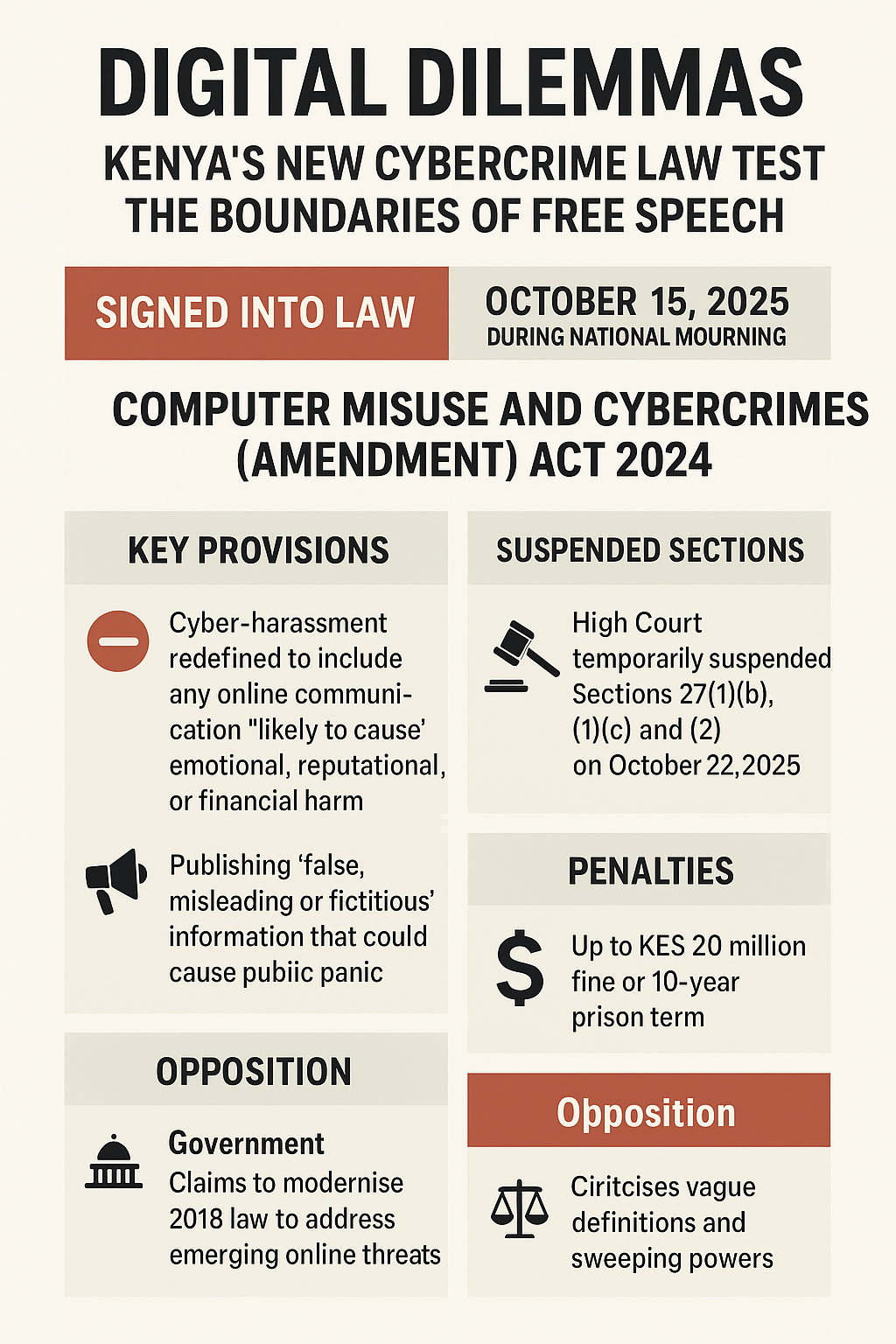
Kenya’s uneasy relationship with digital freedom deepened on October 15, 2025, when President William Ruto assented to the Computer Misuse and Cybercrimes (Amendment) Act 2024—a move that instantly ignited outrage across the country’s vibrant online community. The signing coincided with the death of former Prime Minister Raila Odinga, and critics accused the administration of using a moment of national grief to push through controversial legislation. Ruto rejected that charge, saying that the Bill had already cleared Parliament and that “governance cannot be suspended, even in sadness.” Still, the optics proved volatile: by nightfall, hashtags such as #RejectCyberCrimeLaw trended across X, while activists, journalists, and lawyers decried what they called an assault on free expression in the digital space.

At issue are vague definitions and sweeping powers that critics fear will criminalize dissent. The law expands the offense of cyber-harassment to cover any online communication “likely to cause” emotional, reputational, or financial harm—a threshold that the Kenya Human Rights Commission (KHRC) calls “unconstitutionally broad and prone to abuse.” It also criminalizes the publication of “false, misleading, or fictitious” information deemed capable of causing public panic and grants the National Computer and Cybercrimes Coordination Committee (NC4)—a body dominated by security officials—the power to block or remove content without prior court approval. Penalties are steep: up to KES 20 million in fines or ten years in prison. Civil-society groups, led by the KHRC and activist-musician Reuben Kigame, swiftly challenged the law in the High Court, arguing it violated constitutional rights to free expression and fair trial. On October 22, Justice E. Mabeya temporarily suspended sections 27(1)(b), 27(1)(c), and 27(2)—the core clauses on cyber-harassment and “false” information—pending a full hearing, acknowledging “serious questions on proportionality and vagueness.”

Government officials have defended the legislation as an overdue modernization of Kenya’s 2018 cybercrime law. Spokesperson Isaac Mwaura said it targets “emerging online threats like financial fraud, child exploitation, and cyber-terrorism,” while State House’s Dennis Itumbi maintained the amendments merely “tighten enforcement loopholes.” Yet digital-rights advocates see a wider pattern of algorithmic governance and shrinking civic space—from biometric identity systems like Maisha Namba to Kenya’s cloud-first data partnerships with Big Tech. To them, the new Act represents not reform but regression: a consolidation of executive control over cyberspace. As the High Court prepares to hear the substantive case, Kenya faces a pivotal test. Whether the Cybercrimes (Amendment) Act becomes a legitimate shield against digital abuse or a weapon against dissent will determine how the nation defines liberty in its fast-evolving algorithmic state.

References:

Techcabal Court suspends parts of Kenya’s new cyber law over free speech concerns

Kenya News Agency President Ruto clarifies cyber crime law amid public debate

The Star High Court suspends key provisions of Ruto’s newly assented cybercrime law

Citizen Digital Court suspends cyber harassment section in new Computer Misuse law

Tech Africa News Kenya Begins Drafting National Data Governance Policy

Jijuze Privacy vs. Security — Kenya’s New Surveillance Dilemma

Fraud Syndicates and the Human Factor — The Dark Underside of M-Pesa

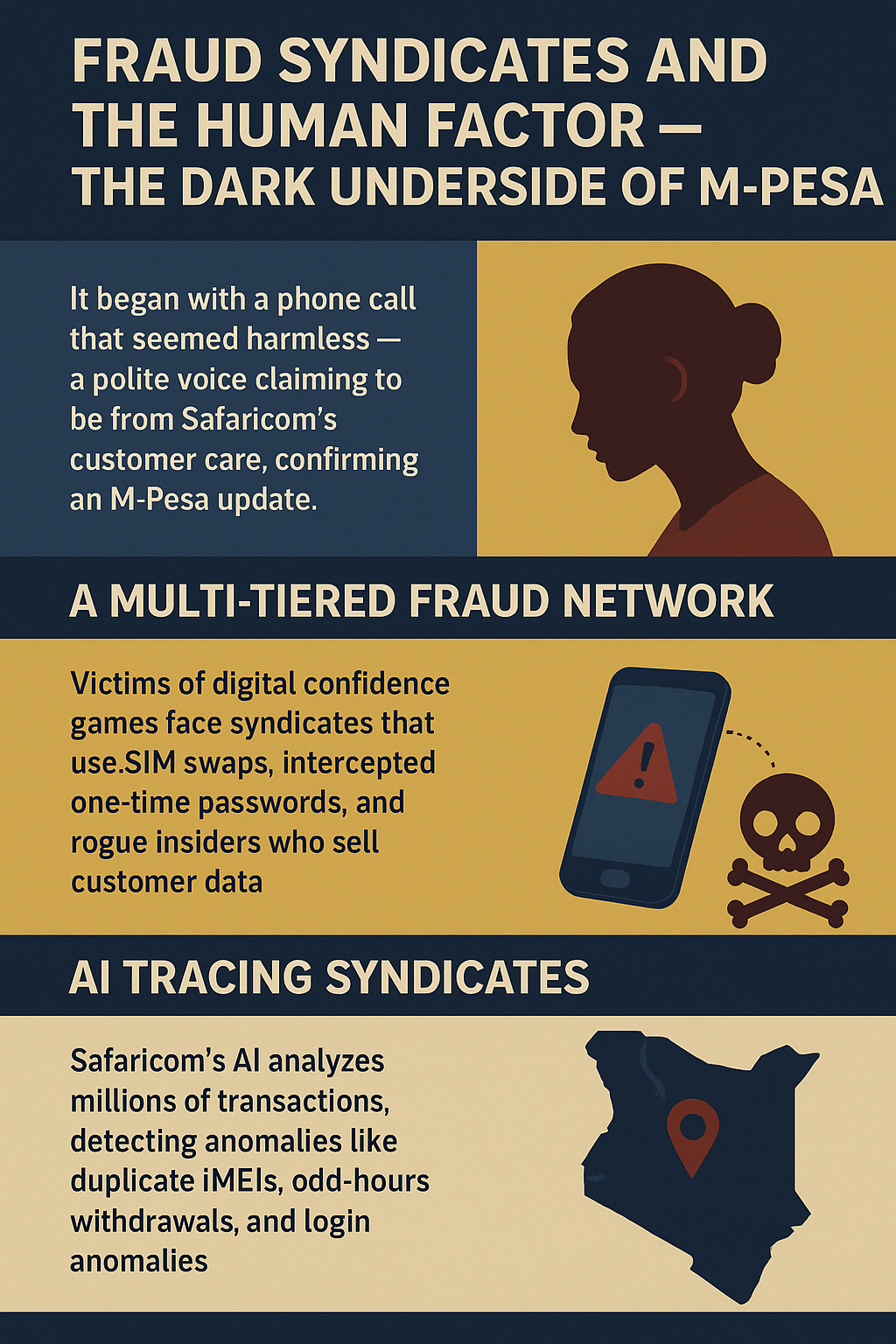
It began with a phone call that seemed harmless — a polite voice claiming to be from Safaricom’s customer care, confirming an M-Pesa update. Within minutes, Jane, a market trader from Nakuru, had lost everything in her wallet: her savings, her chama contributions, her business float. Hers wasn’t an isolated case. Across Kenya, from Kisumu to Kitengela, stories like Jane’s unfold daily — victims of digital confidence games that prey on trust and technological gaps. Beneath the convenience of Kenya’s mobile-money revolution lies a dark economy of cloned SIM cards, intercepted one-time passwords, and rogue insiders who sell customer data. What used to be petty phone scams has evolved into a multi-tiered fraud network, often coordinated through WhatsApp and Telegram groups, blending social engineering with technical precision. By the time victims realize their wallets have been emptied, the syndicates have already moved the money — split it, layered it, and cleaned it across dozens of M-Pesa accounts in seconds.

Behind the scenes, Safaricom’s AI compliance core is racing to keep up. Its models analyze millions of daily transactions, searching for irregular velocity, mirrored wallet behaviors, or login anomalies that betray coordinated fraud. The patterns are hauntingly human — the same phone IMEI used across unrelated accounts, repeated deposits at odd hours, or withdrawals made seconds after password resets. Investigators have identified rogue M-Pesa agents who act as the final cash-out nodes in this digital laundering chain, turning stolen virtual funds into physical currency. In one 2024 case in Eastlands, a syndicate of former call-centre employees was arrested after siphoning KSh 27 million from unsuspecting users — all through identity swaps and internal credential misuse. AI has since helped trace such insider leaks, tagging compromised agent IDs and disabling accounts that exhibit duplicate fingerprints. But even as the system grows smarter, so do the fraudsters, adapting to its logic, learning from its lags, and exploiting the tiniest cracks in Kenya’s fintech armor.

The war against M-Pesa fraud has thus become as much psychological as it is technological. For every line of defense built by machine learning, a counter-strategy emerges in the human domain — manipulation, deceit, and insider temptation. Regulators and investigators now warn that Kenya’s digital integrity hinges not only on code, but on culture — ethics, awareness, and enforcement. Safaricom has begun rolling out human-centered safeguards: community alerts, biometric verification pilots, and tighter collaboration with law enforcement. But the real test is whether ordinary Kenyans, from traders to teachers, can trust a system where the threat no longer comes from distant hackers but from within their own networks. The digital revolution gave Kenya financial freedom; now it must reckon with the predators it empowered. In our next post, we’ll explore the growing debate between privacy and security — and how Kenya’s AI revolution is forcing a reckoning over who really controls your data.

References:

Techcabal Safaricom fires 113 employees over fraud as internal cases rise

Techcabal How Safaricom’s AI exposed money laundering in Kenya’s betting boom

Rest of World M-Pesa has been huge for Kenya’s economy — and for scammers

Techpoint Africa Investigating M-PESA fraud cases in Kenya

The FATF Fallout — Kenya’s Grey Listing and the Regulatory Reckoning

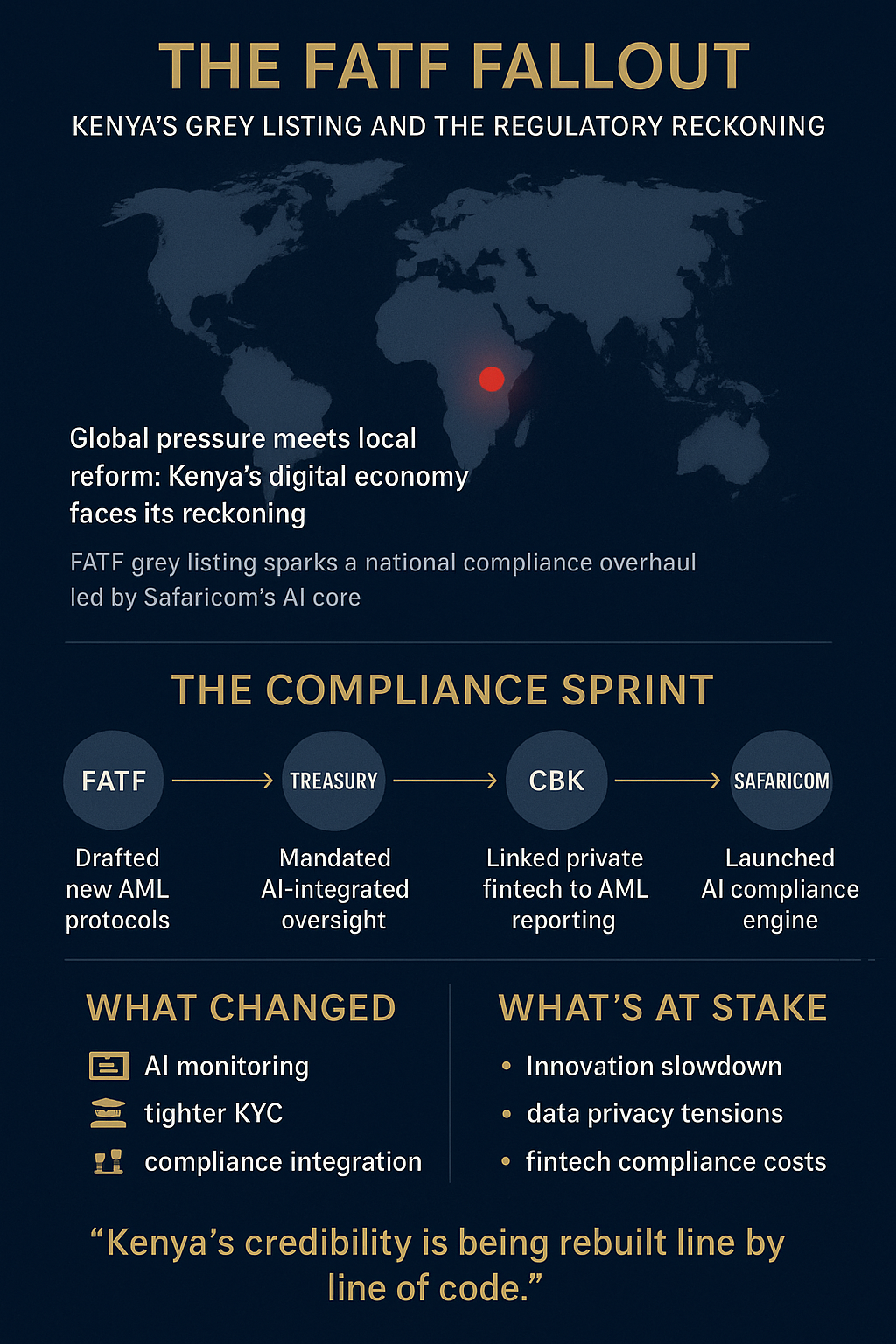
When Safaricom deployed its AI compliance engine, it wasn’t just about technological advancement — it was about survival. Behind the polished rollout was a growing alarm: Kenya had been placed on the Financial Action Task Force’s grey list in February 2024, forcing a reckoning over AML/CFT deficiencies exposed by international watchdogs. The grey listing exposed severe gaps: weak beneficial ownership disclosure, minimal prosecutions of money laundering, and under-regulation of sectors at high risk, including gambling, real estate, non-profit organisations, virtual assets, and law firms. Safaricom, already under pressure, recognized that its standing as the country’s digital financial backbone (through M-Pesa) meant that mere innovation would not suffice without credible compliance. The company’s AI overhaul was not a strategic choice — it was a compliance lifeline in a context where global trust, investor confidence, and even Kenya’s regional financial status were on the line.

The government’s response post-grey-listing was fast but fraught. On 17 June 2025, Kenya passed the new Anti-Money Laundering and Combating Terrorism Financing Act, strengthening the mandate of the Financial Reporting Centre (FRC) to oversee not just banks but non-financial businesses, regulated gambling operators, and high-risk non-profit entities. New requirements for beneficial ownership transparency, risk-based supervision, enhanced due diligence for high-risk customers, and stricter reporting of suspicious transactions were added. Yet, FATF’s June 2025 monitoring statement makes clear: Kenya is still under close watch. The list of obligations under “increased monitoring” remains long: non-financial entities must be better regulated; virtual asset service providers must be accounted for; suspicious transaction reports must rise; enforcement must reach even the high and powerful. The risk is no longer about drafting laws, but whether those laws bite.

But the FATF fallout isn’t only about compliance checkboxes—it’s rewriting Kenya’s fintech ecosystem. Startups, betting firms, M-Pesa agents, virtual asset operators are now navigating a regulatory terrain that demands transparency in ownership, speed in auditing, and an ever-watchful AI lens on behavior. The pushback has begun: fears of overreach, regulatory burden, and challenges for small operators. Still, for the first time in years, Kenya’s financial credibility is being rebuilt around enforceability—not just promise. As the Act takes effect and the global community watches, the real question is whether the government will apply these laws impartially — especially against the well-connected and politically exposed. Because grey-listing may be a stain, but it’s also the mirror revealing whether Kenya’s institutions have the courage and capacity to be truly accountable in a cashless, borderless world. Stay tuned for our next post as we continue to explore these developments and their implications!

References:

Institute for Security Studies Risk and reward of Kenya’s push to reverse FATF grey-listing

The FATF Jurisdictions under Increased Monitoring – 13 June 2025

Thomson Reuters AI, other technology the “only answer” to AML challenges in evolving threat landscape, says ACAMS report

ENACT IFFs and money laundering / Can anti-money laundering amendments get Kenya off FATF’s grey list?

The AI Awakening — Safaricom’s New War on Illicit Finance

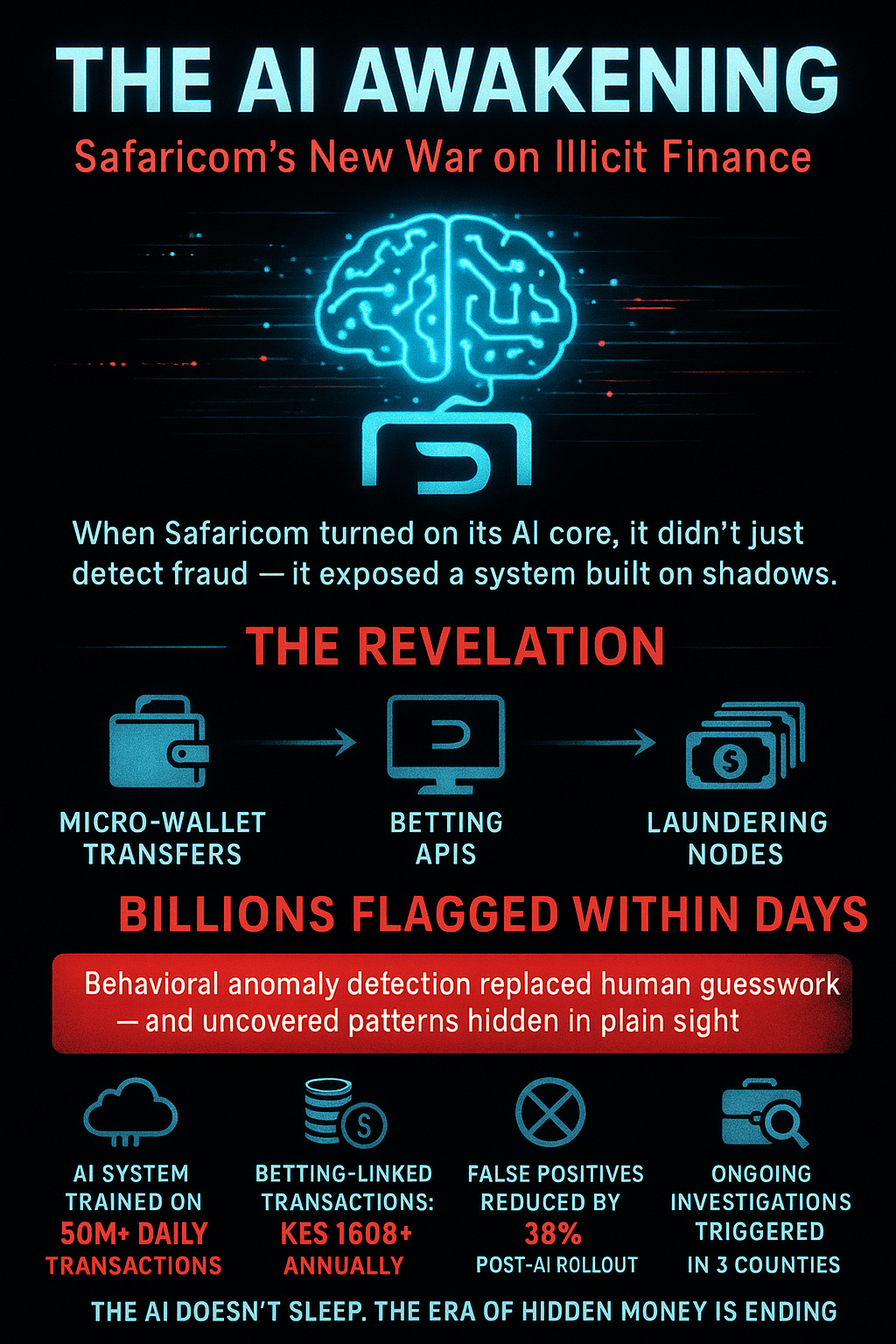
When Safaricom quietly switched on its new artificial intelligence engine earlier this year, no one expected it to rattle the country’s most powerful industry — or expose a side of M-Pesa no one was supposed to see. Within days, the system began lighting up with digital red flags: strange betting transactions looping through ordinary wallets, micro-deposits disguised as gaming payouts, and accounts moving small amounts in patterns too precise to be random. What the algorithms were seeing wasn’t play — it was laundering. Billions of shillings were silently being rinsed through Kenya’s favorite mobile platform, hidden beneath the guise of everyday betting. For weeks, engineers watched in disbelief as the AI’s alerts mapped a web of financial deception so intricate it blurred the line between entertainment and organized crime. The revelation shook Safaricom’s compliance teams — and soon after, the regulators who realized that Kenya’s most celebrated innovation had also become its most sophisticated laundering highway.

Inside Safaricom, a quiet revolution had begun. The company wasn’t just fighting fraud — it was reprogramming its financial DNA. The AI core, built in partnership with advanced compliance auditors and data scientists, doesn’t merely track transactions; it learns human behavior. It detects hesitation, timing anomalies, and wallet relationships that no manual audit could ever spot. What began as a compliance upgrade quickly turned into a forensic awakening — a self-learning system capable of catching what criminals believed was invisible. But the move also triggered backlash. Betting firms, some major ones, protested account freezes and accused Safaricom of overreach. Yet for Safaricom, this was no longer about risk — it was about survival. The same technology that made M-Pesa a lifeline for millions had made it a target for laundering syndicates. Turning AI loose on that frontier was less a choice than an inevitability.

Now, the discovery has thrown Kenya’s digital economy into uncharted territory. Regulators are scrambling to keep up, data privacy watchdogs are asking hard questions, and compliance officers are quietly celebrating the first real glimpse into the scale of illicit flows buried within mobile money. For the first time, artificial intelligence isn’t just assisting Kenya’s war on financial crime — it’s leading it. The system doesn’t sleep, doesn’t flinch, and doesn’t forget. And as it continues to learn, one thing is certain: the era of hidden money on M-Pesa is ending — but the reckoning it has triggered is only beginning. Stay tuned for the next post in this six-part series, where we will delve deeper into the implications of these changes.

References:

Techcabal How Safaricom’s AI exposed money laundering in Kenya’s betting boom

The Kenyan Wall Street How Safaricom is Leveraging AI to Bolster M-Pesa Security and Efficiency

Citizen Digital Father, son arrested for conning M-Pesa operators over Ksh.200K in Nairobi

KBC M-pesa outage on Monday as Safaricom adopts AI to tame fraud

Understanding Kenya’s Investment Landscape Amid Fiscal Strain

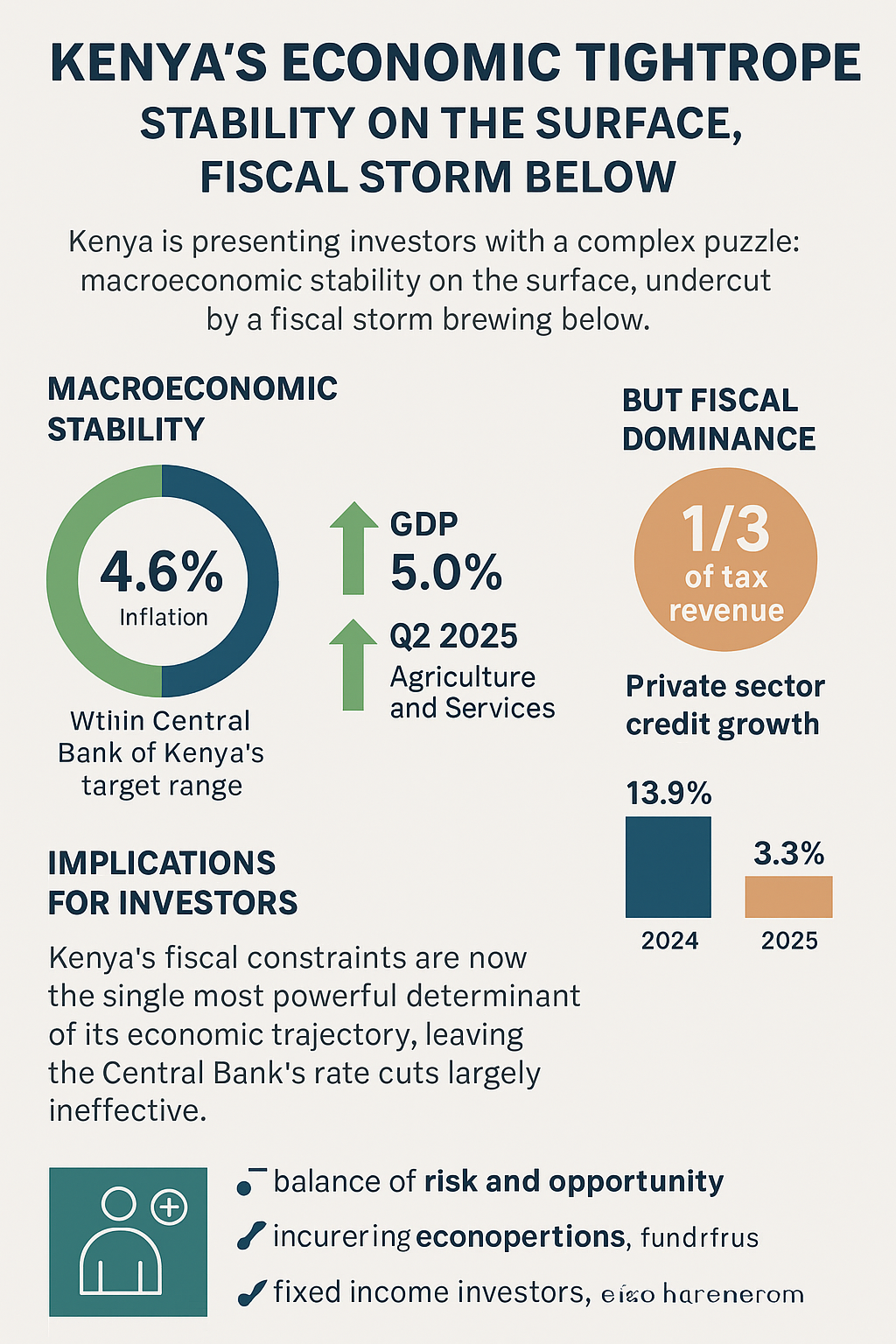
Kenya’s economy is presenting investors with one of its most complex puzzles yet: macroeconomic stability on the surface, undercut by a fiscal storm brewing beneath. Inflation stands at a steady 4.6%—comfortably within the Central Bank of Kenya’s target range—granting policymakers room for monetary easing. GDP data also reflects resilience, with Q2 2025 growth at 5.0%, led by agriculture and a robust services sector. Yet behind these encouraging numbers lies a sobering reality: fiscal dominance. With interest payments now consuming roughly a third of all tax revenue, the government’s borrowing appetite is crowding out private credit. Commercial banks, chasing high-yield government paper, have little incentive to lower lending rates for businesses, leaving private sector credit growth crippled at barely 3.3%, down from 13.9% just a year ago.

This squeeze is not just an abstract statistic; it defines the contours of Kenya’s medium-term investment landscape. The government projects a 5.3% full-year expansion, but global institutions remain unconvinced. The IMF and World Bank forecast growth at 4.8% and 4.5% respectively, citing weak private sector consumption, a sluggish credit channel, and a high risk of debt distress. Kenya’s fiscal constraints are now the single most powerful determinant of its economic trajectory, leaving the Central Bank’s rate cuts largely ineffective. The implication for investors is clear: headline GDP growth masks a structural imbalance where state borrowing sets the price of credit and private enterprise takes a back seat.

The balance of risk and opportunity lies in how investors position themselves. Kenya’s external buffers—rising remittances, strong agricultural exports, and narrowed current account deficit—are encouraging, but remain fragile, as all three are highly exposed to global downturns. For fixed income investors, short-duration government paper offers yield but carries sovereign risk that cannot be ignored. For equities, defensive plays in export-driven agribusiness, technology, and digital services stand out, while firms reliant on domestic mass-market credit may falter. Direct investment opportunities exist in renewable energy, climate-linked finance, and tech, sectors less tied to domestic fiscal strain. For corporate strategists, survival hinges on operational efficiency, alternative financing, and robust risk management to cushion external shocks. Kenya stands at a decisive juncture: without credible fiscal consolidation, its growth story risks becoming a cycle of constrained resilience. For investors, the key lies not just in reading the numbers, but in recognizing the limits of resilience when credit and capital are structurally captured by the state.

References:

KNBS Inflation Rate (CPI)

CNBC Africa Kenya’s inflation rises slightly in September on food, transport

World Bank Group Despite Improvements, Kenya’s Fiscal Path is Fragile Amid High Debt Vulnerabilities and Weak Revenue Growth

Kenya’s Event Security Challenges: A Wake-Up Call

Kenya’s growing profile as a hub for international conferences, cultural festivals, and major sporting events hangs in the balance, threatened by a persistent and damaging weakness—event security lapses. The recent spate of high-profile disruptions, from chaotic crowd control failures to delayed emergency responses, has reignited fears that the country’s infrastructure and management systems are not keeping pace with its ambitions. While Kenya has successfully hosted large-scale gatherings in the past, these successes are increasingly overshadowed by incidents that put both safety and the nation’s reputation at risk. For a tourism and investment-driven economy, where marquee events serve as global shop windows, the stakes could not be higher. Any perception that Kenya cannot guarantee the safety of participants and spectators risks deterring international organizers, sponsors, and attendees, redirecting both revenue and influence to competing destinations.

At the core of the problem lies a combination of fragmented coordination among security agencies, inadequate training for event marshals, and a lack of robust, preemptive risk assessments. Large-scale events—from global athletics meets to high-profile music festivals—often depend on ad hoc arrangements, with security strategies being reactive rather than proactive. This has led to avoidable breaches, where unruly crowd surges, unauthorized access, and even petty crime have disrupted otherwise well-planned programs. For international guests, especially those attending for the first time, such lapses create a lasting negative impression, overshadowing the event’s core purpose and undermining Kenya’s pitch as a safe, reliable host. Stakeholders in the hospitality, transport, and retail sectors warn that the ripple effects of diminished confidence could translate into real economic losses, especially in cities like Nairobi and Mombasa where event-linked tourism forms a major income stream.

The solution requires more than isolated fixes—it demands a systemic overhaul anchored in professionalism, technology, and accountability. Kenya must invest in event-specific security protocols that integrate crowd science, digital surveillance, and emergency response drills into every planning phase. Clear chains of command, mandatory accreditation systems, and cross-agency coordination hubs should be standard practice, not aspirational goals. Without this, the “Africa’s Meeting Place” narrative risks collapsing under the weight of recurring security failures. The opportunity cost is immense: from losing bids to host continental championships, to deterring corporate conventions, to stalling the growth of cultural tourism. Kenya’s position as an event destination of choice is not guaranteed; it must be earned and safeguarded through consistent, visible competence. If the country cannot put its house in order, it may soon find the world taking its events—and its investment—elsewhere.

References:

Jijuze How CHAN 2024 is Boosting Tourism and Infrastructure in East Africa

The Kenyan Wall Street Legacy or Liability? Putting Kenya’s CHAN 2024 Moment Under the Lens

GhanaWeb Crowd disorder at CHAN raises concerns in Kenya

Pulse Sports Protect the Game: How CHAN 2024 Fans Can Keep Big Tournaments Coming to Kenya

FlashScore 2024 CHAN: Kenya fined by CAF again over multiple safety and security breaches

The Standard CHAN 2024: Why Kenya could lose quarterfinal hosting rights

Combatting Fraud in Kenya’s Tourism: A Growing Threat

Kenya’s tourism industry, a vital pillar of the economy and a top foreign exchange earner, is now battling a growing reputational threat: sophisticated fraud targeting unsuspecting travelers. According to the latest sector review, a surge in fake booking websites, impersonated tour operators, and fraudulent payment channels is eroding visitor trust and undermining the gains made in post-pandemic recovery. Many of these scams operate with alarming polish—using stolen branding, cloned websites, and even counterfeit licenses to lure victims into paying for non-existent safaris, hotel stays, or cultural tours. Victims, often diaspora Kenyans and international tourists planning high-value itineraries, only discover the deceit upon arrival, when their bookings prove fake and their funds unrecoverable. The Kenya Tourism Board (KTB) and sector associations have flagged these schemes as a systemic risk that, if unchecked, could tarnish Kenya’s image as a safe, reliable destination.

Industry stakeholders stress that the challenge is compounded by gaps in regulatory oversight, slow cross-border law enforcement cooperation, and limited consumer awareness in key source markets. Fraudsters exploit these vulnerabilities, targeting peak travel seasons and leveraging digital marketing channels to reach large audiences with minimal traceability. Tour operators report that such scams not only cause financial loss but also drive potential travelers toward competing destinations perceived as safer or better regulated. Its important to note that while Kenya’s tourism marketing campaigns have successfully reignited global interest, this momentum risks being reversed if fraud-related horror stories dominate travel forums and social media. Experts recommend a multi-pronged response: real-time verification systems for operators, a central registry of licensed tourism businesses accessible to the public, stronger digital fraud policing, and targeted awareness campaigns in both domestic and foreign markets.

To its credit, the government has begun aligning with these recommendations, with the Ministry of Tourism working alongside the Communications Authority, cybercrime units, and private-sector stakeholders to roll out verification platforms and consumer education drives. Pilots for an online “Tourism Trust Mark” are already underway, enabling travelers to authenticate operators before making payments. Additionally, diplomatic missions are being engaged to circulate fraud alerts in high-risk markets, while tourism associations are exploring partnerships with payment processors to flag suspicious transactions. These initiatives, if scaled and sustained, could restore confidence and reinforce Kenya’s brand as a secure, trustworthy destination. In an increasingly competitive global tourism landscape, safeguarding the integrity of the travel experience is no longer optional—it’s a prerequisite for growth. Kenya’s long-term competitiveness will hinge not just on the beauty of its landscapes, but on the trustworthiness of the path visitors take to reach them.

References:

Kenyans.co.ke DCI Arrest Suspect After Greek Tourist Loses Ksh3.6 Million in Maasai Mara Scam

Government of Canada Kenya travel advice

Action Fraud Kenya Romance Scam

Shian Safaris How to Avoid Being Conned on Your Travels in Kenya

Understanding Kenya’s eTA Troubles: What Travelers Need to Know

Kenya’s ambitious shift to a universal Electronic Travel Authorization (eTA) system on January 1, 2024, was meant to be a game-changer for tourism, projecting an image of digital efficiency and openness. The vision—replacing traditional visas with an online pre-authorization—was sold as “visa-free” travel for the world, echoing President William Ruto’s promise of easier entry and smoother travel. Yet, what travelers encountered was a reality at odds with the marketing: mandatory paid applications, detailed documentation requirements, and unpredictable processing times. For visitors from over 40 countries that once enjoyed genuine visa-free access, the change felt less like liberation and more like an unexpected hurdle. Industry insiders describe the rollout as a “bait and switch” that has not only dented Kenya’s reputation but also triggered fears of retaliatory entry restrictions abroad. This mismatch between promise and practice was compounded in March 2025 when the government quietly replaced a stable Swiss-developed system with a locally built platform plagued by downtimes, payment failures, and technical glitches—sparking a multi-million dollar lawsuit and months of operational chaos.

A Report by iVisa

The fallout has been costly. Tour operators, hotels, and airlines have all reported significant losses as delays, application failures, and the absence of a functional support framework have disrupted itineraries and led to cancellations. Airlines face fines of KES 1 million per passenger without valid eTA documentation, a policy that has left many travelers stranded at departure gates. While Kenya recorded a record-breaking Sh 452 billion in tourism revenue in 2024—driven largely by post-pandemic recovery and aggressive marketing—the eTA crisis has cast a long shadow. The country’s visa openness ranking plunged from 29th to 46th in Africa, eroding hard-earned goodwill and weakening its competitive edge against rivals like Ghana and Rwanda, which have fully opened their borders. Industry leaders, including the Kenya Association of Travel Agents (KATA) and the Kenya Tourism Federation (KTF), warn that unless systemic fixes are made, Kenya’s target of five million annual visitors by 2027 could be jeopardized. Their calls range from establishing an emergency “crisis desk” for stranded travelers to temporarily reinstating visas on arrival while the digital system is repaired.

In response to mounting pressure, the government has introduced notable policy reversals, exempting most African and Caribbean nationals from eTA requirements and promising faster approvals for others. At the same time, industry stakeholders and the Tourism Ministry are working to embed risk management into the process—introducing contingency measures such as backup server capacity, offline verification protocols at airports, and dedicated “rapid response” teams to assist travelers facing last-minute clearance issues. While KATA’s August 2025 meeting with Tourism CS Rebecca Miano confirmed that some operational bottlenecks remain for non-exempt travelers, these interventions are designed to ensure that no visitor’s trip is derailed by system errors or delays. The emphasis now is on creating a safety net that preserves the integrity of Kenya’s digital entry framework while protecting the traveler’s experience. In an era where seamless digital access is part of a destination’s brand, these safeguards—paired with transparent communication—are key to restoring confidence and reinforcing Kenya’s identity as a warm, accessible, and world-class destination.

References:

The Permanent Mission of the Republic of Kenya to the United Nations Implementation of Electronic Travel Authorization (eTA) in Kenya

Kenya Association of Travel Agents Tourism industry raises concerns over ETA system delays

eVisa How Foreigners Will Apply For Kenya ETA Before Visiting (Visa-Free Kenya)

Aljazeera ‘Bait and switch’: Why Kenya’s no-visa policy is drawing pushback

Kenya Association of Travel Agents KATA Meets Tourism CS Rebecca Miano to Address Sector Challenges and Strengthen Collaboration


Experience Magical Kenya: Football and Nature Unite

Kenya is kicking off a fresh chapter in tourism, swapping the usual safari lens for stadium lights. The Football Kenya Federation (FKF) and the Kenya Tourism Board (KTB) have teamed up in a KSh 15 million “Magical Kenya” partnership, putting the Harambee Stars front and center as ambassadors for the nation’s diverse travel experiences. The goal? To fuse the emotional energy of football with Kenya’s appeal—from the drama of CHAN 2024 matches to the breathtaking wildebeest migration in the Maasai Mara—drawing in fans from across Africa and beyond. By co-hosting CHAN alongside Tanzania and Uganda, Kenya is showing it can deliver on both pitch-side excitement and unforgettable tourist adventures, all while positioning itself for the much bigger stage of AFCON 2027.

This partnership isn’t just about branding on jerseys or LED boards; it’s about storytelling that links football passion to travel dreams. Match-day promotions, digital campaigns, and fan events will immerse audiences in Kenya’s landscapes, culture, and hospitality. For potential visitors, the appeal is clear: catch a continental clash at Kasarani, then cap the trip with a coastal beach escape or a safari in Amboseli. By syncing tournament schedules with peak tourism seasons like the Maasai Mara migration, Kenya is creating a “double attraction” that few destinations can rival—where sports fever and natural wonders collide in one itinerary. This approach not only boosts tourism revenue but also strengthens the football sector itself, creating a loop where each success fuels the other.

For sports-loving travelers, this is Kenya’s open invitation: come for the game, stay for the magic. Whether it’s the adrenaline of CHAN, the cultural vibrancy of Nairobi’s markets, or the serenity of Lake Naivasha at sunset, the country is rolling out a red carpet that stretches from the stadium tunnel to the savannah horizon. With strategic planning, creative marketing, and world-class hospitality, Kenya is aiming to score big—not just in the tournament standings, but in the hearts of travelers who’ll carry home memories far beyond the final whistle.

References:

Xinhua Kenya to leverage sports to boost tourism sector

KBC Ministry of Tourism and FKF sign Ksh 15 million partnership to promote Kenya as a sports tourist destination

Citizen Digital FKF signs Ksh15million deal with Kenya Tourism Board

The Eastleigh Voice FKF inks Sh15 million partnership deal with KTB to tap into sports tourism

The Star Arrival of African teams and fans for CHAN 2024, a boost for tourism