Advanced Pyrolysis — Kenya’s High-Risk, High-Reward Gamble in the Battle for Plastic Circularity

After dissecting Kenya’s plastic paradox, amplifying the struggle of waste pickers, and spotlighting the promise of enzymatic recycling, we now turn to one of the most contested technologies in the global waste-to-value conversation: Advanced Pyrolysis. This is the method frequently hailed as the “missing link” for non-recyclable plastics — yet equally criticized for being expensive, energy-hungry, and easily corrupted by weak regulation. And for a country like Kenya, staring at overflowing dumpsites and facing rising global pressure to meet circularity targets, pyrolysis represents both a thrilling opportunity and a dangerous temptation.
The stakes here are far more complex than in enzymatic or mechanical recycling, because pyrolysis operates at the intersection of energy policy, industrial chemistry, geopolitics, and climate governance — a mix Kenya has historically struggled to reconcile coherently.
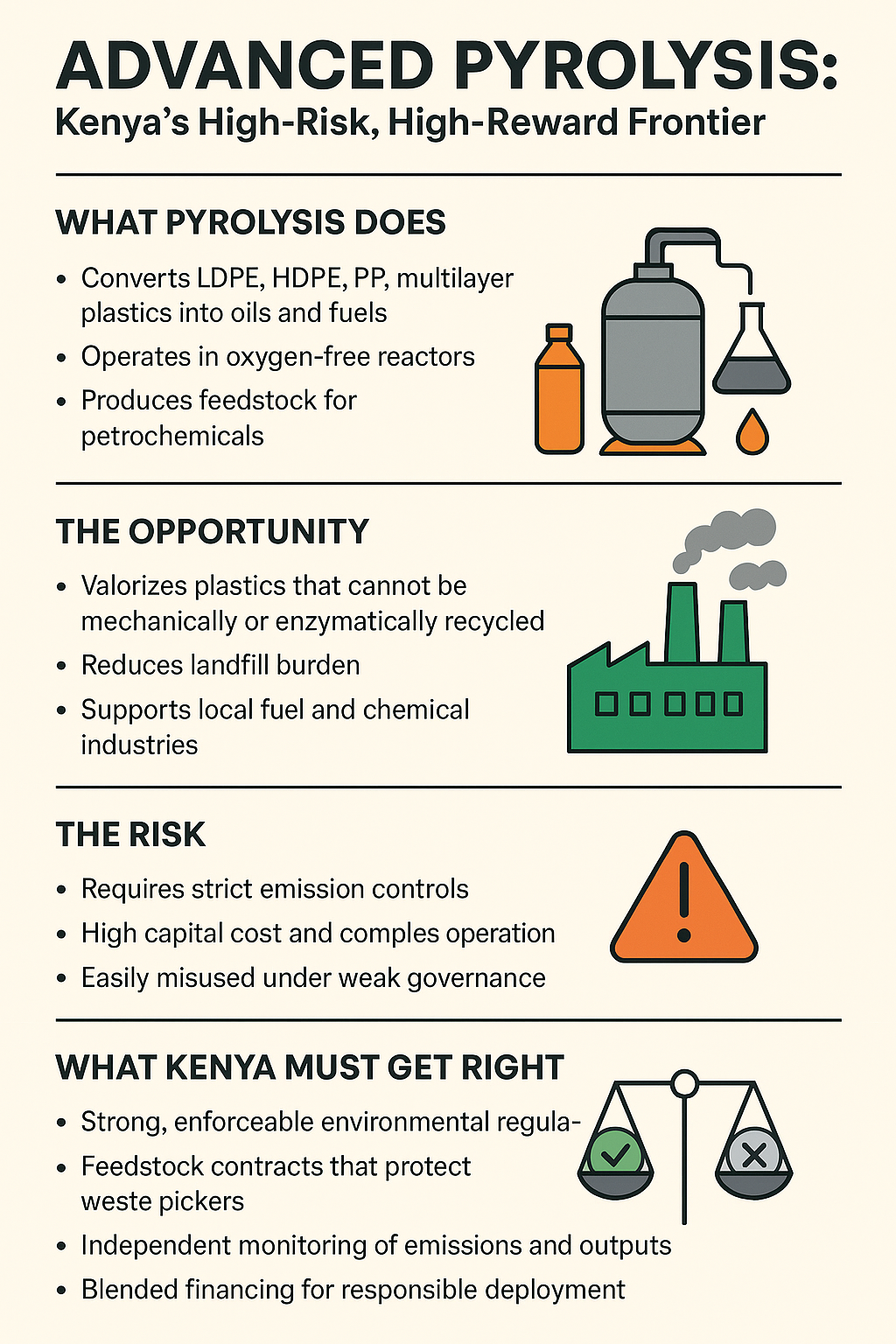
At its core, advanced pyrolysis breaks down hard-to-recycle plastics — LDPE, HDPE, PP, multi-layer laminates — by heating them in oxygen-free reactors, converting them into fuels, naphtha, waxes, or feedstock oils that can re-enter petrochemical production. In theory, this allows Kenya to tap into the vast volumes of low-value plastic that currently have no market and end up burned, buried, or blown into rivers. It offers a potential pathway to energy diversification at a time when fuel costs continue to shake households and industries. And it carries significant economic upside if Kenya positions itself as a regional hub for circular petrochemicals in East Africa.
But the discipline required to execute pyrolysis safely, profitably, and sustainably is far greater than what Kenya’s current plastic waste governance demonstrates. The technology demands consistent feedstock, stable power, advanced emission control systems, certified output testing, and rigorous oversight — factors that have caused even advanced economies to sabotage their own pyrolysis pilots when shortcuts were taken.

This is why pyrolysis is both a strategic advantage and a national vulnerability. If Kenya rushes into pyrolysis without robust environmental regulation, credible emissions monitoring, and a clear economic model that avoids underpricing waste picker feedstock, the country risks creating a new version of the same inequities we are trying to solve — except now, with industrial smokestacks attached. Yet if Kenya gets the sequencing right — establishing strict standards, blending public financing with private risk capital, creating transparent PET/PO feedstock corridors, and placing waste pickers at the center of value creation — pyrolysis could complement enzymatic recycling and cement Kenya’s position as a regional circular economy powerhouse.
The question, then, is not whether pyrolysis works. The question is whether Kenya can adopt it responsibly — without repeating the extractive, opaque, poorly regulated industrial patterns that have crippled other sectors before.
Because the truth is simple: pyrolysis is not a shortcut. It is a stress test of Kenya’s capacity to govern the future.

References:

The Star Tackling pollution: How Murang’a engineer is converting plastic waste into clean fuel

Kenya News Agency Engineer develops certified diesel from plastic waste

The Star Ambitious Murang’a man invents trailblazing fuel blends from plastic waste

Business Daily ICDC invests Sh420m in firm that converts plastic waste into energy

The Guardian Shell quietly backs away from pledge to increase ‘advanced recycling’ of plastics

Borderless Pyrolysis under fire: Environmental and health concerns cast doubt on “miracle” technology

Africa News The Kenyan entrepreneur turning plastic to fuel

Enzymatic Recycling – The Quiet Revolution Kenya Cannot Afford to Ignore

Over the past few weeks, we have peeled back the layers of Kenya’s mounting plastic crisis — first exposing the sheer scale of the waste paradox, then spotlighting the invisible army of waste pickers who keep the nation from sinking under the weight of its own plastic footprint. We have seen how Kenya generates nearly a million tonnes of plastic waste annually, recycles barely a sliver of it, and loses billions of shillings in potential value every year. We have examined how policy inconsistencies, corporate inertia, inadequate infrastructure, and unreliable collection systems have turned plastic waste into a slow, suffocating national emergency. And we have confronted a deeper truth: without the sweat and resilience of waste pickers — the 50,000+ individuals who recover up to 80 percent of all recycled material — Kenya’s recycling ecosystem would simply collapse. These workers, despite being the backbone of the system, remain underpaid, undervalued, and largely ignored by the institutions and corporations whose sustainability targets are built on their unpaid labour.

But beneath this crisis sits an extraordinary opportunity — one that demands a level of boldness Kenya has not yet shown. As the world races toward higher recycled-content mandates and rising climate accountability, a technological shift is underway that could fundamentally reshape how countries handle plastic waste. At the center of this shift is Enzymatic Recycling, one of the most promising innovations in the global circular economy. While traditional mechanical recycling breaks plastic down into lower-quality materials and pyrolysis turns polyolefins into fuel, enzymatic recycling does something radically different: it breaks PET down to its original chemical components, producing a virgin-grade resin indistinguishable from newly manufactured plastic. This isn’t theory — global companies in France, Japan, and the U.S. are scaling it right now, licensing it, and preparing for a long-term transition into fully circular supply chains.

For Kenya, this technology strikes at the heart of its most stubborn problem: the mismatch between overwhelming PET waste and chronic shortages of high-quality recycled PET (rPET) demanded by beverage brands, manufacturers, and exporters. Enzymatic recycling thrives where other systems fail — on dirty, colored, low-grade, and mixed PET. This means that the very materials now rotting in landfills, choking waterways, and being burned in open dumpsites suddenly gain new life and new value. Instead of needing pristine separation, this method can convert even the most degraded PET into premium-quality monomers. It removes the need for energy-intensive re-melting, reduces carbon emissions, and operates at lower temperatures — which translates to lower costs and the ability to deploy modular plants even in emerging markets. It is the rare technology that aligns environmental necessity with economic logic.

But let us be clear: having the technology is not enough. Kenya stands at a crossroads, and the window of opportunity is already narrowing as global demand for rPET continues to spike. To truly capitalize on enzymatic recycling, Kenya must orchestrate a coordinated shift across policy, capital, and human infrastructure. Waste pickers must be formally integrated into feedstock systems, paid fairly, trained, and recognized as skilled operators whose hands determine the purity and volume of incoming materials. Government must enforce Extended Producer Responsibility rules — not as paperwork exercises, but as binding obligations that push brands to fund collection, invest in sorting, and purchase recycled output. Investors must be willing to support hybrid pilot plants through blended finance that de-risks early adoption. And manufacturers must commit to buying locally produced monomers rather than defaulting to cheaper imports that undermine domestic circularity.

If even one of these pillars falls out of alignment, Kenya risks missing a transformative opportunity. But if they converge — if Kenya dares to lead rather than follow — the country could redefine its relationship with plastic waste entirely. Enzymatic recycling could become the anchor of a new green industrial economy: cleaner cities, formalized workforces, new manufacturing value chains, reduced imports, and a strong foothold in the global circular transition. This is more than a technological breakthrough. It is a chance for Kenya to flip its plastic crisis into economic power, environmental resilience, and social justice — all at once.

References:

RSC Sustainability Innovative recycling strategies for non-recycled plastics: advancing the circular economy for a sustainable future

MDPI Biocatalytic Recycling of Polyethylene Terephthalate: From Conventional to Innovative Routes for Transforming Plastic and Textile Waste into Renewable Resources

GreenPeace New documentary exposes recycling fallacy and health impacts of plastic pollution on Kenya’s waste workers

Kenya News Agency  From waste to gold: How plastic recycling is changing lives

The East African Plastic, plastic everywhere but not for African recyclers

Kenya Plastics Pact Kenya Plastics Pact & WWF-Kenya Drive Plastic Recycling Efforts Amid EPR Implementation

The Star Kenya launches pioneer project to protect waste pickers

Capital News Kenya Launches Responsible Sourcing Drive to Protect Waste Pickers

Empowering Kenya’s Informal Waste Pickers for a Sustainable Future

Long before policymakers coined terms like “Extended Producer Responsibility” or “circular economy,” Kenya’s informal waste pickers were already living that reality — only without recognition, protection, or pay equity. Every dawn, thousands of men and women descend upon dumpsites from Dandora to Mombasa, armed with hooks, sacks, and unmatched resilience. They are the invisible workforce behind the country’s fragile recycling system, recovering up to 80 percent of all plastics that ever get recycled. Yet, despite this colossal contribution, their average earnings remain trapped between KSh 30–50 per kilogram, with no health insurance, no stable contracts, and little policy voice. It’s a moral contradiction and an economic inefficiency rolled into one: the very people enabling Kenya’s environmental survival are surviving on its margins. The system is built on their sweat, but not their dignity.

The irony deepens when you follow the plastic’s trail. Once the pickers sell to small middlemen, the material ascends through aggregation points — like Mr. Green Africa’s sorting hubs — and ends up feeding multinational supply chains that boast of “sustainable sourcing.” At every stage, the profit margins grow — except for the people who initiate the cycle. Yet without these workers, Kenya’s plastic waste problem would quadruple overnight. Their local intelligence — knowing which streets yield high-value PET, which neighborhoods mix organics with plastics — is the kind of human data even the best AI sorting systems can’t replicate. In cities like Nairobi, where waste management systems are perpetually underfunded, informal networks fill the void that government institutions have left wide open. The question isn’t whether they matter; it’s whether we’ll ever pay them like they do.

To unlock Kenya’s circular future, policymakers must stop treating informal pickers as peripheral players and start embedding them in the national waste economy. That means formal recognition, access to microfinance, integration into municipal contracts, and training to adapt to upcoming high-tech recycling plants. When hybrid models like enzymatic recycling and pyrolysis eventually take root, the quality of feedstock — clean, segregated plastics — will be the single biggest success factor. And who’s best positioned to ensure that? The same waste pickers who’ve been sorting Kenya’s chaos by hand for decades. Investing in their safety, tools, and professionalization isn’t charity — it’s infrastructure. The day we place their expertise at the center of policy, Kenya’s recycling revolution will finally have the spine it needs.

References:

Africa News Nairobi-based Company Turns Plastic Waste into Eco-Friendly Bricks

The Standard Program to address welfare of Kenyan waste pickers starts

Daily Nation Kenya picked to lead Africa’s plastic waste revolution

WWF Lifetime cost of plastic 10 times higher for low-income countries than rich ones, revealing crippling inequities in plastics value chain

Heinrich Böll Stiftung Garbage collectors who are treated like trash

Daily Nation It is a struggle for recognition and inclusivity

The Scale & Paradox of Plastic Waste in Kenya

Kenya stands on the edge of an environmental paradox that’s as staggering as it is costly: despite being hailed for its pioneering 2017 ban on plastic carrier bags, the country continues to drown under nearly one million tonnes of plastic waste every year — and only eight percent is recycled. That number isn’t just a statistic. It’s the story of factory byproducts clogging riverbeds, single-use PET bottles choking Nairobi’s drainage systems, and a subterranean industry of informal waste pickers struggling to plug the gaps a formal system never filled. Plastic has become so embedded in Kenya’s commercial and daily routines that even earnest policy moves, like the 2020 crackdown on single-use plastics in protected areas, feel like drops in a polluted ocean. What’s worse, Kenya’s natural ingenuity and abundant human capital — the informal collectors who shoulder the bulk of clean-up efforts — remain trapped in a cycle of exploitation, underpayment, and policy neglect, while multinational manufacturers flood the market with non-recoverable plastic packaging under the guise of “market-driven growth.”

Yet in this legacy of mismanaged waste lies a dormant opportunity worth billions — literally. Kenya’s private sector loses up to KSh 15 billion annually in potential value from unprocessed plastic waste streams. That is money sitting in landfill sites, swirling in the Indian Ocean, or being sorted by waste pickers subsisting on KSh 30-50 per kilogram of plastic recovered. This unclaimed wealth is compounded by the escalating costs borne by governments and local communities: blocked sewers that exacerbate seasonal floods, medical bills from microplastic-related illnesses, and polluted wildlife habitats that undercut Kenya’s ecological and tourism wealth. But the paradox sharpens: while the nation bleeds resources, global brands seeking recycled content for sustainable packaging are willing to pay premium rates for high-quality rPET — a commodity Kenya could generate domestically at scale, given the right policies, technologies, and inclusive business models. Kenya isn’t just missing a recycling opportunity; it is busy exporting one.

But urgency is no longer optional. Rising urbanization, weak enforcement of Extended Producer Responsibility rules, and surging petrochemical imports have created a multiplying time bomb. What we’re facing now isn’t just waste; it’s a strategic misalignment of economic potential, institutional responsiveness, and environmental justice. The conversation must shift — from one of blame to one of opportunity. Not just about banishing plastic, but transforming its lifecycle. That transition hinges on a fundamental question: will Kenya choose to leave this issue to informal scavengers, or finally build a circular economy pipeline that centers their expertise, funds local innovation, and forces global polluters to pay fair value for the plastics they profit from? The next post will dig deeper into the most overlooked yet indispensable piece of this puzzle: the country’s informal waste pickers — the grassroots engine behind an untapped revolution.

References:

Africa News Nairobi-based Company Turns Plastic Waste into Eco-Friendly Bricks

The Standard Program to address welfare of Kenyan waste pickers starts

Daily Nation Kenya picked to lead Africa’s plastic waste revolution

Yale Engineering A device to convert plastic waste into fuel

WWF Lifetime cost of plastic 10 times higher for low-income countries than rich ones, revealing crippling inequities in plastics value chain

Carbios Carbios licensing documentation ready for worldwide industrial and commercial deployment of its PET biorecycling technology

The First Law of Politico-Dynamics: Power Is Never Lost, Only Transformed

What’s something you believe everyone should know.

One of the greatest truths in both physics and politics is this: power never disappears—it merely changes form. Just as energy can neither be created nor destroyed, political power, too, is a conserved force that shifts, mutates, and re-emerges. Tanzania’s recent history is a masterclass in this invisible law. Under the late President John Magufuli, the country witnessed a deliberate compression of democratic energy. Opposition rallies were banned, media voices silenced, and civil liberties choked under an increasingly authoritarian grip. The 2020 general elections—tainted by accusations of fraud and intimidation—did not destroy dissent; they simply converted it into dormant potential energy, locked within the state’s total control. What appeared as political dominance was, in essence, the gathering of immense pressure beneath the surface of the republic.

When Magufuli passed away in 2021 and Vice President Samia Suluhu Hassan took over, that compressed energy found a new expression. For a moment, Tanzania seemed to exhale. Political dialogue resumed, exiled opposition leaders like Tundu Lissu returned, and the media regained a measure of freedom. Yet this was not the dismantling of power but its phase shift—a transformation from brute coercion to soft diplomacy. The ruling party, CCM, maintained its institutional grip, only trading kinetic repression for the subtler currency of legitimacy and international goodwill. Tanzania’s newfound openness was real, but it was carefully managed; the core quantum of control remained untouched. The machinery of power, having changed its form, retained its full magnitude, calibrated now for persuasion instead of fear.

By 2023, the cycle completed itself. The language of reform gave way once more to the mechanics of control. Opposition figures were again entangled in legal webs, critics silenced through procedural precision, and the state’s energy of dominance reappeared cloaked in legality. The lesson is universal: no political power is ever destroyed—it only transforms. What matters is not whether power exists, but how it is expressed, shared, and held accountable. Citizens must therefore act as the catalysts of transformation, ensuring that this energy—inevitable, immense, and perpetual—remains a force for justice rather than repression. The equation, always, must balance.

The Machine Has Taken the Wheel — and the Citizen Is the Passenger

Kenya has crossed a line that few noticed but everyone will soon feel. Power is no longer only exercised through parliaments or police — it now flows invisibly through algorithms. From biometric verification at Huduma Centres to risk-scoring systems in the Kenya Revenue Authority (KRA), decisions about who is served, who is flagged, and who is ignored are increasingly being made by code. The Maisha Namba digital identity system — hailed as the backbone of Kenya’s digital transformation — has already shown how easily automation can exclude citizens. Court petitions warn that technical errors and biased design could lock thousands out of essential services without explanation. Meanwhile, police are piloting predictive analytics to map “high-risk” zones, and cybercrime units use social-media scraping tools to monitor dissent. What looks like modernization is fast becoming mechanized control. The machine is now a policymaker — and citizens are its subjects.

Kenya’s legal firewall is alarmingly thin. The National Artificial Intelligence Strategy (2025–2030) — launched to much applause — offers lofty ethics and fairness goals but zero enforcement. The Data Protection Act (2019) was never built to confront opaque AI systems or demand algorithmic audits. Oversight bodies like the Office of the Data Protection Commissioner (ODPC) and ICT Authority lack both the technical muscle and legal mandate to compel transparency from state vendors. Contracts with tech giants such as Huawei, Microsoft, and Oracle remain classified, their algorithms shielded from public scrutiny even as they shape how millions are governed. Experts warn this marks the rise of algorithmic colonialism — where the decision-making tools of foreign corporations become the digital architecture of domestic governance. Kenya may soon discover that it doesn’t just lack ownership of its data — it has surrendered control over the very logic that interprets it.

The stakes could not be higher. As the world races to regulate artificial intelligence — with Europe’s AI Act and new Algorithmic Accountability Bills in the U.S. — Kenya stands at a crossroads between leadership and loss of agency. If it fails to legislate now, automation will outpace democracy itself. Algorithms trained on biased data will entrench inequality faster than any law can undo it. Citizens will be profiled, scored, and excluded — not by government decree, but by silent lines of code. The next phase of Kenya’s reform journey must be radical: transparency must be mandatory, algorithmic decisions must be appealable, and the public must reclaim the right to know how the state’s machines think. In the end, Kenya’s digital destiny will not be determined by data alone — but by who dares to demand accountability from the algorithm. Because the next struggle for freedom will not be fought in the streets. It will be fought — and either won or lost — in the source code.

References:

Strathmore University Kenya’s Efforts in AI and Implementation Plan of the Kenyan National AI Strategy

Ministry of Information, Communications and the Digital Economy Kenya’s Artificial Intelligence (AI) Strategy 2025-2030 launched at the KICC, Nairobi

Namati Kenyan Citizens Who Struggle to Obtain IDs Still Blocked from Enrolling to Digital ID Maisha Namba, Court Told

ID Tech Legal Challenge Targets Kenya’s New Digital ID System Over Rights Concerns

Daily Nation Exclusive: How Kenyan police use mobile phones to track, capture suspects

East African Journal of Law and Ethics Digital Policing in Kenya: Opportunities and Challenges

The Watchers of the Digital Republic: Kenya’s Quiet March Into a Surveillance State

Kenya is watching itself — pixel by pixel. Over the last five years, the country has built an unseen digital nervous system linking thousands of Huawei-powered Safe City cameras, police databases, and social-media monitoring tools. From downtown Nairobi to Mombasa’s seafront, every movement can be captured and cross-checked within seconds at the National Police Service Command Centre. Officials hail this as “smart security”; critics call it the birth of an algorithmic state. It is now evident that Kenya’s system is among the most extensive in sub-Saharan Africa — facial recognition, automatic number-plate readers, and voice analytics feeding a real-time surveillance web. Civil-rights groups such as Article 19 Eastern Africa warn that the same technologies meant to protect citizens are increasingly used to watch them, often without consent or transparency.

The legal architecture meant to contain this power is full of blind spots. The Cybercrimes (Amendment) Act 2024 widened government interception powers and allowed the Communications Authority to pull down online content on loosely defined “security” grounds. Meanwhile, the National Intelligence Service runs data-fusion platforms that combine SIM registration, mobile-money, and tax records — none of which fall under the Data Protection Act’s civilian oversight. The Office of the Data Protection Commissioner cannot audit national-security operations, leaving surveillance programs completely opaque. As the Kenya Human Rights Commission noted in an April 2024 brief, “privacy protections collapse precisely where the State holds the most data.” In the name of safety, a culture of monitoring has replaced a culture of accountability.

Kenya’s experiment is shaping regional norms. The Huawei model first tested in Nairobi has now appeared in Ethiopia, Uganda, and Tanzania, while Western donors — from the EU to Interpol — fund “cyber-capacity” projects that quietly expand the same infrastructure. Analysts describe this as a surveillance compromise: Eastern hardware, Western money, African data. What began as a modernization effort has become a mirror of global power politics — a democracy borrowing the tools of autocracy to stay secure. Unless Parliament enacts a Surveillance Oversight Law and empowers independent audits, Kenya risks institutionalizing fear as policy. The technology that promised protection now records obedience, and in this new digital republic one truth persists: the cameras no longer blink — they remember.

References:

Article 19 Eastern Africa Surveillance, data protection, and freedom of expression in Kenya and Uganda during COVID-19

The Kenyan Wall Street Kenya Upgrades Cybercrime Law to Hand Gov’t Sweeping Powers to Block Websites

The Star Controversial Cybercrime Act: What they said

Huawei Safaricom:Enhancing Security in Kenya with Huawei’s Converged Command & Control Solution

Africa – China Reporting Project Huawei’s surveillance tech in Kenya: A safe bet?

Coda Story In Africa’s first ‘safe city,’ surveillance reigns

The Conversation State surveillance: Kenyans have a right to privacy – does the government respect it?

BBC Safe cities: Using smart tech for public security


The Future Grid: Where Africa’s Power and Politics Collide.

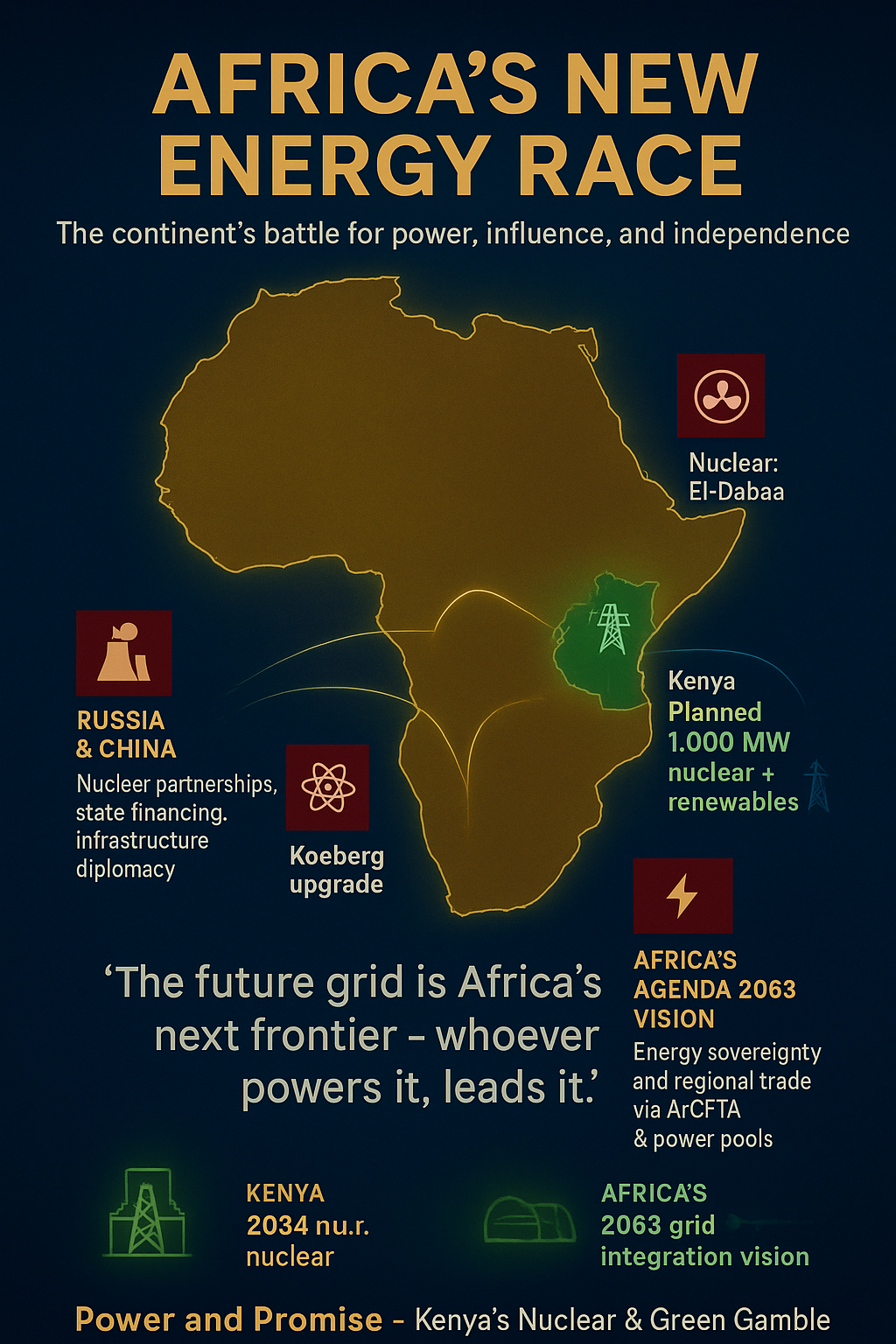
Africa’s energy landscape is shifting faster than at any time in its postcolonial history. From North Africa’s nuclear ventures to Southern Africa’s hydrogen ambitions, the continent is quietly constructing a new map of power — one defined not by oil reserves, but by grid capacity and global alliances. Russia and China are embedding influence through nuclear partnerships; the United States and Europe counter with renewables and clean-tech financing. Across the continent, energy has become the new currency of diplomacy. The story is no longer about light bulbs and power stations — it’s about sovereignty, soft power, and survival. And in this unfolding drama, Kenya stands at the intersection of ambition and caution, armed with geothermal prowess, nuclear dreams, and the burden of fiscal fragility.

Kenya’s choices now echo far beyond its borders. Once hailed as Africa’s renewable beacon, the nation’s dual pursuit of nuclear energy and grid modernization could redefine East Africa’s energy future — or divide it. Egypt’s El-Dabaa reactor is already nearing completion; South Africa is upgrading its Koeberg plant; and Uganda and Ghana are moving from feasibility to formal partnerships. Kenya, strategically perched in the Eastern Africa Power Pool, holds the potential to become a regional energy exporter, a stabilizer in a volatile market. Yet that promise hinges on policy discipline and trust — two currencies Kenya is struggling to sustain. Its fiscal instability, opaque power contracts, and political indecision risk eroding the credibility needed to lead the continental transition. The dream of an integrated African grid may depend less on megawatts and more on governance — and Kenya’s ability to align vision with viability.

The next decade will determine whether Kenya emerges as a powerful nation or merely a powered one. To lead Africa’s energy race, it must balance ambition with accountability, geopolitics with pragmatism. This is not just about building reactors or expanding wind farms — it’s about mastering the grid as an instrument of economic independence and continental diplomacy. The nuclear plant, if realized, will stand not merely as a symbol of technological progress, but as a test of strategic maturity. For Africa, and Kenya especially, the energy race is no longer about who generates power — it’s about who commands it. The atom, the turbine, and the tariff are now the instruments of influence. Kenya’s gamble could define not just its own future, but the direction of Africa’s entire energy destiny.

References:

Sollay Kenyan Foundation Navigating the Challenges of Kenya’s Energy Crisis in 2025

Semafor Africa’s top bank has a fresh chance to bet on nuclear

Observer Research Foundation Advantage China in Africa’s nuclear energy market race

Intellinews More than 20 African countries exploring potential of nuclear energy – IAEA report

IEA Kenya’s energy sector is making strides toward universal electricity access, clean cooking solutions and renewable energy development

Daily Nation Why Kenya is losing its position as regional energy sector leader

When the Lights Cost Too Much: Why Kenya’s Electricity Remains Out of Reach

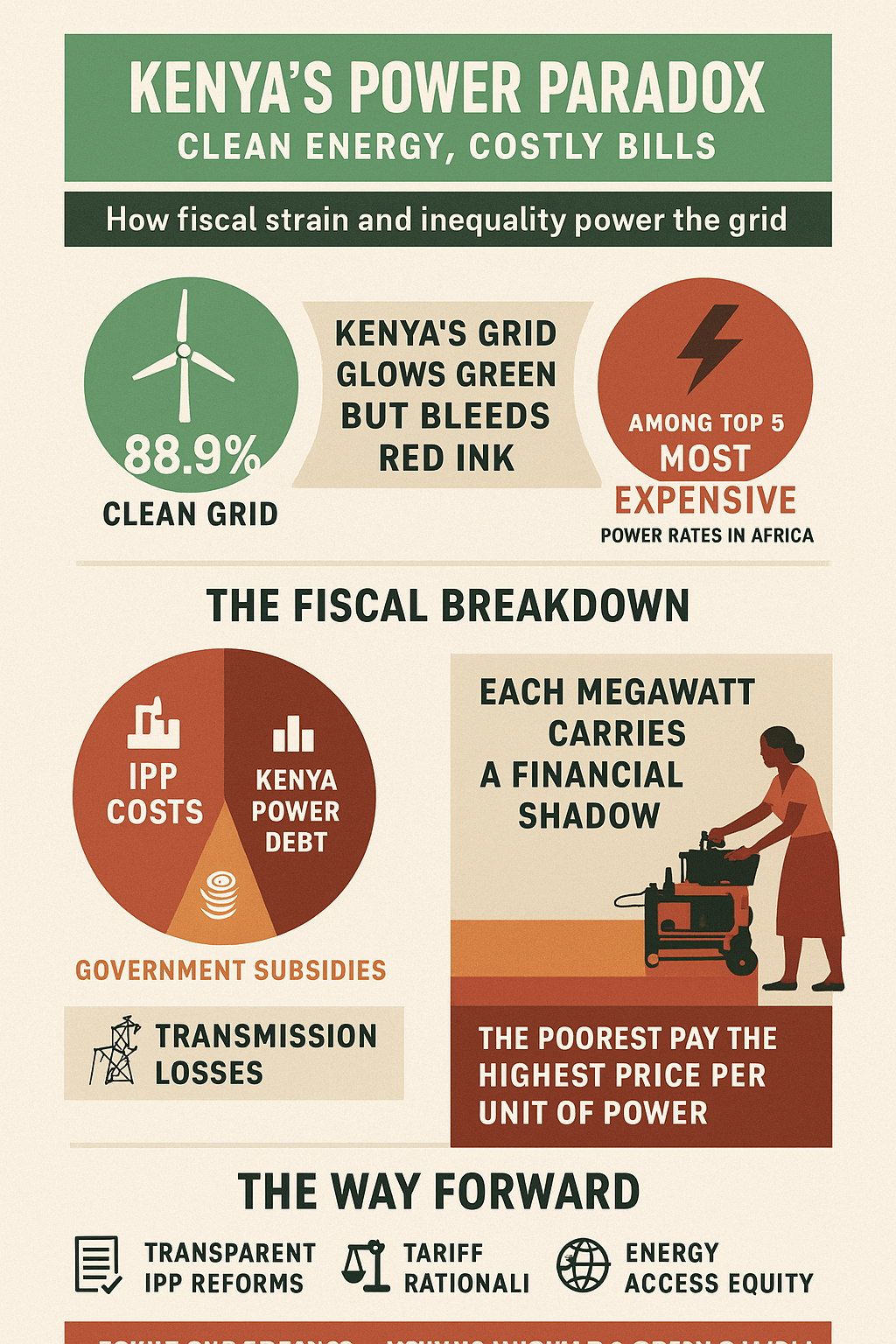
Kenya’s power paradox runs deep: a country rich in renewable generation, yet burdened by some of the highest electricity costs in Africa. On paper, nearly 90% of Kenya’s grid is green — geothermal, hydro, and wind forming a rare climate success story. But for millions of households and industries, that triumph hasn’t translated into affordability. Consumers pay between KSh 25 and 30 per kilowatt-hour, rates that undercut competitiveness and squeeze living standards. In the informal settlements of Nairobi, small shop owners still ration power hours to manage costs, while factories in Athi River and Thika cite electricity tariffs as a primary obstacle to growth. The contradiction is glaring: Kenya has abundant clean power, yet access remains economically exclusionary — an irony that exposes how generation success can mask distributional failure.

At the core of this crisis lies a web of fiscal and contractual distortions. Independent Power Producer (IPP) deals, negotiated during periods of emergency and donor pressure, locked Kenya Power into long-term capacity charges that bleed the utility dry even when consumption dips. The state utility’s balance sheet tells a grim story — mounting arrears, bailout dependencies, and a tariff structure that barely recovers operational costs. Subsidies designed to protect consumers often backfire, distorting market signals and worsening public debt. Populist interventions — from tariff freezes to election-time lifeline promises — have turned energy pricing into political theatre, undermining reform momentum. Meanwhile, Kenya’s push toward big-ticket projects like nuclear power adds new fiscal layers to an already fragile system. It’s a balancing act where every kilowatt carries not just a cost, but a liability.

NTV Kenya Youtube Channel

The human toll of this misalignment is profound. While urban elites and large manufacturers negotiate preferential rates, rural households and informal traders bear the heaviest burden. Many still rely on kerosene lamps and diesel generators — paying more per unit of energy than the grid-connected middle class. The national electrification dream, once buoyed by donor-funded rural projects, has slowed under the weight of poor planning and financial strain. Energy inequality now mirrors broader economic divides, threatening social cohesion and trust in public institutions. The solution lies not in more megawatts, but in smarter management — transparent IPP contracts, realistic tariffs, and equity-centered reform. Kenya’s next decade will determine whether electricity remains a privilege or becomes the universal right it was promised to be. And as the country turns toward nuclear expansion, the cost question will no longer be technical — it will be moral.

References:

Ecofin Agency Kenya Ranks Best in Africa for Power Rules but Prices Keep Rising

Global Petrol Prices Kenya electricity prices

Citizen Digital Cost of electricity: MPs question high amounts paid to independent power producers

The Star Lights on, bills up: Paradox of high electricity costs in Kenya despite abundant renewable sources

Daily Nation Kenya Power MD: Why your electricity bill is so high

Stears Increased electricity tariffs strain Kenyan low and middle-income households

Business Daily Kenyan homes pay highest electricity bills in Eastern, Central Africa


Power Without Progress? Kenya’s Renewable Revolution at Risk

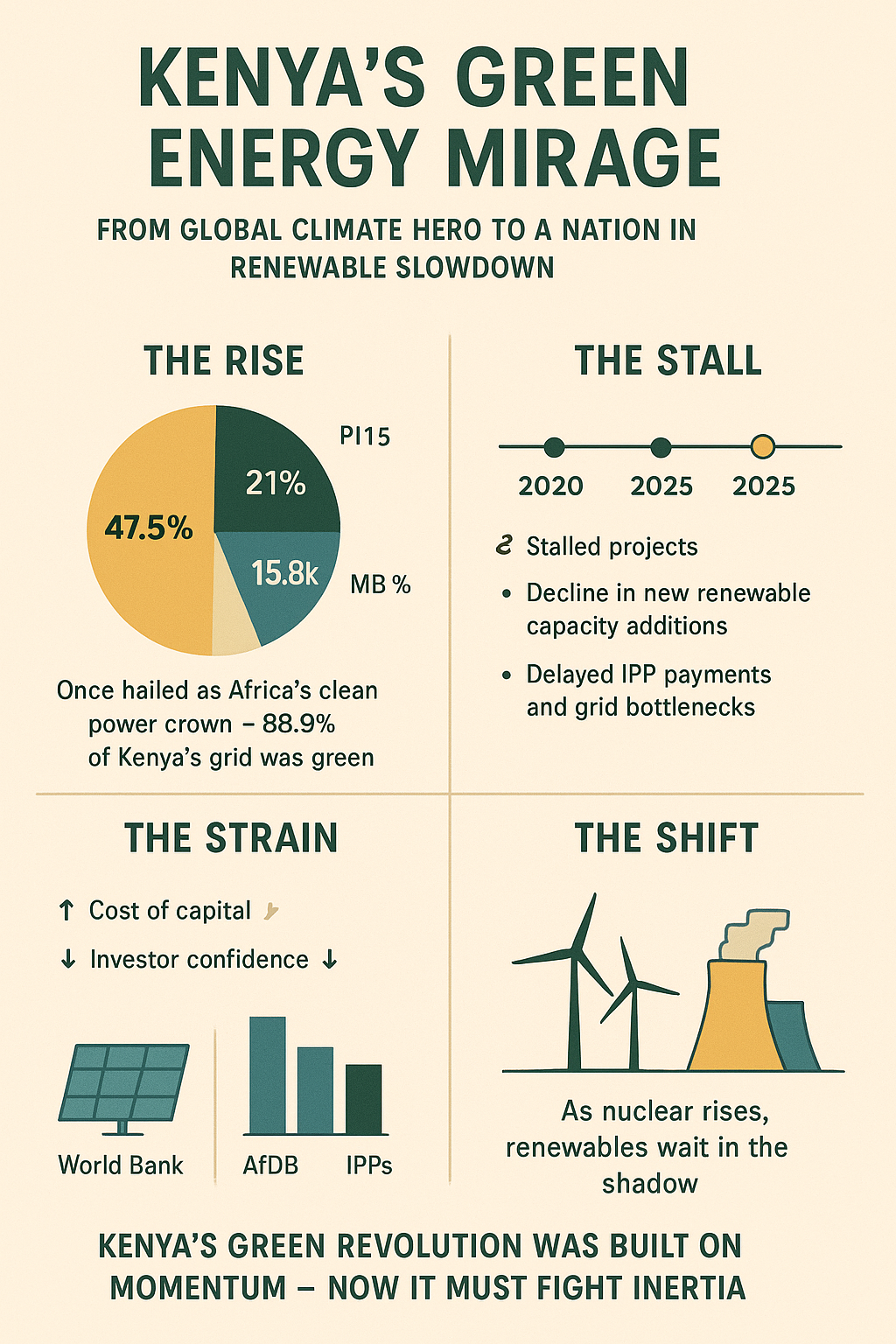
For years, Kenya stood as a global symbol of clean energy success — a nation that proved Africa could power progress without burning its future. With nearly 90% of its electricity drawn from renewables, Kenya’s geothermal fields, hydropower dams, and wind farms once made headlines as the triumph of policy discipline and natural endowment. Yet today, that narrative is faltering. Behind the statistics lies a quiet stagnation. Few major renewable projects have been commissioned since the early 2020s, while others — like Menengai Geothermal and Lake Turkana Wind — have suffered delays, funding gaps, and regulatory setbacks. Grid instability and transmission shortfalls have worsened, creating a paradox: Kenya generates green energy, but struggles to distribute it efficiently or expand access affordably. What was once the continent’s clean energy beacon now risks dimming into complacency.

The chill is most visible in the financing landscape. Kenya’s renewable push was built on concessional lending and development partnerships — a model now straining under fiscal pressure and global credit tightening. According to the World Bank and IEA, the cost of capital for African energy projects has risen sharply, even as debt distress restricts new borrowing. This has slowed project pipelines and rattled investor confidence. Independent Power Producers (IPPs), once seen as catalysts of the renewable surge, now face payment delays and opaque contract reviews that threaten future participation. In solar and mini-grid development — once the pride of Kenya’s rural electrification drive — progress has stalled under mounting bureaucracy and reduced donor enthusiasm. The result is a deep irony: a country rich in green potential but starved of green liquidity. The geothermal wells still steam, but the flow of financing and political focus has cooled.

Kenya’s pivot toward industrial-scale projects — including its ambitious nuclear agenda — risks further diluting the urgency once attached to renewables. Policy attention and investor courting now lean heavily toward centralized megaprojects, sidelining community-level innovation and decentralized energy solutions that had made Kenya’s progress unique. Meanwhile, regional rivals such as Ethiopia and Morocco are racing ahead with diversified, well-financed renewable strategies. Kenya’s hard-won first-mover advantage is eroding, not from technological failure but from strategic drift. Without renewed investment in transparent governance, private-sector trust, and equitable policy incentives, the nation’s celebrated “green crown” could fade into a mirage of past glory — a relic of what once was. And as Kenya’s energy gaze shifts from wind and steam to uranium and reactors, the next big question looms large: why does clean power still cost so much?

References:

IEA Kenya’s energy sector is making strides toward universal electricity access, clean cooking solutions and renewable energy development

IEA How a high cost of capital is holding back energy development in Kenya and Senegal

Daily Nation GDC loses battle with Menengai residents over drilling projects

African Development Bank Group Kenya – 35MW OrPower Menengai Geothermal Power Project – P-KE-FA0-027