The Data State: Power, Privacy, and Kenya’s Struggle for Digital Sovereignty

Kenya’s digital transformation has reached an inflection point. Through the integration of platforms such as eCitizen, Maisha Namba, and IFMIS, the State now operates as a vast data processor — collecting, linking, and analyzing the lives of millions of citizens in real time. What began as a quest for efficiency has evolved into a new form of governance: one built on algorithms and infrastructure rather than laws and institutions. Under the Data Protection Act (DPA) 2019, citizens were promised control over their personal information, while the Office of the Data Protection Commissioner (ODPC) was established as the custodian of privacy rights. Yet in practice, enforcement remains weak, politically constrained, and under-resourced. The result is a paradox: Kenya’s most progressive digital laws coexist with some of its most opaque data practices. As it is, the country is witnessing the emergence of a public-private algorithmic interlock — a hybrid system in which state and corporate power merge to govern through data.
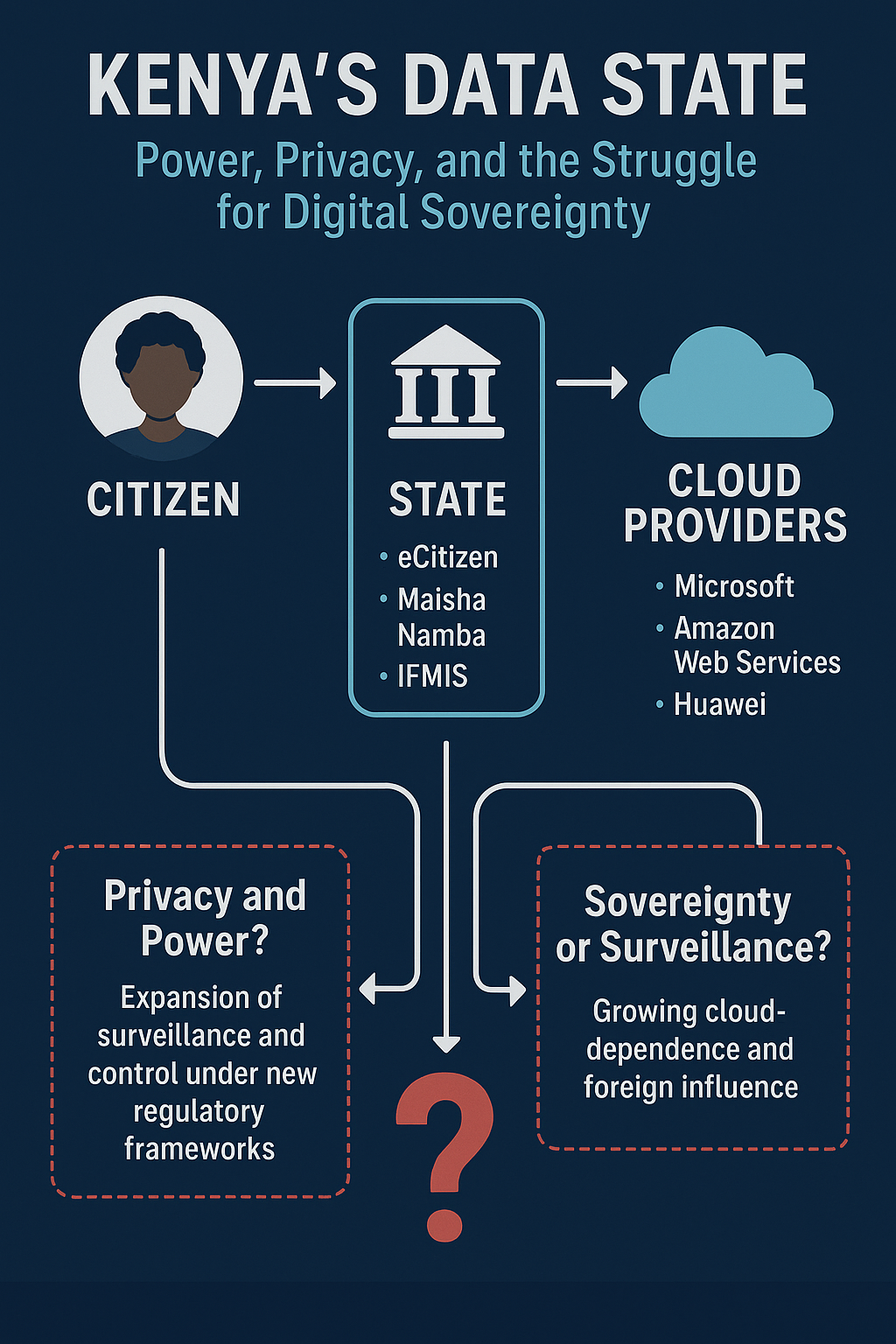
At the core of this interlock lies Kenya’s cloud dependency, the Achilles’ heel of its digital sovereignty. The Cloud-First Policy (2023) was designed to enhance efficiency by migrating state systems to cloud infrastructure. In reality, it has tethered Kenya’s critical data to foreign providers — notably Microsoft Azure, Amazon Web Services (AWS), and Huawei Cloud. These platforms host sensitive national databases, including immigration, healthcare, and education records. While they offer advanced security and performance, they also place Kenya’s sovereignty at risk: jurisdiction over this data often lies outside national reach. The government’s own National Cloud Data Centre at Konza Technopolis, meant to localize and secure state data, remains underutilized, operating below capacity. Analysts warn that this imbalance represents a “sovereignty paradox” — a situation in which Kenya aspires to digital independence but relies on foreign entities to store and secure the very data that constitutes its national identity. In a world where information is power, Kenya’s cloud partnerships may have outsourced the core infrastructure of governance itself.

This dependency also feeds into the expanding reach of digital surveillance, often justified under the banner of cybersecurity. The fusion of citizen databases — spanning KRA tax systems, telecommunication registries, and biometric IDs — enables predictive profiling that blurs the boundary between public safety and state intrusion. The Cybercrimes (Amendment) Act 2024 further amplifies this concern, granting security agencies powers to intercept and remove online content without prior judicial approval. Civil-society groups warn that such tools could easily be weaponized to silence critics and monitor dissent under the guise of digital policing. At the same time, Kenya still lacks a comprehensive data ownership framework, leaving citizens powerless to reclaim or delete their data. The ODPC’s reactive approach, compounded by political pressure, means violations are often addressed only after they occur. Looking ahead, Kenya’s battle for democracy is increasingly being fought not in parliaments or streets but within servers and code. Whether the nation’s digital transformation strengthens sovereignty or surrenders it will depend on one crucial question — who ultimately controls the data that defines its people.

References:

Tech Africa News Kenya Begins Drafting National Data Governance Policy

Microsoft Microsoft and G42 announce $1 billion comprehensive digital ecosystem initiative for Kenya

Site Selection Africa: Digital Giants Unveil Billion-Dollar Data and Skills Plan for Kenya and East Africa

Data Guidance Kenya: The Cloud Policy – what organizations need to know

CM Advocates Legal Boundaries of Data Commissioner’s Enforcement Powers
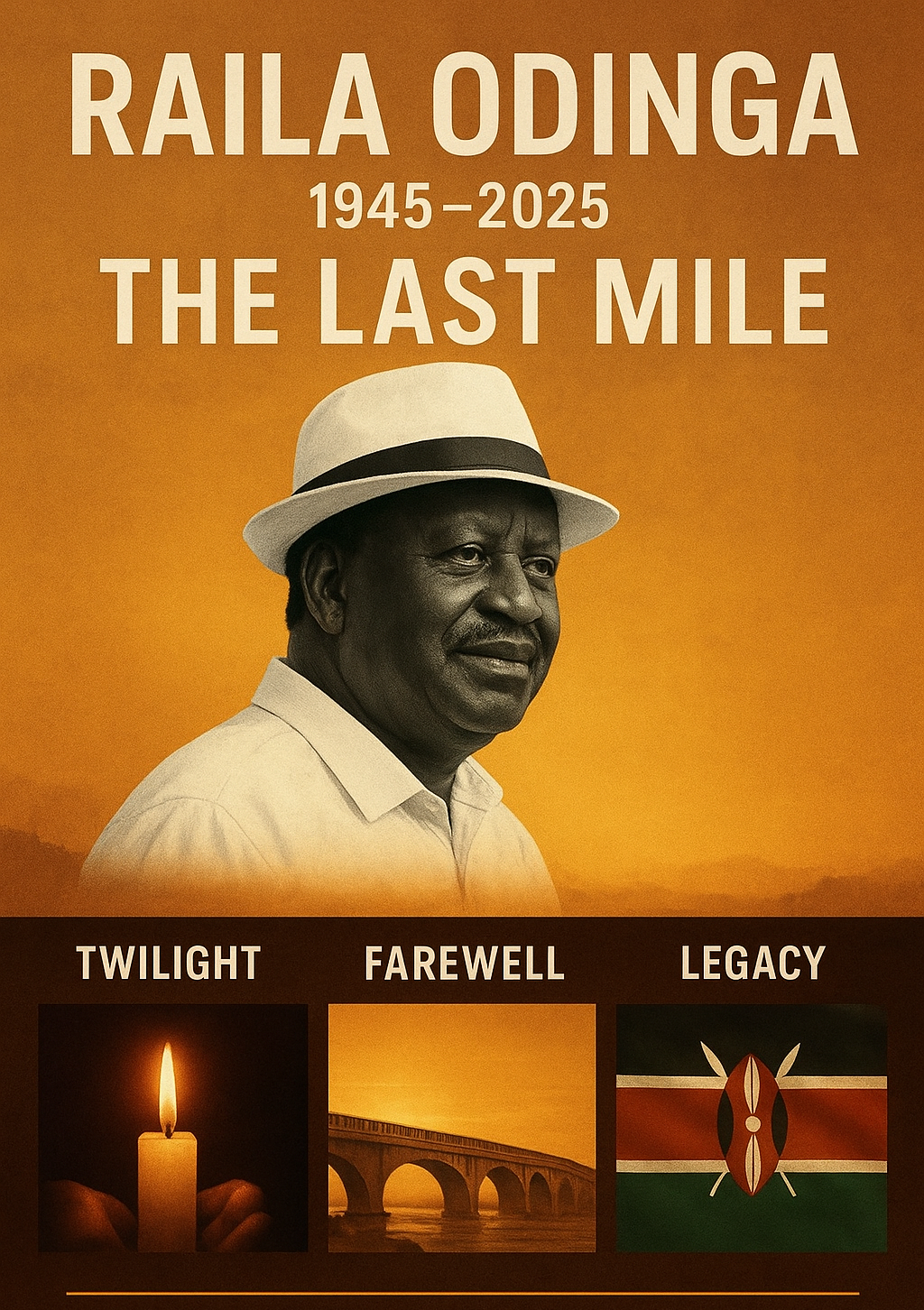
The Last Mile — Raila Odinga’s Twilight, Passing, and the Idea That Survived Him

In his twilight years, Raila Odinga had become more than a politician — he was Kenya’s political conscience, a bridge between the generations that fought for freedom and those still searching for meaning within it. After the bruising 2022 election, where he faced yet another defeat in a career defined by near-victories, Raila chose not confrontation but calm. His refusal to ignite division, even amid widespread frustration, marked a quiet evolution: from fiery agitator to custodian of peace. He spent his final active years mentoring a younger political class and reminding Kenya that democracy must outlive its disappointments. The rallies grew fewer, but his voice — gravelled yet resolute — remained an anchor for millions who saw in him a mirror of their struggle. Even in moments of political isolation, Raila commanded moral gravity; when he spoke of justice, people listened not out of allegiance, but respect. His final public appearances, increasingly statesmanlike, hinted at a man preparing not for another contest, but for continuity — ensuring the dream he carried for half a century would not die with him.

When news of his passing broke, it felt as though time itself had paused across Kenya. From the streets of Kibera to the hills of Nyamira, from church altars to Parliament floors, an unmistakable silence hung over the nation. For once, political color faded — blue, yellow, and red replaced by the black of mourning and the green of shared belonging. Thousands gathered in impromptu vigils, waving candles instead of party flags. Old rivals spoke his name with reverence; even his fiercest critics acknowledged the void his absence left behind. His cortege became a national pilgrimage — a river of gratitude winding through the land he had served but never ruled. In a country accustomed to contested memories, Raila’s farewell became a rare moment of collective clarity: a recognition that disagreement need not erase contribution, and that service to country often comes without reward. For a few days, Kenya remembered what unity felt like — not uniformity, but shared remembrance.

And yet, the story did not end with his burial. Raila’s true legacy now lives not in statues or slogans, but in the enduring architecture of Kenya’s democracy — in devolved counties that still echo his reformist spirit, in youth movements that speak his language of resistance and reform, and in every citizen who believes that politics can be moral without being naïve. Across Africa, too, his influence endures — in the language of reformers who cite his journey as proof that persistence can be a form of victory. Raila Odinga’s life was not a straight line, but a circle — one that began with rebellion, matured into reform, and closed with reconciliation. In his passing, Kenya lost a leader; in his legacy, Africa gained an ideal. For generations to come, his story will remain both lesson and mirror — a reminder that while men die, ideas, when carried with courage, do not.

References:

Daily Nation End of an era: Curtains fall on Raila Amolo Odinga’s chapter

Democracy in Africa Raila Odinga: the man who changed Kenya without ever ruling it

The Standard Tribute to Raila Odinga, the man who shaped my generation

KBC Raila Odinga was a true son of the soil and champion of Kenya’s second liberation

Raila Odinga — The Continental Visionary and the Pan-African Ideal

By the time Raila Odinga transitioned from the turbulence of Kenyan politics to the corridors of the African Union in 2018, he had already achieved what few opposition leaders ever do — moral ascendancy without state power. His appointment as the AU High Representative for Infrastructure Development in Africa by then-Chairperson Moussa Faki Mahamat was more than a ceremonial posting; it was a recognition that Raila’s vision had outgrown the boundaries of national politics. For decades, he had spoken of roads, ports, and energy grids n ot as isolated projects, but as the veins of a continental body long deprived of oxygen. His task was formidable: harmonize the patchwork of infrastructure blueprints stretching from Cairo to Cape Town and Dakar to Mombasa — an endeavor rooted in the dream of Pan-African unity that Kwame Nkrumah and Julius Nyerere once championed. Under his oversight, progress accelerated on key projects like the Trans-African Highway corridors, the Northern Corridor Integration Projects, and renewed discussions on the Lamu Port–South Sudan–Ethiopia Transport (LAPSSET) initiative. To Raila, infrastructure was not merely development; it was destiny — the physical manifestation of political freedom.

Video Courtesy: Make Afrika Great Youtube Channel

Yet the vision extended beyond concrete and steel. Raila often argued that Africa’s “second liberation” would be economic — a struggle against the colonial hangovers of dependency and fragmentation. Speaking at multiple AU and regional forums, he lamented that Africa had “many presidents but few partners,” calling for the synchronization of policy and investment around continental value chains. His dream was to transform roads into trade routes and power grids into bridges of sovereignty. But his tenure at the AU also exposed him to the bureaucratic inertia and political contradictions that continue to stifle Pan-African ambitions. Many member states guarded national interests more fiercely than collective progress, and overlapping institutions competed for influence rather than complementing one another. Still, Raila persisted — pushing for the African Integrated High-Speed Railway Network (AIHSRN) and advocating for infrastructure financing mechanisms that would reduce reliance on external lenders. His approach fused technocracy with activism: bold enough to confront inertia, diplomatic enough to sustain consensus. It was a delicate dance — one that mirrored his lifelong balancing act between idealism and realism.

In hindsight, Raila Odinga’s continental journey completes a narrative arc that began in confinement and ended in connection. From his Kamiti cell to his AU office in Addis Ababa, the constant thread was belief — in people, in progress, and in the idea that freedom is incomplete without opportunity. His Pan-African legacy mirrors his Kenyan one: influence without dominion, architecture without the architect’s seat. Where others sought to rule, he sought to knit — to join fractured pieces of governance, identity, and geography into a whole. Whether championing devolution in Kenya or interconnectivity across Africa, his conviction remained the same: development must be democratic, and democracy must deliver. In his passing, Kenya and Africa bid farewell to a statesman whose life embodied the struggle between power and principle — and whose vision of unity, justice, and dignity will continue to outlive him, guiding generations yet to lead.

References:

The Standard Raila Odinga lands new job

BBC Raila Odinga: The man who shaped Kenyan politics

Daily Nation Invest on infrastructure, Raila Odinga tells African nations

Business Daily Raila’s unfinished business


The Algorithm and the Republic — Kenya’s Reckoning with AI Governance

When a private company’s neural nets began to unmask the hidden flows inside M-Pesa, the discovery jolted more than the fintech sector — it forced Kenya to confront a systemic question: who watches the watchers, and on what rules? The rollout of AI-driven compliance tools at Safaricom was never merely a tech upgrade; it arrived as part of a national emergency — a response to international pressure, spiralling fraud, and regulatory failure. The Financial Action Task Force’s increased-monitoring designation and months of global scrutiny had already pushed lawmakers and regulators into a sprint of reforms; industry actors answered with models that could learn patterns humans could not. But those same models required data — vast, granular, and often personal — and the legal scaffolding for such access was changing in real time. Kenya’s recent cyber-law overhaul and parliamentary amendments to the Computer Misuse and Cybercrime Act expanded state powers over online infrastructure, tightened penalties for SIM-swap and phishing offences, and gave the National Computer and Cybercrimes Coordination Committee sweeping directive authority over platforms and applications. Those moves addressed real harms — SIM swap fraud, phishing, and mass laundering — but they also recalibrated the balance between surveillance and rights.

Video Courtesy: The Kenyan Wall Street Youtube Channel

That recalibration is tested in the day-to-day rub of enforcement. Regulators and the ODPC have begun to draw lines: the Data Protection Commissioner’s recent ruling against a major betting operator for excessive data demands underscores the point that AML objectives cannot be a carte blanche for limitless intrusion. In the Betika case the ODPC found the company’s demand for three months of a user’s M-Pesa statements at account-closure to be disproportionate and ordered compensation, signalling that data-minimisation and privacy remain legally enforceable even amid AML pressures. At the same time, FATF’s 2025 monitoring guidance — and independent analysis from ISS Africa — make plain that Kenya must also show measurable results in prosecutions, beneficial-ownership transparency, and risk-based supervision of non-financial entities (including gambling and virtual assets) if it is to repair global confidence. The practical implication is blunt: Kenya cannot satisfy international partners by papering laws alone; enforcement and proportionate procedural safeguards must accompany technical surveillance. Otherwise the country risks swapping one reputational problem (grey-listing) for another — a domestic legitimacy crisis born of heavy-handed data practices.

So where does Kenya go from here? The answer lies in design choices — legal, technical, and institutional — that make accountability a feature, not an afterthought. We recommend three urgent, interlocking reforms that turn the AI question into a governance opportunity: (1) Purpose-bound, time-limited data access. AML or security queries should be scoped narrowly and logged; full transaction histories must not be a default feed into private models. (2) Explainability + redress. Any automated decision that materially affects a person (account freezes, cash-outs blocked, KYC escalations) must carry a succinct, non-technical rationale and a fast appeals channel routed through an independent body. (3) Joint independent oversight. Operationalize a statutory ODPC–FRC technical review board with public reporting obligations, the power to audit both models and data requests, and a mandate to publish redaction and retention metrics. These are not frictionless reforms — they will slow some processes and impose costs — but that trade-off is precisely the point: legitimacy costs less than lost trust. If Kenya stitches these protections into law and practice — and couples them with meaningful prosecution of financial crimes and improved beneficial-ownership registers — it can convert the awkward moment of global scrutiny into a first-mover advantage: an African model of rights-based, explainable AI governance for financial systems. The choices made now will decide whether Kenya’s algorithms become instruments of accountability or mechanisms that hollow out public trust.

References:

Business Daily Security or surveillance? How amended cyber law could reshape Kenya’s online space

Daily Nation How AI can close trust gaps in Africa’s financial systems

The Kenyan Wall Street How Safaricom is Leveraging AI to Bolster M-Pesa Security and Efficiency

Business Daily What FATF grey-listing means for Kenya

From Prisoner to Architect — The Making of Kenya’s Democratic Warrior

Raila Amolo Odinga’s political story begins not on a campaign podium, but behind bars. In August 1982, after a failed coup against President Daniel arap Moi’s regime, Raila was arrested and detained without trial for six years under accusations of complicity in the uprising. What began as a state crackdown on dissent became a crucible that forged one of Africa’s most enduring pro-democracy figures. In the dark cells of Kamiti Maximum Prison, stripped of freedom and family, Raila endured torture, isolation, and the psychological warfare designed to break men. Yet, by his own accounts, it was there that his conviction hardened. The son of Kenya’s first Vice President, Jaramogi Oginga Odinga, he inherited not privilege but rebellion. Jaramogi had himself been exiled from power for opposing one-party rule; Raila would inherit his father’s unfinished argument with the state. When he was finally released in 1988 — gaunt, silent, but unbowed — he emerged as a man tempered by captivity, convinced that Kenya’s salvation lay not in vengeance but in reform. His years in detention gave him something no election could: moral legitimacy born of sacrifice.

Courtesy of: The Kenyan Historian Youtube Channel

The 1990s marked Raila’s metamorphosis from political prisoner to national democrat. The winds of change were sweeping across Africa — Cold War ideologies fading, the Berlin Wall fallen — and Kenya’s own citizens were growing restless under Moi’s tightening grip. Raila joined the Forum for the Restoration of Democracy (FORD) alongside Kenneth Matiba, Martin Shikuku, and other dissidents who risked their lives demanding multi-party politics. He was detained again in 1990, but by 1991, global and local pressure forced Moi to repeal Section 2A of the Constitution, ending one-party rule. Raila became a founding member of FORD–Kenya, carrying the movement his father once led. But internal fractures soon followed, splitting the party into FORD–Kenya under Jaramogi and FORD–Asili under Matiba. After his father’s death in 1994, Raila charted his own course, forming the National Development Party (NDP) — a daring step that re-introduced ideological energy into a weary opposition. By 1997, his presidential bid secured nearly 11 percent of the vote, propelling him into Parliament and solidifying him as a national force. When he stunned observers by merging the NDP with Moi’s KANU in 2001, many called it betrayal; Raila called it strategy. That alliance exposed him to the machinery of state and taught him, perhaps for the first time, that real reform required more than protest — it demanded structural redesign from within.

That understanding would shape the statesman he became after 2002. Having helped unseat KANU through the NARC coalition, Raila became Minister for Energy, spearheading Kenya’s shift toward regional electrification and rural connectivity. His fingerprints were on policies that powered the next decade’s economic surge. After the 2007 crisis, his role as Prime Minister (2008–2013) turned moral vision into governance — co-steering the coalition government that delivered the 2010 Constitution, which entrenched devolution, expanded civil liberties, and bound executive power with accountability. That charter, arguably the cornerstone of Kenya’s democratic stability, was the very framework he had imagined during his darkest hours in Kamiti. Even beyond Kenya, his appointment as the African Union’s High Representative for Infrastructure reaffirmed that his reformist instincts had transcended borders. From the prison cell to continental platforms, Raila’s life formed a single narrative arc — of endurance turned into architecture. He built what he once suffered to imagine: a Kenya where dissent is not a crime, and where power, at last, answers to the people.

References:

Daily Nation Raila Odinga’s long political journey and his clash with three presidents

The New York Times Will the fifth time be the charm for Raila Odinga?

The Star Raila Odinga’s political journey: So close, yet so far from power

Aljazeera Raila Odinga: The symbol and symptom of Kenya’s political tragedy

BBC Raila Odinga: The man who shaped Kenyan politics

The Enigma of Power — Raila Odinga and the Paradox of Influence Without Office

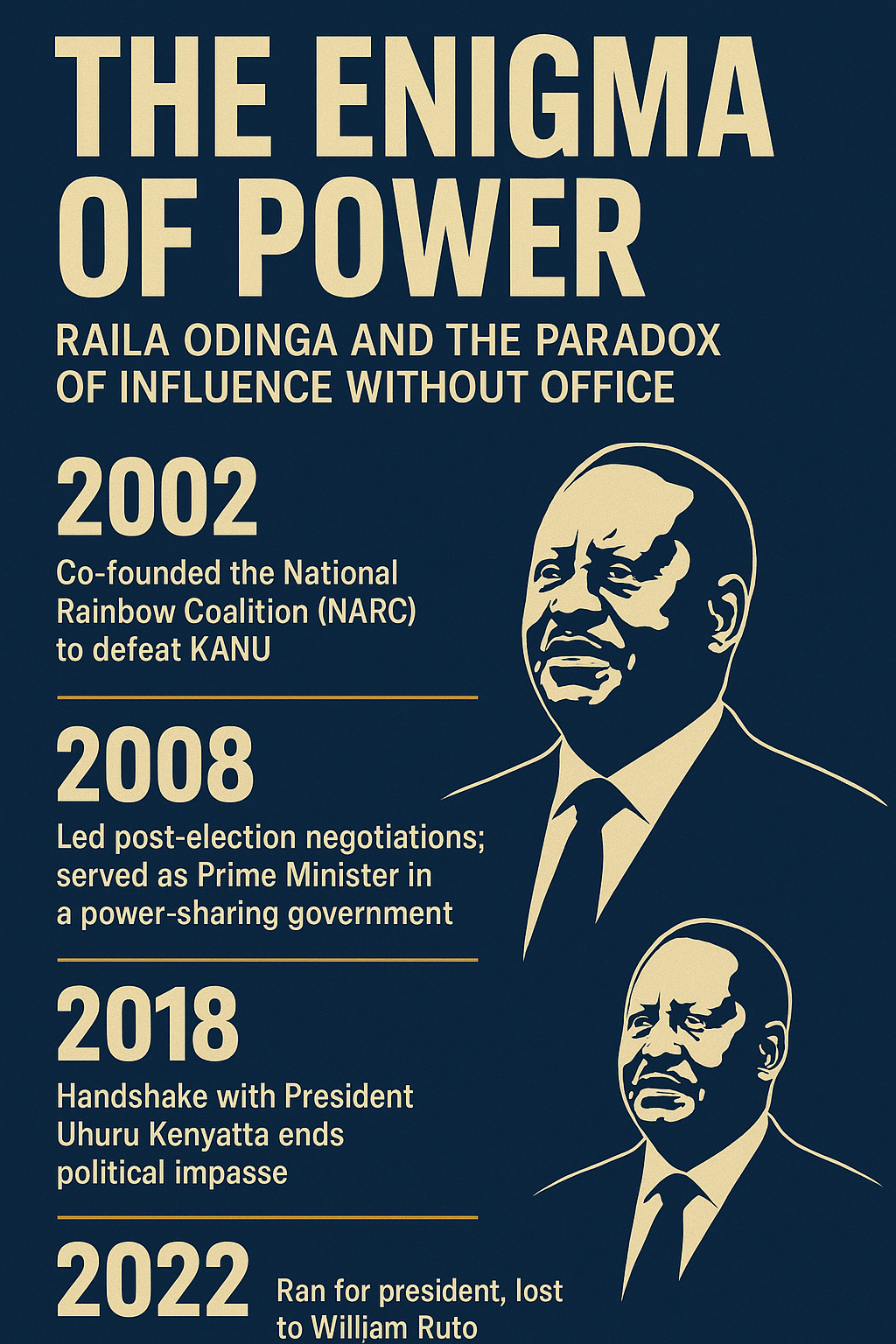
History rarely rewards those who come close — but in Raila Odinga’s case, proximity itself became the point of power. For more than four decades, Raila lived at the edge of power yet shaped every regime from within the shadows of opposition. He was, as The Africa Report aptly put it, “the man who lost every election but won Kenya’s democracy.” From the twilight of Daniel arap Moi’s rule to the dawn of Kenya’s multiparty renaissance, Raila’s defiance never waned — earning him both fear and reverence in equal measure. In 2002, when KANU’s dominance finally cracked, it was his dramatic declaration of “Kibaki Tosha” that propelled Mwai Kibaki to State House and ushered in the first peaceful transfer of power in Kenya’s history. Yet even in victory, Raila remained the outsider: betrayed by broken coalition promises, sidelined by those he helped elect. Still, he never relinquished the moral authority of the people’s voice. In 2005, his “Orange” movement defeated Kibaki’s draft constitution — a rare case of an opposition leader reshaping national destiny without holding office. And when the 2007 elections collapsed into violence, it was again Raila’s resilience that forced Kenya back from the brink, transforming a disputed vote into a dialogue for survival. Through pain, loss, and endurance, he became less a politician and more a barometer of Kenya’s democratic conscience — the man who could lose and still lead.

Raila's political influence over time

Raila’s power was never institutional; it was cultural, narrative, and profoundly human. He understood Kenya’s pulse — and weaponised symbolism like few before him. His aliases — Agwambo, Tinga, Baba — transcended politics, morphing into collective identities of resistance, belonging, and hope. His supporters saw in him their own unfulfilled promise; his rivals, a reminder that legitimacy cannot be decreed. Each administration that followed — from Kibaki to Kenyatta to Ruto — has been shaped, challenged, or legitimised by Raila’s political presence. As Prime Minister in the 2008 Grand Coalition, he co-supervised the nation’s reconstruction after post-election chaos and championed reforms that birthed the 2010 Constitution — arguably his greatest institutional legacy. That charter redefined Kenyan governance, devolving power to the counties and embedding civil rights into law, echoing the principles for which he had once been jailed. Later, his controversial 2018 “Handshake” with President Uhuru Kenyatta ended months of unrest following the disputed 2017 polls and restored political calm — though it also fractured his traditional support base. Yet, even that act reinforced his lifelong philosophy: that peace, not position, defines statesmanship. His later appointment as the African Union’s High Representative for Infrastructure confirmed his continental stature — a statesman recognised beyond Kenya’s borders for blending political endurance with technocratic vision.

In the end, Raila Odinga’s paradox was not that he failed to capture the presidency, but that he redefined what power itself means in a fragile democracy. His defeats never diminished his influence; they amplified it. Every president who took office did so under the long shadow of his moral authority. He forced institutions to evolve, compelled courts to assert independence, and transformed the vocabulary of opposition into the grammar of governance. In his twilight years, even adversaries acknowledged that Kenya’s political story could not be told without him — that every victory or reform bore his fingerprints somewhere beneath the surface. He was both architect and agitator, healer and heretic, rebel and reformer. Raila Odinga never occupied State House, but he changed what it stood for — from a fortress of fear to a house answerable to its citizens. And as the nation continues to wrestle with the legacy of leadership and legitimacy, his life offers a sobering truth: that true power is not seized, but earned — and sometimes, it lives longest in the hands of those who never hold the crown.

References:

The Africa Report Raila Odinga: The man who lost every election but won Kenya’s democracy

The Star Raila Odinga: The man who changed Kenya without ever ruling it

The Star Most consequential politician in history of Kenya bows out

All Africa Kenya Mourns Raila Odinga ‘The President’ It Never Had

TRT World Raila Odinga: Kenya’s political enigma never left the stage


Steam or Atom? Kenya’s Defining Energy Gamble

Kenya’s energy story is being rewritten on two dramatically different blueprints. In the steaming Rift Valley, the hum of geothermal turbines tells the story of a nation that has nearly conquered its clean energy dream — with close to 90% of its power drawn from renewables, mainly geothermal, hydro, and wind. This success has made Kenya a continental symbol of green progress and a diplomatic darling of climate-conscious financiers. Yet, in quiet government boardrooms in Nairobi, a second vision gathers force — one powered not by heat from the earth but by the fission of the atom. The Nuclear Power and Energy Agency (NuPEA) is advancing plans for a 1,000-megawatt nuclear plant set to begin construction by 2027 and deliver electricity by 2034. The result is a nation straddling a paradox: can Kenya remain the face of Africa’s green revolution while becoming its first atomic pioneer?

Behind the glossy renewable statistics lies a more fragile truth. Kenya’s hydropower output has fallen prey to erratic weather, with droughts cutting generation by 15% in 2022, while rising demand — now peaking above 2,300 megawatts — has exposed the limits of an overstretched grid. The blackouts that have rippled through homes and factories underscore a growing reality: renewable success has not translated into industrial reliability. For planners pursuing Vision 2030 and the Bottom-Up Economic Transformation Agenda (BETA), the numbers are sobering — the nation’s installed capacity of 3,400 MW must grow nearly twenty-fold to meet future manufacturing and digital-era needs. In this context, nuclear energy is being framed not as an ideological betrayal of green ideals, but as a pragmatic lifeline — a bid for baseload stability, energy sovereignty, and freedom from the climate vulnerabilities that shadow the country’s renewable crown.

Yet this dual pursuit exposes Kenya to a dangerous collision of timelines, financing, and identity. The government’s promise of a 100% renewable grid by 2030 sits uneasily beside its nuclear timeline, forcing a quiet redefinition of “clean” from renewable to low-carbon. The nuclear build, projected at $2–3 billion, also competes for scarce development funding with the $19.1 billion needed to expand renewables under the National Energy Compact. Beyond cost, the gamble risks eroding Kenya’s most valuable diplomatic asset — its green reputation. As the country steps onto the nuclear stage, it must navigate a delicate balance between sustaining its climate leadership and pursuing industrial power. The question now confronting Nairobi is not just how to keep the lights on, but how to do so without dimming the glow of its hard-won green identity — a tension that will define Kenya’s energy destiny and set the stage for the next chapter: the global power play behind its nuclear dream.

References:

African Business Kenya plans first nuclear plant within decade

Government Advertising Agency Kenya targets 20,000MW nuclear power to ease electricity shortfall

The Kenyan Wall Street Kenya Sets New Electricity Demand Record as Grid Faces Rapid Growth

Business Daily Electricity production hits new record high on rising demand

Kenya News Agency NuPEA pledges nuclear power production takeoff by 2034


The Passing of a Titan — Raila Odinga and the National Mourning

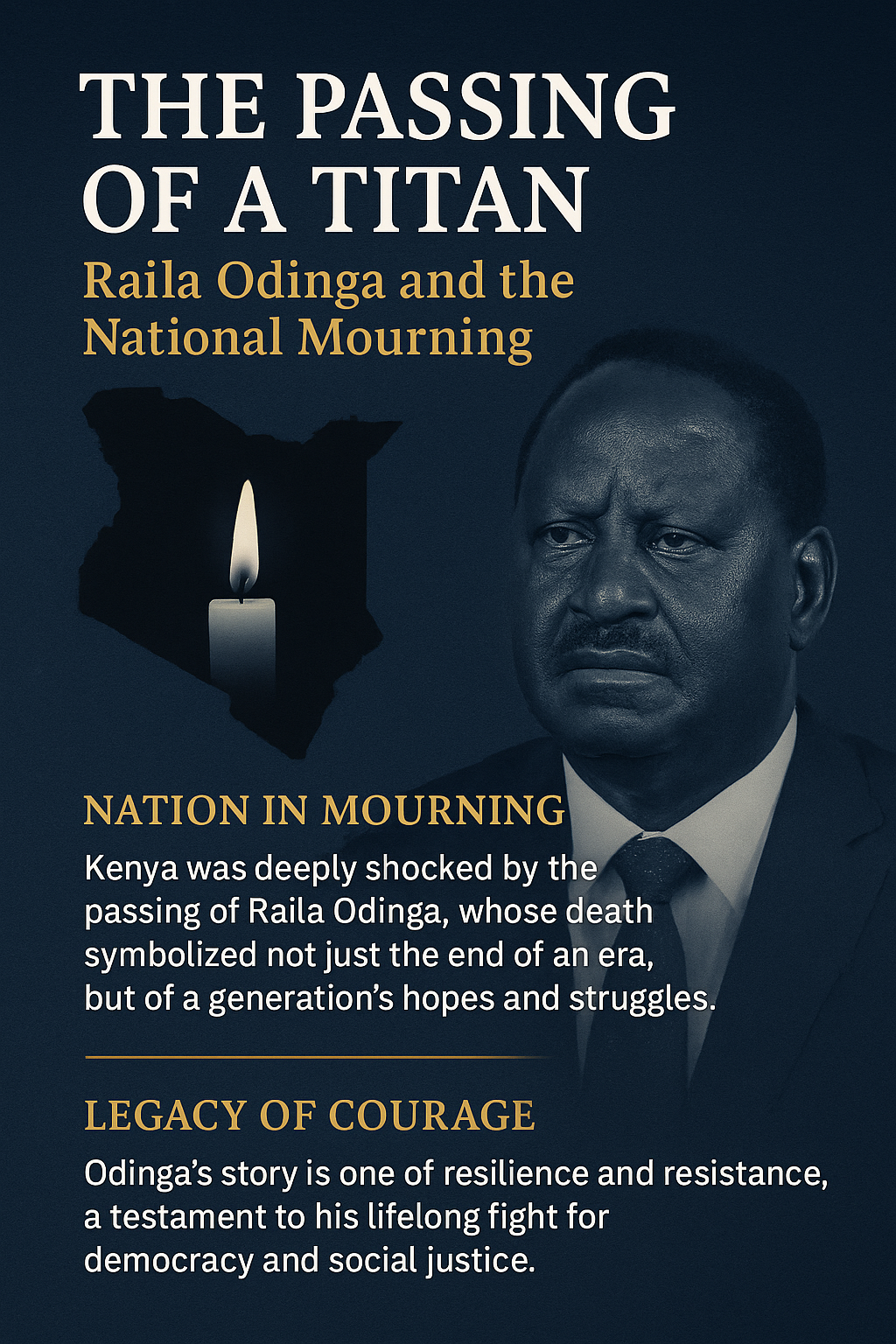
When the news broke that Raila Amolo Odinga had breathed his last, Kenya did not just lose a leader — it lost a paradox made flesh. He was the man who never won the presidency, yet arguably won the soul of Kenya’s democracy — the one who lost every major election but gained the moral authority few in power ever matched. Across towns and villages, in markets and offices, a shared stillness settled like evening dew — part disbelief, part reverence. Television stations turned monochrome; social feeds filled with memories of rallies, reform, and resilience. From Kibera to Kisumu, from Nairobi to Namanga, Raila’s name echoed in chants of grief and gratitude. He was more than a politician; he was the pulse of a people who found in him the courage to speak, to dissent, and to dream. To many, Raila Odinga was Kenya’s moral compass — the man who, even in loss, made millions believe in the promise of justice.

As the state prepared to honour him, the weight of history pressed against the walls of memory. Here was a man who had been imprisoned for ideals, tortured for his convictions, yet emerged each time more resolute than before. The tributes flowing in from across Africa captured this paradox of pain and purpose — Tanzania’s President calling him “the conscience of East Africa,” Nigeria’s Senate hailing him as “a reformer who saw power as duty, not privilege.” In Nairobi, the national flag flew at half-mast, while Parliament prepared to host what may be the most emotionally charged state funeral in decades. But behind the ceremonies lay a deeper reckoning — the realization that Kenya’s democratic soul was, in many ways, shaped by one man’s endurance. To chronicle Raila’s life is to trace the country’s long struggle between oppression and reform, silence and voice, fear and freedom.

And now, in death, his story returns to the people who carried him for half a century — the voters who called him “Baba,” the youth who painted his slogans, the rivals who feared yet respected him. His passing is not just a political event; it is a national rite of reflection — a chance for Kenya to measure how far it has come, and how far it still must go to realize the ideals he fought for. In the coming posts of this legacy series, we will explore those ideals — from his days in detention to his time as Prime Minister, from his Pan-African mission to his unfinished democratic dream. Raila Odinga’s journey did not end with his last breath; it endures in the conscience of a nation still learning to live up to the ideals he refused to abandon. Stay with us as we begin this national remembrance — a chronicle of courage, conviction, and continuity.

References:

BBC ‘Father of our democracy’: Kenya’s Raila Odinga dies in India aged 80

The Standard Raila Odinga’s death: What the world is saying

France 24 Kenya opposition leader Raila Odinga dies, sparking emotion, uncertainty

Daily Nation Raila Odinga dies at age 80 in India

Digital Leap or Digital Trap? Kenya’s Governance Gap in the AI Era

Kenya’s digital revolution is unfolding at breakneck speed, promising to propel the nation into the heart of Africa’s AI transformation. Anchored by the Data Protection Act (DPA) 2019 and the National Artificial Intelligence Strategy (2025–2030), the framework looks robust and visionary. It enshrines data privacy as a constitutional right, establishes the Office of the Data Protection Commissioner (ODPC), and commits to algorithmic transparency, fairness, and human oversight. Kenya’s regulatory model has even earned international acclaim — Nairobi is slated to host the Global Privacy Assembly in 2027, a symbolic recognition of its leadership in ethical data governance. Complementing this is the Kenya Bureau of Standards (KEBS) Draft Code of Practice for AI Applications, a soft-law guideline urging developers to uphold explainability, bias detection, and user control. Yet, beneath these commendable milestones lies a troubling contradiction: while Kenya’s digital frameworks project global sophistication, their domestic enforcement remains weak, underfunded, and vulnerable to political interference. The result is a widening gap between the vision of digital accountability and the lived experience of digital vulnerability.

Security & AI Governance: Reducing Risks in AI Systems (IBM Technology)

The cracks are increasingly visible. The Kenya Robotics and Artificial Intelligence Association Bill (2023) offers a striking example: penalties for violations start at just KES 20,000, a figure critics say mocks the idea of deterrence. Meanwhile, the Kenya Information and Communications (Amendment) Bill (2025) threatens to introduce consumption-based internet billing — a policy that could push millions of rural and low-income Kenyans offline, undermining the government’s own pledge of universal digital inclusion. Analysts argue that these contradictions reveal a deeper crisis of coherence: the coexistence of progressive rhetoric and regressive policymaking. Kenya’s digital ecosystem thrives in innovation but falters in accountability. Citizens remain largely unaware of how their personal data — collected through AI-driven platforms in banking, telecommunications, and social services — is analyzed, profiled, or traded. This governance vacuum has turned the promise of the DPA into a largely symbolic safeguard, one that lacks the institutional strength to protect the very citizens it was written for.

The Maisha Namba digital identity project has become the defining case study in this paradox. Like its predecessor Huduma Namba, it has faced multiple High Court suspensions for failing to meet the DPA’s core requirement — the Data Protection Impact Assessment (DPIA). Civil society watchdogs, led by Haki na Sheria and the Katiba Institute, continue to challenge the government’s persistence in rolling out the system despite clear judicial orders. Experts warn that the project’s centralized biometric database presents a single point of failure — a goldmine for identity theft and a recipe for exclusion should data integrity ever be compromised. The executive’s determination to proceed despite these warnings reflects a governance culture where compliance is optional and constitutional limits are elastic. In the absence of strong regulatory oversight and digital literacy, Kenya risks converting its AI ambition into an algorithmic vulnerability — a digital trap masquerading as a leap forward. The challenge is no longer about drafting new laws; it is about enforcing the ones that already exist with integrity, transparency, and public trust.

References:

The Star Lift order not permit to print Maisha Namba cards, State told

Business Daily Why IT experts want State to reject the new robotics bill

Indepth Research Institute Nairobi To Host The World On Data Privacy in 2027: Big Tech, Big Policy, Big Moment

Biometric Update Advocates pick privacy, inclusion holds in Kenya’s Maisha Namba digital ID system


Digital Dilemmas: Kenya’s New Cybercrime Law Tests the Boundaries of Free Speech

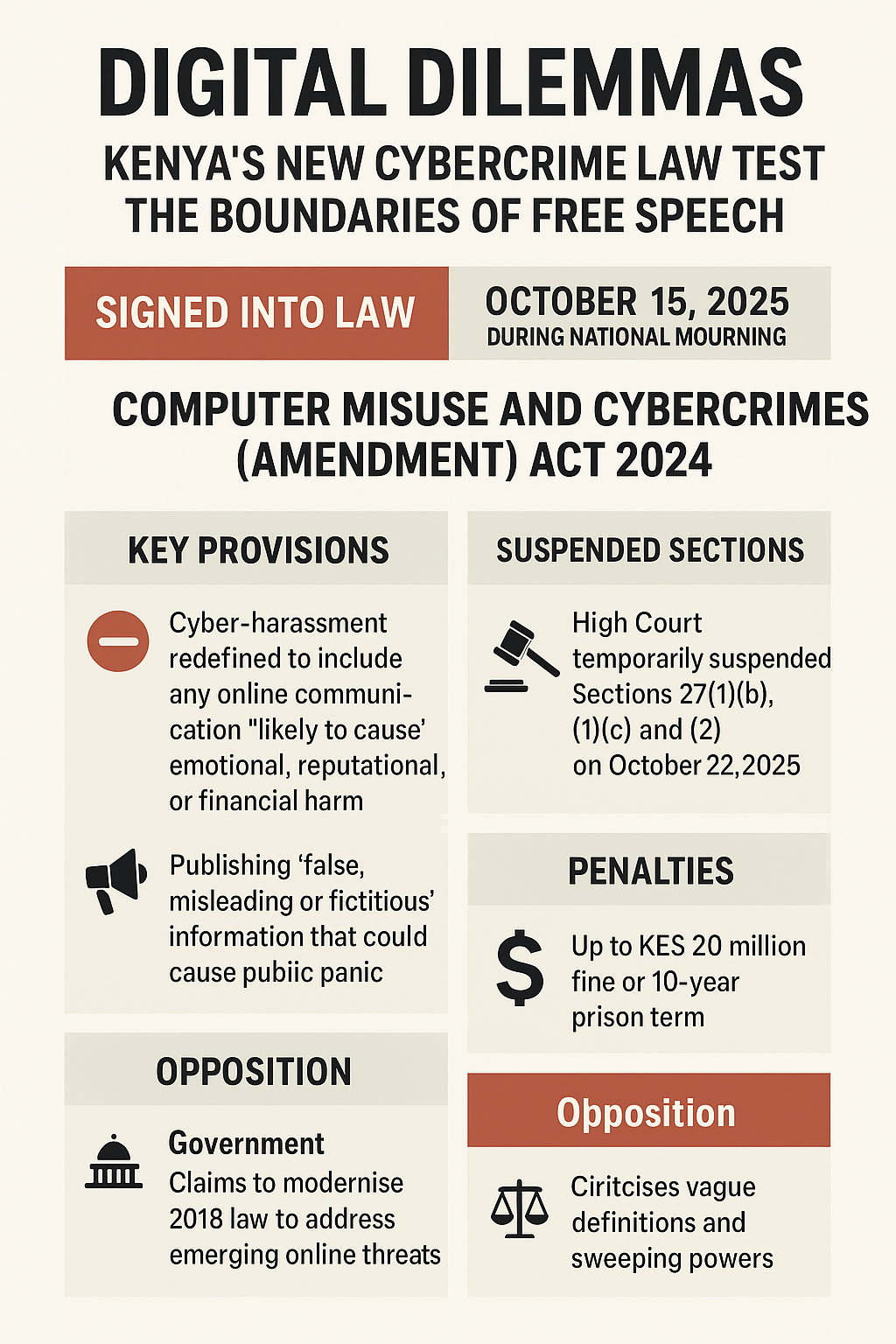
Kenya’s uneasy relationship with digital freedom deepened on October 15, 2025, when President William Ruto assented to the Computer Misuse and Cybercrimes (Amendment) Act 2024—a move that instantly ignited outrage across the country’s vibrant online community. The signing coincided with the death of former Prime Minister Raila Odinga, and critics accused the administration of using a moment of national grief to push through controversial legislation. Ruto rejected that charge, saying that the Bill had already cleared Parliament and that “governance cannot be suspended, even in sadness.” Still, the optics proved volatile: by nightfall, hashtags such as #RejectCyberCrimeLaw trended across X, while activists, journalists, and lawyers decried what they called an assault on free expression in the digital space.

At issue are vague definitions and sweeping powers that critics fear will criminalize dissent. The law expands the offense of cyber-harassment to cover any online communication “likely to cause” emotional, reputational, or financial harm—a threshold that the Kenya Human Rights Commission (KHRC) calls “unconstitutionally broad and prone to abuse.” It also criminalizes the publication of “false, misleading, or fictitious” information deemed capable of causing public panic and grants the National Computer and Cybercrimes Coordination Committee (NC4)—a body dominated by security officials—the power to block or remove content without prior court approval. Penalties are steep: up to KES 20 million in fines or ten years in prison. Civil-society groups, led by the KHRC and activist-musician Reuben Kigame, swiftly challenged the law in the High Court, arguing it violated constitutional rights to free expression and fair trial. On October 22, Justice E. Mabeya temporarily suspended sections 27(1)(b), 27(1)(c), and 27(2)—the core clauses on cyber-harassment and “false” information—pending a full hearing, acknowledging “serious questions on proportionality and vagueness.”

Government officials have defended the legislation as an overdue modernization of Kenya’s 2018 cybercrime law. Spokesperson Isaac Mwaura said it targets “emerging online threats like financial fraud, child exploitation, and cyber-terrorism,” while State House’s Dennis Itumbi maintained the amendments merely “tighten enforcement loopholes.” Yet digital-rights advocates see a wider pattern of algorithmic governance and shrinking civic space—from biometric identity systems like Maisha Namba to Kenya’s cloud-first data partnerships with Big Tech. To them, the new Act represents not reform but regression: a consolidation of executive control over cyberspace. As the High Court prepares to hear the substantive case, Kenya faces a pivotal test. Whether the Cybercrimes (Amendment) Act becomes a legitimate shield against digital abuse or a weapon against dissent will determine how the nation defines liberty in its fast-evolving algorithmic state.

References:

Techcabal Court suspends parts of Kenya’s new cyber law over free speech concerns

Kenya News Agency President Ruto clarifies cyber crime law amid public debate

The Star High Court suspends key provisions of Ruto’s newly assented cybercrime law

Citizen Digital Court suspends cyber harassment section in new Computer Misuse law

Tech Africa News Kenya Begins Drafting National Data Governance Policy

Jijuze Privacy vs. Security — Kenya’s New Surveillance Dilemma